LIBER XII · CAPUT 12
COSTUS
Latine · Mayhoff 1906
radix et folium Indis in maximo pretio.
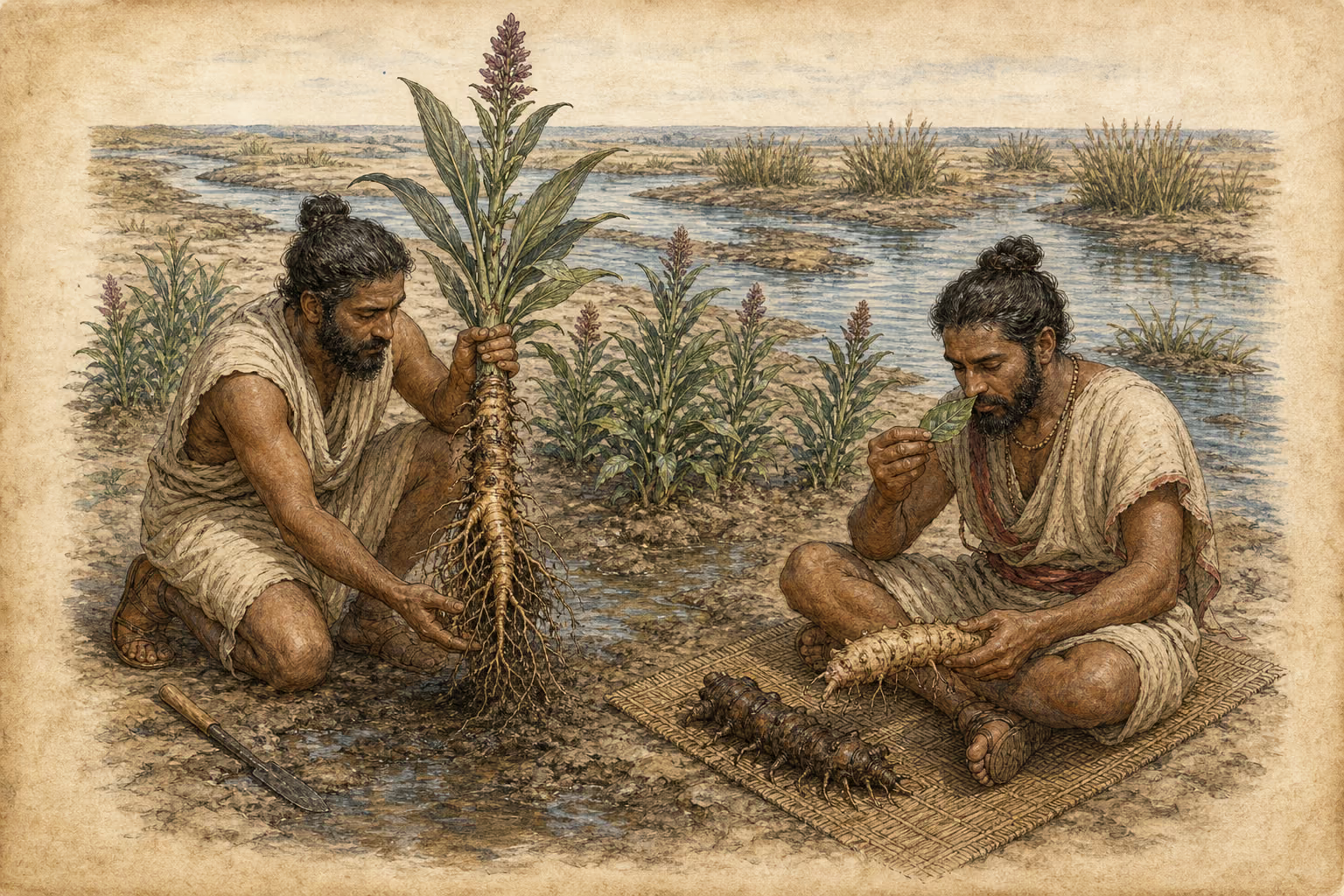
Radix costi gustu fervens, odore eximia, frutice alias inutili. primo statim introitu amnis Indi in Patale insula duo eius genera: nigrum et, quod melius, candicans. pretium in libras $X$ VS.
De folio nardi plura dici par est ut principali in unguentis. frutex est gravi et crassa radice, sed brevi ac nigra fragilique, quamvis pingui, situm redolente, ut cypiros, aspero sapore, folio parvo densoque. cacumina in aristas se spargunt; ideo gemina dote nardi spicas ac folia celebrant. alterum eius genus apud Gangen nascens damnatur in totum ozaenitidos nomine, virus redolens. adulteratur et pseudonardo herba, quae ubique nascitur crassiore atque latiore folio et colore languido in candidum vergente, item sua radice permixta ponderis causa et cummi spumaque argenti aut stibi ac cypiro cypirive cortice. sincerum quidem levitate deprehenditur et colore rufo odorisque suavitate et gustu maxime siccante os, sapore iucundo. pretium spicae in libras $X$ C. folii divisere annonam amplitudine. hadrosphaerum vocatur maioribus pilulis $X$ XXXX. quod minore folio est, mesosphaerum appellatur; emitur $X$ LX. laudatissimum microsphaerum e minimis foliis; pretium eius $X$ LXXV. odoris gratia omnibus, maior recentibus. nardo colos, si inveteravit, nigriori melior. in nostro orbe proxime laudatur Syriacum, mox Gallicum, tertio loco Creticum, quod aliqui agrion vocant, alii phun, folio olusatri, caule cubitali, geniculato, in purpuram albicante, radice obliqua villosaque et imitante avium pedes. baccaris vocatur nardum rusticum, de quo dicemus inter flores. sunt autem omnia ea herbae praeter Indicum. ex iis Gallicum et cum radice vellitur abluiturque vino. siccatur in umbra, alligatur fasciculis in charta, non multum ab Indico differens, Syriaco tamen levius. pretium $X$ III. in his probatio una, ne sint fragilia et arida potius quam sicca folia. cum Gallico nardo semper nascitur herba quae hirculus vocatur a gravitate odoris et similitudine, qua maxime adulteratur. distat quod sine cauliculo est et quod minoribus foliis quodque radicis neque amarae neque odoratae.
English · Bostock & Riley 1855–57
A root and a leaf, however, are the productions which are held in the very highest estimation in India. The root is that of the costus; it has a burning taste in the mouth, and a most exquisite odour; in other respects, the branches are good for nothing. In the island of Patale, situate at the very mouth of the river Indus, there are two kinds of costus found, the black and the white; the last is considered the best. The price of it is five denarii per pound.
Of the leaf, which is that of the nard, it is only right to speak somewhat more at length, as it holds the principal place among our unguents. The nard is a shrub with a heavy, thick root, but short, black, brittle, and yet unctuous as well; it has a musty smell, too, very much like that of the cyperus, with a sharp, acrid taste, the leaves being small, and growing in tufts. The heads of the nard spread out into ears; hence it is that nard is so famous for its two-fold production, the spike or ear, and the leaf. There is another kind, again, that grows on the banks of the Ganges, but is altogether condemned, as being good for nothing; it bears the name of ozænitis, and emits a fetid odour. Nard is adulterated with a sort of plant called pseudo-nard, which is found growing everywhere, and is known by its thick, broad leaf, and its sickly colour, which inclines to white. It is sophisticated, also, by being mixed with the root of the genuine nard, which adds very considerably to its weight. Gum is also used for the same purpose, antimony, and cyperus; or, at least, the outer coat of the cyperus. Its genuineness is tested by its lightness, the redness of its colour, its sweet smell, and the taste more particularly, which parches the mouth, and leaves a pleasant flavour behind it; the price of spikenard is one hundred denarii per pound.
Leaf nard varies in price according to the size; for that which is known by the name of hadrosphærum, consisting of the larger leaves, sells at forty denarii per pound; when the leaves are smaller, it is called mesosphærum, and is sold at sixty. But that which is considered the most valuable of all, is known as microsphærum, and consists of the very smallest of the leaves; it sells at seventy-five denarii per pound. All these varieties of nard have an agreeable odour, but it is most powerful when fresh. If the nard is old when gathered, that which is of a black colour is considered the best.
In our part of the world, the Syrian nard is held in the next highest esteem next to this; then the Gallic; and in the third place, that of Crete, which by some persons is called “agrion,” and by others “phu.” This last has exactly the leaf of the olusatrum, with a stalk a cubit in length, knotted, of a whitish colour, inclining to purple, and a root that runs sideways; it is covered, too, with long hair, and strongly resembles the foot of a bird. Field nard is known by the name of baccar. We shall have further occasion to mention it when we come to speak of the flowers. All these kinds of nard, however, are to be reckoned as herbs, with the exception of Indian nard. Of these, the Gallic kind is pulled up along with the root, and washed in wine; after which it is dried in the shade, and wrapped up in paper, in small parcels. It is not very different from the Indian nard, but is lighter than that of Syria; the price at which it sells is three denarii per pound. The only way of testing the leaves of all these varieties of nard, is to see that they are not brittle and parched, instead of being dried naturally and gradually. Together with the nard that grows in Gaul, there always springs up a herb, which is known by the name of hirculus, or the “little goat,” on account of its offensive smell, it being very similar to that of the goat. This herb, too, is very much used in the adulteration of nard, though it differs from it in the fact that it has no stem, and its leaves are smaller; the root, too, is not bitter, and is entirely destitute of smell.