LIBER XII · CAPUT 14
THE TREES THAT BEAR FRANKINCENSE
Latine · Mayhoff 1906
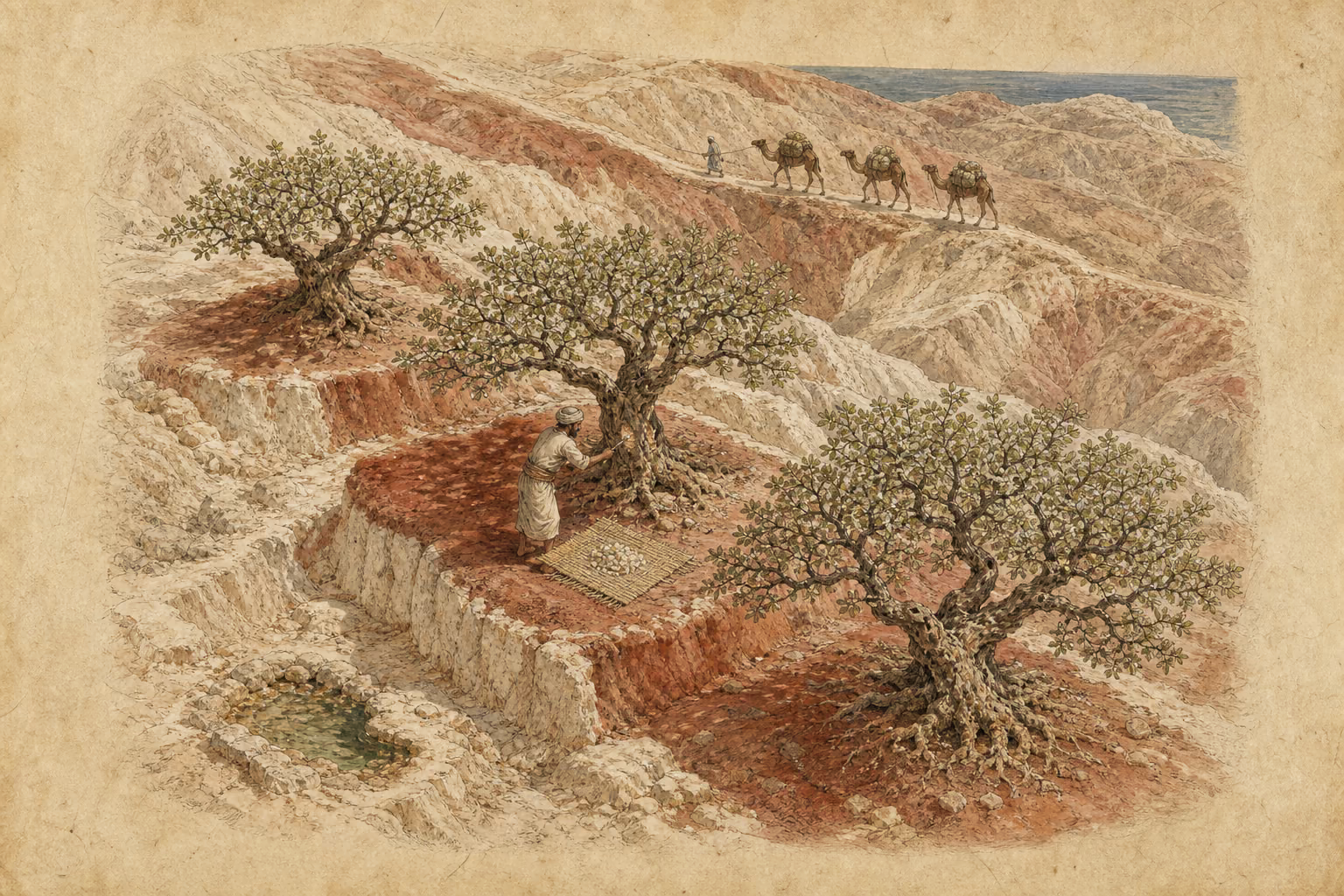
Principalia ergo in illa tus atque murra, haec et cum Trogodytis communis, tura praeter Arabiam nullis ac ne Arabiae quidem universae. in medio eius fere sunt Atramitae, pagus Sabaeorum capite regni Sabota in monte excelso, a quo octo mansionibus distat regio eorum turifera Sariba appellata; hoc significare Graeci mysterium dicunt. spectat ortus solis aestivi, undique rupibus invia et a dextera mari scopulis inaccesso. id solum e rubro lacteum traditur. silvarum longitude est schoeniXX, latitudo dimidium eius. schoenus patet Eratosthenis ratione stadia XL, hoc est p. V???, aliqui XXXII stadia singulis schoenis dedere. attolluntur colles alti, decurruntque et in plana arbores sponte natae. terram argillosam esse convenit, raris fontibus ac nitrosis. attingunt et Minaei, pagus alius, per quos evehitur uno tramite angusto. hi primi commercium turis fecere maximeque exercent, a quibus et Minaeum dictum est. nec praeterea Arabum alii turis arborem vident, ac ne horum quidem omnes, feruntqueIII non amplius esse familiarum quae ius per successiones id sibi vindicent; sacros vocari ob id nec ullo congressu feminarum funerumque, cum incidant eas arbores aut metant, pollui atque ita religionem mercis augeri. quidam promiscuum tus iis populis esse tradunt in silvis, alii per vices annorum dividi.
Nec arboris ipsius quae sit facies constat. res in Arabia gessimus et Romana arma in magnam partem eius penetravere, Gaius etiam Caesar Augusti filius inde gloriam petiit, nec tamen ab ullo, quod equidem sciam, Latino arborum earum tradita est facies. Graecorum exempla variant: alii folio piri, minore dumtaxat et herbidi coloris, prodidere, alii lentisco similem subrutilo folio, quidam terebinthum esse, et hoc visum Antigono regi allato frutice. Iuba rex iis voluminibus, quae scripsit ad C. Caesarem Augusti filium ardentem fama Arabiae, tradit contorti esse caudicis, ramis aceris maxime Pontici, sucum amygdalae modo emittere, talesque in Carmania apparere et in Aegypto satas studio Ptolemaeorum regnantium. cortice lauri esse constat; quidam et folium simile dixere: talis certe fuit arbor Sardibus, nam et Aiae reges serendi curam habuerunt. qui mea aetate legati ex Arabia venerant, omnia incertiora fecerunt, quod iure miremur, virgis etiam turis ad nos commeantibus, quibus credi potest matrem quoque teretem enodi fruticare trunco.
Meti semel anno solebat minore occasione vendendi; iam quaestus alteram vindemiam adfert. prior atque naturalis vindemia circa canis ortum flagrantissimo aestu, incidentibus qua maxime videatur esse praegnas tenuissimusque tendi cortex. laxatur hic plaga, non adimitur; inde prosilit spuma pinguis. haec concreta densatur, ubi loci natura poscat, tegete palmea excipiente, aliubi area circumpavita. purius illo modo, sed hoc ponderosius. quod in arbore haesit, ferro depectitur, ideo corticosum. silva divisa certis portionibus mutua innocentia tuta est: nemo saucias arbores custodit, nemo furatur alteri. at Hercules Alexandriae, ubi tura interpolantur, nulla satis custodit diligentia officinas. subligaria signantur opifici; persona additur capiti densusve reticulus; nudi emittuntur: tanto minus fidei apud nos poena quam apud illos silvae habent! autumno legitur ex aestivo partu; hoc purissimum, candidum. secunda vindemia est vere, ad eam hieme corticibus incisis. rufum hoc exit nec conparandum priori. illud carfiathum, hoc dathiathum vocant. creditur et novellae arboris candidius esse, sed veteris odoratius. quidam et in insulis melius putant, gigni, Iuba in insulis negat nasci. quod ex eo rotunditate guttae pependit, masculum vocamus, cum alias non fere mas vocetur ubi non sit femina; religioni tributum, ne sexus alter usurparetur. masculum aliqui putant a specie testium dictum. praecipua autem gratia mammoso, cum haerente lacrima priore consecuta alia miscuit se. singula haec manum inplere solita invenio, cum minore deripiendi aviditate lentius nasci liceret. Graeci stagonian et atomum tali modo appellant, minorem autem orobian. micas concussu elisas mannam vocamus. etiamnum tamen inveniuntur guttae quae tertiam partem mnae, hoc est XXVIII denariorum pondus, aequent. Alexandro Magno in pueritia sine parsimonia tura inerenti aris paedagogus Leonides dixerat, ut illo modo, cum devicisset turiferas gentes, supplicaret. at ille Arabiae potitus ture onustam navem misit et exhortatus est, ut large deos adoraret. tus collectum Sabotam camelis convehitur, porta ad id una patente. degredi via capital reges fecere. ibi decumas deo quem vocant Sabin mensura, non pondere, sacerdotes capiunt, nec ante mercari licet: inde inpensae publicae tolerantur; nam et benigne certo dierum numero deus hospites pascit. evehi non potest nisi per Gebbanitas, itaque et horum regi penditur vectigal. caput eorum Thomna abest a Gaza, nostri litoris in Iudaea oppido, |XXIIIII|.XXXVII. D p., quod dividitur in mansiones camelorum LXV. sunt et quae sacerdotibus dantur portiones scribisque regum certae. sed praeter hos et custodes satellitesque et ostiarii et ministri populantur. iam quacumque iter est aliubi pro aqua, aliubi pro pabulo aut pro mansionibus variisque portoriis pendunt, ut sumptus in singulas camelos $X$ DCLXXXVIII ad nostrum litus colligat, iterumque imperii nostri publicanis penditur. itaque optimi turis libra $X$ VI pretium habet, secundi $X$ V, tertii $X$ III. adulteratur apud nos resinae candidae gemma perquam simili, sed deprehenditur quibus dictum est modis. probatur candore, amplitudine, fragilitate, carbone, ut statim ardeat, item ne dentem recipiat potiusque in micas frietur.
English · Bostock & Riley 1855–57
There is no country in the world that produces frankincense except Arabia, and, indeed, not the whole of that. Almost in the very centre of that region, are the Atramitæ, a community of the Sabæi, the capital of whose kingdom is Sabota, a place situate on a lofty mountain. At a distance of eight stations from this is the incense-bearing region, known by the name of Saba. The Greeks say that the word signifies a “secret mystery.” This district looks towards the north-east, and is rendered inaccessible by rocks on every side, while it is bounded on the right by the sea, from which it is shut out by cliffs of tremendous height. The soil of this territory is said to be of a milky white, a little inclining to red. The forests extend twenty schœni in length, and half that distance in breadth. The length of the schœnus, according to the estimate of Eratosthenes, is forty stadia, or, in other words, five miles; some persons, however, have estimated the schœnus at no more than thirty-two stadia. In this district some lofty hills take their rise, and the trees, which spring up spontaneously, run downwards along the declivities to the plains. It is generally agreed that the soil is argillaceous, and that the springs which there take their rise are but few in number, and of a nitrous quality. Adjoining are the Minæi, the people of another community, through whose country is the sole transit for the frankincense, along a single narrow road. The Minæi were the first people who carried on any traffic in frankincense, which they still do to a greater extent than any other persons, and hence it is that it has received the appellation of “Minæan.” It is the Sabæi alone, and no other people among the Arabians, that behold the incense-tree; and, indeed, not all of them, for it is said that there are not more than three thousand families which have a right to claim that privilege, by virtue of hereditary succession; and that for this reason those persons are called sacred, and are not allowed, while pruning the trees or gathering the harvest, to receive any pollution, either by intercourse with women, or coming in contact with the dead; by these religious observances it is that the price of the commodity is so considerably enhanced. Some persons, however, say, that the right of gathering incense in the forests belongs to all these people in common, while others again state, that they take their turns year by year.
Nor is it by any means agreed what is the appearance of the incense-tree. We have sent several expeditions against Arabia, and the Roman arms have penetrated into the greater part of that country; indeed, Caius Cæsar, the son of Augustus, even earned considerable renown there; and yet this tree has been described by no Latin writer, at least that I know of. The descriptions given of it by the Greek writers vary very considerably: some of them say that it has exactly the leaf of the pear-tree, only somewhat smaller, and of a grass-green colour. Others, again, say, that it has a rather reddish leaf, like that of the mastich, and others, that it is a kind of terebinth, and that King Antigonus, to whom a branch of it was brought, was of that opinion. King Juba, in the work which he wrote and dedicated to Caius Cæsar, the son of Augustus, who was inflamed by the wide-spread renown of Arabia, states, that the tree has a spiral stem, and that the branches bear a considerable resemblance to those of the Pontic maple, while it secretes a sort of juice very similar to that of the almond-tree. Such, he says, is the appearance of the tree as seen in Carmania and Egypt, where it was introduced and planted under the auspices of the Ptolemies when reigning there. It is well known that it has a bark not unlike that of the laurel, and, indeed, some persons have asserted that their leaves are similar. At all events, such was the case with the tree as it grew at Sardes: for the kings of Asia also took considerable care to have it planted there. The ambassadors who in my time have come to Rome from Arabia, have made all these matters more uncertain, even, than they were before; a thing at which we may justly be surprised, seeing that some sprigs even of the incense-tree have been brought among us, from which we have some reason to conclude that the parent tree is round and tapering, and that it puts forth its shoots from a trunk that is entirely free from knots.
In former times, when they had fewer opportunities of selling it, they used to gather the frankincense only once a year; but at the present day, as there is a much greater demand for it, there is a second crop as well. The first, and what we may call the natural, vintage, takes place about the rising of the Dog-star, a period when the heat is most intense; on which occasion they cut the tree where the bark appears to be the fullest of juice, and extremely thin, from being distended to the greatest extent. The incision thus made is gradually extended, but nothing is removed; the consequence of which is, that an unctuous foam oozes forth, which gradually coagulates and thickens. When the nature of the locality requires it, this juice is received upon mats of palm-leaves, though in some places the space around the tree is made hard by being well rammed down for the purpose. The frankincense that is gathered after the former method, is in the purest state, though that which falls on the ground is the heaviest in weight: that which adheres to the tree is pared off with an iron instrument, which accounts for its being found mingled with pieces of bark.
The forest is allotted in certain portions, and such is the mutual probity of the owners, that it is quite safe from all depredation; indeed, there is no one left to watch the trees after the incisions are made, and yet no one is ever known to plunder his neighbour. But, by Hercules! at Alexandria, where the incense is dressed for sale, the workshops can never be guarded with sufficient care; a seal is even placed upon the workmen’s aprons, and a mask put upon the head, or else a net with very close meshes, while the people are stripped naked before they are allowed to leave work. So true it is that punishments afford less security among us than is to be found by these Arabians amid their woods and forests! The incense which has accumulated during the summer is gathered in the autumn: it is the purest of all, and is of a white colour. The second gathering takes place in spring, incisions being made in the bark for that purpose during the winter: this, however, is of a red colour, and not to be compared with the other incense. The first, or superior kind of incense, is known as carfiathum, the latter is called dathiathum. It is thought, also, that the incense which is gathered from the tree while young is the whitest, though the produce of the old trees has the most powerful smell; some persons, too, have an impression that the best incense is found in the islands, but Juba asserts that no incense at all is grown there.
That incense which has hung suspended in globular drops is known to us as “male” frankincense, although it is mostly the case that we do not use the term “male” except in contradistinction to the word “female:” it has been attributed, however, to religious scruples, that the name of the other sex was not employed as a denomination for this substance. Some persons, again, are of opinion that the male frankincense has been so called from its resemblance to the testes of the male. The incense, however, that is the most esteemed of all is that which is mammose, or breast-shaped, and is produced when one drop has stopped short, and another, following close upon it, has adhered, and united with it. I find it stated that one of these lumps used to make quite a handful, at a time when men displayed less eagerness to gather it, and it was allowed more time to accumulate. The Greeks call such lumps as these by the name of stagonia and atomus, while the smaller pieces are called orobia. The fragments which are broken off by shaking the tree are known to us as manna. Even at the present day, however, there are drops found which weigh one-third of a mina, or, in other words, twenty-eight denarii. Alexander the Great, when a boy, was on one occasion loading the altars with frankincense with the greatest prodigality, upon which his tutor Leonides remarked to him that it would be time to worship the gods in such a lavish manner as that, when he had conquered the countries that produced the frankincense. After Alexander had conquered Arabia, he despatched to Leonides a ship freighted with frankincense, and sent him word, requesting that he would now worship the gods without stint or limit.
The incense, after being collected, is carried on camels’ backs to Sabota, at which place a single gate is left open for its admission. To deviate from the high road while conveying it, the laws have made a capital offence. At this place the priests take by measure, and not by weight, a tenth part in honour of their god, whom they call Sabis; indeed, it is not allowable to dispose of it before this has been done: out of this tenth the public expenses are defrayed, for the divinity generously entertains all those strangers who have made a certain number of days’ journey in coming thither. The incense can only be exported through the country of the Gebanitæ, and for this reason it is that a certain tax is paid to their king as well. Thomna, which is their capital, is distant from Gaza, a city of Judæa, on the shores of our sea, 4436 miles, the distance being divided into sixty-five days’ journey by camel. There are certain portions also of the frankincense which are given to the priests and the king’s secretaries: and in addition to these, the keepers of it, as well as the soldiers who guard it, the gate-keepers, and various other employes, have their share as well. And then besides, all along the route, there is at one place water to pay for, at another fodder, lodging at the stations, and various taxes and imposts besides; the consequence of which is, that the expense for each camel before it arrives at the shores of our sea is six hundred and eighty-eight denarii; after all this, too, there are certain payments still to be made to the farmers of the revenue of our empire. Hence it is that a pound of the best frankincense sells at six denarii, the second quality five, and the third three. Among us, it is adulterated with drops of white resin, a substance which bears a strong resemblance to it: but the fraud may be easily detected by the methods which have been already mentioned. It is tested by the following qualities; its whiteness, size, brittleness, and the readiness with which it takes fire when placed on heated coals; in addition to which, it should not give to the pressure of the teeth, but from its natural brittleness crumble all to pieces.