LIBER XII · CAPUT 17
MASTICH
Latine · Mayhoff 1906
Ergo transit in mastichen, quae et ex alia spina fit in India itemque in Arabia; lainam vocant. sed mastiche quoque gemina est, quoniam et in Asia Graeciaque reperitur herba a radice folia emittens et carduum similem malo, seminis plenum ac lacrimae, quae erumpit incisa parte summa, vix ut dinosci possit a mastiche vera. nec non et tertia in Ponto est, bitumini similior, laudatissima autem Chia candida, cuius pretium in libras $X$ X, nigrae vero $X$ II. Chia e lentisco traditur gigni cummium modo. adulteratur ut tura resina.
Arabia etiamnum et ladano gloriatur. forte casuque hoc et iniuria odorum fieri plures tradidere, caprasque maleficum alias frondibus animal, odoratorum vero fruticum adpetentius, tamquam intellegant pretia, carpere germinum caules praedulci liquor turgentes destillantemque ab iis casus mixtura sucum inprobo barbarum villo abstergere. hunc glomerari pulvere, incoqui sole, et ideo in ladano caprarum pilos esse. sed hoc non alibi fieri quam in Nabataeis, qui sunt ex Arabia contermini Syriae. recentiores ex auctoribus storbon hoc vocant traduntque silvas Arabum pastu caprarum infringi atque ita sucum villis inhaerescere, verum autem ladanum Cypri insulae esse, ut obiter quaeque genera odorum dicantur, quamvis non terrarum ordine. similiter hoc et ibi fieri tradunt et esse oesypum hircorum barbis genibusque villosis inhaerens, sed hederae flore deroso, pastibus matutinis, cum est rorulenta Cypros. dein nebula sole discussa pulverem madentibus villis adhaerescere atque ita ladanum depecti. sunt qui herbam in Cypro, ex qua id fiat, ledam appellent; etenim illi ledanum vocant. huius pinguia insidere; itaque et tractis funiculis herbam eam convolvi atque ita offas fieri. ergo in utraque gente bina genera, terrenum et facticium. id quod terrenum est friabile, facticium lentum. nec non fruticem esse dicunt in Carmania et super Aegyptum per Ptolemaeos tralatis plantis aut, ut alii, degenerante in id turis arbore, colligique ut cummim inciso cortice et caprinis pellibus excipi. pretia sunt laudatissimo in libras asses XXXX. adulteratur myrti bacis et aliis animalium sordibus. sinceri odor esse debet ferus et quodam modo solitudinem redolens, ipsum visu aridum tactu statim mollescere, accensum fulgere odore iucundo; gravi myrtatum deprehenditur crepitatque igni. praeterea sincero calculi potius e rupibus inhaerent quam pulvis.
In Arabia et olea dotatur lacrima, qua medicamentum conficitur Graecis cnhaemon dictum, singulari effectu contrahendis vulnerum cicatricibus. in maritimis hae fluctibus aestuque operiuntur, nec bacae nocetur, cum constet in foliis salem relinqui.
Haec sunt peculiaria Arabiae, et pauca praeterea communia alibi dicenda, quoniam in iis vincitur. peregrinos ipsa mire odores et ad cxteros petit: tanta mortalibus suarum rerum satias est alienarumque aviditas. petunt igitur in Elymaeos arborem bratum, cupresso fusae similem, exalbidis ramis, iucundi odoris accensam et cum miraculo historiis Claudi Caesaris praedicatam. folia eius inspergere potionibus Parthos tradit; odorem esse proximum cedro fumumque eius contra ligna alia remedio. nascitur ultra Pasitigrim finibus oppidi Sostratae in monte Scanchro. petunt et in Carmanos arborem stobrum ad suffitus, perfusam vino palmeo accendentes. huius odor redit a camaris ad solum, iucundus, sed adgravans capita, citra dolorem tamen; hoc somnum aegris quaerunt. his commerciis Carra oppidum aperuere, quod est ibi nundinarium. inde Gabbam omnes petere solebant dierum viginti itinere et Palaestinen Syriam. postea Characem peti coeptum ac regna Parthorum ex ea causa, auctor est Iuba. mihi ad Persas etiam prius ista portasse quam in Syriam aut Aegyptum videntur Herodoto teste, qui tradit singula milia talentum annua turis pensitasse Arabas regibus Persarum. ex Syria revehunt styracem, acri odore eius in focis abigentes suorum fastidium. cetero non alia sunt ligni genera in usu quam odorata, cibosque Sabaei coquunt turis ligno, alii murrae, oppidorum vicorumque non alio quam ex aris fumo atque nidore. ad hunc ergo sanandum styracem in follibus petunt hircinis suffiuntque tecta: adeo nulla est voluptas quae non adsiduitate fastidium pariat. eundem et ad serpentes fugandas urunt in odoriferis silvis frequentissimas.
English · Bostock & Riley 1855–57
The transition, therefore, is very easy to mastich, which grows upon another prickly shrub of India and Arabia, known by the name of laina. Of mastich as well there are two different kinds; for in Asia and Greece there is also found a herb which puts forth leaves from the root, and bears a thistly head, resembling an apple, and full of seeds. Upon an incision being made in the upper part of this plant drops distil from it, which can hardly be distinguished from the genuine mastich. There is, again, a third sort, found in Pontus, but more like bitumen than anything else. The most esteemed, however, of all these, is the white mastich of Chios, the price of which is twenty denarii per pound, while the black mastich sells at twelve. It is said that the mastich of Chios exudes from the lentisk in the form of a sort of gum: like frankincense, it is adulterated with resin.
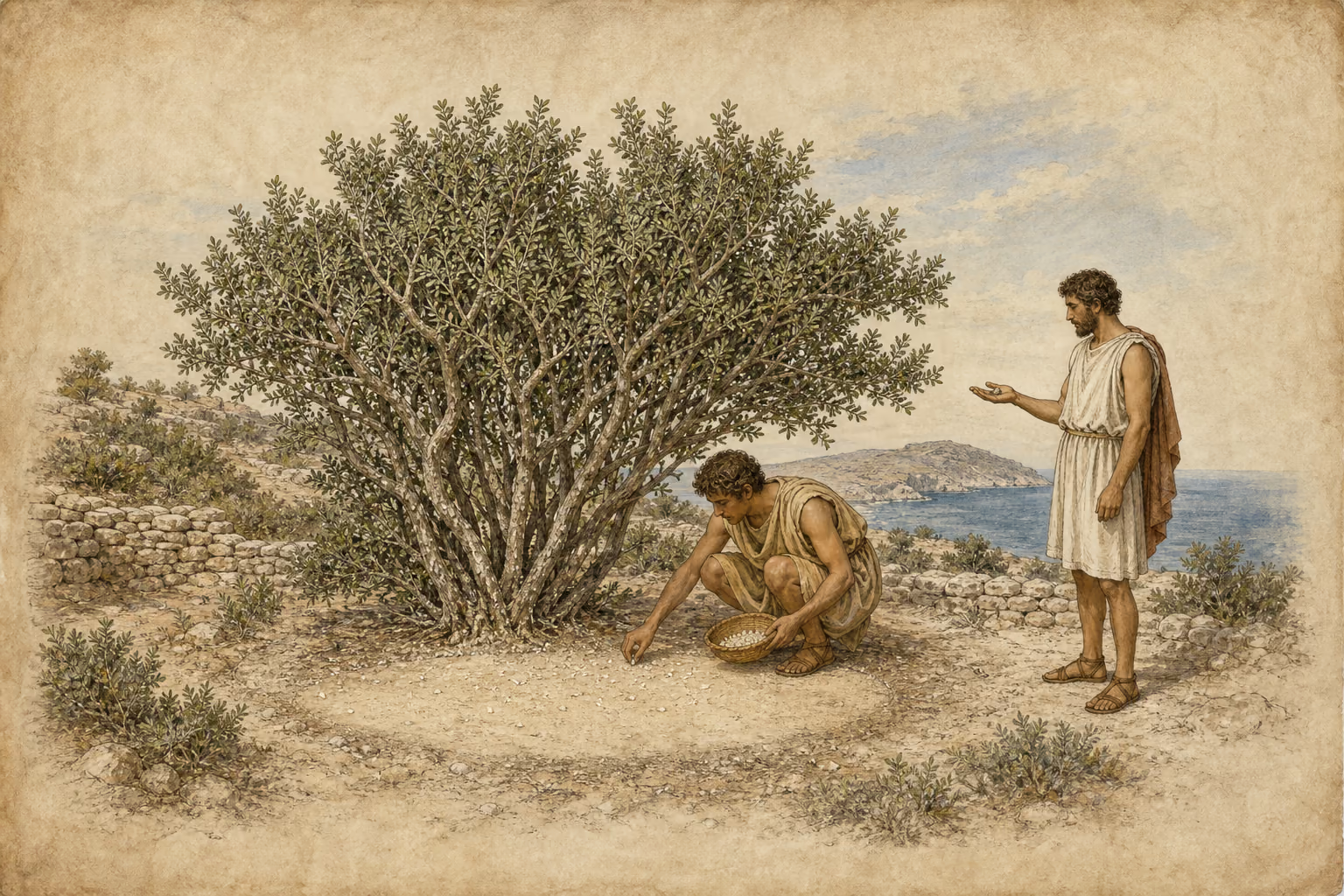
Arabia, too, still boasts of her ladanum. Many writers have stated that this substance is the fortuitous result of an accidental injury inflicted upon a certain odoriferous plant, under the following circumstances: the goat, they say, which is in general an animal that is extremely mischievous to foliage, is particularly fond of the shrubs that are odoriferous, as if, indeed, it were really sensible of the value that is set upon them. Hence it is that as the animal crops the sprouting shoots of the branches which are swollen with a liquid juice of remarkable sweetness, these juices drop and become mingled together, and are then wiped up by the shaggy hairs of its unlucky beard. Being there mingled with the dust, these juices form knots and tufts, and are then dried by the sun; and hence the circumstance is accounted for that in the ladanum which is imported by us we find goats’ hairs. This, however, we are told, occurs nowhere but among the Nabatæi, a people of Arabia, who border upon Syria. The more recent writers call this substance by the name of stobolon, and state that in the forests of Arabia the trees are broken by the goats while browzing, and that the juices in consequence adhere to their shaggy hair; but the genuine ladanum, they assure us, comes from the island of Cyprus. I make mention of this in order that every kind of odoriferous plant may be taken some notice of, even though incidentally and not in the order of their respective localities. They say also that this Cyprian ladanum is collected in the same manner as the other, and that it forms a kind of greasy substance or œsypum, which adheres to the beards and shaggy legs of the goats; but that it is produced from the flowers of the ground-ivy, which they have nibbled when in quest of their morning food, a time at which the whole island is covered with dew. After this, they say, when the fogs are dispersed by the sun, the dust adheres to their wet coats, and the ladanum is formed, which is afterwards taken off of them with a comb.
There are some authors who give to the plant of Cyprus, from which it is made, the name of leda; and hence it is that we find it also called ledanum. They say, also, that a viscous substance settles upon this plant, and, that, by the aid of strings wound around it, its leaves are rolled into balls, from which a kind of cake is made. Hence it is, that in Cyprus, as well as in Arabia, there are two kinds of ladanum; the one natural, and mingled with earth, and the other artificial: the former is friable, while the latter is of a viscous nature.
It is stated, also, that this substance is the produce of a shrub originally found in Carmania, and propagated by plants, by order of the Ptolemies, in the parts beyond Egypt; while other authorities are found, which say that it grows on the incense tree, and is gathered like gum, from incisions made in the bark, after which it is collected in bags of goat-skin. That of the most approved quality, sells at the rate of forty asses per pound. Ladanum is adulterated with myrtle berries, and filth taken from the fleeces of other animals besides the goat. If genuine, it ought to have a wild and acrid smell, in some measure redolent of the desert places where it is produced: it is dry and parched in appearance, but becomes soft the moment it is touched. When ignited, it gives a brilliant flame, and emits a powerful but pleasant odour; if mixed with myrtle berries, its spurious quality is immediately discovered by their crackling in the fire. In addition to this, the genuine ladanum has more grits, or stony particles, adhering to it, than dust.
In Arabia, too, the olive-tree distils a sort of tear, with which the Indians make a medicament, known by the Greeks as enhæmon; it is said to be of wonderful efficacy in contracting and healing wounds and sores. These trees, situate on the coasts there, are covered by the sea at high water, without the berries suffering the slightest injury, although it is a well-known fact, that the salt collects upon the leaves. All these trees are peculiar to Arabia, but it has some few besides, in common with other countries, of which we shall make mention elsewhere, the kinds growing in Arabia being of inferior quality. The people of that country have a wonderful regard for the perfumes of foreign parts, and import them from places at a considerable distance; so soon are men sated with what they have of their own, and so covetous are they of what belongs to others.
Hence it is, that they import from the country of the Elymæi the wood of a tree called bratus, which is similar in appearance to a spreading cypress. Its branches are of a whitish colour, and the wood, while burning, emits a pleasant odour; it is highly spoken of by Claudius Cæsar, in his History, for its marvellous properties. He states that the Parthians sprinkle the leaves of it in their drink, that its smell closely resembles that of the cedar, and that the smoke of it is efficacious in counteracting the effects of smoke emitted by other wood. This tree grows in the countries that lie beyond the Pasitigris, in the territory of the city of Sittaca, upon Mount Zagrus.
The Arabians import from Carmania also the wood of a tree called stobrum, which they employ in fumigations, by steeping it in palm wine, and then setting fire to it. The odour first ascends to the ceiling, and then descends in volumes to the floor; it is very agreeable, but is apt to cause an oppression of the head, though unattended with pain; it is used for promoting sleep in persons when ill. For these branches of commerce, they have opened the city of Carræ, which serves as an entrepot, and from which place they were formerly in the habit of proceeding to Gabba, at a distance of twenty days’ journey, and thence to Palæstina, in Syria. But at a later period, as Juba informs us, they began to take the road, for the purposes of this traffic, to Charax and the kingdom of the Parthians. For my own part, it would appear to me that they were in the habit of importing these commodities among the Persians, even before they began to convey them to Syria or Egypt; at least Herodotus bears testimony to that effect, when he states that the Arabians paid a yearly tribute of one thousand talents, in frankincense, to the kings of Persia.
From Syria they bring back storax, which, burnt upon the hearth, by its powerful smell dispels that loathing of their own perfumes with which these people are affected. For in general there are no kinds of wood in use among them, except those which are odoriferous; indeed, the Sabæi are in the habit of cooking their food with incense wood, while others, again, employ that of the myrrh tree; and hence, the smoke and smells that pervade their cities and villages are no other than the very same which, with us, proceed from the altars. For the purpose of qualifying this powerful smell, they burn storax in goat-skins, and so fumigate their dwellings. So true it is, that there is no pleasure to be found, but what the continual enjoyment of it begets loathing. They also burn this substance to drive away the serpents, which are extremely numerous in the forests which bear the odoriferous trees.