LIBER XII · CAPUT 25
BALSAMUM; OPOBALSAMUM; AND XYLOBALSAMUM
Latine · Mayhoff 1906
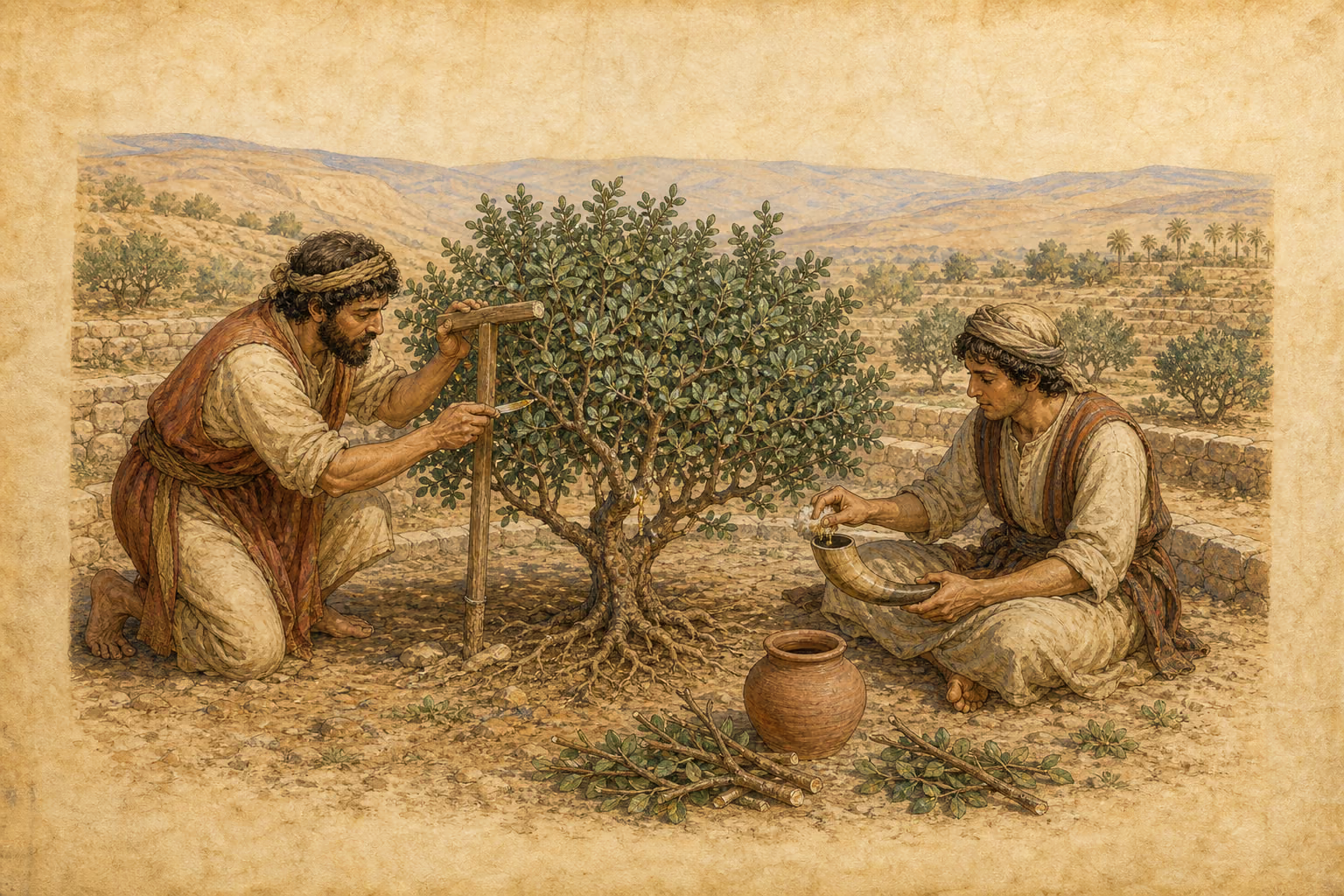
Sed omnibus odoribus praefertur balsamum, uni terrarum Iudaeae concessum, quondam in duobus tantum hortis, utroque regio, altero iugerum viginti non amplius, altero pauciorum. ostendere arborum bane urbi Imperatores Vespasiani, clarumque dictu, a Pompeio Magno in triumpho arbores quoque duximus. servit nunc haec ac tributa pendit cum sua gente, in totum alia natura quam nostri externique prodiderant. quippe viti similior est quam myrto. malleolis seri didicit nuper, vincta ut vitis, et inplet colles vinearum modo. quae sine adminiculis se ipsa sustinet, tondetur simili???er fruticans ac rastris nitescit properatque nasci, intra tertium annum fructifera. folium proximum tuburi, perpetua coma. saeviere in eam udaei sicut in vitam quoque suam; contra defendere Romani, et dimicatum pro frutice est; seritque nunc eum fiscus, nec umquam fuit numerosior. proceritas intra bina cubita subsistit. arbori tria genera: tenue et capillacea coma quod vocatur eutheriston; alterum scabro aspectu, incurvum, fruticosum, odoratius; hoc trachy appellant, tertium eumeces, quia est reliquis procerius, levi cortice. huic secunda bonitas, novissima eutheristo. semen eius vino proximum gustu, colore rufum, nec sine pingui. peius in grano quod levius atque viridius. ramus crassior quam myrto. inciditur vitro, lapide osseisve cultellis; ferro laedi vitalia odit, emoritur protinus, eodem amputari supervacua patiens. incidentis manus libratur artifici temperamento, ne quid ultra corticem violet. sucus e plaga manat quem opobalsamum vocant, suavitatis eximiae. sed tenui gutta ploratu: lanis parva colligitur in cornua, ex iis novo fictili conditur, crassiori similis oleo et in musto candida; rufescit deinde simulque durescit e tralucido. Alexandro Magno res ibi gerente toto die aestivo unam concham impleri iustum erat, omni vero fecunditate e maiore horto congios senos, e minore singulos, cum et duplo rependebatur argento, nunc etiam singularum arborum largior vena. ter omnibus percutitur aestatibus, postea deputatur. et sarmenta quoque in merce sunt. DCCC HS amputatio ipsa surcalusque veniere intra quintum devictae Iudaeae annum; xylobalsamum vocatur et coquitur in unguentis. pro suco ipso substituere officinae. corticis etiam ad medicamenta pretium est. praecipua autem gratia lacrimae, secunda semini, tertia cortici, minima ligno. ex hoc buxosum optimum, quod et odoratissimum, e semine autem maximum et ponderosissimum, mordens gustu fervensque in ore. adulteratur Petraeo hyperico, quod coarguitur magnitudine, inanitate, longitudine, odoris ignavia, sapore piperis. lacrimac probatio ut sit e pingui tenuis ac modice rufa et in fricando odorata. secundus candidi coloris, peior viridis crassusque, pessimus niger, quippe ut oleum senescit. ex omni incisura maxime probatur quod ante semen fluxit. et alias adulteratur seminis suco, vixque maleficium deprehenditur gustu amariore; esse enim debet lenis, non subacidus, odore tantum austerus. vitiatur et oleo rosae, cypri, lentisci, balani, terebinthi, myrti, resina, galbano, cera Cypria, prout quaeque res fuit, nequissime autem cummi: quoniam arescit, in manu inversa et in aqua sidit, quae probatio eius gemina est. debet et sincerum arescere, sed hoc cummi addita fragili crusta evenit. et gustu deprehenditur, carbone vero quod cera resinaque adulteratum est, nigriore flamma. nam melle mutatum statim in manu contrahit muscas. praeterea sinceri densatur in tepida aqua gutta sidens ad ima vasa, adulterata olei modo innatat et, si metopio vitiata est, circulo candido cingitur. summa est probatio ut lac coagulet, in veste maculas non faciat. nec manifestior alibi fraus, quippe milibus denarium sextarii, empti vendente fisco trecenis denariis, veneunt: in tantum expedit augere liquorem. xylobalsamo pretium in libras $X$ VI.
Proxima Iudaeae Syria supra Phoenicen styracem gignit circa Gabala et Marathunta et Casium Seleuciae montem. arbor est eodem nomine, cotoneo malo similis, lacrimae ex austero iucundi odoris; intus similitudo harundinis, suco praegnans. in hanc circa canis ortus advolant pinnati vermiculi erodentes, ob id scobe sordescit. styrax laudatur post supra dicta ex Pisidia [Side], Cypro, Cilicia, Creta, minime ex Amano Syriae medicis, sed unguentariis magis. colos in quacumque natione praefertur rufus et pinguiter lentus, deterior furfurosus et cano situ obductus. adulteratur cedri resina vel cummi, alias melle aut amygdalis amaris. omnia ea deprehenduntur gustu. pretium optimo $X$ XVII. exit et in Pamphylia, sed aridior minusque sucosus. dat et galbanum Syria in eodem Amano monte e ferula, quae eiusdem nominis, resinae modo; stagonitim appellant. quod maxime laudant, cartilaginosum, purum ad similitudinem hammoniaci minimeque lignosum. sic quoque adulteratur faba aut sacopenio. sincerum, si uratur, fugat nidore serpentes. permutatur iu libras $X$ V.
English · Bostock & Riley 1855–57
But to all other odours that of balsamum is considered preferable, a plant that has been only bestowed by Nature upon the land of Judæa. In former times it was cultivated in two gardens only, both of which belonged to the kings of that country: one of them was no more than twenty jugera in extent, and the other somewhat smaller. The emperors Vespasianus and Titus had this shrub exhibited at Rome; indeed, it is worthy of signal remark, that since the time of Pompeius Magnus, we have been in the habit of carrying trees even in our triumphal processions. At the present day this tree pays us homage and tribute along with its native land, but it has been found to be of altogether a different nature to that which our own as well as foreign writers had attributed to it: for, in fact, it bears a much stronger resemblance to the vine than to the myrtle. This recent acquisition by conquest has learned, like the vine, to be reproduced by mallet -shoots, and it covers declivities just like the vine, which supports its own weight without the aid of stays. When it puts forth branches it is pruned in a similar manner, and it thrives by being well raked at the roots, growing with remarkable rapidity, and bearing fruit at the end of three years. The leaf bears a very considerable resemblance to that of rue, and it is an evergreen. The Jews vented their rage upon this shrub just as they were in the habit of doing against their own lives and persons, while, on the other hand, the Romans protected it; indeed, combats have taken place before now in defence of a shrub. At the present day the reproduction of it has become a duty of the fiscal authorities, and the plants were never known to be more numerous or of larger growth; they never exceed the height, however, of a couple of cubits.
There are three different kinds of balsamum. The first has a thin and hair-like foliage, and is known by the name of eutheriston. The second is of a rugged appearance, bending downwards, full of branches, and more odoriferous than the first; the name of this is trachy. The third kind is the eumeces, so called, because it is taller than the others; it has a smooth, even, bark. It is the second in quality, the eutheriston being inferior to the trachy. The seed of this plant has a flavour strongly resembling that of wine; it is of a reddish colour, and not without a certain amount of unctuousness; the grains of inferior quality are lighter in weight and of a greener hue: the branches of the shrub are thicker than those of the myrtle. Incisions are made in it either with glass, or else a sharp stone, or knives made of bone: it being highly injurious to touch the vital parts with iron, for in such case it will immediately wither away and die. On the other hand, it will allow of all the superfluous branches being pruned away with an instrument of iron even. The hand of the person who makes the incision is generally balanced by an artificial guide, in order that he may not accidentally inflict a wound in the wood beyond the bark.
A juice distils from the wound, which is known to us as opobalsamum; it is of extraordinary sweetness, but only exudes in tiny drops, which are then collected in wool, and deposited in small horns. When taken from out of these, the substance is placed in new earthen vessels; it bears a strong resemblance to a thick oil, and is of a white colour when fresh. It soon, however, turns red, and as it hardens loses its transparency. When Alexander the Great waged war in those parts, it was looked upon as a fair summer day’s work to fill a single concha with this liquid; the entire produce of the larger garden being six congii, and of the smaller one a single congius; the price, too, at which it was sold was double its weight in silver. At the present day the produce of a single tree, even, is larger; the incisions are made three times every summer, after which the tree is pruned.
The cuttings, too, form an article of merchandize: the fifth year after the conquest of Judæa, these cuttings, with the suckers, were sold for the price of eight hundred thousand sesterces. These cuttings are called xylobalsamum, and are boiled down for mixing with unguents, and in the manufactories have been substituted for the juices of the shrub. The bark is also in great request for medicinal purposes, but it is the tears that are so particularly valuable; the seed holding the second rank in estimation, the bark the third, and the wood being the least esteemed of all. Of the wood, that kind which resembles boxwood is considered the best: it has also the strongest smell. The best seed is that which is the largest in size and the heaviest in weight; it has a biting or rather burning taste in the mouth. Balsamum is adulterated with hypericon from Petra, but the fraud is easily detected, from the fact that the grains of the latter are larger, comparatively empty, and longer than those of balsamum; they are destitute also of any pungency of smell, and have a flavour like that of pepper.
As to the tears of balsamum, the test of their goodness is their being unctuous to the touch, small, of a somewhat reddish colour, and odoriferous when subjected to friction. That of second-rate quality is white; the green and coarse is inferior, and the black is the worst of all; for, like olive-oil, it is apt to turn rancid when old. Of all the incisions, the produce is considered the best of those from which the liquid has flowed before the formation of the seed. In addition to what has been already stated, it is often adulterated with the juice of the seed, and it is with considerable difficulty that the fraud is detected by a slight bitterness in the taste, which ought to be delicate and without the slightest mixture of acidity, the only pungency being that of the smell. It is adulterated also with oil of roses, of cyprus, of mastich, of balanus, of turpentine, and of myrtle, as also with resin, galbanum, and Cyprian wax, just as occasion may serve. But the very worst adulteration of all, is that which is effected with gum, a substance which is dry when emptied into the hand, and falls to the bottom when placed in water; both of which are characteristics of the genuine commodity. Balsamum, in a genuine state, should be quite hard, but when it is mixed with gum a brittle pellicle forms upon it. The fraud can also be detected by the taste, and when placed upon hot coals it may easily be seen if there has been any adulteration with wax and resin; the flame too, in this case, burns with a blacker smoke than when the balsamum is pure. When mixed with honey its qualities are immediately changed, for it will attract flies even in the hand. In addition to these various tests, a drop of pure balsamum, if placed in luke-warm water will settle to the bottom of the vessel, whereas, if it is adulterated, it will float upon the surface like oil, and if it has been drugged with metopion or hammoniacum, a white circle will form around it. But the best test of all is, that it will cause milk to curdle, and leave no stain upon cloth. In no commodity are there practised more palpable frauds than in this, for a sextarius of balsamum which is sold by the fiscal authorities at three hundred denarii, is sold again for a thousand, so vast is the profit to be derived from increasing this liquid by sophistication. The price of xylobalsamum is six denarii per pound.
That part of Syria joining up to Judæa, and lying above Phœnicia, produces storax, which is found in the vicinity of Gabala and Marathus, as also of Casius, a mountain of Seleucia. The tree bears the same name, and has a strong resemblance to, the quince. The tear has a harsh taste, with a pleasant smell; in the interior it has all the appearance of a reed, and is filled with a liquid juice. About the rising of the Dog-star, certain small winged worms hover about this substance and eat it away, for which reason it is often found in a rotten state, with worm-holes full of dust. The storax next in estimation after that already mentioned, comes from Pisidia, Sidon, Cyprus, and Cilicia; that of Crete being considered the very worst of all. That which comes from Mount Amanus, in Syria, is highly esteemed for medicinal purposes, and even more so by the perfumers. From whatever country it comes, that which is of a red colour is preferred, and it should be both unctuous as well as viscous to the touch; the worst kind is that which crumbles like bran, and is covered all over with a whitish mould. This substance is adulterated with the resin of cedar or with gum, and sometimes with honey or bitter almonds; all which sophistications may, however, be detected by the taste. The price of storax of the best quality is seventeen denarii per pound. It comes also from Pamphylia, but this last is more arid, and not so full of juice.
Syria produces galbanum too, which grows upon the same mountain of Amanus: it exudes from a kind of giant-fennel of the same name as the resin, though sometimes it is known as stagonitis. The kind that is the most esteemed is cartilaginous, clear like hammoniacum, and free from all ligneous substances. Still, however, it is sometimes adulterated with beans, or with sacopenium. If ignited in a pure state, it has the property of driving away serpents by its smoke. It is sold at five denarii per pound, and is only employed for medicinal purposes.