LIBER XII · CAPUT 5
THE INDIAN THORN
Latine · Mayhoff 1906
Est ibi et spina similis, sed deprehensa vel lucernis igni protinus transiliente.
Nunc eas exponemus, quas mirata est Alexandri Magni victoria orbe eo patefacto.
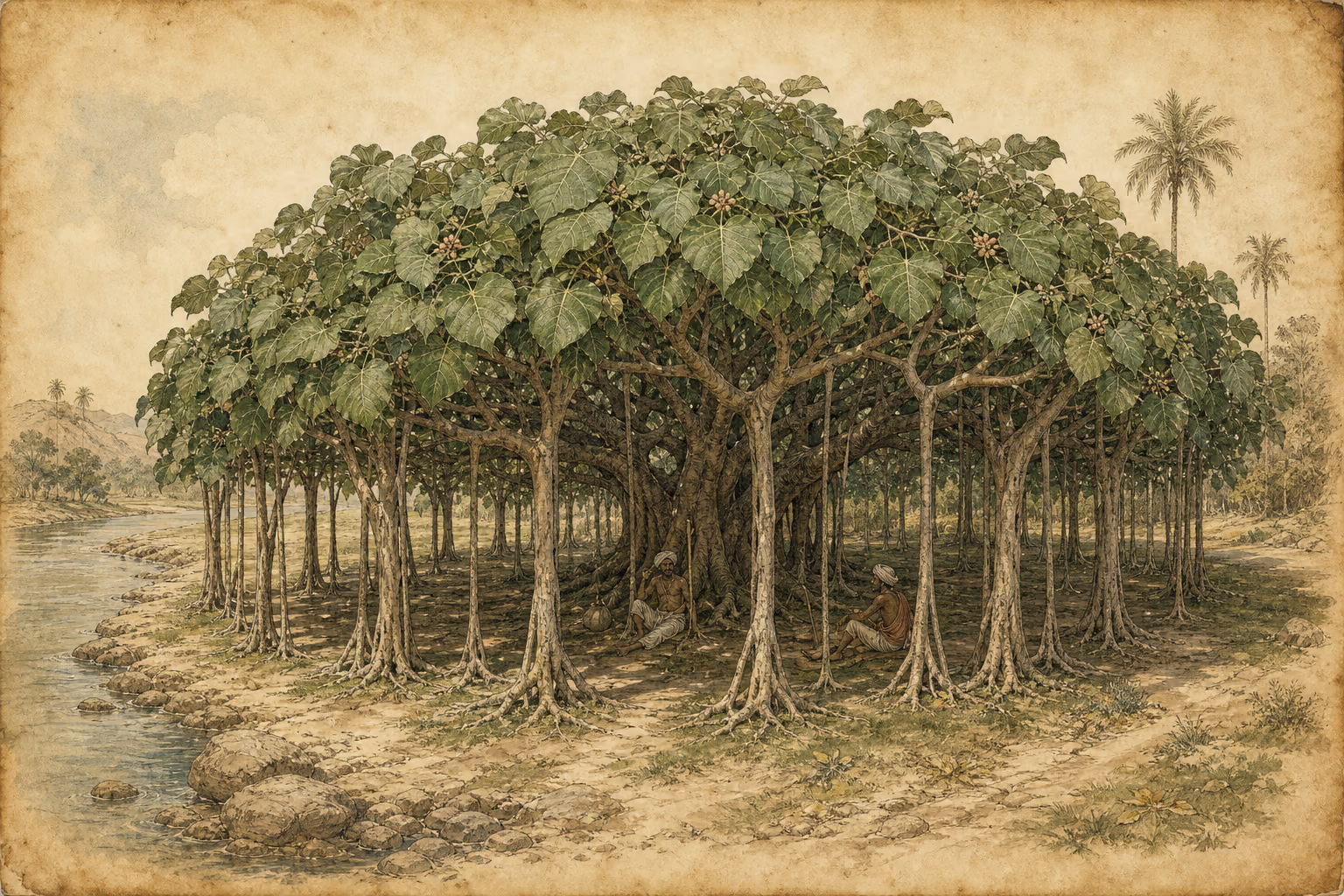
Ficus ibi eximia pomo, se ipsa semper serens. vastis diffunditur ramis, quorum imi in terram adeo curvantur, ut annuo spatio infigantur novamque sibi progeniem faciant circa parentem in orbem quodam opere topiario. intra saepem eam aestivant pastores, opacam pariter et munitam vallo arboris, decora specie subter intuenti proculve fornicato ambitu. superiores eiusdem rami in excelsum emicant silvosa multitudine, vasto matris corpore, ut LX passus pleraeque orbe colligant, umbra vero bina stadia operiant. foliorum latitudo peltae effigiem Amazonicae habet; ea causa fructum integens crescere prohibet. rarus... que nec fabae magnitudinem excedens, sed per folia solibus coctus praedulcis sapore et dignus miraculo arboris. gignitur circa Acesinen maxime amnem.
English · Bostock & Riley 1855–57
There is in India, also, a kind of thorn very similar to ebony, though it may be distinguished from it, by the aid of a lantern even; for, on the application of flame, it will instantly run across the tree. We will now proceed to describe those trees which were the admiration of Alexander the Great in his victorious career, when that part of the world was first revealed by his arms.
The Indian fig bears but a small fruit. Always growing spontaneously, it spreads far and wide with its vast branches, the ends of which bend downwards into the ground to such a degree, that they take fresh root in the course of a year, and thus form a new plantation around the parent stock, traced in a circular form, just as though it had been the work of the ornamental gardener. Within the bowers thus formed, the shepherds take up their abode in the summer, the space occupied by them being, at once, overshadowed and protected by the bulwark which the tree thus throws around; a most graceful sight, whether we stand beneath and look upwards, or whether we view its arcaded foliage from a distance. The higher branches, however, shoot upwards to a very considerable height, and, by their number, form quite a grove, springing aloft from the vast trunk of the parent tree, which overspreads, very frequently, a space of sixty paces in extent, while the shade that is thrown by it will cover as much as a couple of stadia. The broad leaves of the tree have just the shape of an Amazonian buckler; and hence it is that the fruit, from being quite covered by the leaves, is greatly impeded in its growth. The fruit, indeed, of this tree is but scanty, and never exceeds a bean in size; being ripened, however, by the rays of the sun, as these penetrate the leaves, the figs are remarkable for their singular lusciousness, and are quite worthy of the marvellous tree by which they are produced. These fig-trees are found, more particularly, in the vicinity of the river Acesines.