LIBER XII · CAPUT 7
THE PEPPER-TREE.—THE VARIOUS KINDS OF PEPPER—BREGMA—ZINGIBERI, OR ZIMPIBERI
Latine · Mayhoff 1906
Oliva Indiae sterilis praeterquam oleastri fructus. passim vero quae piper gignunt iunipiris nostris similes, quamquam in fronte Caucasi solibus opposita gigni tantum eas aliqui tradidere. semina a iunipiro distant parvulis siliquis, quales in phasiolis videmus. hae prius quam 5 dehiscant decerptae tostaeque sole faciunt quod vocatur piper longum, paulatim vero dehiscentes maturitate ostendunt candidum piper, quod deinde tostum solibus colore rugisque mutatur. verum et his sua iniuria est, atque caeli intemperie carbunculant fiuntque semina cassa et inania, quod vocant bregma, sic Indorum lingua significante mortuum. hoc ex omni genere asperrimum est levissimumque et pallidum, gratius nigrum, lenius utroque candidum. non est huius arboris radix, ut aliqui existimavere, quod vocant zingiberi, alii vero zimpiberi, quamquam sapore simili. id 15 enim in Arabia atque Trogodytica in villis nascitur, parva herba, radice candida. celeriter ea cariem sentit, quamvis in tanta amaritudine. pretium eius in libras $X$ VI. piper longum facillime adulteratur Alexandrino sinapi. emitur in libras $X$ XV, album $X$ VII, nigrum $X$ III. usum eius adeo placuisse mirum est; in aliis quippe suavitas cepit, in aliis species invitavit: huic nec pomi nec bacae commendatio est aliqua. sola placere amaritudine, et hanc in Indos peti! quis ille primus experiri cibis voluit aut cui in appetenda aviditate esurire non fuit satis? utrumque silvestre gentibus suis est et tamen pondere emitur ut aurum vel argentum.
Piperis arborem iam et Italia habet, maiorem myrto nec absimilem. amaritudo grano eadem quae piperi musteo credatur esse: deest tosta illa maturitas ideoque et rugarum colorisque similitudo. adulteratur iunipiri bacis mire vim trahentibus; in pondere quidem multis modis.
Est etiamnum in India piperis granis simile quod vocatur caryophyllon, grandius fragiliusque. tradunt in Indica loto id gigni. advehitur odoris gratia. fert et spina piperis similitudinem praecipua amaritudine, foliis parvis densisque cypri modo, ramis trium cubitorum, cortice pallido, radice lata lignosaque, buxei coloris. hac in aqua cum semine excocta in aereo -vase medicamentum fit, quod vocatur lycion. ea spina et in Pelio monte nascitur adulteratque medicamentum, item asphodeli radix aut fel bubulum aut apsinthium vel rhus vel amurca. aptissimum medicinae quod est spumosum. Indi in utribus camelorum aut rhinocerotum id mittunt. spinam ipsam in Graecia quidam pyxacanthum Chironium vocant.
English · Bostock & Riley 1855–57
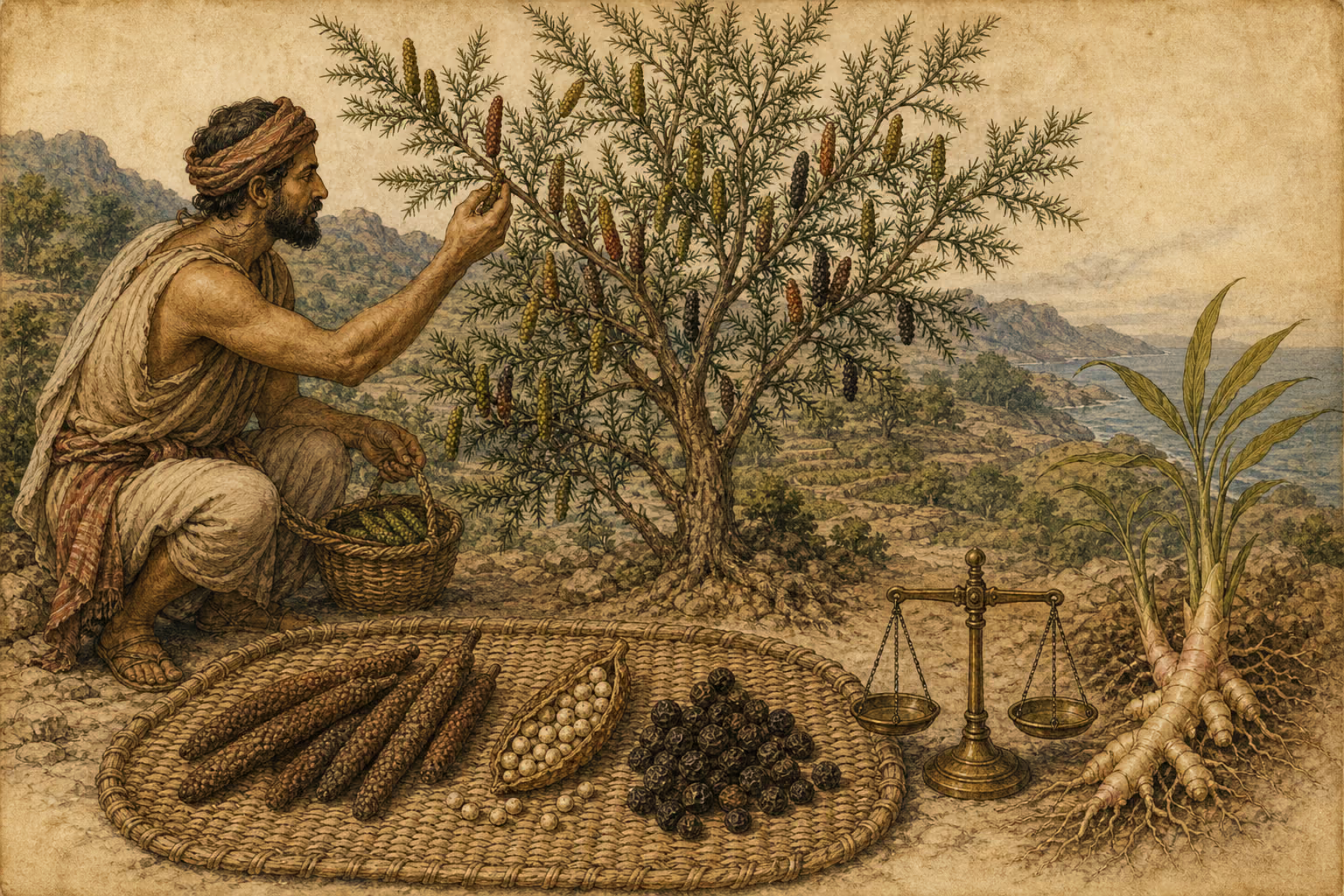
The olive-tree of India is unproductive, with the sole exception of the wild olive. In every part we meet with trees that bear pepper, very similar in appearance to our junipers, although, indeed, it has been alleged by some authors that they only grow on the slopes of Caucasus which lie exposed to the sun. The seeds, however, differ from those of the juniper, in being enclosed in small pods similar to those which we see in the kidney-bean. These pods are picked before they open, and when dried in the sun, make what we call “long pepper.” But if allowed to ripen, they will open gradually, and when arrived at maturity, discover the white pepper; if left exposed to the heat of the sun, this becomes wrinkled, and changes its colour. Even these productions, however, are subject to their own peculiar infirmities, and are apt to become blasted by the inclemency of the weather; in which case the seeds are found to be rotten, and mere husks. These abortive seeds are known by the name of “bregma,” a word which in the Indian language signifies “dead.” Of all the various kinds of pepper, this is the most pungent, as well as the very lightest, and is remarkable for the extreme paleness of its colour. That which is black is of a more agreeable flavour; but the white pepper is of a milder quality than either.
The root of this tree is not, as many persons have imagined, the same as the substance known as zimpiberi, or, as some call it, zingiberi, or ginger, although it is very like it in taste. For ginger, in fact, grows in Arabia and in Troglodytica, in various cultivated spots, being a small plant with a white root. This plant is apt to decay very speedily, although it is of intense pungency; the price at which it sells is six denarii per pound. Long pepper is very easily adulterated with Alexandrian mustard; its price is fifteen denarii per pound, while that of white pepper is seven, and of black, four. It is quite surprising that the use of pepper has come so much into fashion, seeing that in other substances which we use, it is sometimes their sweetness, and sometimes their appearance that has attracted our notice; whereas, pepper has nothing in it that can plead as a recommendation to either fruit or berry, its only desirable quality being a certain pungency; and yet it is for this that we import it all the way from India! Who was the first to make trial of it as an article of food? and who, I wonder, was the man that was not content to prepare himself by hunger only for the satisfying of a greedy appetite? Both pepper and ginger grow wild in their respective countries, and yet here we buy them by weight—just as if they were so much gold or silver. Italy, too, now possesses a species of pepper-tree, somewhat larger than the myrtle, and not very unlike it. The bitterness of the grains is similar to that which we may reasonably suppose to exist in the Indian pepper when newly gathered; but it is wanting in that mature flavour which the Indian grain acquires by exposure in the sun, and, consequently, bears no resemblance to it, either in colour or the wrinkled appearance of the seeds. Pepper is adulterated with juniper berries, which have the property, to a marvellous degree, of assuming the pungency of pepper. In reference to its weight, there are also several methods of adulterating it.
There is, also, in India another grain which bears a considerable resemblance to pepper, but is longer and more brittle; it is known by the name of caryophyllon. It is said that this grain is produced in a sacred grove in India; with us it is imported for its aromatic perfume. The same country produces, also, a thorny shrub, with grains which bear a resemblance to pepper, and are of a remarkably bitter taste. The leaves of this shrub are small, like those of the cyprus; the branches are three cubits in length, the bark pallid, and the roots wide-spreading and woody, and of a colour resembling that of boxwood. By boiling this root with the seed in a copper vessel, the medicament is prepared which is known by the name of lycion. This thorny shrub grows, also, on Mount Pelion; this last kind is much used for the purpose of adulterating the medicament above mentioned. The root of the asphodel, ox-gall, wormwood, sumach, and the amurca of olive oil, are also employed for a similar purpose. The best lycion for medicinal purposes, is that which has a froth on its surface; the Indians send it to us in leather bottles, made of the skin of the camel or the rhinoceros. The shrub itself is known by some persons in Greece under the name of the Chironian pyxacanthus.