LIBER XIII · CAPUT 12
THE NINE DIFFERENT KINDS OF PAPER
Latine · Mayhoff 1906
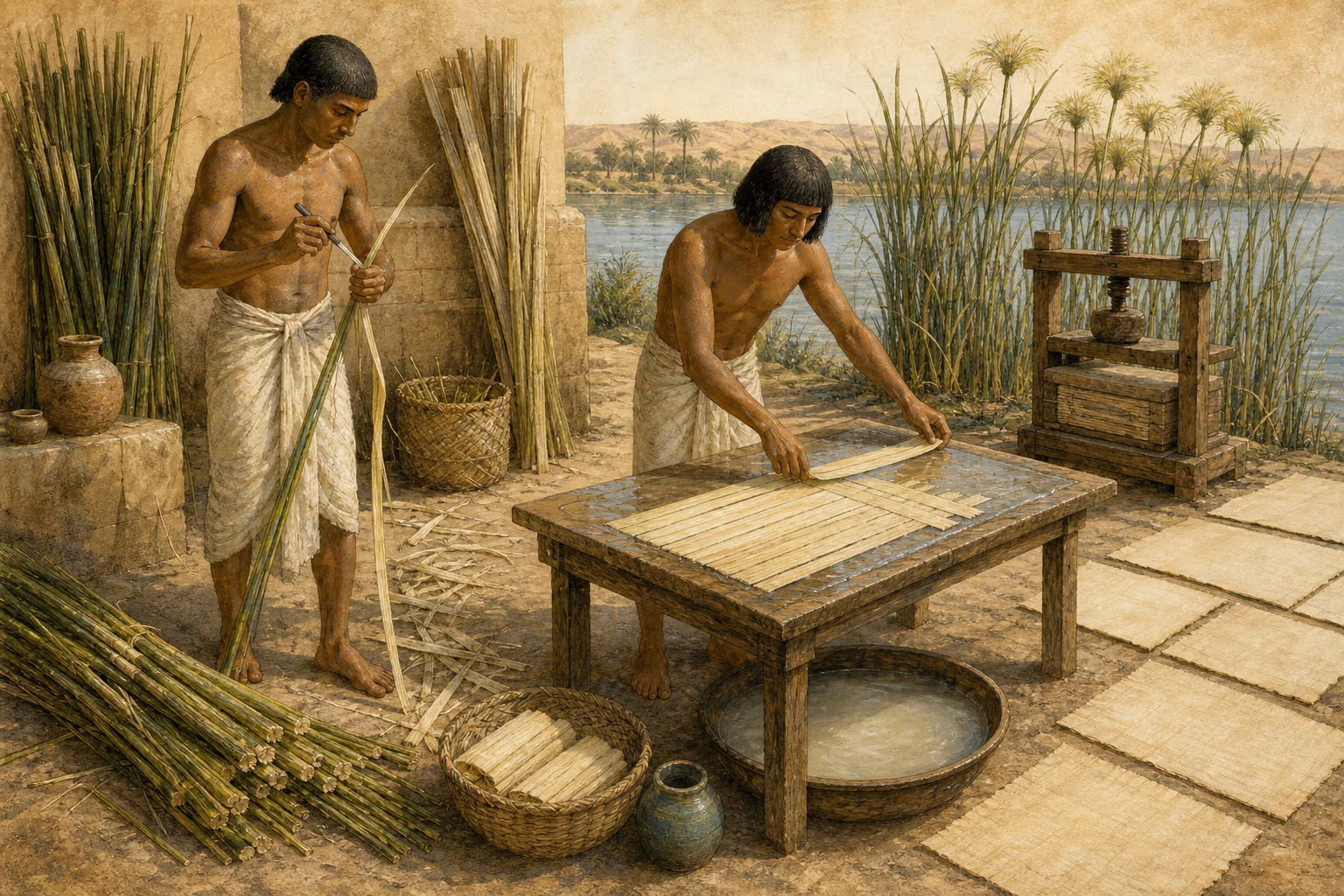
Praeparatur ex eo charta diviso acu in praetenues, sed quam latissimas philyras. principatus medio, atque inde scissurae ordine. hieratica appellabatur antiquitus religiosis tantum voluminibus dicata, quae adulatione Augusti nomen accepit, sicut secunda Liviae a coniuge eius: ita descendit hieratica in tertium nomen. proximum amphitheatriticae datum fuerat a confecturae loco; excepit hanc Romae Fanni sagas officina tenuatamque curiosa interpolatione principalem fecit e plebeia et nomen ei dedit; quae non esset ita recurata, in suo mansit amphitheatritica. post hanc Saitica ab oppdo ubi maxima fertilitas, ex vilioribus ramentis, propiorque etiamnum cortici Taeneotica a vicino loco, pondere iam haec, non bonitate, venalis. nam emporitica inutilis scribendo involucris chartarum segestriumque mercibus usum praebet, ideo a mercatoribus cognominata. post hanc papyrum est extremumque eius scirpo simile ac ne funibus quidem nisi in umore utile. Texitur omnis madente tabula Nili aqua. turbidum liquoris glutinum praebet. in rectum primo supina tabulae schida adlinitur longitudine papyri quae potuit esse, resegminibus utrimque amputatis, traversa postea crates peragit. premitur ergo praelis, et siccantur sole plagulae atque inter se iunguntur, proximarum semper bonitatis deminutione ad deterrimas. numquam plures scapo quam vicenae.
Magna in latitudine earum differentia: XIII digitorum optimis, duo detrahuntur hieraticae, Fanniana denos habet, et uno minus amphitheatritica, pauciores Saitica, nec malleo sufficit; nam emporiticae brevitas sex digitos non excedit. praeterea spectatur in chartis tenuitas, densitas, candor, levor. primatum mutavit Claudius Caesar: nimia quippe Augustae tenuitas tolerandis non sufficiebat calamis; ad hoc tramittens litteras liturae metum adferebat ex aversis, et alias indecoro visu pertralucida. igitur e secundo corio statumina facta sunt, e primo subtemina. auxit et amplitudinem, pedali mensura. erat et cubitalis macrocollis, sed ratio deprehendit vitium, unius schidae revulsione plures infestante paginas. ob haec praelata omnibus Claudia, Augustae in epistulis auctoritas relicta; Liviana suam tenuit, cui nihil e prima erat, sed omnia e secunda.
Scabritia levigatur dente conchave, sed caducae litterae fiunt. minus sorbet politura charta, magis splendet. rebellat saepe umor incuriose datus primo, malleoque deprehenditur aut etiam odore, cum cura fuit indiligentior. deprehenditur et lentigo oculis, sed inserta mediis glutinamentis taenea fungo papyri bibula, vix nisi littera fundente se: tantum inest fraudis. alius igitur iterum texendis labor.
Glutinum vulgare e pollinis flore temperatur fervente aqua, minimo aceti aspersu, nam fabrile cummisque fragilia sunt. diligentior cura mollia panis fermentati colat aqua fervente; minimum hoc modo intergerivi, atque etiam Nili lenitas superatur. cmne autem glutinum nec vetustius esse debet uno die nec recentius.— (postea malleo tenuatur et glutino percurritur, iterumque constricta erugatur atque extenditur malleo) — ita sint longinqua monimenta. Tiberi Gaique Gracchorum manus apud Pomponium Secundum vatem civemque clarissimum vidi annos fere post ducentos; iam vero Ciceronis ac Divi Augusti Vergilique saepenumero videmus.
English · Bostock & Riley 1855–57
Paper is made from the papyrus, by splitting it with a needle into very thin leaves, due care being taken that they should be as broad as possible. That of the first quality is taken from the centre of the plant, and so in regular succession, according to the order of division. “Hieratica” was the name that was anciently given to it, from the circumstance that it was entirely reserved for the religious books. In later times, through a spirit of adulation, it received the name of “Augusta,” just as that of second quality was called “Liviana,” from his wife, Livia; the consequence of which was, that the name “hieratica” came to designate that of only third-rate quality. The paper of the next quality was called “amphitheatrica,” from the locality of its manufacture. The skilful manufactory that was established by Fannius at Rome, was in the habit of receiving this last kind, and there, by a very careful process of insertion, it was rendered much finer; so much so, that from being a common sort, he made it a paper of first-rate quality, and gave his own name to it: while that which was not subjected to this additional process retained its original name of “amphitheatrica.” Next to this is the Saitic paper, so called from the city of that name, where it is manufactured in very large quantities, though of cuttings of inferior quality. The Tæniotic paper, so called from a place in the vicinity, is manufactured from the materials that lie nearer to the outside skin; it is sold, not according to its quality, but by weight only. As to the paper that is known as “emporetica,” it is quite useless for writing upon, and is only employed for wrapping up other paper, and as a covering for various articles of merchandize, whence its name, as being used by dealers. After this comes the bark of the papyrus, the outer skin of which bears a strong resemblance to the bulrush, and is solely used for making ropes, and then only for those which have to go into the water.
All these various kinds of paper are made upon a table, moistened with Nile water; a liquid which, when in a muddy state, has the peculiar qualities of glue. This table being first inclined, the leaves of papyrus are laid upon it lengthwise, as long, indeed, as the papyrus will admit of, the jagged edges being cut off at either end; after which a cross layer is placed over it, the same way, in fact, that hurdles are made. When this is done, the leaves are pressed close together, and then dried in the sun; after which they are united to one another, the best sheets being always taken first, and the inferior ones added afterwards. There are never more than twenty of these sheets to a roll.
There is a great difference in the breadth of the various kinds of paper. That of best quality is thirteen fingers wide, while the hieratica is two fingers less. The Fanniana is ten fingers wide, and that known as “amphitheatrica,” one less. The Saitic is of still smaller breadth, indeed it is not so wide as the mallet with which the paper is beaten; and the emporetica is particularly narrow, being not more than six fingers in breadth.
In addition to the above particulars, paper is esteemed according to its fineness, its stoutness, its whiteness, and its smoothness. Claudius Cæsar effected a change in that which till then had been looked upon as being of the first quality: for the Augustan paper had been found to be so remarkably fine, as to offer no resistance to the pressure of the pen; in addition to which, as it allowed the writing upon it to run through, it was continually causing apprehensions of its being blotted and blurred by the writing on the other side; the remarkable transparency, too, of the paper was very unsightly to the eye. To obviate these inconveniences, a groundwork of paper was made with leaves of the second quality, over which was laid a woof, as it were, formed of leaves of the first. He increased the width also of paper; the width [of the common sort] being made a foot, and that of the size known as “macrocollum,” a cubit; though one inconvenience was soon detected in it, for, upon a single leaf being torn in the press, more pages were apt to be spoilt than before. In consequence of the advantages above-mentioned, the Claudian has come to be preferred to all other kinds of paper, though the Augustan is still used for the purposes of epistolary correspondence. The Livian, which had nothing in common with that of first quality, but was entirely of a secondary rank, still holds its former place.
The roughness and inequalities in paper are smoothed down with a tooth or shell; but the writing in such places is very apt to fade. When it is thus polished the paper does not take the ink so readily, but is of a more lustrous and shining surface. The water of the Nile that has been originally employed in its manufacture, being sometimes used without due precaution, will unfit the paper for taking writing: this fault, however, may be detected by a blow with the mallet, or even by the smell, when the carelessness has been extreme. These spots, too, may be detected by the eye; but the streaks that run down the middle of the leaves where they have been pasted together, though they render the paper spongy and of a soaking nature, can hardly ever be detected before the ink runs, while the pen is forming the letters; so many are the openings for fraud to be put in practice. The consequence is, that another labour has been added to the due preparation of paper.
The common paper paste is made of the finest flour of wheat mixed with boiling water, and some small drops of vinegar sprinkled in it: for the ordinary workman’s paste, or gum, if employed for this purpose, will render the paper brittle. Those, however, who take the greatest pains, boil the crumb of leavened bread, and then strain off the water: by the adoption of this method the paper has the fewest seams caused by the paste that lies between, and is softer than the nap of linen even. All kinds of paste that are used for this purpose, ought not to be older or newer than one day. The paper is then thinned out with a mallet, after which a new layer of paste is placed upon it; then the creases which have formed are again pressed out, and it then undergoes the same process with the mallet as before. It is thus that we have memorials preserved in the ancient handwriting of Tiberius and Caius Gracchus, which I have seen in the possession of Pomponius Secundus, the poet, a very illustrious citizen, almost two hundred years since those characters were penned. As for the handwriting of Cicero, Augustus, and Virgil, we frequently see them at the present day.