LIBER XIII · CAPUT 22
THE EUONYMOS
Latine · Mayhoff 1906
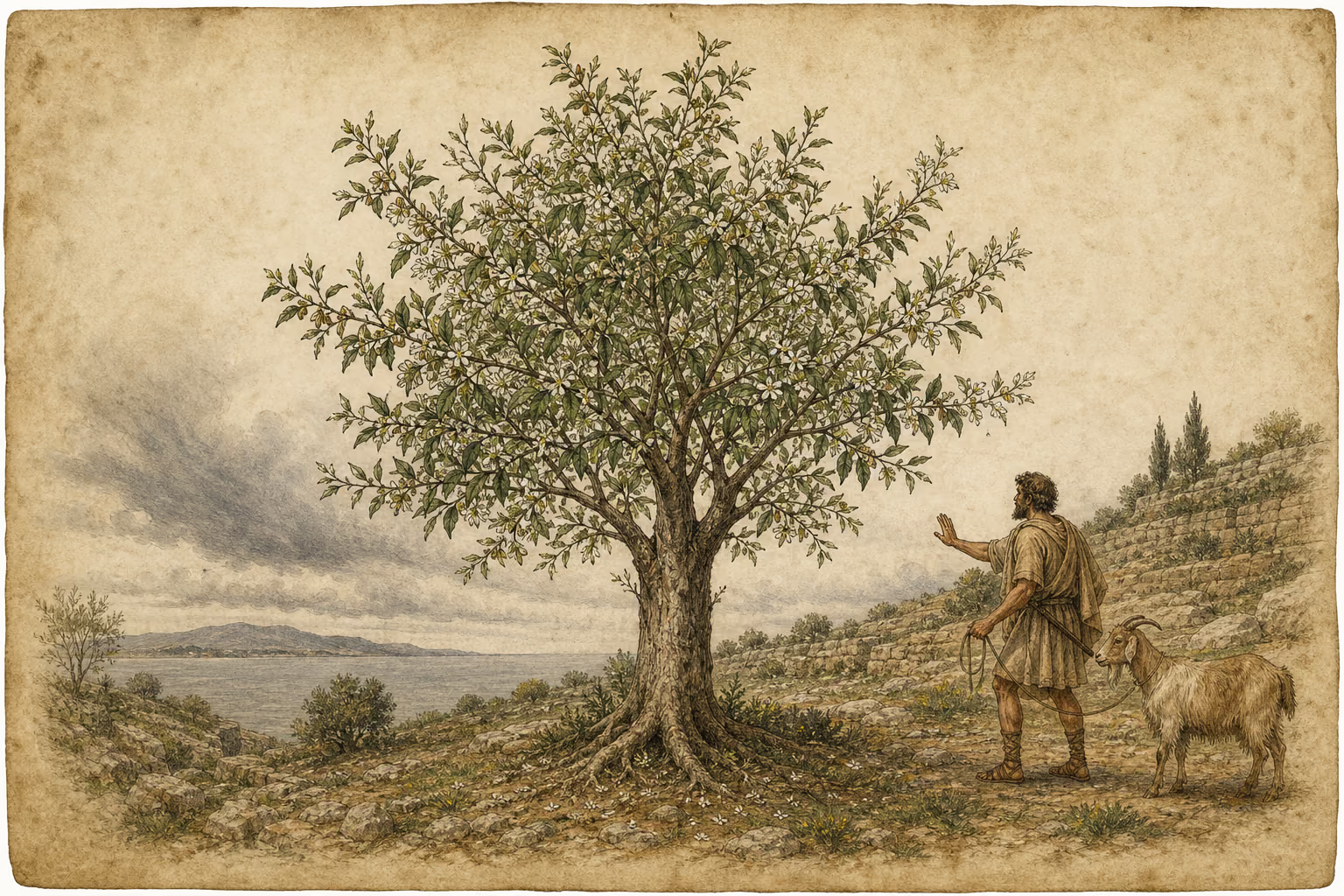
nec auspicatior in Lesbo insula arbor quae vocatur euonymos, non absimilis Punicae arbori — inter eam et laurum folia magnitudine, figura vero et mollitia Punicae —, floris candidi odore statim pestem denuntians. fert siliquas sesames, intus granum quadriangula figura, spissum, letale animalibus; nec non et folio eadem vis. succurrit aliquando praeceps alvi exinanitio.
Alexander Cornelius arborem leonem appellavit, ex qua facta esset Argo, similem robori viscum ferenti, quae neque aqua neque igni posset corrumpi, sicuti nec viscum, nulli alii cognitam, quod equidem sciam.
Andrachlen omnes fere Graecis porcillacae nomine interpretantur, cum sit herba et andrachne vocetur unius litterae diversitate. cetero andrachle est silvestris arbor neque in planis nascens, similis unedoni, folio tantum minore et numquam decidente, cortice non scabro quidem, sed qui circumgelatus videri possit: tam tristis aspectus est. similis et coccygia folio, magnitudine minor. proprietatem habet fructum amittendi lanugine (pappum vocant), quod nulli alii arbori evenit. similis et apharce, bifera aeque quam andrachle. priorem fruc???um incipiente pubescere uva peragunt, alterum initio hiemis, quales eos non traditur.
Et ferulam inter externas dixisse conveniat arborumque generi adscripsisse, quoniam quarundam naturae, sicuti distinguemus, lignum omne corticis loco habent forinsecus, ligni autem loco fungosam intus medullam ut sabuci, quaedam vero inanitatem ut harundines. ferula calidis nascitur locis atque trans maria, geniculatis nodata scapis. duo eius genera: nartheca Graeci vocant adsurgentem in altitudinem, nartheciam vero semper humilem. a genibus exeunt folia, maxima ut quaeque terrae proxima. cetera natura eadem quae anetho, et fructu simili. nulli fruticum levitas maior; ob id gestatu facilis baculorum usum senectuti praebet.
Semen ferulae thapsian quidam vocavere, decepti quoniam ferula sine dubio est thapsia, sed sui generis, foliis feniculi, inani caule nec excedente baculi longitudinem. semen quale ferulae, radix candida. incisa lacte manat et contusa suco, nec corticem abdicant. omnia ea venena: quippe etiam fodientibus nocet, si minima aspiret aura; intumescunt corpora, faciemque invadunt ignes sacri; ob id cerato prius inlinunt. quibusdam tamen morbis auxiliari dicunt medici permixtam aliis, item alopeciis suggillatisque ac liventibus, ceu vero remedia desint, ut scelera non tractent. sed ista praetexunt noxio instrumento, tantumque inpudentiae est, ut venenum artis esse persuadeant. thapsia in Africa vehementissima. quidam caulem incidunt per messes et in ipsa excavant radice, quo sucus confluat, arefactumque tollunt. alii folia, caulem, radicem tundunt in pila et sucum in sole coactum dividunt in pastillos. Nero Caesar claritatem ei dedit initio imperi, nocturnis grassationibus converberata facie inlinens id cum ture ceraque et secuto die contra famam cutem sinceram circumferens. ignem ferulis optime servari certum est easque in Aegypto praecellere.
English · Bostock & Riley 1855–57
There is no tree productive of a more auspicious presage than one which grows in the Isle of Lesbos, and is known by the name of euonymos. It bears some resemblance to the pomegranate tree, the leaf being in size between the leaf of that and the leaf of the laurel, while in shape and softness it resembles that of the pomegranate tree: it has a white blossom, by which it immediately gives us notice of its dangerous properties. It bears a pod very similar to that of sesame, within which there is a grain of quadrangular shape, of coarse make and poisonous to animals. The leaf, too, has the same noxious effects; sometimes, however, a speedy alvine discharge is found to give relief on such occasions.
Alexander Cornelius has called a tree by the name of “eon,” with the wood of which, he says, the ship Argo was built. This tree has on it a mistletoe similar to that of the oak, which is proof against all injury from either fire or water, in the same manner, in fact, as that of no other tree known. This tree, however, appears to have been known to no other author, that I am aware of.
Nearly all the Greek writers interpret the name of the tree called “andrachle,” as meaning the same as “purslain:” whereas purslain is, in reality, a herb, and, with the difference of a single letter, is called “andrachne.” The andrachle is a wild tree, which never grows in the plain country, and is similar to the arbute tree in appearance, only that its leaves are smaller, and never fall off. The bark, too, is not rough, but might be taken to be frozen all over, so truly wretched is its appearance.
Similar, too, in leaf to the preceding tree, is the coccygia, though not so large; it has this peculiarity, that it loses its fruit while still in the downy state—they then call it “pappus”—a thing that happens to no other tree. The apharce is another tree that is similar to the andrachle, and like it, bears twice in the year: just as the grape is beginning to flower the first fruit is ripening, while the second fruit ripens at the commencement of winter; of what nature this fruit is we do not find stated.
We ought to place the ferula also in the number of the exotics, and as making one of the trees. For, in fact, we distinguish the trees into several different kinds: it is the nature of some to have wood entirely in place of bark, or, in other words, on the outside; while, in the interior, in place of wood, there is a fungous kind of pith, like that of the elder; others, again, are hollow within, like the reed. The ferula grows in hot countries and in places beyond sea, the stalk being divided into knotted joints. There are two kinds of it; that which grows upwards to a great height the Greeks call by the name of “narthex,” while the other, which never rises far from the ground, is known as the “narthecya.” From the joints very large leaves shoot forth, the largest lying nearest to the ground: in other respects it has the same nature as the anise, which it resembles also in its fruit. The wood of no shrub is lighter than this; hence it is very easily carried, and the stalks of it make good walking-sticks for the aged.
The seed of the ferula has been by some persons called “thapsia;” deceived, no doubt, by what is really the fact, that the thapsia is a ferula, but of a peculiar kind, with leaves like those of fennel, and a hollow stalk not exceeding a walking-stick in length; the seed is like that of the ferula, and the root of the plant is white. When an incision is made in the thapsia, a milky juice oozes from it, and, when pounded, it produces a kind of juice; the bark even is never thrown away. All these parts of the shrub are poisonous, and, indeed, it is productive of injurious effects to those engaged in digging it up; for if the slightest wind should happen to be blowing towards them from the shrub, the body begins to swell, and erysipelas attacks the face: it is for this reason that, before beginning work, they anoint the face all over with a solution of wax. Still, however, the medical men say that, mixed with other ingredients, it is of considerable use in the treatment of some diseases. It is employed also for the cure of scald-head, and for the removal of black and blue spots upon the skin, as if, indeed, we were really at a loss for remedies in such cases, without having recourse to things of so deadly a nature. These plants, however, act their part in serving as a pretext for the introduction of noxious agents; and so great is the effrontery now displayed, that people would absolutely persuade one that poisons are a requisite adjunct to the practice of the medical art.
The thapsia of Africa is the most powerful of all. Some persons make an incision in the stalk at harvest-time, and bore holes in the root, too, to let the juice flow; after it has become quite dry, they take it away. Others, again, pound the leaves, stalk, and root in a mortar, and after drying the juice in the sun, divide it into lozenges. Nero Cæsar, at the beginning of his reign, conferred considerable celebrity on this plant. In his nocturnal skirmishes it so happened that he received several contusions on the face, upon which he anointed it with a mixture composed of thapsia, frankincense, and wax, and so contrived the next day effectually to give the lie to all rumours, by appearing with a whole skin. It is a well-known fact, that fire is kept alight remarkably well in the hollow stalk of the ferula, and that for this purpose those of Egypt are the best.