LIBER XIII · CAPUT 4
THE NATURE OF THE PALM-TREE
Latine · Mayhoff 1906
Iudaea vero incluta est vel magis palmis, quarum natura nunc dicetur. sunt quidem et in Europa vulgoque Italia, sed steriles. ferunt in maritimis Hispaniae fructum, verum inmitem; dulcem in Africa, sed statim evanescentem. contra in oriente ex iis vina gentiumque aliquis panis, plurimis vero etiam quadrupedum cibus; quam ob rem iure dicentur externae. 5 nulla est in Italia sponte genita nec in alia parte terrarum nisi in calida, frugifera vero nusquam nisi in fervida. gignitur levi sabulosaque terra, maiore in parte et nitrosa. gaudet riguis totoque anno bibere, cum amet sitientia. fimo quidam etiam laedi putant, Assyriorum pars aliqua, si non rivis misceat. genera earum plura, et prima frutice non excedentia sterilem hunc — aliubi et ipsum fertilem — brevisque rami orbe foliosum. tectorii vicem hic parietibus plerisque in locis praestat contra aspergines. est et procerioribus silva arbore ex ipsa, foliorum aculeo fruticante circa totas pectinatim. quas silvestres intellegi necesse est, incerta tamen libidine etiam mitioribus se miscent. reliquae, teretes atque procerae, densis gradatisque corticum pollicibus aut orbibus faciles ad scandendum orientis se populis praebent, vitilem sibi arborique indutis circulum mira pernicitate cum homine subeuntem. coma omnis in cacumine et pomum est, non inter folia hoc, ut in ceteris, sed suis inter ramos palmitibus racemosum, utraque natura uvae atque pomi. folia, cultrato mucrone lateribus in sese bifida, tabellas primum demons;ravere geminas, nunc ad funes vitiliumque nexus et capitum levia umbracula finduntur. arboribus, immo potius omnibus quae terra gignat herbisque etiam, utrumque esse sexum diligentissimi naturae tradunt, quod in plenum satis sit dixisse hoc in loco, nullis tamen arboribus manifestius. mas palmite floret, femina citra florem germinat tantum spicae modo. utrisque autem prima nascitur pomi caro, postea lignum intus, hoc est semen eius. argumentum quod parvae sine hoc reperiuntur in eodem palmite. est autem oblongum, non ut olivis orbiculatum, praeterea caesum a dorso pulvinata fissura et in alvo media plerisque umbilicatum. inde primum spargitur radix. seritur autem pronum et bina iuxta composita semina superque totidem; quoniam infirma e singulis planta est, quaternae coalescunt. multis candidisque lignum hoc a carnibus discernitur tunicis, aliis corpori adhaerentibus, laxeque distans tantum cacuminis filo adhaeret. caro maturescit anno. quibusdam tamen in locis, ut in Cypro, quamquam ad maturitatem non perveniat, grato sapore dulcis est. folium ibi latius, fructus quam reliquis rotundior nec ut devoretur corpus, verum ut expuatur suco modo expresso. et in Arabia languide dulces traduntur esse palmae, quamquam Iuba apud Scenitas Arabas praefert omnibus saporibus quam vocant dablan. cetero sine maribus non gignere feminas sponte edito nemore confirmant circaque to singulos plures nutare in eum pronas blandioribus comis. illum erectis hispidum adflatu visuque ipso et pulvere etiam reliquas maritare; huius arbore excisa viduvio sterilescere feminas. adeoque est veneris intellectus, ut coitus etiam excogitatus sit ab homine, e maribus flore ac lanugine, interim vero tantum pulvere, insperso feminis.
Seruntur autem palmae et trunco duum cubitorum longitudine, a cerebro ipso arboris fissuris diviso atque defosso. et ab radice avulsae vitalis est satus et ramorum tenerrimis. in Assyria ipsa quoque arbor strata in solo umido tota radicatur, sed in frutices, non in arborem. ergo plantaria instituunt anniculasque transferunt et iterum bimas. gaudent enim mutatione sedis, verna alibi, in Assyria autem circa canis ortus. nec ferro attingunt ibi novellas, sed religant comas, ut in altitudinem exeant. robustas deputant crassitudinis gratia, semipedales ramorum truncos relinquentes, qui decisi alibi necant matrem. diximus salsum ab iis solum diligi. ergo, ubi non est tale, salem aspergunt, non radicibus, sed longius paulo. quaedam in Syria et Aegypto in binos se cividunt truncos, in Creta et in ternos, quaedamque et quinos. ferunt statim in trimatu, in Cypro vero, Syria, Aegypto quadrimae, aliae quinquennes, altitudine hominis, nullo intus pomi ligno quamdiu sunt novellae, ob id spadonum accepto nomine.
Genera earum multa. sterilibus ad materias operumque lautiora utitur Assyria et tota Persis. sunt et caeduae palmarum quoque silvae, rursus germinantes ab radice succisae. dulcis medulla earum in cacumine, quod cerebrum appellant, exemptaque vivunt, quod non aliae. Vocantur autem chamaeropes, folio latiore ac molli ad vitilia utilissimae, copiosae in Creta, sed magis in Sicilia. e palmis prunae vivaces ignisque lentus. fructiferarum aliis brevius lignum in pomo, aliis longius, his mollius, illis durius, quibusdam osseum, limarum dente contra fascinantes religione politum. aliud pluribus vestitum paucioribusve tunicis, aliud crassioribus tenuioribusve. ita fiunt undequinquaginta genera, si quis omnium persequi velit nomina, etiam barbara, vinorumque ex iis differentias. clarissimae omnium, quas regias appellavere ob honorem, quoniam regibus tantum Persidis servarentur, Babylone natae uno in horto Bagou; ita vocant spadones, qui apud eos etiam regnavere. hortus ille numquam nisi dominantis in aula fuit. at in meridiano orbe praecipuam optinent nobilitatem syagri proximamque margarides. hae breves, candidae, rotundae, acinis quam quam balanis similiores, quare et nomen a margaritis accepere. una earum arbor in Chora esse traditur, una et syagrorum, mirumque de ea accepimus, cum phoenice ave, quae putatur ex huius palmae argumento nomen accepisse, intermori ac renasci ex se ipsa, eratque, cum proderem, fertilis. pomum ipsum grande, durum, horridum et a ceteris generibus distans sapore quodam ferinae in apris evidentissimo, quae causa nominis. quarta auctoritas sandalidum a similitudine appellatarum, iam in Aethiopiae fine quinque harum, qui plurimas, arbores tradunt, non raritate magis quam suavitate mirabiles. ab his caryotae maxime celebrantur, et cibo quidem, sed et suco uberrimae, ex quibus praecipua vina orienti, inimica capili, unde pomo nomen. sed ut copia ibi atque fertilitas, ita nobilitas in Iudaea, nec in tota, sed Hiericunte maxime, quamquam laudata et Archelaide et Phaselide atque Liviade, gentis eiusdem convallibus. dos iis praecipua suco pingui lactentibus quodamque vini sapore in melle praedulci. sicciores ex hoc genere nicolai, sed amplitudinis praecipuae: quaterni cubitorum longitudinem efficiunt. minus speciosae, sed sapore caryotarum sorores et ob hoc adelphides dictae proximam suavitatem habent, non tamen eandem. tertium ex his genus patetae: nimio liquore abundant, rumpitque se pomi ipsius, etiam in sua matre, ebrietas, calcatis similis. suum genus e sicciore turba dactylis, praelonga gracilitate curvatis interim; nam quos ex his honori deorum damus, chydaeos appellavit Iudaea gens contumelia numinum insignis. in totum arentes Thebaidi atque Arabiae macroque corpore exiles, et adsiduo vapore torrente crustam verius quam cutem obducunt. in ipsa quidem Aethiopia friatur haec — tanta est siccitas — et farinae modo spissatur in panem. gignitur autem in frutice ramis cubitalibus, folio latiore, pomo rotundo, sed maiore quam mali amplitudine; coecas vocant. triennio maturescunt, semperque frutici pomum est subnascente alio. Thebaidis fructus extemplo in cados conditur cum sui ardoris anima. ni ita fiat, celeriter expirat marcescitque non retostus furnis. e reliquo genere plebeiae videntur Syriae et quas tragemata appellant. nam in alia parte Phoenices Ciliciaeque populari etiam nomine a nobis appellantur balani. eorum quoque plura genera. differunt figura rotunditatis aut proceritatis, differunt et colore, nigriores ac rubentes. nec pauciores fico traduntur colores, maxime tamen placent candidi. Distant et magnitudine, prout multi cubitum effecere, quidam sunt non ampliores faba. servantur ii demum qui nascuntur in salsis atque sabulosis, ut in Iudaea atque Cyrenaica Africa, non item in Aegypto, Cypro, Syria, Seleucia Assyria, quam ob rem sues et reliqua animalia ex iis saginantur. vitiati aut vetusLi eius pomi signum est decidisse candidam verrucam, qua racemo adhaeserint. Alexandri milites palmis viridibus strangulati sunt; in Gedrosis id factum est pomi genere, alibi copia evenit: est enim tanta suavitas musteis, ut finis mandendi non nisi periculo fiat.
English · Bostock & Riley 1855–57
Judæa, too, is greatly renowned for its perfumes, and even still more so for its palm-trees, the nature of which I shall take this opportunity of enlarging upon. There are some found in Europe also. They are not uncommon in Italy, but are quite barren there. The palms on the coast of Spain bear fruit, but it is sour. The fruit of those of Africa is sweet, but quickly becomes vapid and loses its flavour; which, however is not the case with the fruit of those that grow in the East. From these trees a wine is made, and bread by some nations, and they afford an aliment for numerous quadrupeds. It will be with very fair reason then, that we shall confine our description to the palm-tree of foreign countries. There are none in Italy that grow spontaneously, nor, in fact, in any other part of the world, with the exception of the warm countries: indeed, it is only in the very hottest climates that this tree will bear fruit.
The palm-tree grows in a light and sandy soil, and for the most part of a nitrous quality. It loves the vicinity of flowing water; and as it is its nature to imbibe the whole of the year, there are some who are of opinion that in a year of drought it will receive injury from being manured even, if the manure is not first mixed with running water: this, at least, is the idea entertained by some of the Assyrians.
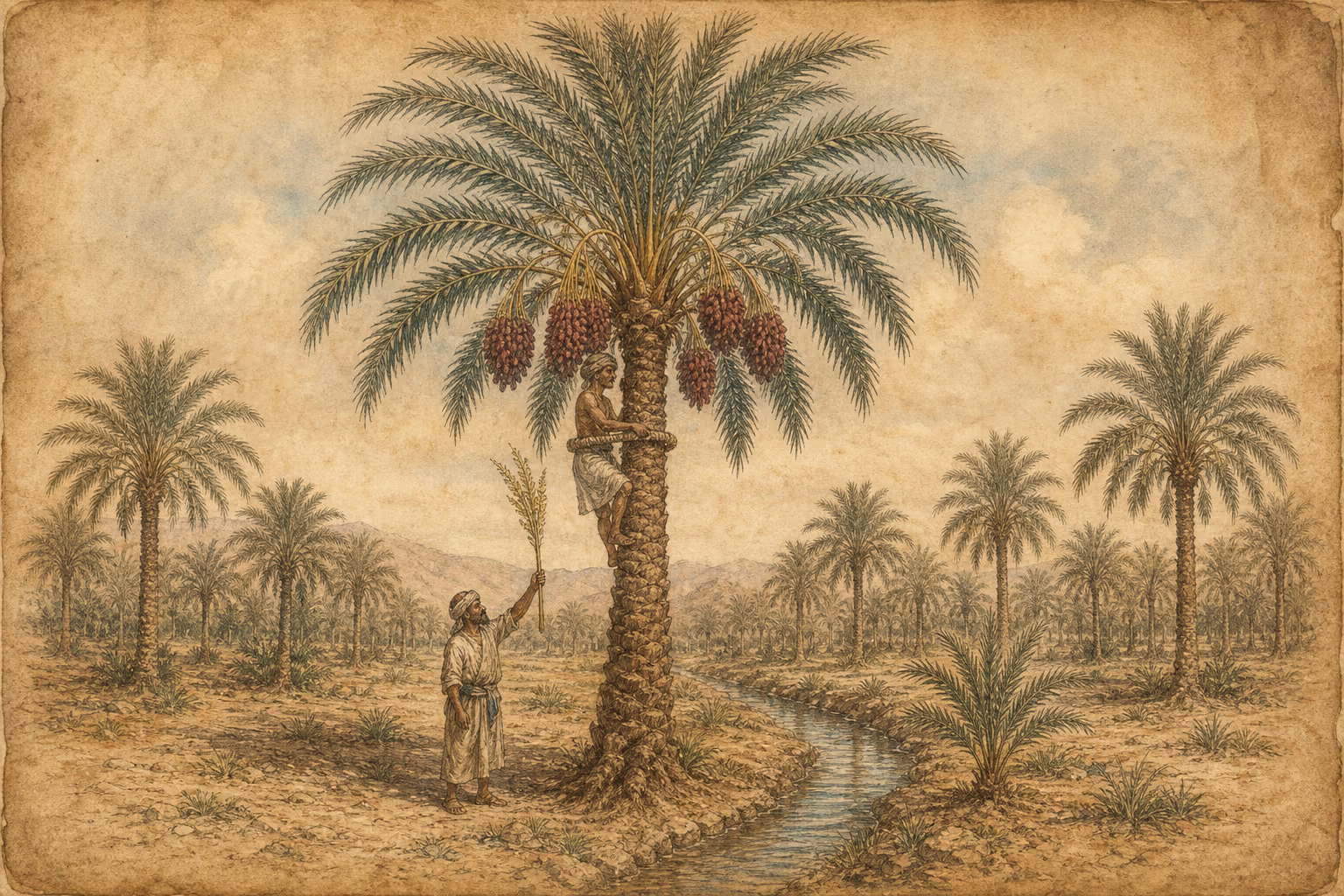
The varieties of the palm are numerous. First of all, there are those which do not exceed the size of a shrub; they are mostly barren, though sometimes they are known to produce fruit; the branches are short, and the tree is well covered with leaves all round. In many places this tree is used as a kind of rough-cast, as it were, to protect the walls of houses against damp. The palms of greater height form whole forests, the trunk of the tree being protected all round by pointed leaves, which are arranged in the form of a comb; these, it must be understood, are wild palms, though sometimes, by some wayward fancy or other, they are known to make their appearance among the cultivated varieties. The other kinds are tall, round, and tapering; and being furnished with dense and projecting knobs or circles in the bark, arranged in regular gradation, they are found easy of ascent by the people in the East; in order to do which, the climber fastens a loop of osier round his body and the trunk, and by this contrivance ascends the tree with astonishing rapidity. All the foliage is at the summit, and the fruit as well; this last being situate, not among the leaves, as is the case with other trees, but hanging in clusters from shoots of its own among the branches, and partaking of the nature both of the grape and the apple. The leaves terminate in a sharp edge, like that of a knife, while the sides are deeply indented—a peculiarity which first gave the idea of a troop of soldiers presenting face on two sides at once; at the present day they are split asunder to form ropes and wythes for fastening, as well as light umbrellas for covering the head.
The more diligent enquirers into the operations of Nature state that all trees, or rather all plants, and other productions of the earth, belong to either one sex or the other; a fact which it may be sufficient to notice on the present occasion, and one which manifests itself in no tree more than in the palm. The male tree blossoms at the shoots; the female buds without blossoming, the bud being very similar to an ear of corn. In both trees the flesh of the fruit shows first, and after that the woody part inside of it, or, in other words, the seed: and that this is really the case, is proved by the fact, that we often find small fruit on the same shoot without any seed in it at all. This seed is of an oblong shape, and not rounded like the olive-stone. It is also divided down the back by a deep indentation, and in most specimens of this fruit there is exactly in the middle a sort of navel, as it were, from which the root of the tree first takes its growth. In planting this seed it is laid on its anterior surface, two being placed side by side, while as many more are placed above; for when planted singly, the tree that springs up is but weak and sickly, whereas the four seeds all unite and form one strong tree. The seed is divided from the flesh of the fruit by several coats of a whitish colour, some of which are attached to the body of it; it lies but loosely in the inside of the fruit, adhering only to the summit by a single thread.
The flesh of this fruit takes a year to ripen, though in some places, Cyprus for instance, even if it should not reach maturity, it is very agreeable, for the sweetness of its flavour: the leaf of the tree too, in that island, is broader than elsewhere, and the fruit rounder than usual: the body of the fruit however, is never eaten, but is always spit out again, after the juice has been extracted. In Arabia, the palm fruit is said to have a sickly sweet taste, although Juba says that he prefers the date found among the Arabian Scenitæ, and to which they give the name of “dablan,” before those of any other country for flavour. In addition to the above particulars, it is asserted that in a forest of natural growth the female trees will become barren if they are deprived of the males, and that many female trees may be seen surrounding a single male with downcast heads and a foliage that seems to be bowing caressingly towards it; while the male tree, on the other hand, with leaves all bristling and erect, by its exhalations, and even the very sight of it and the dust from off it, fecundates the others: if the male tree, too, should happen to be cut down, the female trees, thus reduced to a state of widowhood, will at once become barren and unproductive. So well, indeed, is this sexual union between them understood, that it has been imagined even that fecundation may be ensured through the agency of man, by means of the blossoms and the down gathered from off the male trees, and, indeed, sometimes by only sprinkling the dust from off them on the female trees.
Palm-trees are also propagated by planting; the trunk is first divided with certain fissures two cubits in length which communicate with the pith of the tree, and is then buried in the earth. A slip also torn away from the root will produce a sucker with vitality, and the same may be obtained from the more tender among the branches. In Assyria, the tree itself is sometimes laid level, and then covered over in a moist soil; upon which it will throw out roots all over, but it will grow only to be a number of shrubs, and never a tree: hence it is that they plant nurseries, and transplant the young trees when a year old, and again when two years old, as they thrive all the better for being transplanted; this is done in the spring season in other countries, but in Assyria about the rising of the Dog-star. In those parts they do not touch the young trees with the knife, but merely tie up the foliage that they may shoot upwards, and so attain considerable height. When they are strong they prune them, in order to increase their thickness, but in so doing leave the branches for about half a foot; indeed, if they were cut off at any other place, the operation would kill the parent tree. We have already mentioned that they thrive particularly well in a saltish soil; hence, when the soil is not of that nature, it is the custom to scatter salt, not exactly about the roots, but at a little distance off. There are palm-trees in Syria and in Egypt which divide into two trunks, and some in Crete into three and as many as five even. Some of these trees bear immediately at the end of three years, and in Cyprus, Syria, and Egypt, when they are four years old; others again at the end of five years: at which period the tree is about the height of a man. So long as the tree is quite young the fruit has no seed within, from which circumstance it has received the nickname of the “eunuch.”
There are numerous varieties of the palm-tree. In Assyria, and throughout the whole of Persis, the barren kinds are made use of for carpenters’ work, and the various appliances of luxury. There are whole forests also of palm-trees adapted for cutting, and which, after they are cut, shoot again from the root; the pith of them towards the top, which is usually called the brain of the tree, is sweet to the taste, and the tree will live even after it has been extracted, which is the case with no other kind. The name of this tree is “chamæreps;” it has a broader and softer leaf than the others, which is extremely useful for various kinds of wickerwork; these trees are very numerous in Crete, and even more so in Sicily. The wood of the palm-tree, when ignited, burns both brightly and slowly. In some of those that bear fruit, the seed of the fruit is shorter than in others, while in some, again, it is longer; in some it is softer than in others, and in some harder; in some it is osseous and crescent-shaped; polished with a tooth, superstition employs the stone as an antidote against charms and fascination. This stone is enclosed in several coats, more or less in number; sometimes they are of a thick texture, and sometimes very thin.
Hence it is that we find nine and forty different kinds of palm-trees, if any one will be at the trouble of enumerating all their various barbarous names, and the different wines that are extracted from them. The most famous of all, are those which, for the sake of distinction, have received the name of “royal” palms, because they were preserved solely by the kings of Persia; these used to grow nowhere but at Babylon, and there only in the garden of Bagoüs, that being the Persian for an eunuch, several of whom have even reigned over that country! This garden was always carefully retained within the precincts of the royal court.
In the southern parts of the world, the dates known as “syagri,” hold the highest rank, and next after them those that are called “margarides.” These last are short, white, and round, and bear a stronger resemblance to grapes than to dates; for which reason it is that they have received their name, in consequence of their close resemblance to “margaritæ,” or pearls. It is said that there is only one tree that bears them, and that in the locality known as Chora. The same is the case also with the tree that bears the syagri. We have heard a wonderful story too, relative to this last tree, to the effect that it dies and comes to life again in a similar manner to the phœnix, which, it is generally thought, has borrowed its name from the palm-tree, in consequence of this peculiarity; at the moment that I am writing this, that tree is still bearing fruit. As for the fruit itself, it is large, hard, and of a rough appearance, and differing in taste from all other kinds, having a sort of wild flavour peculiar to itself, and not unlike that of the flesh of the wild boar; it is evidently this circumstance from which it has derived its name of “syagrus.”
In the fourth rank are the dates called “sandalides,” from their resemblance to a sandal in shape. It is stated, that on the confines of Æthiopia there are but five of these trees at the most, no less remarkable for the singular lusciousness of their fruit, than for their extreme rarity. Next to these, the dates known as “caryotæ” are the most esteemed, affording not only plenty of nutriment, but a great abundance of juice; it is from these that the principal wines are made in the East; these wines are apt to affect the head, a circumstance from which the fruit derives its name. But if these trees are remarkable for their abundance and fruitfulness, it is in Judæa that they enjoy the greatest repute; not, indeed, throughout the whole of that territory, but more particularly at Hiericus, although those that grow at Archelais, Phaselis, and Livias, vallies in the same territory, are highly esteemed. The more remarkable quality of these is a rich, unctuous juice; they are of a milky consistency, and have a sort of vinous flavour, with a remarkable sweetness, like that of honey. The Nicolaän dates are of a similar kind, but somewhat drier; they are of remarkable size, so much so, indeed, that four of them, placed end to end, will make a cubit in length. A less fine kind, but of sister quality to the caryotæ for flavour, are the “adelphides,” hence so called; these come next to them in sweetness, but still are by no means their equals. A third kind, again, are the patetæ, which abound in juice to excess, so much so, indeed, that the fruit bursts, in its excess of liquor, even upon the parent tree, and presents all the appearance of having been trodden under foot.
There are numerous kinds of dates also, of a drier nature, which are long and slender, and sometimes of a curved shape. Those of this sort which we consecrate to the worship of the gods are called “chydæi” by the Jews, a nation remarkable for the contempt which they manifest of the divinities. Those found all over Thebais and Arabia are dry and small, with a shrivelled body: being parched up and scorched by the constant heat, they are covered with what more nearly resembles a shell than a skin. In Æthiopia the date is quite brittle even, so great is the driness of the climate; hence the people are able to knead it into a kind of bread, just like so much flour. It grows upon a shrub, with branches a cubit in length: it has a broad leaf, and the fruit is round, and larger than an apple. The name of this date is “coïx.” It comes to maturity in three years, and there is always fruit to be found upon the shrub, in various stages of maturity. The date of Thebais is at once packed in casks, with all its natural heat and freshness; for without this precaution, it quickly becomes vapid; it is of a poor, sickly taste, too, if it is not exposed, before it is eaten, to the heat of an oven.
The other kinds of dates appear to be of an ordinary nature, and are generally known as “tragemata;” but in some parts of Phœnicia and Cilicia, they are commonly called “balani,” a name which has been also borrowed by us. There are numerous kinds of them, which differ from one another in being round or oblong; as also in colour, for some of them are black, and others red—indeed it is said that they present no fewer varieties of colour than the fig: the white ones, however, are the most esteemed. They differ also in size, according to the number which it requires to make a cubit in length; some, indeed, are no larger than a bean. Those are the best adapted for keeping which are produced in salt and sandy soils, Judæa, and Cyrenaïca in Africa, for instance: those, however, of Egypt, Cyprus, Syria, and Seleucia in Assyria, will not keep: hence it is that they are much used for fattening swine and other animals. It is a sign that the fruit is either spoilt or old, when the white protuberance disappears, by which it has adhered to the cluster. Some of the soldiers of Alexander’s army were choked by eating green dates; and a similar effect is produced in the country of the Gedrosi, by the natural quality of the fruit; while in other places, again, the same results arise from eating them to excess. Indeed, when in a fresh state, they are so remarkably luscious, that there would be no end to eating them, were it not for fear of the dangerous consequences that would be sure to ensue.