LIBER XIV · CAPUT 1
CHAPS. 1 & 2. (1.)—THE NATURE OF THE VINE. ITS MODE OF FRUCTIFICATION
Latine · Mayhoff 1906
Externae arbores indocilesque nasci alibi quam ubi coepere et quae in alienas non commeant terras hactenus fere sunt, licetque iam de communibus loqui, quarum omnium peculiaris parens videri potest Italia. noscentes tantum meminerint naturas earum a nobis interim dici, non culturas, quamquam et colendi maxima in natura portio est. illud satis mirari non queo, interisse quarundam memoriam atque etiam nominum quae auctores prodidere notitiam. quis enim non communicato orbe terrarum maiestate Romani imperii profecisse vitam putet commercio rerum ac societate festae pacis omniaque, etiam quae ante occulta fuerant, in promiscuo usu facta? at Hercules non reperiuntur qui norint multa ab antiquis prodita. tanto priscorum cura fertilior aut industria felicior fuit, ante milia annorum inter principia litterarum Hesiodo praecepta agricolis pandere orso subsecutisque non paucis hanc curam eius, unde nobis crevit labor, quippe cum requirenda sint non solum postea inventa, verum etiam ea quae invenerant prisci, desidia rerum internecione memoriae indicta. cuius vitii causas quis alias quam publicas mundi invenerit? nimirum alii subiere ritus circaque alia mentes hominum detinentur et avaritiae tancum artes coluntur. antea inclusis gentium imperiis intra ipsas adeoque et ingeniis, quadam sterilitate fortunae necesse erat animi bona exercere, regesque innumeri honore artium colebantur et in ostentatione has praeferebant opes, inmortalitatem sibi per illas prorogari arbitrantes, qua re abundabant et praemia et opera vitae. posteris laxitas mundi e; rerum amplitudo damno fuit. postquam senator censu legi coeptus, iudex fieri censu, magistratum ducemque nihil magis exornare quam census, postquam coepere orbitas in auctoritate summa et potentia esse, captatio in quaestu fertilissimo ac sola gaudia in possidendo, pessum iere vitae pretia omnesque a maximo bono liberales dictae artes in contrarium cecidere ac servitute sola profici coeptum. hanc alius alio modo et in aliis adorare, eodem tamen habendique ad spes omnium tendente voto. passim vero etiam egregii aliena vitia quam bona sua colere malle. ergo Hercules voluptas vivere coepit, vita ipsa desiit. sed nos oblitterata quoque scrutabimur, nec deterrebit quarundam rerum humilitas, sicuti nec in animalibus fecit, quamquam videmus Vergilium praecellentissimum vatem ea de causa hor???orum dotes fugisse et in his quae rettulit flores modo rerum decerpsisse, beatum felicemque gratiae quindecim omnino generibus uvarum nominatis, tribus oleae, totidem pirorum, malo vero tantum Assyrio, ceteris omnibus neglectis.
Vnde autem potius incipiamus quam a vitibus? quarum principatus in tantum peculiaris Italiae est, ut vel hoc uno omnia gentium vicisse etiam odorifera possit videri bona, quamquam ubicumque pubescentium odori nulla suavitas praefertur.
Vites iure apud priscos magnitudine quoque inter arbores numerabantur. lovis simulacrum in urbe Populonio ex una conspicimus tot aevis incorruptum, item Massiliae pateram. Metaponti templum Iunonis vitigineis columnis stetit. etiam nunc scalis tectum Ephesiae Dianae scanditur una vite Cypria, ut ferunt quoniam ibi ad praecipuam amplitudinem exeunt. nec est ligno ulli aeternior natura. verum ista ex silvestribus facta crediderim; hae vites tonsura annua coercentur, et vis earum omnis evocatur in palmites aut deprimitur in propagines, sucique tantum gratia ex iis petitur pluribus modis ad caeli mores solique ingenia. in Campano agro populis nubunt, maritasque conplexae atque per ramos earum procacibus bracchiis geniculato cursu scandentes cacumina aequant, in tantum sublimes, ut vindemitor auctoratus rogum ac tumulum excipiat, nulla fine crescendi, vidiqueiam porticus, villas et domos ambiri singularum palmitibus ac sequacibus loris. quodque memoria dignum inter prima Valerianus quoque Cornelius existimavit, una vitis Romae in Liviae porticibus subdiales inambulationes umbrosis pergulis opacat, eadem duodenis musti amphoris fecunda. ulmos quidem ubique exuperant, miratumque altitudinem earum Ariciae ferunt legatum regis Pyrrhi Cineam facete lusisse in austeriorem gustum vini, merito matrem eius pendere in tam alta cruce. rumpotinus vocatur et alio nomine opulus arbor Italiae Padum transgressis, cuius tabulata in orbem patula???eplent puroque perductae dracone in palmam eius inde sub rectos ramorum digitos flagella dispergunt. eaedem motici hominis altitudine adminiculatae sudibus horrent, vineamque faciunt aliae inprobo reptatu pampinorumque per inaniaomnia discursu atria media conplentes. tot differentias vel sola tantum Italia recipit. stat provinciarum aliquarum per se vitis sine ullo pedamento, arcus sues in se colligens et brevitate crassitudinem pascens. vetant hoc aliubi venti, ut in Africa et Narbonensis provinciae partibus, ubi ecrescere ultra suos pollices prohibitae semperque pastinatis similes herbarum modo vagantur per arva ac sucum terrae passim uvis bibunt, quae ob id magnitudinem infantium puerorum in interiore parte Africae exsuperant. vina non alibi tristiora, sed uva non alibi gratior callo, unde possit invenisse nomen durus acinus. namque genera magnitudine, colore, saporibus acini innumera etiamnum multiplicantur vino. hic purpureo lucent colore, illic fulgent roseo nitentque viridi; candicans enim nigerque vulgares. tument vero mammarum modo bumasti, praelongis dactyli porriguntur acinis. est et illa naturae lascivia, ut praegrandibus adhaereant parvi comites, suavitate certantes; leptorragas has vocant. durant aliae per hiemes, pensili concamaratae nodo. aliae in sua tantum continentur anima, ollis fictilibus et insuper doliis inclusae, stipatae vinaceis circumsudantibus. aliis gratiam, qui et vinis, fumus adfert, fabrilisque in eo gloriam praecipuam fornacibus Africae Tiberi Caesaris auctoritas fecit; ante eum Raeticis prior mensa erat uvis ex Veroniensium agro. quin et patientia nomen acinis dat passis. conduntur et musto uvae ipsaeque vino suo inebriantur. aliae decocto in musto dulcescunt, aliae vero subolem novam in ipsa matre expectant tralucidae, vitro, additque acinis eandem quam in doliis amphorisve duratricem illam firmitalem austeritas picis infusa pediculo. iam inventa vitis per se in vino picem resipiens, Viennensem agrum nobilitans Taburrno Sotanoque et Helvico generibus, non pridem haec inlustrata atque Vergili vatis aetate incognita, a cuius obitu XC aguntur anni. quid, quod inserta castris summam rerum imperiumque continet centurionum in manu vitis et opimo praemio tardos ordines ad lentas perducit aquilas atque eiam in delictis poenam ipsam honorat? nec non vineae oppugnationum dedere rationem. nam in medicaminibus adeo magnum obtinent locum, ut per sese vino ipso remedia sint.
English · Bostock & Riley 1855–57
Those which have been hitherto mentioned, are, nearly all of them, exotic trees, which it is impossible to rear in any other than their native soil, and which are not to be naturalized in strange countries. It is now for us to speak of the more ordinary kinds, of all of which Italy may be looked upon as more particularly the parent. Those who are well acquainted with the subject, must only bear in mind that for the present we content ourselves with merely stating the different varieties of these trees, and not the mode of cultivating them, although there is no doubt that the characteristics of a tree depend very considerably upon its cultivation. At this fact I cannot sufficiently express my astonishment, that of some trees all memory has utterly perished, and that the very names of some, of which we find various authors making mention, have wholly disappeared. And yet who does not readily admit that now, when intercommunications have been opened between all parts of the world, thanks to the majestic sway of the Roman empire, civilization and the arts of life have made a rapid progress, owing to the interchange of commodities and the common enjoyment by all of the blessings of peace, while at the same time a multitude of objects which formerly lay concealed, are now revealed for our indiscriminate use?
Still, by Hercules! at the present day there are none to be found who have any acquaintance with much that has been handed down to us by the ancient writers; so much more comprehensive was the diligent research of our forefathers, or else so much more happily employed was their industry. It is a thousand years ago since Hesiod, at the very dawn, so to say, of literature, first gave precepts for the guidance of the agriculturist, an example which has since been followed by no small number of writers. Hence have originated considerable labours for ourselves, seeing that we have not only to enquire into the discoveries of modern times, but to ascertain as well what was known to the ancients, and this, too, in the very midst of that oblivion which the heedlessness of the present day has so greatly tended to generate. What causes then are we to assign for this lethargy, other than those feelings which we find actuating the public in general throughout all the world? New manners and usages, no doubt, have now come into vogue, and the minds of men are occupied with subjects of a totally different nature; the arts of avarice, in fact, are the only ones that are now cultivated.
In days gone by, the sway and the destinies of states were bounded by their own narrow limits, and consequently the genius of the people was similarly circumscribed as well, through a sort of niggardliness that was thus displayed by Fortune: hence it became with them a matter of absolute necessity to employ the advantages of the understanding: kings innumerable received the homage of the arts, and in making a display of the extent of their resources, gave the highest rank to those arts, entertaining the opinion that it was through them that they should ensure immortality. Hence it was that due rewards, and the various works of civilization, were displayed in such vast abundance in those times. For these later ages, the enlarged boundaries of the habitable world, and the vast extent of our empire, have been a positive injury. Since the Censor has been chosen for the extent of his property, since the judge has been selected according to the magnitude of his fortune, since it has become the fashion to consider that nothing reflects a higher merit upon the magistrate and the general than a large estate, since the being destitute of heirs has begun to confer upon persons the very highest power and influence, since legacy-hunting has become the most lucrative of all professions, and since it has been considered that the only real pleasures are those of possessing, all the true enjoyments of life have been utterly lost sight of, and all those arts which have derived the name of liberal, from liberty, that greatest blessing of life, have come to deserve the contrary appellation, servility alone being the passport to profit.
This servility each one has his own peculiar way of making most agreeable, and of putting in practice in reference to others, the motives and the hopes of all tending to the one great object, the acquisition of wealth: indeed, we may everywhere behold men even of naturally excellent qualities preferring to foster the vicious inclinations of others rather than cultivate their own talents. We may therefore conclude, by Hercules! that pleasure has now begun to live, and that life, truly so called, has ceased to be. As to ourselves, however, we shall continue our researches into matters now lost in oblivion, nor shall we be deterred from pursuing our task by the trivial nature of some of our details, a consideration which has in no way influenced us in our description of the animal world. And yet we find that Virgil, that most admirable poet, has allowed this to influence him, in his omission to enlarge upon the beauties of the garden; for, happy and graceful poet as he is, he has only culled what we may call the flower of his subject: indeed, we find that he has only named in all some fifteen varieties of the grape, three of the olive, the same number of the pear, and the citron of Assyria, and has passed over the rest in silence altogether.
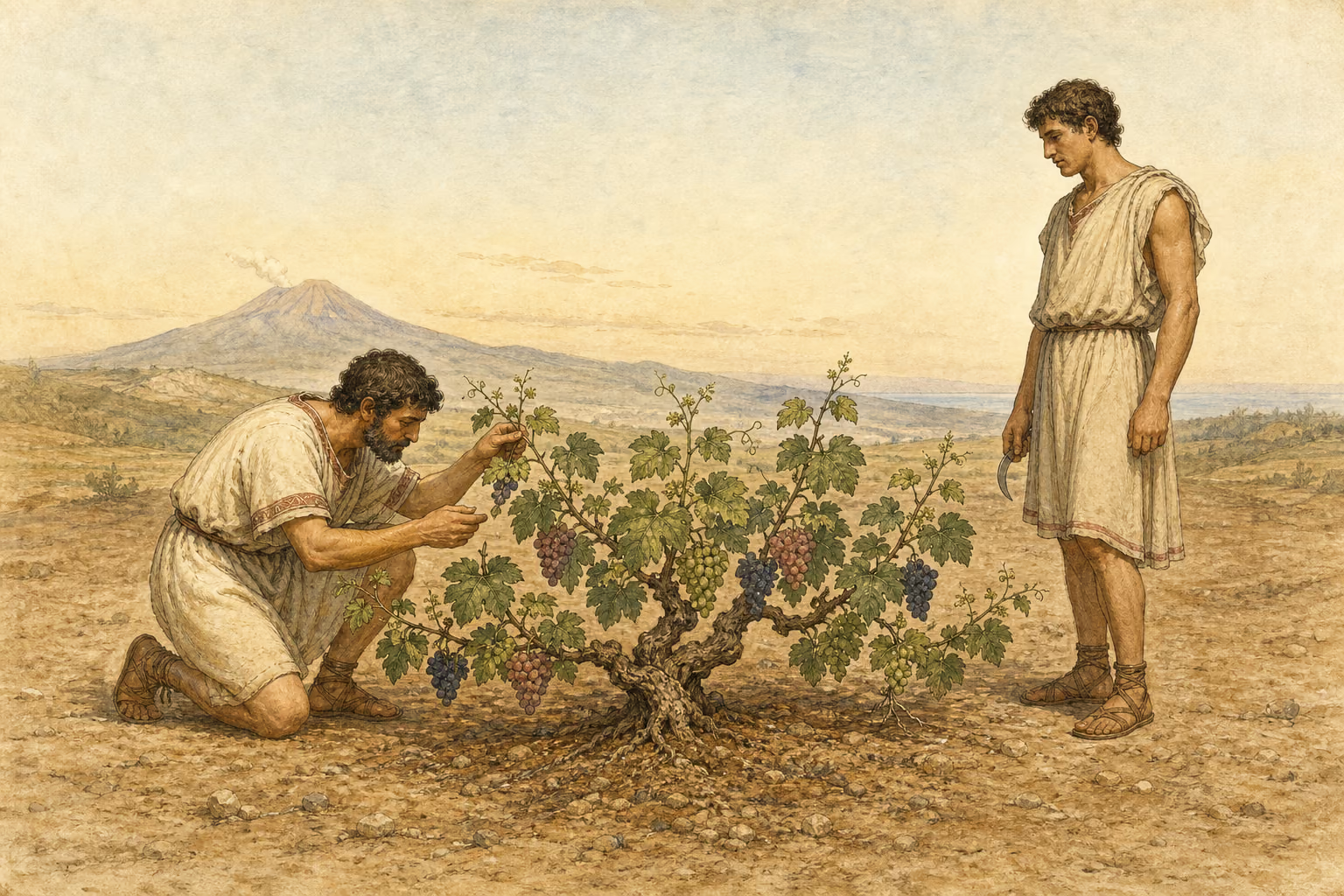
With what then ought we to begin in preference to the vine, the superiority in which has been so peculiarly conceded to Italy, that in this one blessing we may pronounce her to have surpassed those of all other nations of the earth, with the sole exception of those that bear the various perfumes? and even there, when the vine is in flower, there is not a perfume known which in exquisite sweetness can surpass it. The vine has been justly reckoned by the ancients among the trees, on account of its remarkable size. In the city of Populonium, we see a statue of Jupiter formed of the trunk of a single vine, which has for ages remained proof against all decay; and at Massilia, there is a patera made of the same wood. At Metapontum, the temple of Juno has long stood supported by pillars formed of the like material; and even at the present day we ascend to the roof of the temple of Diana at Ephesus, by stairs constructed, it is said, of the trunk of a single vine, that was brought from Cyprus; the vines of that island often attaining a most remarkable size. There is not a wood in existence of a more lasting nature than this; I am strongly inclined, however, to be of opinion that the material of which these various articles were constructed was the wild vine.
The cultivated vine is kept down by pruning every year, and all the strength of the tree is drawn as much as possible into the shoots, or else thrown downwards to the sets; indeed, it is only allowed to expand with the view of ensuring an abundant supply of juice, a result which is obtained in various modes according to the peculiarities of the climate and the nature of the soil. In Campania they attach the vine to the poplar: embracing the tree to which it is thus wedded, the vine grasps the branches with its amorous arms, and as it climbs, holds on with its knotted trunk, till it has reached the very summit; the height being sometimes so stupendous that the vintager when hired is wont to stipulate for his funeral pile and a grave at the owner’s expense. The vine keeps continually on the increase, and it is quite impossible to separate the two, or rather, I may say, to tear them asunder. Valerianus Cornelius has regarded it as one of the most remarkable facts that could be transmitted to posterity, that single vines have been known to surround villas and country-houses with their shoots and creeping tendrils ever on the stretch. At Rome, in the porticoes of Livia, a single vine, with its leaf-clad trellises, protects with its shade the walks in the open air; the fruit of it yields twelve amphoræ of must.
Everywhere we find the vine overtopping the elm even, and we read that Cineas, the ambassador of King Pyrrhus, when admiring the great height of the vines at Aricia, wittily making allusion to the peculiar rough taste of wine, remarked that it was with very good reason that they had hung the parent of it on so lofty a gibbet. There is a tree in that part of Italy which lies beyond the Padus, known as the “rumpotinus,” or sometimes by the name of “opulus,” the broad circular storeys of which are covered with vines, whose branches wind upwards in a serpentine form to the part where the boughs finally divide, and then, throwing out their tendrils, disperse them in every direction among the straight and finger-like twigs which project from the branches. There are vines also, about as tall as a man of moderate height, which are supported by props, and, as they throw out their bristling tendrils, form whole vineyards: while others, again, in their inordinate love for climbing, combined with skill on the part of the proprietor, will cover even the very centre of the court-yard with their shoots and foliage. So numerous are the varieties of the vine which even Italy alone presents.
In some of the provinces the vine is able to stand of itself without anything to support it, drawing in its bending branches, and making up in its thickness for its stunted size. In other places, again, the winds will not allow of this mode of culture, as in Africa, for instance, and various parts of the province of Gallia Narbonensis. These vines, being prevented from growing beyond the first branches, and hence always retaining a resemblance to those plants which stand in need of the hoe, trail along the ground just like them, and every here and there suck up the juices from the earth to fill their grapes: it is in consequence of this, that in the interior of Africa the clusters are known to exceed the body of an infant in size. The wine of no country is more acid than those of Africa, but there is nowhere to be found a grape that is more agreeable for its firmness, a circumstance which may very probably have given rise to its name of the “hard grape.” As to the varieties of the grape, although they are rendered innumerable by the size, the colour, and the flavour of the berry, they are multiplied even still more by the wines that they produce. In one part they are lustrous with a rich purple colour, while in another, again, they glow with a rosy tint, or else are glossy with their verdant hue. The grapes that are merely white or black are the common sorts. The bumastus swells out in form like a breast, while that known as the “dactylus,” has a berry of remarkable length. Nature, too, displays such varieties in these productions of hers, that small grapes are often to be found adhering to the largest vines, but of surpassing sweetness; they are known by the name of “leptorragæ.” Some, again, will keep throughout the winter, if care is taken to hang them to the ceiling with a string; while others, again, will keep by virtue of their own natural freshness and vigour, if put into earthen jars, which are then enclosed in dolia, and covered up with the fermenting husks of grapes. Some grapes receive from the smoke of the blacksmith’s forge that remarkable flavour which it is also known to impart to wines: it was the high name of the Emperor Tiberius that brought into such great repute the grapes that had been smoked in the smithies of Africa. Before his time the highest rank at table was assigned to the grapes of Rhætia, and to those growing in the territory of Verona.
Raisins of the sun have the name of “passi,” from having been submitted to the influence of the sun. It is not uncommon to preserve grapes in must, and so make them drunk with their own juices; while there are some that are all the sweeter for being placed in must after it has been boiled; others, again, are left to hang on the parent tree till a new crop has made its appearance, by which time they have become as clear and as transparent as glass. Astringent pitch, if poured upon the footstalk of the grape, will impart to it all that body and that firmness which, when placed in dolia or amphoræ, it gives to wine. More recently, too, there has been discovered a vine which produces a fruit that imparts to its wine a strong flavour of pitch: it is the famous grape that confers such celebrity on the territory of Vienne, and of which several varieties have recently enriched the territories of the Arverni, the Sequani, and the Helvii: it was unknown in the time of the poet Virgil, who has now been dead these ninety years.
In addition to these particulars, need I make mention of the fact that the vine has been introduced into the camp and placed in the centurion’s hand for the preservation of the supreme authority and command? that this is the high reward which summons the lagging ranks to the eagles raised aloft, and that even in chastisement for faults it tends to reflect honour upon the punishment? It was the vineyard, too, that first afforded a notion, the practical utility of which has been experienced in many a siege. Among the medicinal preparations, too, the vine holds so high a place, that its very wines taken by themselves are efficacious as remedies for disease.