LIBER XIV · CAPUT 2
NINETY-ONE VARIETIES OF THE VINE
Latine · Mayhoff 1906
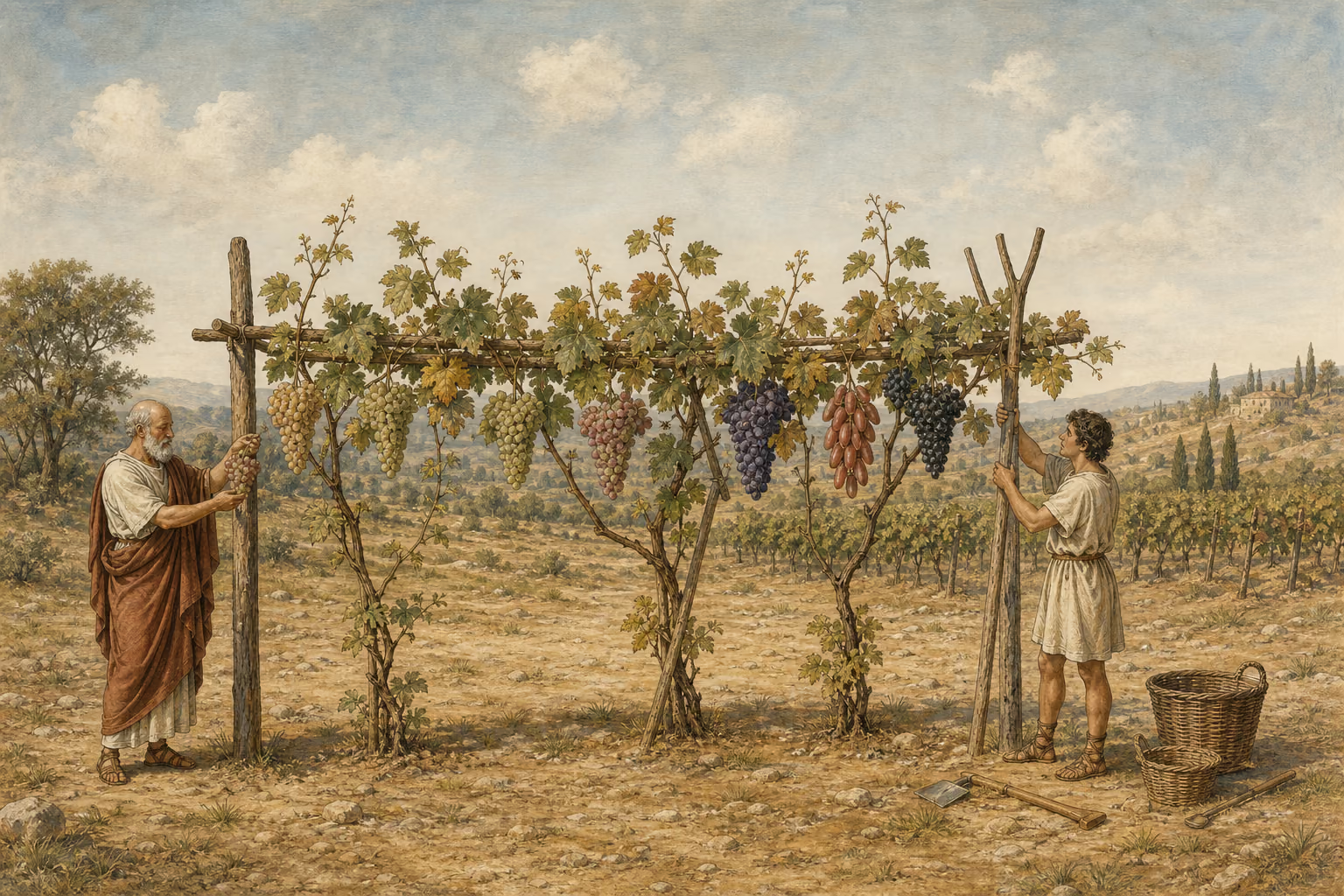
Genera vitium numero conprehendi posse unus existimavit Democritus, cuncta sibi Graeciae cognita professus; ceteri innumera atque infinita esse prodiderunt, quod verius apparebit ex vini. nec omnia dicentur, sed maxime insignia, quippe totidem paene sunt quot agri, quam ob rem celeberrimas vitium aut quibus est aliqua proprietate miraculum ostendisse sa???is erit.
Principatus datur Aminneis firmitatem propter senioque proficientem vini eius utique vitam. quinque earum genera. ex iis germana minor acino melius deflorescit, imbres tempestatesque tolerat, non item maior, sed in arbore quam in iugo minus obnoxia. gemellarum, quibus hoc nomen uvae semper geminae dedere, asperrimus sapor, sed vires praecipuae. ex iis minor austro laeditur, ceteris ventis alitur, ut in Vesuvio monte Surrentinisque collibus, in reliquis Italiae partibus non nisi arbori accommodata. quintum genus lanatae. ne Seras miremur aut Indos adeo, lanugo eam vestit. prima ex Aminneis maturescit ocissimeque putrescit.
Proxima dignitas Nomentanis, rubente materia, quapropter quidam rubellas appellavere vineas. hae minus fertiles, vinaceis et faece nimiae, contra pruinas fortissimae, siccitate magis quam imbre, aestu quam algore vexantur. quam ob rem in frigidis umidisque principatum obtinent. fertilior quae minor acino et folio scissa minus.
Apianis apes dedere cognomen, praecipue earum avidae. ex iis duo genera lanugine et ipsa pubescunt. distant quod altera celerius maturescit, quamquam et altera properante. situs frigidi iis non respuuntur, et tamen nullae celerius imbre putrescunt. vina primo dulcia austeritatem annis accipiunt. Etruria nulla rlagis vite gaudet. et hactenus potissima nobilitas datur peculiaribus atque vernaculis Italiae; ceterae advenere. e Caio Thasove Graecula non inferior Aminneis bonitate, praetenera acino et uva tam parva, ut nisi pinguissimo solo colere non prosit. eugeniam Tauromenitani colles cum generositatis cognomine misere Albano tantum agro, quoniam translata statim mutatur. namque est aliquis tantus locorum amor, ut omnem in iis gloriam suam relinquant nec usquam transeant totae. quod et in Raetica Allobrogicaque, quam supra picatam appellavimus, evenit, domi nobilibus nec agnoscendis alibi. fecundae tamen bonitatis vice copiam praestant, eugenia ferventibus locis, Raetic.a temperatis, Allobrogica frigidis, gelu maturescens et colore nigra. ex iis quas adhuc diximus, sed etiam e nigris, vina vetustate in album colorem transeunt. reliquae ignobiles, aliquando tamen caeli aut soli opera non fallunt vetustatem, sicuti Faecenia et cum ea florens Biturigiaca, acino rarior, numquam floris obnoxii, quoniam antecedunt ventisque et imbribus resistunt, meliores tamen algentibus locis quam calidis, umidis quam sitientibus. visulla grandi magis quam denso uvarum partu, inpatiens variantis caeli, sed contra tenorem unum algoris aestusve constans. quae minor est ex eo genere, melior. in eligendo solo morosa, pingui putrescit, gracili omnino non provenit; mediam temperiem delicate quaerit, ob hoc Sabinis collibus familiaris. uva eius indecora visu, sapore iucunda. nisi matura protinus rapitur, etiam non putrescens cadit. contra grandines eam tuetur foliorum amplitudo atque duritia.
Insignes iam colore inter purpureas nigrasque helvolae saepius variantes et ob id varianae a quibusdam appellatae. praefertur in iis nigrior; utraque alternis annis fertilis, sed melior vino, cum parcior. et praeciae duo genera magnitudine acini discernuntur, quibus materies plurima uvaque ollis utilissima; folium apio simile. baliscam Dyrrachini celebrant, Hispaniae coccolobin vocant. rarior uva, aestus austrosque tolerat, capiti inimica, copia larga. Hispaniae duo genera eius faciunt, unum oblongo acino, alterum rotundo; novissimas vindemiant. quo dulcior est coccolobis, hoc melior. sed et austera transit in dulcem vetustatem, et quae dulcis fuit in austeritatem; tune Albano vino aemulantur. tradunt vesicae vitiis utilissimum ex iis potum. albuelis summis arboribus fertilior est, visulla imis; quam ob rem circa easdem satae diversitate naturae locupletant. inerticulam e nigris appellavere, iustius sobriam dicturi, inveterato praecipue commendabilem vino, sed viribus innoxiam, si quidem temulentiam sola non facit.
Fertilitas commendat ceteras principemque helvennacam. duo eius genera: maior quam quidam longam, minor quam marcum appellant, non tam fecundam, sed gratiorem haustu. discernitur folio circinato, verum utraque gracilis. furcas subdere iis necessarium: alioqui ubertatem suam non tolerant. maritimo adflatu gaudent, roscida odere. nulla vitium minus Italiam amat, rara, parva, putrescens in ea, vino quoque quod genuit aestatem non exuperans; nec alia macro solo familiarior. Graecinus, qui alioqui Cornelium Celsum transcripsit, arbitratur non naturam eius repugnare Italiae, sed culturam avide palmites evocantium. ob id fertilitate sua absumi, si non praepinguis soli ubertas lassescentem sustineat. carbunculare negatur, magna dote, si verum est aliqua in vite caelo non esse ius.
Aestus fert spionia, quam quidam spineam vocant, autumnisque imbribus pinguescit; quin immo nebulis una alitur, ob id Ravennati agro peculiaris. vennunculam inter optime deflorescentes e ollis aptissimam Campani malunt surculam vocare, alii scapulam, Tarracina Numisianam, nullas vires proprias habentem, sed totam perinde ac solum valeat, Surrentinis tamen efficacissimam testis Vesuvio tenus. ibi enim Murgentina e Sicilia potentissima, quam Pompeianam aliqui vocant, laeto demum feracem, sicut horconia in Campania tantum. e diverso arceraca, Vergilio argitis dicta, ultro solum laetius facit, ipsa contra imbres et senectam fortissima, vino quidem vix annua ac vilitatis cibariae, sed ubertate praecipua. tolerat et annos mettica, contra omne sidus firmissima, nigro acino, vinis in vetustate rufescentibus.
English · Bostock & Riley 1855–57
Democritus, who has declared that he was acquainted with every variety of the grape known in Greece, is the only person who has been of opinion that every kind could be enumerated; but, on the other hand, the rest of the authors have stated that they are quite innumerable and of infinite extent, an assertion the truth of which will be more evident, if we only consider the vast number of wines. I shall not attempt, then, to speak of every kind of vine, but only of those that are the most remarkable, seeing that the varieties are very nearly as numberless as the districts in which they grow. It will suffice, then, to point out those which are the most remarkable among the vines, or else are peculiar for some wonderful property.
The very highest rank is given to the Aminean grape, on account of the body and durability of its wine, which improves with old age. There are five varieties of the Aminean grape; of these, the smaller germana, or “sister” grape, has a smaller berry than the rest, and flowers more strongly, being able to bear up against rain and tempestuous weather; a thing that is not the case with the larger germana, though it is less exposed to danger when attached to a tree than when supported only by a trellis. Another kind, again, has obtained the name of the “gemella,” or “twin” grape, because the clusters always grow in couples: the flavour of the wine is extremely rough, but it is remarkable for its strength. Of these several varieties the smaller one suffers from the south wind, but receives nutriment from all the others, upon Mount Vesuvius, for instance, and the hills of Surrentum: in the other parts of Italy it is never grown except attached to trees. The fifth kind is that known as the lanata, or “woolly” grape; so that we need not be surprised at the wool-bearing trees of the Seres or the Indians, for this grape is covered with a woolly down of remarkable thickness. It is the first of the Aminean vines that ripens, but the grape decays with remarkable rapidity.
The second rank belongs to the vines of Nomentum, the wood of which is red, from which circumstance the vines have received from some the name of “rubellæ.” The grapes of this vine produce less wine than usual, in consequence of the extraordinary quantity of husk and lees they throw off: but the vine is remarkably strong, is well able to stand the frost, and is apt to receive more detriment from drought than from rain, from heat than from cold; hence it is that those are looked upon as the best that are grown in cold and moist localities. That variety which has the smallest grape is considered the most fruitful: the one which has a jagged leaf is less productive.
The vine known as the “apiana,” has received that name from the bee, an insect which is remarkably fond of it: there are two varieties of this vine. This grape, too, is covered in its young state with a kind of down; the main difference between the two varieties is, that the one ripens more rapidly than the other, though this last ripens with considerable quickness. A cold locality is not at all hurtful to them, although there is no grape that ripens sooner: these grapes, however, very soon rot in the rain. The wines produced by this grape are sweet at first, but contract a rough flavour in the course of years. This vine is cultivated more than any other in Etruria. Thus far we have made mention of the more celebrated vines among those which are peculiar and indigenous to Italy; the rest have been introduced from Chios or Thasos.
The small Greek grape is not inferior to the Aminean for the excellence of its quality: the berry is remarkably thin-skinned, and the cluster so extremely small, that it is not worth while cultivating it, except on a soil of remarkable richness. The eugenia, so called from its high qualities, has been introduced into the Alban territory from the hills of Tauromenium: it is found, however, to thrive only there, for if transplanted elsewhere it degenerates immediately: in fact, there is in some vines so strong an attachment to their native soil, that they leave behind them all their high repute, and are never transplanted in their full entirety. This is the case, too, with the Rhætian and the Allobrogian grapes, of which we have made mention above as the pitch-flavoured grape; these are justly deemed excellent in their own country, while elsewhere they are held in no esteem at all. Still, however, in consequence of their remarkable fertility, they make up for quality by abundance: the eugenia thrives in spots which are scorching hot, the Rhætian vine in places of a more moderate temperature, and the Allobrogian in cold, exposed situations, the fruit being of a black colour, and ripened by the agency of frost.
The wines produced from the vines of which we have hitherto made mention, even though the grapes are black, become, all of them, when old, of a white complexion. The other vines are of no note in particular, though sometimes, thanks to some peculiarity either in the climate or the soil, the wines produced from them attain a mature old age; such, for instance, as the Fecenian vine, and the Biturigian, which blossoms at the same time with it, but has not so many grapes. The blossoms of these last-mentioned vines are not liable to receive injury, both because they are naturally but transitory, and have the power of resisting the action of both wind and storm; still, however, those that grow in cold spots are considered superior to those produced in a warm site, and those found in moist places superior to those grown in dry, thirsty localities.
The vine known as the “visula” * * * * more than abundance of fruit, being unable to endure the extreme variations of the atmosphere, though it is very well able to stand a continuation of either cold or heat. Of this last kind the smaller one is the best, but difficult to please in its choice; in a rich earth it is apt to rot, while in a thin soil it will come to nothing at all: in its fastidiousness it requires a soil of middling quality, and hence it is that it is so commonly found on the hills of the Sabine territory. Its grape is unsightly in appearance, but has a very pleasant flavour: if it is not gathered at the very moment that it is ripe, it will fall, even before it decays. The extreme size of the leaves, and its natural hardiness, are its great protection against the disastrous effects of hail.
The grapes known as “helvolæ” are remarkable for the peculiarity of their colour, which is a sort of midway between purple and black, but varies so frequently that it has made some persons give them the name of “varianæ.” Of the two sorts of helvolæ, the black is the one generally preferred: they both of them produce every other year, but the wine is best when the vintage has been less abundant.
The vine that is known as the “precia” is also divided into two varieties, distinguished by the size of the grape. These vines produce a vast quantity of wood, and the grape is very good for preserving in jars; the leaves are similar in appearance to that of parsley. The people of Dyrrhachium hold in high esteem the vine known as the “basilica,” the same which in Spain is called the “cocolobis.” The grapes of this vine grow in thin clusters, and it can stand great heat, and the south winds. The wine produced from it is apt to fly to the head: the produce of the vine is very large. The people in Spain distinguish two kinds of this vine, the one with the oblong, the other with the round grape; they gather this fruit the very last of all. The sweeter the cocolobis is, the more it is valued; but even if it has a rough taste, the wine will become sweet by keeping, while, on the other hand, that which was sweet at first, will acquire a certain roughness; it is in this last state that the wine is thought to rival that of Alba. It is said that the juice of this grape is remarkably efficacious when drunk as a specific for diseases of the bladder.
The “albuelis” produces most of its fruit at the top of the tree, the visula at the bottom; hence, when planted around the same tree, in consequence of these peculiarities in their nature, they bear between them a two-fold crop. One of the black grape vines has been called the “inerticula,” though it might with more propriety have been styled the “sobria;” the wine from it is remarkably good, and more particularly when old; but though strong, it is productive of no ill effects, and, indeed, is the only wine that will not cause intoxication.
The abundance of their produce again recommends other vines to us, and, in the first place, that known as the “helvennaca.” Of this vine there are two kinds; the larger, which is by some called the “long” helvennaca, and the smaller kind, which is known as the “emarcum,” not so prolific as the first, but producing a wine of more agreeable flavour; it is distinguished by its rounded leaf, but they are both of them of slender make. It is requisite to place forks beneath these vines for the support of their branches, as otherwise it would be quite impossible for them to support the weight of their produce: they receive nutriment from the breezes that blow from the sea, and foggy weather is injurious to them. There is not one among the vines that manifests a greater aversion to Italy, for there it becomes comparatively leafless and stunted, and soon decays, while the wine which it produces there will not keep beyond the summer: no vine, however, thrives better in a poor soil. Græcinus, who has copied from the works of Cornelius Celsus, gives it as his opinion that it is not that the nature of this vine is repugnant to the climate of Italy, but that it is the mode of cultivating it that is wrong, and the anxiety to force it to put forth its shoots; a mode of treatment, he thinks, which absorbs all its fertility, unless the soil in which it is planted happens to be remarkably rich, and by its support prevents it from being exhausted. It is said that this vine is never carbuncled, a remarkable quality, if, indeed, it really is the fact that there is any vine in existence that is exempt from the natural influences of the climate.
The spionia, by some called the “spinea,” is able to bear heat very well, and thrives in the autumn and rainy weather: indeed, it is the only one among all the vines that does well amid fogs, for which reason it is peculiar to the territory of Ravenna. The venicula is one of those that blossom the strongest, and its grapes are particularly well adapted for preserving in jars. The Campanians, however, prefer to give it the name of “scircula,” while others, again, call it “stacula.” Tarracina has a vine known as the “numisiana;” it has no qualities of its own, but has characteristics just according to the nature of the soil in which it is planted: the wine, however, if kept in the earthen casks of Surrentum, is remarkable for its goodness, that is to say, as far south as Vesuvius. On arriving in that district, we find the Murgentina, the very best among all those that come from Sicily. Some, indeed, call the vine “Pompeiana” and it is more particularly fruitful when grown in Latium, just as the “horconia” is productive nowhere but in Campania. Of a contrary nature is the vine known as the “argeica,” and by Virgil called “argitis:” it makes the ground all the more productive, and is remarkably stout in its resistance to rain and the effects of old age, though it will hardly produce wine every year; it is remarkable for the abundant crops which it bears, though the grapes are held but in small esteem for eating. The vine known as the “metica” lasts well for years, and offers a successful resistance to all changes of weather; the grape is black, and the wine assumes a tawny hue when old.