LIBER XIV · CAPUT 22
DRUNKENNESS
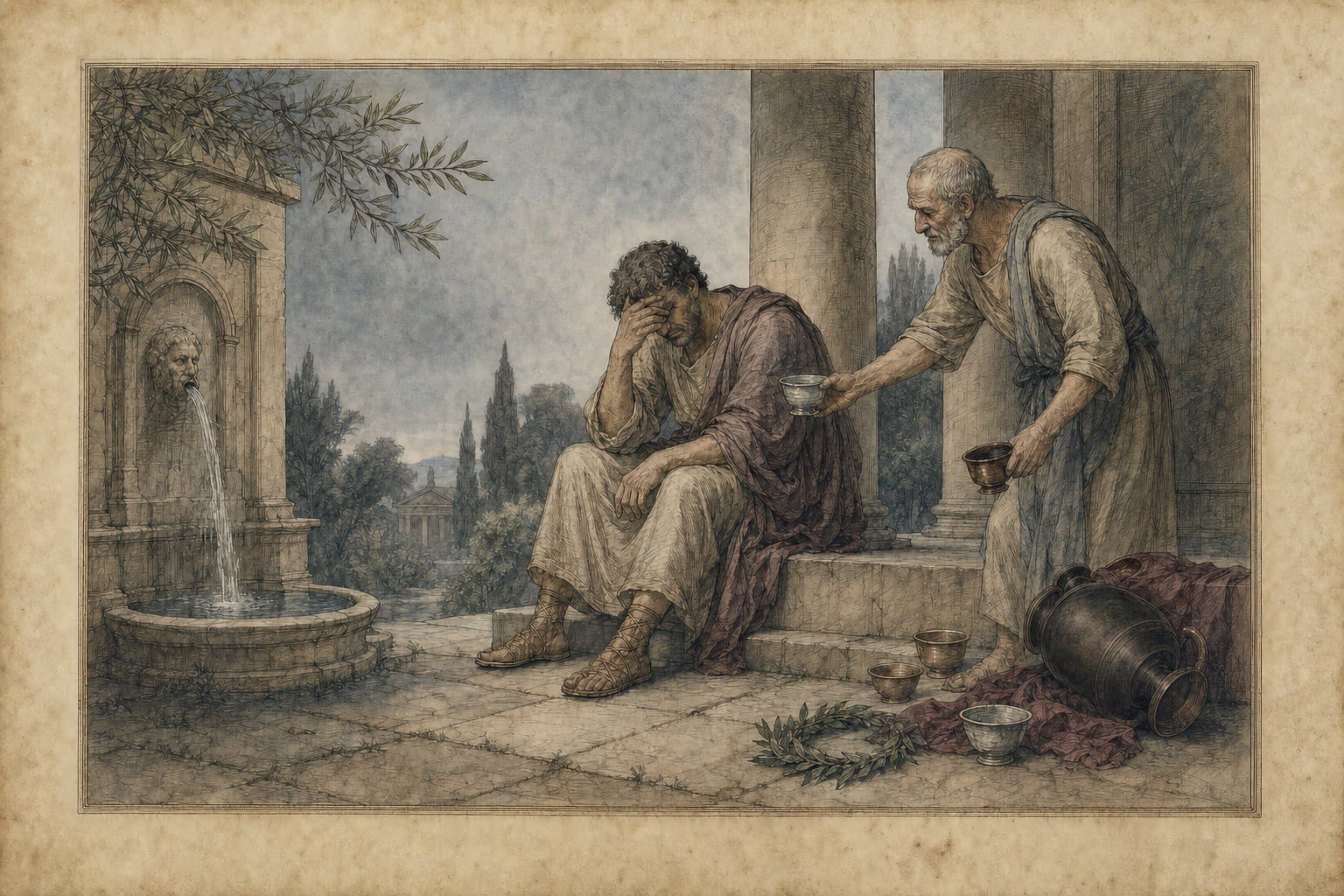
Latine · Mayhoff 1906
Ac si quis diligentius reputet, in nulla parte operosior vita est — ceu non saluberrimum ad potus aquae liquorem natura dederit, quo cetera omnia animalia utuntur; at nos vinum bibere et iumenta cogimus — tantoque opere, tanto labore et inpendio praestat quod hominis mentem mutet ac furorem gignat, milibus scelerum ob ideditis, tanta dulcedine, ut magna pars non aliud vitae praemium intellegat. quin immo, ut plus capiamus, sacco frangimus vires, et alia inritamenta excogitantur ac bibendi causa etiam venena concipiuntur, aliis cicutam praesumentibus, ut bibere mors cogat, aliis pumicis farinam et quae referendo pudet docere. cautissimos ex iis in balineis coqui videmus exanimesque efferri, iam vero alios lectum expectare non posse, immo vero nec tunicam, nudosque ibi protinus et anhelos ingentia vasa corripere, velut ad ostentationem virium, ac plena infundere, ut statim vomant rursusque hauriant, idque iterum tertiumque, tamquam ad perdenda vina geniti et tamquam effundi ilia non possint nisi per corpus humanum! huc pertinent peregrinae exercitationes et volutatio in caeno ac pectorosa cervicis repandae ostentatio. per omnia haec praedicatur sitis quaeri. iam vero quae in bibendo certamina, quae vasa adulteriis caelata, tamquam per se parum doceat libidines temulentia! ita vina ex libidine hauriuntur, atque etiam praemio invitatur ebrietas et, si dis placet, emitur. alius, ut quantum biberit, tantum edit, pretium vinolentiae lege accipit, alius quantum alea quaesierit, tantum bibit. tunc avidi matronam oculi licentur, graves produnt maritum, tunc animi secreta proferuntur. alii testamenta sua nuncupant, alii mortifera elocuntur rediturasque per iugulum voces non continent — quam multis ita interemptis!— volgoque veritas iam attributa vino est. interea, ut optime cedat, solem orientem non vident ac minus diu vivunt. hinc pallor et genae pendulae, oculorum ulcera, tremulae manus effundentes plena vasa — quae sit poena praesens —, furiales somni et inquies nocturna praemiumque summum ebrietatis libido portentosa ac iucundum nefas. postero die ex ore halitus cadi ac rerum omnium oblivio morsque memoriae. rapere se ita vitam praedicant, cum priorem diem cotidie perdant; illi vero et venientem. Tiberio Claudio principe ante hos annos XL institutum, ut ieiuni biberent potiusque vinum antecederet cibos, externis et hoc artibus ac medicorum placitis novitate semper aliqua sese commendantium. gloriam hac virtute Parthi quaerunt, famam apud Graecos Alcibiades meruit, apud nos cognomen etiam Novellius Torquatus Mediolanensis, ad proconsulatum usque praeturae honoribus gestis, tribus congiis — unde et cognomen illi fuit — epotis uno impetu, spectante miraculi gratia Tiberio principe, in senecta iam severo atque etiam saevo alias. et ipsi iuventa ad merum pronior fuerat, eaque commendatione credidere L. Pisonem urbis curae ab eo delectum, quod biduo duabusque noctibus perpotationem continuasset apud ipsum iam principem. nec alio magis Drusus Caesar regenerasse patrem Tiberium ferebatur. Torquato rara gloria, quando et haec ars suis legibus constat, non labasse sermone, non levatum vomitione nec alia corporis parte, dum biberet, matutinas obisse sine iniuria vigilias, plurimum hausisse uno potu, plurimum praeterea aliis minoribus addidisse, optima fide non respirasse in hauriendo neque expuisse nihilque ad elidendum in pavimentis sonum ex vino reliquisse, diligenti scito legum contra bibendi fallacias. Tergilla Ciceronem M. F. binos congios simul haurire solitum ipsi obicit Marcoque Agrippae a temulento scyphum inpactum. etenim haec sunt ebrietatis opera. sed nimirum hanc gloriam auferre Cicero voluit interfectori patris sui M. Antonio. is enim ante eum avidissime adprehenderat hanc palmam edito etiam volumine de sua ebrietate, quo patrocinari sibi ausus adprobavit plane, ut equidem arbitror, quanta mala per temulentiam terrarum orbi intulisset. exiguo tempore ante proelium Actiacum id volumen evomuit, quo facile intellegatur ebrius iam sanguine civium et tanto magis eum sitiens. namque et haec necessitas vitium comitatur, ut bibendi consuetudo augeat aviditatem, scitumque est Scytharum legati, quanto plus biberint, tanto magis sitire Parthos.
Est et occidentis populis sua ebrietas fruge madida, pluribus modis per Gallias Hispaniasque, nominibus aliis, sed ratione eadem. Hispaniae iam et vetustatem ferre. ea genera docuerunt. Aegyptus quoque e fruge sibi potus similes excogitavit, nullaque in parte mundi cessat ebrietas, meros quippe hauriunt tales sucos nec diluendo ut vina mitigant. at Hercules illic tellus fruges parere videbatur. hen mira vitiorum sollertia! inventum est quem ad modum aquae quoque inebriarent.
Duo sunt liquores humanis corporibus gratissimi, intus vini, foris olei, arborum e genere ambo praecipui, sed olei necessarius; nec segniter in eo vita elaboravit. quanto tamen in potu ingeniosior fuerit, apparebit ad bibendum generibus centum octoginta quinque, si species vero aestimentur, paene duplici numero excogitatis tantoque paucioribus olei, de quo sequenti volumine dicemus.
English · Bostock & Riley 1855–57
If any one will take the trouble duly to consider the matter, he will find that upon no one subject is the industry of man kept more constantly on the alert than upon the making of wine; as if Nature had not given us water as a beverage, the one, in fact, of which all other animals make use. We, on the other hand, even go so far as to make our very beasts of burden drink wine: so vast are our efforts, so vast our labours, and so boundless the cost which we thus lavish upon a liquid which deprives man of his reason and drives him to frenzy and to the commission of a thousand crimes! So great, however, are its attractions, that a great part of mankind are of opinion that there is nothing else in life worth living for. Nay, what is even more than this, that we may be enabled to swallow all the more, we have adopted the plan of diminishing its strength by pressing it through filters of cloth, and have devised numerous inventions whereby to create an artificial thirst. To promote drinking, we find that even poisonous mixtures have been invented, and some men are known to take a dose of hemlock before they begin to drink, that they may have the fear of death before them to make them take their wine: others, again, take powdered pumice for the same purpose, and various other mixtures, which I should feel quite ashamed any further to enlarge upon.
We see the more prudent among those who are given to this habit have themselves parboiled in hot-baths, from whence they are carried away half dead. Others there are, again, who cannot wait till they have got to the banqueting couch, no, not so much as till they have got their shirt on, but all naked and panting as they are, the instant they leave the bath they seize hold of large vessels filled with wine, to show off, as it were, their mighty powers, and so gulp down the whole of the contents only to vomit them up again the very next moment. This they will repeat, too, a second and even a third time, just as though they had only been begotten for the purpose of wasting wine, and as if that liquor could not be thrown away without having first passed through the human body. It is to encourage habits such as these that we have introduced the athletic exercises of other countries, such as rolling in the mud, for instance, and throwing the arms back to show off a brawny neck and chest. Of all these exercises, thirst, it is said, is the chief and primary object.
And then, too, what vessels are employed for holding wine! carved all over with the representations of adulterous intrigues, as if, in fact, drunkenness itself was not sufficiently capable of teaching us lessons of lustfulness. Thus we see wines quaffed out of impurities, and inebriety invited even by the hope of a reward,—invited, did I say?—may the gods forgive me for saying so, purchased outright. We find one person induced to drink upon the condition that he shall have as much to eat as he has previously drunk, while another has to quaff as many cups as he has thrown points on the dice. Then it is that the roving, insatiate eyes are setting a price upon the matron’s chastity; and yet, heavy as they are with wine, they do not fail to betray their designs to her husband. Then it is that all the secrets of the mind are revealed; one man is heard to disclose the provisions of his will, another lets fall some expression of fatal import, and so fails to keep to himself words which will be sure to come home to him with a cut throat. And how many a man has met his death in this fashion! Indeed, it has become quite a common proverb, that “in wine there is truth.”
Should he, however, fortunately escape all these dangers, the drunkard never beholds the rising sun, by which his life of drinking is made all the shorter. From wine, too, comes that pallid hue, those drooping eyelids, those sore eyes, those tremulous hands, unable to hold with steadiness the overflowing vessel, condign punishment in the shape of sleep agitated by Furies during the restless night, and, the supreme reward of inebriety, those dreams of monstrous lustfulness and of forbidden delights. Then on the next day there is the breath reeking of the wine-cask, and a nearly total obliviousness of everything, from the annihilation of the powers of the memory. And this, too, is what they call “seizing the moments of life!” whereas, in reality, while other men lose the day that has gone before, the drinker has already lost the one that is to come.
They first began, in the reign of Tiberius Claudius, some forty years ago, to drink fasting, and to take whets of wine before meals; an outlandish fashion, however, and only patronized by physicians who wished to recommend themselves by the introduction of some novelty or other.
It is in the exercise of their drinking powers that the Parthians look for their share of fame, and it was in this that Alcibiades among the Greeks earned his great repute. Among ourselves, too, Novellius Torquatus of Mediolanum, a man who held all the honours of the state from the prefecture to the pro-consulate, could drink off three congii at a single draught, a feat from which he obtained the surname of “Tricongius:” this he did before the eyes of the Emperor Tiberius, and to his extreme surprise and astonishment, a man who in his old age was very morose, and indeed very cruel in general; though in his younger days he himself had been too much addicted to wine. Indeed it was owing to that recommendation that it was generally thought that L. Piso was selected by him to have the charge and custody of the City of Rome; he having kept up a drinking-bout at the residence of Tiberius, just after he had become emperor, two days and two nights without intermission. In no point, too, was it generally said that Drusus Cæsar took after his father Tiberius more than this. Torquatus had the rather uncommon glory—for this science, too, is regulated by peculiar laws of its own—of never being known to stammer in his speech, or to relieve the stomach by vomiting or urine, while engaged in drinking. He was always on duty at the morning guard, was able to empty the largest vessel at a single draught, and yet to take more ordinary cups in addition than any one else; he was always to be implicitly depended upon, too, for being able to drink without taking breath and without ever spitting, or so much as leaving enough at the bottom of the cup to make a plash upon the pavement; thus showing himself an exact observer of the regulations which have been made to prevent all shirking on the part of drinkers.
Tergilla reproaches Cicero, the son of Marcus Cicero, with being in the habit of taking off a couple of congii at a single draught, and with having thrown a cup, when in a state of drunkenness, at M. Agrippa; such, in fact, being the ordinary results of intoxication. But it is not to be wondered at that Cicero was desirous in this respect to eclipse the fame of M. Antonius, the murderer of his father; a man who had, before the time of the younger Cicero, shown himself so extremely anxious to maintain the superiority in this kind of qualification, that he had even gone so far as to publish a book upon the subject of his own drunkenness. Daring in this work to speak in his own defence, he has proved very satisfactorily, to my thinking, how many were the evils he had inflicted upon the world through this same vice of drunkenness. It was but a short time before the battle of Actium that he vomited forth this book of his, from which we have no great difficulty in coming to the conclusion, that drunk as he already was with the blood of his fellow-citizens, the only result was that he thirsted for it all the more. For, in fact, such is the infallible characteristic of drunkenness, the more a person is in the habit of drinking, the more eager he is for drink; and the remark of the Scythian ambassador is as true as it is well known—the more the Parthians drank, the thirstier they were for it.
The people of the Western world have also their intoxicating drinks, made from corn steeped in water. These beverages are prepared in different ways throughout Gaul and the provinces of Spain; under different names, too, though in their results they are the same. The Spanish provinces have even taught us the fact that these liquors are capable of being kept till they have attained a considerable age. Egypt, too, has invented for its use a very similar beverage made from corn; indeed, in no part of the world is drunkenness ever at a loss. And then, besides, they take these drinks unmixed, and do not dilute them with water, the way that wine is modified; and yet, by Hercules! one really might have supposed that there the earth produced nothing but corn for the people’s use. Alas! what wondrous skill, and yet how misplaced! means have absolutely been discovered for getting drunk upon water even.
There are two liquids that are peculiarly grateful to the human body, wine within and oil without; both of them the produce of trees, and most excellent in their respective kinds. Oil, indeed, we may pronounce an absolute necessary, nor has mankind been slow to employ all the arts of invention in the manufacture of it. How much more ingenious, however, man has shown himself in devising various kinds of drink will be evident from the fact, that there are no less than one hundred and ninety-five different kinds of it; indeed, if all the varieties are reckoned, they will amount to nearly double that number. The various kinds of oil are much less numerous—we shall proceed to give an account of them in the following Book.