LIBER XV · CAPUT 13
TWELVE KINDS OF PLUMS
Latine · Mayhoff 1906
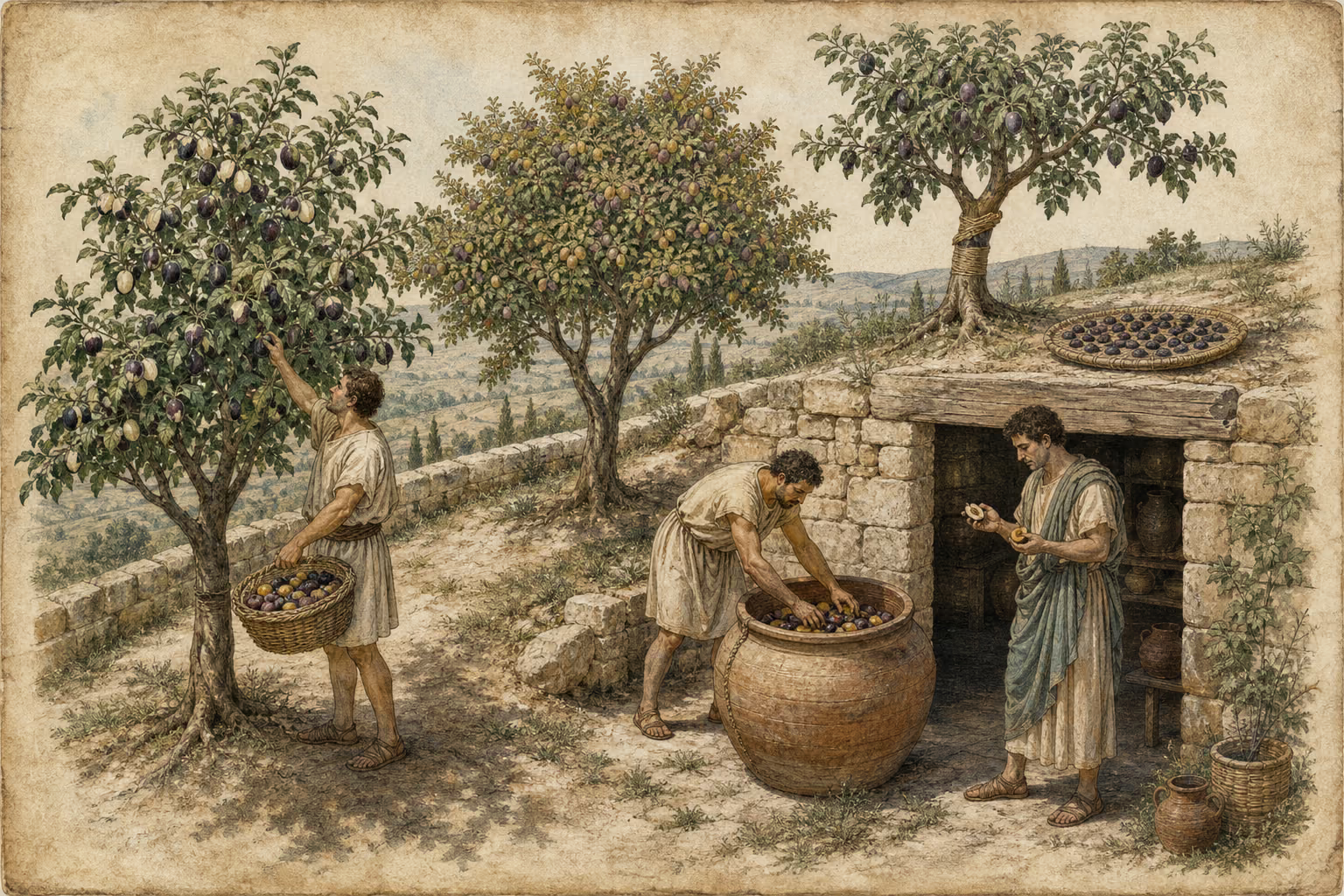
Ingens postea turba prunorum: versicoloriae nigro candicant, hordearia appellata a comitatu frugis eius; alia eodem colore seriora maioraque, asinina cognominata a vilitate. sunt minora, at laudatiora cerina atque purpurea, nec non ab externa gente Armeniaca, quae sola et odore commendantur. peculiaris inpudentia est nucibus insitorum, quae faciem parentis sucumque adoptionis exhibent, appellata ab utroque nucipruna. et haec autem et Persica et cerina ac silvestria ut uvae cadis condita usque ad alia nascentia aetatem sibi prorogant, reliquorum velocitas cito mitescentium transvolat. nuper in Baetica malina appellari coeperunt malis insita et alia amygdalina amygdalis. his intus in ligno nucleus amygdalae est, nec aliud pomum ingeniosius geminatum est. in peregrinis arboribus dicta sunt Damascena, a Syriae Damasco cognominata, iam pridem in Italia nascentia, grandiore quamquam ligno et exiliore carne nec umquam in rugas siccata, quoniam soles sui desunt. simul dici possunt populares eorum myxae, quae et ipsae nunc coeperunt Romae nasci insitae in sorvis.
In totum quidem Persica peregrina etiam Asiae Graeciaeque esse ex nomine ipso apparet atque e Perside advecta. sed pruna silvestria ubique nasci certum est, quo magis miror huius pomi mentionem a Catone non habitam, praesertim cum condenda demonstraret quaedam et silvestria. nam Persicae arbores sero et cum difficultate transiere, ut quae in Rhodo nihil ferant, quod primum ab Aegypto earum fuerat hospitium. falsum est venenata cum cruciatu in Persis gigni et poenarum causa ab regibus tralata in Aegyptum terra mitigata. id enim de Persea diligentiores tradunt, quae in totum alia est, myxis rubentibus similis, nec extra orientem nasci voluit. eam quoque eruditiores negaverunt ex Perside propter supplicia tralatam, sed a Perseo Memphi satam, et ob id Alexandrum illa coronari victores ibi instituisse in honorem atavi sui. semper autem folia habet et poma subnascentibus aliis. sed pruna quoque omnia post Catonem coepisse manifestum erit.
English · Bostock & Riley 1855–57
Next comes a vast number of varieties of the plum, the parti-coloured, the black, the white, the barley plum—so called, because it is ripe at barley-harvest—and another of the same colour as the last, but which ripens later, and is of a larger size, generally known as the “asinina,” from the little esteem in which it is held. There are the onychina, too, the cerina, —more esteemed, and the purple plum: the Armenian, also an exotic from foreign parts, the only one among the plums that recommends itself by its smell. The plum-tree grafted on the nut exhibits what we may call a piece of impudence quite its own, for it produces a fruit that has all the appearance of the parent stock, together with the juice of the adopted fruit: in consequence of its being thus compounded of both, it is known by the name of “nuci-pruna.” Nut-prunes, as well as the peach, the wild plum, and the cerina, are often put in casks, and so kept till the crop comes of the following year. All the other varieties ripen with the greatest rapidity, and pass off just as quickly. More recently, in Bætica, they have begun to introduce what they call “malina,” or the fruit of the plum engrafted on the apple-tree, and “amygdalina,” the fruit of the plum engrafted on the almond-tree, the kernel found in the stone of these last being that of the almond; indeed, there is no specimen in which two fruits have been more ingeniously combined in one.
Among the foreign trees we have already spoken of the Damascene plum, so called from Damascus, in Syria, but introduced long since into Italy; though the stone of this plum is larger than usual, and the flesh smaller in quantity. This plum will never dry so far as to wrinkle; to effect that, it needs the sun of its own native country. The myxa, too, may be mentioned, as being the fellow-countryman of the Damascene: it has of late been introduced into Rome, and has been grown engrafted upon the sorb.
The name of “Persica,” or “Persian apple,” given to this fruit, fully proves that it is an exotic in both Greece as well as Asia, and that it was first introduced from Persis. As to the wild plum, it is a well-known fact that it will grow anywhere; and I am, therefore, the more surprised that no mention has been made of it by Cato, more particularly as he has pointed out the method of preserving several of the wild fruits as well. As to the peach-tree, it has been only introduced of late years, and with considerable difficulty; so much so, that it is perfectly barren in the Isle of Rhodes, the first resting-place that it found after leaving Egypt.
It is quite untrue that the peach which grows in Persia is poisonous, and produces dreadful tortures, or that the kings of that country, from motives of revenge, had it transplanted in Egypt, where, through the nature of the soil, it lost all its evil properties—for we find that it is of the “persea” that the more careful writers have stated all this, a totally different tree, the fruit of which resembles the red myxa, and, indeed, cannot be successfully cultivated anywhere but in the East. The learned have also maintained that it was not introduced from Persis into Egypt with the view of inflicting punishment, but say that it was planted at Memphis by Perseus; for which reason it was that Alexander gave orders that the victors should be crowned with it in the games which he instituted there in honour of his ancestor: indeed, this tree has always leaves and fruit upon it, growing immediately upon the others. It must be quite evident to every one that all our plums have been introduced since the time of Cato.