LIBER XV · CAPUT 24
THE CAROB
Latine · Mayhoff 1906
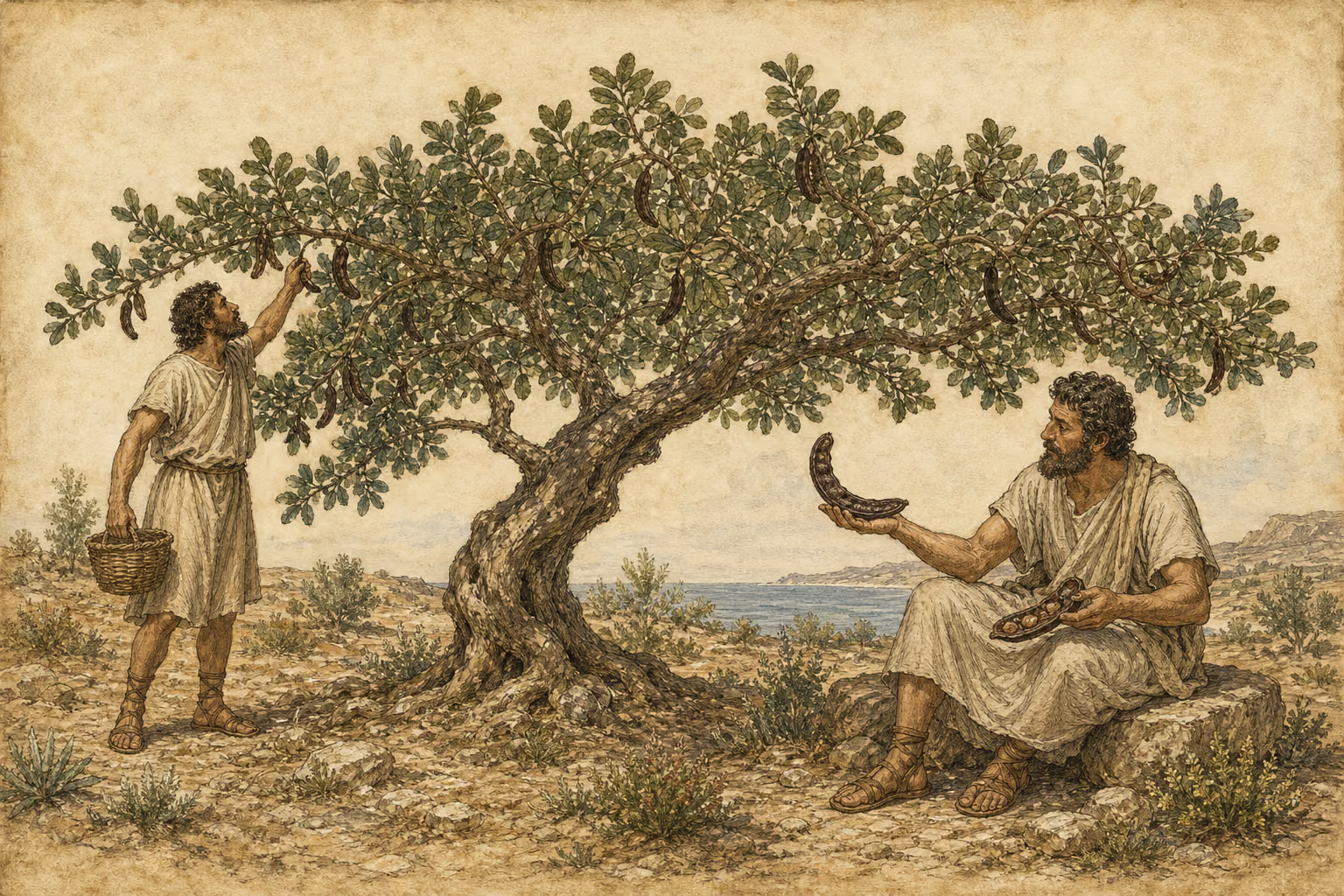
Haut procul abesse videantur et praedulces siliquae, nisi quod in iis ipse manditur cortex. digitorum omnis longitude illis et interim falcata, pollicari latitudine. glandes inter poma numerari non possunt, quam ob rem in sua natura dicentur.
Reliqua carnosi sunt generis, eaque bacis atque carnibus distant. alia acinis caro, alia moris, alia unedonibus, et alia acinis, inter cutem sucumque, alia myxis, alia bacis ut olivis. moris sucus in came vinosus, trini colores, 20 candidus primo, mox rubens, maturis niger. in novissimis florent, inter prima maturescunt. tingunt manus suco matura, eluunt acerba. minimum in hac arbore ingenia profecerunt, nec nominibus nec insitis; nec alio mode quam pomi magnitudine differunt mora Ostiensia et Tusculana Romae. nascuntur et in rubis, multum differente callo.
Aliud corpus et terrestribus fragis, aliud congeneri eorum unedoni, quod solum pormum simul e frutice terraeque gignitur. arbor ipsa fruticosa. fructus anno maturescit, pariterque floret subnascens et prior coquitur. mas sit an femina sterilis, inter auctores non constat. pomum inhonorum, ut cui nomen ex argument sit unum tantum edendi. duobus tamen his nominibus appellant Graeci comaron et memaecylon, quo apparet totidem esse genera; et apud nos alio nomine arbutus vocatur. Iuba auctor est quinquagenum cubitorum altitudine in Arabia esse eas.
Acinorum quoque magna est differentia, primum inter uvas ipsas callo, teneritate, crassitudine, interiore ligno aliis parvo et aliis etiam gemino, qui minime feraces musti. plurimum vero differunt hederae sabucique acini, et figura etiam Punici, angulosi quippe soli. nec cutis ulla singulis praeter communem quae est candida. totisque sucus et caro est, iis praecipue quibus parvolum inest ligni. magna et bacis differentia: aliae namque sunt olivis, lauris et alio modo loto, cornis, alio myrtis, lentisco. aquifolio enim ac spinae sine suco, medioque etiamnum genere inter bacas acinosquecerasis. pomum iis primo candidum et fere omnibus bacis; mox aliis virescit, ut olivis, lauris, rubet vero moris, cerasis, cornis. dein nigrescit moris, cerasis, olivis.
English · Bostock & Riley 1855–57
The carob, a fruit of remarkable sweetness, does not appear to be so very dissimilar to the chesnut, except that the skin is eaten as well as the inside. It is just the length of a finger, and about the thickness of the thumb, being sometimes of a curved shape, like a sickle. The acorn cannot be reckoned in the number of the fruits; we shall, therefore, speak of it along with the trees of that class.
The other fruits belong to the fleshy kind, and differ both in the shape and the flesh. The flesh of the various berries, of the mulberry, and of the arbute, are quite different from one another—and then what a difference, too, between the grape, which is only skin and juice, the myxa plum, and the flesh of some berries, such as the olive, for instance! In the flesh of the mulberry there is a juice of a vinous flavour, and the fruit assumes three different colours, being at first white, then red, and ripe when black. The mulberry blossoms one of the very last, and yet is among the first to ripen: the juice of the fruit, when ripe, will stain the hands, but that of the unripe fruit will remove the marks. It is in this tree that human ingenuity has effected the least improvement of all; there are no varieties here, no modifications effected by grafting, nor, in fact, any other improvement except that the size of the fruit, by careful management, has been increased. At Rome, there is a distinction made between the mulberries of Ostia and those of Tusculum. A variety grows also on brambles, but the flesh of the fruit is of a very different nature.
The flesh of the ground-strawberry is very different to that of the arbute-tree, which is of a kindred kind: indeed, this is the only instance in which we find a similar fruit growing upon a tree and on the ground. The tree is tufted and bushy; the fruit takes a year to ripen, the blossoms of the young fruit flowering while that of the preceding year is arriving at maturity. Whether it is the male tree or the female that is unproductive, authors are not generally agreed.
This is a fruit held in no esteem, in proof of which it has gained its name of “unedo,” people being generally content with eating but one. The Greeks, however, have found for it two names—“comaron” and “memecylon,” from which it would appear that there are two varieties. It has also with us another name besides that of “unedo,” being known also as the “arbutus.” Juba states that in Arabia this tree attains the height of fifty cubits.
There is a great difference also among the various acinus fruits. First of all, among the grapes, we find considerable difference in respect to their firmness, the thinness or thickness of the skin, and the stone inside the fruit, which in some varieties is remarkably small, and in others even double in number: these last producing but very little juice. Very different, again, are the berries of the ivy and the elder; as also those in the pomegranate, these being the only ones that are of an angular shape. These last, also, have not a membrane for each individual grain, but one to cover them all in common, and of a pale colour. All these fruits consist, too, of juice and flesh, and those more particularly which have but small seeds inside.
There are great varieties, too, among the berry fruits; the berry of the olive being quite different from that of the laurel, the berry of the lotus from that of the cornel, and that of the myrtle from the berry of the lentisk. The berry, however, of the aquifolium and the thorn is quite destitute of juice.
The cherry occupies a middle place between the berry and the acinus fruit: it is white at first, which is the case also with nearly all the berries. From white, some of the berries pass to green, the olive and the laurel, for instance; while in the mulberry, the cherry, and the cornel, the change is to red; and then in some to black, as with the mulberry, the cherry, and the olive, for instance.