LIBER XVI · CAPUT 24
THE CARE BESTOWED ON THE LEAVES OF THE PALM, AND THE USES TO WHICH THEY ARE APPLIED
Latine · Mayhoff 1906
est et publica omnium foliorum in ipsis differentia. namque pars inferior a terra herbido viret colore, ab eadem leviora nervos callumque et articulos in superiore habent parte, incisuras vero subter, ut manus humana. oleae superne candidiora et minus levia, item hederae. sed omnium folia cotidie ad solem oscitant, inferiores partes tepefieri volentia. superior pars omnium lanuginem quantulamcumque habet, quae in aliis gentium lana est.
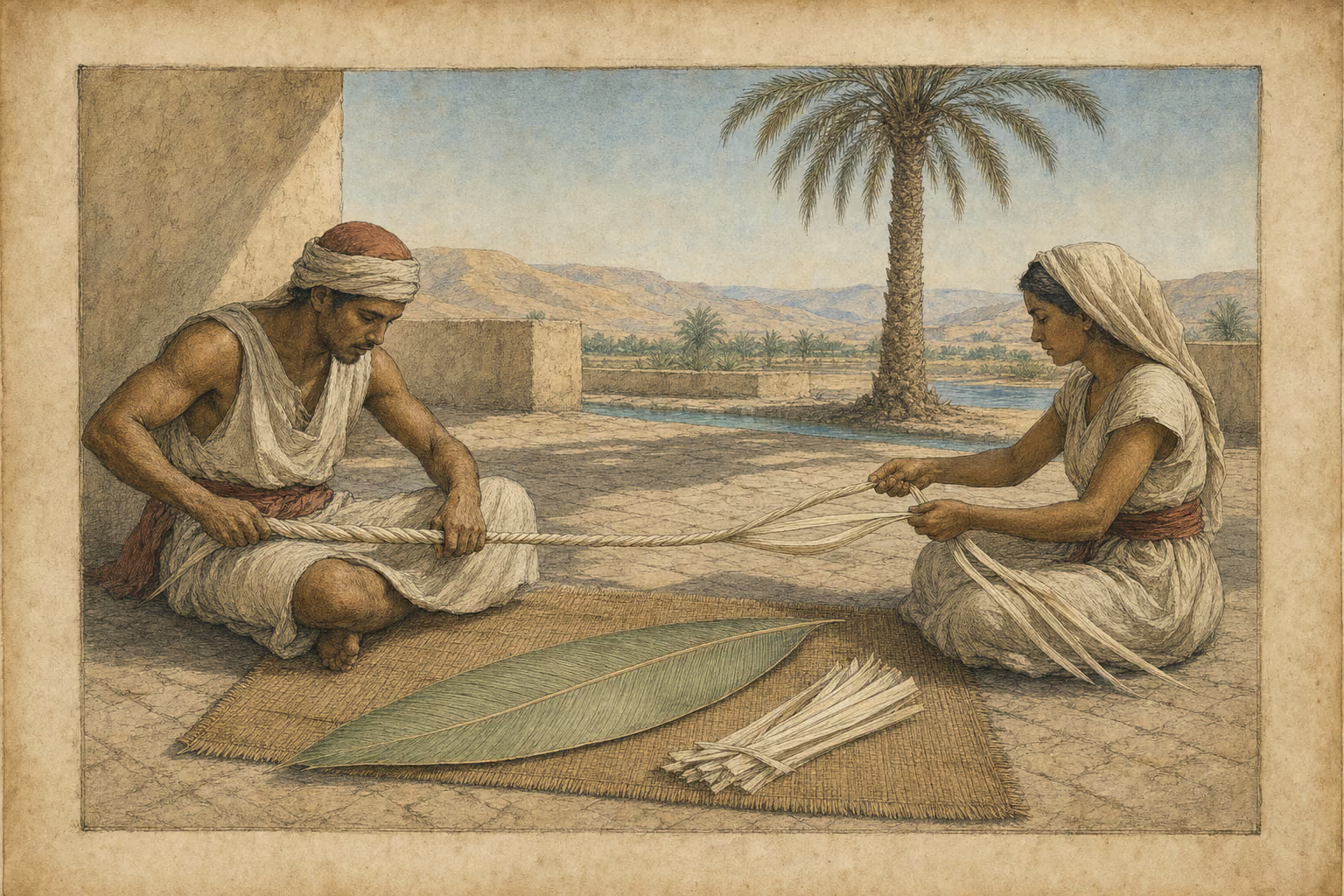
In oriente funes validos e foliis palmae fieri dictum est, eosque in umore utiliores esse. et apud nos vero palmis a messe decerpuntur. ex his meliora quae sese non diviserint. siccantur sub tecto quaternis diebus, mox in sole expanduntur et noctibus relicta, done candore inarescant, postea in opera finduntur.
Latissima fico, viti, platano, angusta myrto, punicae, oleae, capillata pino, cedro, aculeata aquifolio et ilicum generi—nam iuniperis spina pro folio est—, carnosa cupresso, tamarici, crassissima alno, longa harundini, salici, palmae et duplicia, circinata piro, mucronata malo, angulosa hederae, divisa platano, insecta pectinum modo piceae, abieti, sinuosa toto ambitu robori, spinosa cute rubo. mordacia sunt quibusdam, ut urticis, pungentia pino, piceae, abieti, larici, cedro, aquifoliis, pediculo brevi oleae, ilici, longo vitibus, tremulo populis, et iisdem solis inter se crepitantia. iam et in pomo ipso mali quodam in genere parva mediis emicant folia, interim et gemina, praeterea aliis circa ramos, aliis et in cacumine ramorum, robori et in caudice ipso. iam densa aut rara semperque lata rariora. disposita myrto, concava buxo, inordinata pomis, plura eodem pediculo exeuntia malis pirisque, ramulosa ulmo et cytiso. quibus adicit Cato decidua popul ea quernaque, animalibus iubens dari non perarida, bubus quidem et ficulnea ilignaque et hederacea. dantur et ex harundine ac lauru. decidunt sorbo universa, ceteris paulatim. et de foliis hactenus.
English · Bostock & Riley 1855–57
These trees also present in their leaves the same difference that is to be observed in those of all the rest: the underside, which looks towards the ground, is of a green, grassy colour, and has a smooth surface; while the veins, the callous skin, and the articulations, lie upon the upper face, the veins making incisions in the parts beneath, like those to be seen upon the human hand. The leaf of the olive is whiter above, and not so smooth; the same is the case, too, with that of the ivy. The leaves of all trees turn every day towards the sun, the object being that the under side may be warmed by its heat. The upper surface of them all has a down upon it, in however small quantity it may be; in some countries this down is used as a kind of wool.
We have already said that in the East strong ropes are made of the leaves of the palm, and that they are improved by lying in the water. Among ourselves, too, the leaves of the palm are generally plucked immediately after harvest, the best being those that have no divisions in them. These leaves are left to dry under cover for four days, after which they are spread out in the sun, and left out in the open air all night, till they have become quite white and dry: after this they are split before they are put to any use.
The broadest leaves are those of the fig, the vine, and the plane; while those of the myrtle, the pomegranate, and the olive are narrow. The leaf of the pine and the cedar is fine and resembles hair, while that of the holly and one variety of the holm oak is prickly—indeed, in the juniper, we find a thorn in place of a leaf. The leaf of the cypress and the tamarisk is fleshy, and that of the alder is remarkable for its thickness. In the reed, the willow, and the palm, the leaf is long, and in the latter tree it is double as well: that of the pear is rounded, and it is pointed in the apple. In the ivy the leaf is angular, and in the plane divided. In the pitch-tree and the fir the leaf is indented like the teeth of a comb; while in the robur it is sinuous on the whole of the outer margin: in the bramble it has a spiny surface. In some plants the leaf has the property of stinging, the nettle for instance; while in the pine, the pitch-tree, the fir, the larch, the cedar, and the holly, it is prickly. In the olive and the holm-oak it has a short stalk, in the vine a long one: in the poplar the stalk of the leaf is always quivering, and the leaves of this tree are the only ones that make a crackling noise when coming in contact with another.
In one variety of the apple-tree we find a small leaf protruding from the very middle of the fruit, sometimes, indeed, a couple of them. Then, again, in some trees the leaves are arranged all round the branches, and in others at the extremities of them, while in the robur they are found upon the trunk itself. They are sometimes thick and close, and at others thinly scattered, which is more particularly the case where the leaf is large and broad. In the myrtle they are symmetrically arranged, in the box, concave, and, upon the apple, scattered without any order or regularity. In the apple and the pear we find several leaves issuing from the same stalk, and in the elm and the cytisus they are covered with ramified veins. To the above particulars Cato adds that the leaves of the poplar and the quercus should not be given to cattle after they have fallen and become withered, and he recommends the leaves of the fig, the holm-oak, and the ivy for oxen: the leaves, too, of the reed and the laurel are sometimes given them to eat. The leaves of the service-tree fall all at once, but in the others only by degrees. Thus much in reference to the leaves.