LIBER XVI · CAPUT 25
THE NATURAL ORDER OF THE PRODUCTION OF PLANTS
Latine · Mayhoff 1906
Ordo autem naturae annuus ita se habet: primus est conceptus flare incipiente vento favonio, ex a. d. fere VI idus Febr. hoc maritantur vivescentia e terra, quippe cum etiam equae in Hispania, ut diximus. hic est genitalis spiritus mundi a fovendo dictus, ut quidam existimavere. flat ab occasu aequinoctiali ver inchoans. catlitionem rustici vocant, gestiente natura semina accipere eaque animam ferente omnibus satis. concipiunt variis diebus et pro sua quaeque natura alia protinus, ut animalia, tardius aliqua et diutius gravida partus gerunt, quod germinatio ideo vocatur. pariunt vero, cum florent, flosque ille ruptis constat utriculis; educatio in pomo est.
Haec et germinatio laborarborum, flos est pleni veris indicium et anni renascentis, flos gaudium arborum. tunc se novas aliasque quam sunt ostendunt, tunc variis colorum picturis in certamen usque luxuriant. sed hoc negatum plerisque; non enim omnes florent, et sunt tristes quaedam quaeque non sentiant gaudia annorum. nam neque ilex, picea, larix, pinus ullo flore exhilarantur natalesve pomorum annuos versicolori nuntio promittunt, nec fici atque caprifici; protinus enim fructum pro flore gignunt. in ficis mirabiles sunt et abortus qui numquam maturescunt. nec iuniperi florent. quidam earum duo genera tradunt: alteram florere nec ferre, quae vero non floreat ferre protinus bacis nascentibus, quae biennio haereant. sed id falsum, omnibusque his dura facies semper. sic et hominum multis fortuna sine flore est.
Omnes autem germinant, etiam quae non florent, magna et locorum differentia, quippe cum ex eodem genere quae sunt in palustribus priora germinent, mox campestria, novissima in silvis, per se autem tardius piri silvestres quam ceterae. primo favonio cornus, proxime laurus pauloque ante aequinoctium tilia, acer, inter primas vero populus, ulmus, salix, alnus, nuces. festinat et platanus. cetera vere coepturo, aquifolium, terebinthus, paliurus, castanea, glandes, serotino autem germine mains, tardissimo suber. quibusdam geminatur germinatio, nimia soli ubertate aut invitantis caeli voluptate, quod magis in herbis segetum evenit. in arboribus tamen nimia germinatio elactescit. sunt aliae naturales quibusdam praeterque vernam, quae suis constant sideribus—quorum ratio aptius reddetur tertio ab hoc volumine—, hiberna aquilae exortu, aestiva canis ortu, tertia arcturi. has duas quidam omnibus arboribus communes putant, sentiri autem maxime in fico, vile, punicis, causam adferentes, quoniam in Thessalia Macedoniaque plurima tum ficus exeat. maxime tamen in Aegypto apparet haec ratio. et reliquae quidem arbores, ut primum coepere, continuant germinationem, robur et abies et larix intermittunt tripertito ac terna germina edunt. ideo et ter squamas corticum spargunt, quod omnibus arboribus in germinatione evenit, quoniam praegnatium rumpitur cortex. est autem prima earum incipiente vere circiter xv diebus. iterum germinant transeunte geminos sole. sic fit, ut prima cacumina inpelli secutis appareat, geniculato incremento. tertia est earundem a solstitio brevissima, nec diutius septenis diebus, clareque et tune cernitur excrescentium cacuminum articulatio. vitis sola bis parturit, primum cum emittit uvam, iterum cum digerit. eorum, quae non florent, partus tantum est et maturitas. quaedam statim in germinatione florent properantque in eo, sed tarde maturescunt, ut vitis. serotino quaedam germinatu florent maturantque celeriter, sicuti morus, quae novissima urbanarum germinat nec nisi exacto frigore, ob id dicta sapientissima arborum. sed cum coepit, in tantum universa germinatio erumpit, ut una nocte peragatur etiam cum strepitu.
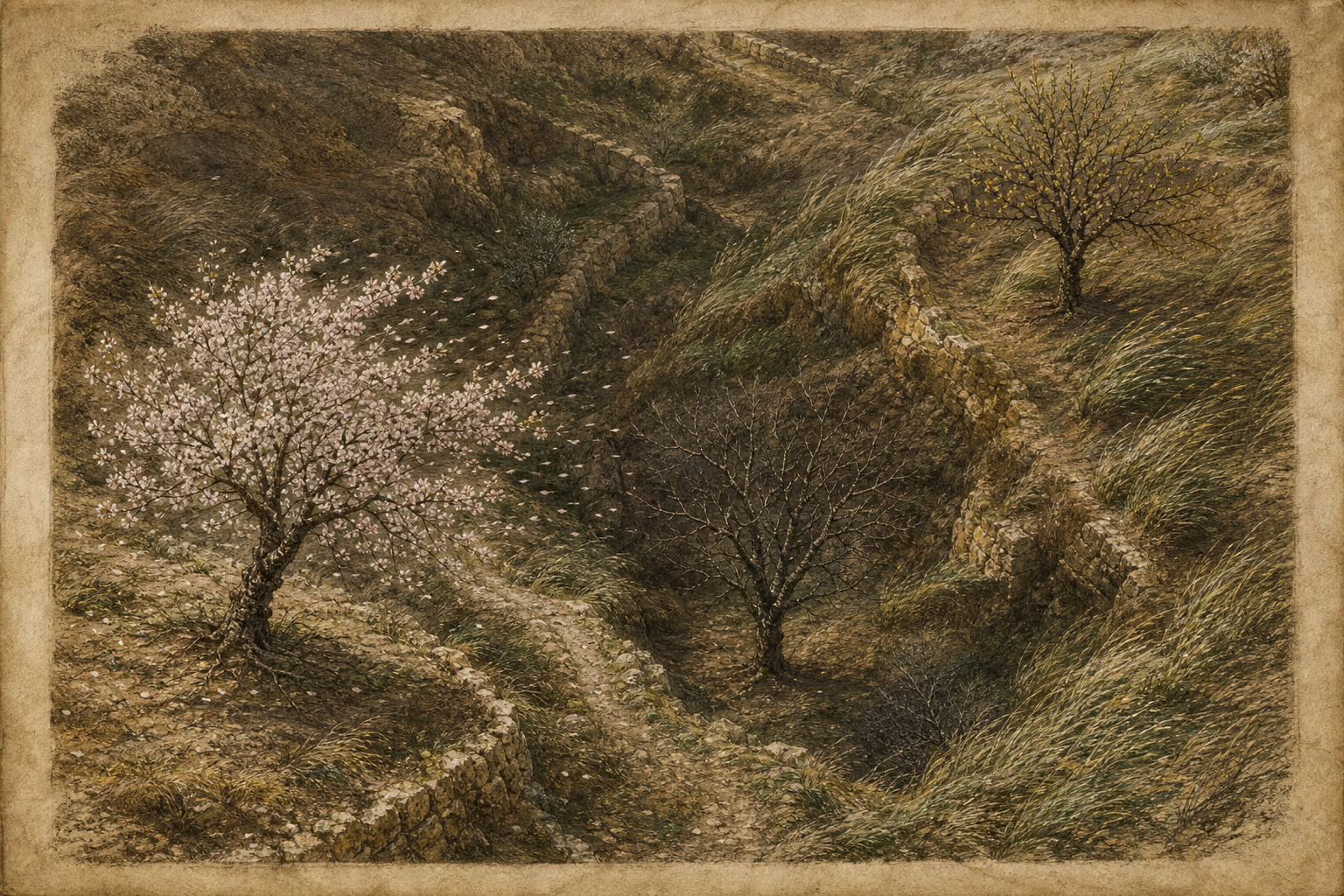
Ex iis, quae hieme aquila exoriente, ut diximus, concipiunt, floret prima omnium amygdala mense Ianuario, Martio vero pomum maturat. ab ea proximae florent Armeniaca, dein tuberes et praecoces, illae peregrinae, hae coactae; ordine autem naturae silvestrium primae sabucus, cui medulla plurima, et cui nulla, cornus mascula, urbanarum malus parvoque post, ut simul possit videri, pirus et cerasus et prunus. sequitur laurus, illam cupressus, dein punica, fici. et vites et oleae florentibus iam his germinant, concipiunt vergiliarum exortu. hoc sidus illarum est. floret autem solstitio vitis et, quae paulo serius incipit, olea. deflorescunt omnia septenis diebus non celerius, quaedam tardius, sed nulla pluribus bis septenis, omnia et intra VIII id. Iul. etesiarum praecursu.
English · Bostock & Riley 1855–57
The following is the order in which the operations of Nature take place throughout the year. The first is fecundation, which takes place when the west wind begins to prevail, generally about the sixth day before the ides of February. By the agency of this wind all the productions of the earth are impregnated; to such an extent, indeed, that the mares even in Spain are impregnated by it, as we have already stated. This is the generating principle of the universe, and it receives its name of Favonius, as some think, from our word “fovere,” which means “to warm and cherish:” it blows from due west at the opening of the spring. The peasantry call this period of the year the “time of heat,” because Nature is then longing to receive the seeds of her various productions, and is imparting life to everything that is planted. The vegetables conceive on various days, each according to its respective nature: some immediately, as with animals, others, again, more slowly, carrying with them for a longer period the produce of their conception, a state which has from that circumstance obtained the name of “germination.” When the plant flowers, it may be said to bring forth, and the flower makes its appearance by bursting its little capsule, which has acted to it as an uterus. The period of training and education is the growth of the fruit. This, as well as that of germination, is a laborious process.
The appearance of the blossom bespeaks the arrival of the spring and the birth anew of the year; this blossom is the very pride and delight of the trees. Then it is that they show themselves quite renewed, and altogether different from what they really are; then it is that they quite revel in the contest with each other which shall excel in the various hues and tints which they display. This merit has, however, been denied to many of them; for they do not all blossom, and there are certain sombre trees which do not participate in this joyous season of the year. The holm-oak, the pitch-tree, the larch, and the pine are never bedecked with blossoms, and with them there is no particular forerunner sent forth to announce the yearly birth of their respective fruits. The same is the case, too, with the cultivated and the wild fig, which immediately present their fruit in place of any blossom. Upon the fig, too, it is remarkable that there are abortive fruit to be seen which never ripen.
The juniper, also, is destitute of blossom; some writers, however, distinguish two varieties of it, one of which blossoms but bears no fruit, while the other has no blossom, but presents the berries immediately, which remain on the tree for so long a period as two years: this assertion, however, is utterly fallacious, and all the junipers always present the same sombre appearance. So, too, in life, the fortunes of many men are ever without their time of blossoming.
All trees germinate, however, even those which do not blossom. In this respect there is a very considerable difference in relation to the various localities; for in the same species we find that the tree, when planted in a marshy spot, will germinate earlier than elsewhere; next to that, the trees that grow on the plains, and last of all those that are found in the woods: the wild pear, too, is naturally later in budding than the other pears. At the first breath of the west wind the cornel buds, and close upon it the laurel; then, a little before the equinox, we find the lime and the maple germinating. Among the earlier trees, too, are the poplar, the elm, the willow, the alder, and the nut-trees. The plane buds, too, at an early period.
Others, again, germinate at the beginning of spring, the holly, for instance, the terebinth, the paliurus, the chesnut, and the glandiferous trees. On the other hand, the apple is late in budding, and the cork-tree the very last of all. Some trees germinate twice, whether it is that this arises from some exuberant fertility of the soil, or from the inviting temperature of the atmosphere; this takes place more particularly in the several varieties of the cereals. Excessive germination, however, has a tendency to weaken and exhaust the tree.
Besides the spring budding, some trees have naturally another budding, which depends upon the influence of their own respective constellations, a theory which we shall find an opportunity of more conveniently discussing in the next Book but one. The winter budding takes place at the rising of the Eagle, the summer at that of the Dog-star, and a third budding again at that of Arcturus. Some persons think that these two buddings are common to all trees, but that they are to be remarked more particularly in the fig, the vine, and the pomegranate; seeing that, when this is the case, the crop of figs, in Thessaly and Macedonia more particularly, is remarkably abundant: but it is in Egypt more especially that illustrations of this vast abundance are to be met with. All the trees in general, when they have once begun to germinate, proceed continuously with it; the robur, however, the fir-tree, and the larch germinate intermittently, ceasing thrice, and as many times beginning to bud again, and hence it is that they shed the scales of their bark three several times; a thing that takes place with all trees during the period of germination, the outer coat of the tree bursting while it is budding.
With these last trees the first budding takes place at the beginning of spring, and lasts about fifteen days; and they germinate a second time when the sun is passing through the sign of Gemini: hence it is that we see the points of the first buds pushed upwards by those beneath, a joint marking the place where they unite. The third germination of these trees takes place at the summer solstice, and lasts no more than seven days: at this period we may very distinctly detect the articulations by which the buds are joined to one another as they grow. The vine is the only tree that buds twice; the first time when it first puts forth the grape, and the second time when the grape comes to maturity. In the trees which do not blossom there is only the budding, and then the gradual ripening of the fruit. Some trees blossom while they are budding, and pass rapidly through that period; but the fruit is slow in coming to maturity, as in the vine, for instance. Other trees, again, blossom and bud but late, while the fruit comes to maturity with great rapidity, the mulberry, for example, which is the very last to bud of all the cultivated trees, and then only when the cold weather is gone: for this reason it has been pronounced the wisest among the trees. But in this, the germination, when it has once begun, bursts forth all over the tree at the very same moment; so much so, indeed, that it is accomplished in a single night, and even with a noise that may be audibly heard.
Of the trees which, as we have already stated, bud in winter at the rising of the Eagle, the almond blossoms the first of all, in the month of January namely, while by March the fruit is well developed. Next to it in blossoming is the plum of Armenia, and then the tuber and the early peach, the first two being exotics, and the latter forced by the agency of cultivation. Among the forest trees, the first that blossoms in the course of nature is the elder, which has the most pith of any, and the male cornel, which has none at all. Among the cultivated trees we next have the apple, and immediately after—so much so, indeed, that it would almost appear that they blossom simultaneously—the pear, the cherry, and the plum. Next to these is the laurel, and then the cypress, and after that the pomegranate and the fig: the vine, too, and the olive are budding when these last trees are in flower, the period of their conception being the rising of the Vergiliæ, that being their constellation. As for the vine, it blossoms at the summer solstice, and the olive begins to do so a little later. All blossoms remain on the trees seven days, and never fall sooner; some, indeed, fall later, but none remain on more than twice seven days. The blossoms are always off before the eighth day of the ides of July, the period of the prevalence of the Etesian winds.