LIBER XVI · CAPUT 26
AT WHAT PERIOD EACH TREE BEARS FRUIT. THE CORNEL
Latine · Mayhoff 1906
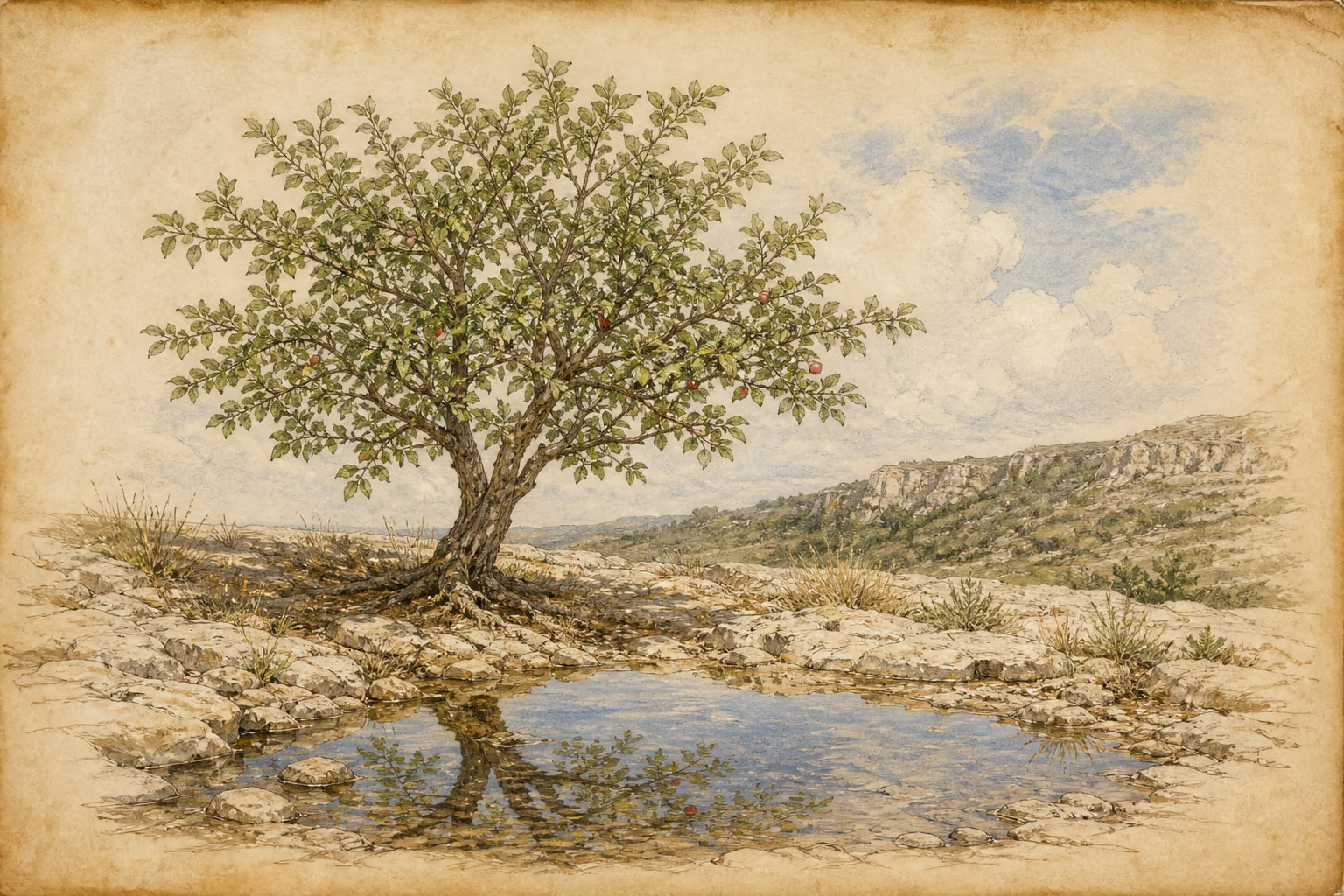
Nec statim fructus sequitur in aliquibus. cornus enim circa solstitia reddit primo candidum, postea sanguineum. ex eo genere femina post autumnum fert bacas acerbas et ingustabiles cunctis animantibus, ligno quoque fungosa et inutilis, cum mas e fortissimis durissimisque sit. tanta differentia ab eodem genere fit sexu. et terebinthus messibus reddit semen et acer et fraxinus, nuces et mala et pira praeterquam hiberna aut praecocia autumno, glandiferae serius etiamnum, vergiliarum occasu, aesculus tantum autumno, incipiente autem hieme quaedam genera mali pirique et suber. abies floret croci colore circa solstitium, semen reddit post vergiliarum occasum. pinus autem et picea praeveniunt germinatione xv fere diebus, semen vero post vergilias et ipsae reddunt.
Citreae et iuniperus et ilex anniferae habentur, novusque fructus in his cum annotino pendet. in maxima tamen admiratione pinus est: habet fructum maturescentem, habet proximo anno ad maturitatem venturum ac deinde tertio. nec ulla arborum avidius se promittit; quo mense ex ea nux decerpitur, eodem maturescit alia; sic dispensatur, ut nullo non mense maturescant. quae se in arbore ipsa divisere, azaniae vocantur laeduntque ceteras, nisi detrahantur.
Fructum arborum solae nullum ferunt—hoc est ne semen quidem—tamarix, scopis tantum nascens, populus, alnus, ulmus Atinia, alaternus, cui folia inter ilicem et olivam. infelices autem existimantur damnataeque religione, quae nequeseruntur umquam neque fructum ferunt. Cremutius auctor est numquam virere arborem, ex qua Phyllis se suspenderit. quae cummim gignunt, post germinationem aperiunt; cummis non nisi fructu detracto spissatur.
Novellae arbores carent fructu, quamdiu crescunt. perdunt facillime ante maturitatem palma, ficus, amygdala, malus, pirus, item punica, quae etiam roribus nimiis et pruinis florem amittit. qua de causa inflectunt ramos eius, ne subrecti umorem infestum excipiant atque contineant. pirus et amygdala, etiam si non pluat, sed fiat austrinum caelum aut nubilum, amittunt florem et primos fructus, si, cum defloruere, tales dies fuerint. ocissime autem salix amittit semen, antequam omnino maturitatem sentiat, ob id dicta Homero frugiperdia. secuta aetas scelere suo interpretata est hanc sententiam, quando semen salicis mulieri sterilitatis medicamentum esse constat. sed in hoc quoque providens natura facile nascenti et depacto surculo incuriosius semen dedit. una tamen proditur ad maturitatem perferre solita in Creta insula ipso descensu Iovis speluncae durum ligneumque, magnitudine ciceris.
Fiunt vero quaedam loci vitio infructuosa, sicut in Paro silva Cende quae nihil fert. persicae arbores in Rhodo florent tantum. fit haec differentia et sexu, ut in iis quae mares non ferunt; aliqui hoc permutant et mares esse quae ferant tradunt. facit et densitas sterilitatem.
Gignentium autem quaedam et lateribus ramorum et cacuminibus ferunt, ut pirus, punica, ficus, myrtus. cetero eadem natura quae frugibus. namque et in eis spica in cacumine nascitur, legumina in lateribus. palma sola, ut dictum est, in spathis habet fructum, racemis propendentem.
Reliquis sub folio pomum, ut protegatur, excepta fico, cui folium maximum umbrosissimumque et ideo supra id pomum. eidem uni serius folium nascitur quam pomum. insigne proditur in quodam genere Ciliciae, Cypri, Helladis, ficos sub folio, grossos vero post folium nasci. ficus et praecoces habet, quas Athenis prodromos vocant, in Laconico genere maxime.
English · Bostock & Riley 1855–57
Upon some trees the fruit does not follow immediately upon the fall of the blossom. The cornel about the summer solstice puts forth a fruit that is white at first, and after that the colour of blood. The female of this tree, after autumn, bears a sour berry, which no animal will touch; its wood, too, is spongy and quite useless, while, on the other hand, that of the male tree is one of the very strongest and hardest woods known: so great a difference do we find in trees belonging to the same species. The terebinth, the maple, and the ash produce their seed at harvest-time, while the nut-trees, the apple, and the pear, with the exception of the winter or the more early kinds, bear fruit in autumn. The glandiferous trees bear at a still later period, the setting of the Vergiliæ, with the exception of the æsculus, which bears in the autumn only; while some kinds of the apple and the pear, and the cork-tree, bear fruit at the beginning of winter.
The fir puts forth blossoms of a saffron colour about the summer solstice, and the seed is ripe just after the setting of the Vergiliæ. The pine and the pitch-tree germinate about fifteen days before the fir, but their seed is not ripe till after the setting of the Vergiliæ.
The citron-tree, the juniper, and the holm-oak are looked upon as having fruit on them the whole year through, and upon these trees we see the new fruit hanging along with that of the preceding year. The pine, however, is the most remarkable of them all; for it has upon it at the same moment the fruit that is hastening to maturity, the fruit that is to come to maturity in the ensuing year, and the fruit that is to ripen the next year but one. Indeed, there is no tree that is more eager to develope its resources; for in the same month in which a nut is plucked from it, another will ripen in the same place; the arrangement being such, that there is no month in which the nuts of this tree are not ripening. Those nuts which split while still upon the tree, are known by the name of azaniæ; they are productive of injury to the others, if not removed.
The only ones among all the trees that bear nothing whatever, not so much as any seed even, are the tamarisk, which is used only for making brooms, the poplar, the alder, the Atinian elm, and the alaternus, which has a leaf between that of the holm-oak and the olive. Those trees are regarded as sinister, and are considered inauspicious, which are never propagated from seed, and bear no fruit. Cremutius informs us, that this tree, being the one upon which Phyllis hanged herself, is never green. Those trees which produce a gum open of themselves after germination: the gum never thickens until after the fruit has been removed.
Young trees are unproductive so long as they are growing. The fruits which fall most readily before they come to maturity are the date, the fig, the almond, the apple, the pear, and the pomegranate, which last tree is also very apt to lose its blossom through excessive dews and hoar frosts. For this reason it is, too, that the growers bend the branches of the pomegranate, lest, from being straight, they may receive and retain the moisture that is so injurious to them. The pear and the almond, even if it should not rain, but a south wind happen to blow or the weather become cloudy, are apt to lose their blossoms, and their first fruit as well, if, after the blossom has fallen, there is a continuance of such weather. But it is the willow that loses its seed the most speedily of all, long, indeed, before it is ripe; hence it is that Homer has given it the epithet of “fruit-losing.” Succeeding ages, however, have given to this term an interpretation conformable to their own wicked practices, it being a well-known fact that the seed of the willow has the effect of producing barrenness in females.
In this respect, however, Nature has employed her usual foresight, bestowing but little care upon the seed of a tree which is produced so easily, and propagated by slips. There is, however, it is said, one variety of willow, the seed of which arrives at maturity: it is found in the Isle of Crete, at the descent from the grotto of Jupiter: the seed is unsightly and ligneous, and in size about as large as a chick-pea.
Certain trees also become unproductive, owing to some fault in the locality, such, for instance, as a coppice-wood in the island of Paros, which produces nothing at all: in the Isle of Rhodes, too, the peach-trees never do anything more than blossom. This distinction may arise also from the sex; and when such is the case, it is the male tree that never produces. Some authors, however, making a transposition, assert that it is the male trees only that are prolific. Barrenness may also arise from a tree being too thickly covered with leaves.
Some among the fruit-trees bear on both the sides of the branches and the summit, the pear, for instance, the fig-tree, and the myrtle. In other respects the trees are pretty nearly of a similar nature to the cereals, for in them we find the ear growing from the summit, while in the leguminous varieties the pod grows from the sides. The palm, as we have already stated, is the only one that has fruit hanging down in bunches enclosed in capsules.
The other trees, again, bear their fruit beneath the leaves, for the purpose of protection, with the exception of the fig, the leaf of which is very large, and gives a great abundance of shade; hence it is that we find the fruit placed above it; in addition to which, the leaf makes its appearance after the fruit. There is said to be a remarkable peculiarity connected with one species of fig that is found in Cilicia, Cyprus, and Hellas; the fruit grows beneath the leaves, while at the same time the green abortive fruit, that never reaches maturity, is seen growing on the top of them. There is also a tree that produces an early fig, known to the Athenians by the name of “prodromos.” In the Laconian varieties of this fruit more particularly, we find trees that bear two crops in the year.