LIBER XVI · CAPUT 30
DIFFERENCES IN TREES IN RESPECT OF THE TRUNKS AND BRANCHES
Latine · Mayhoff 1906
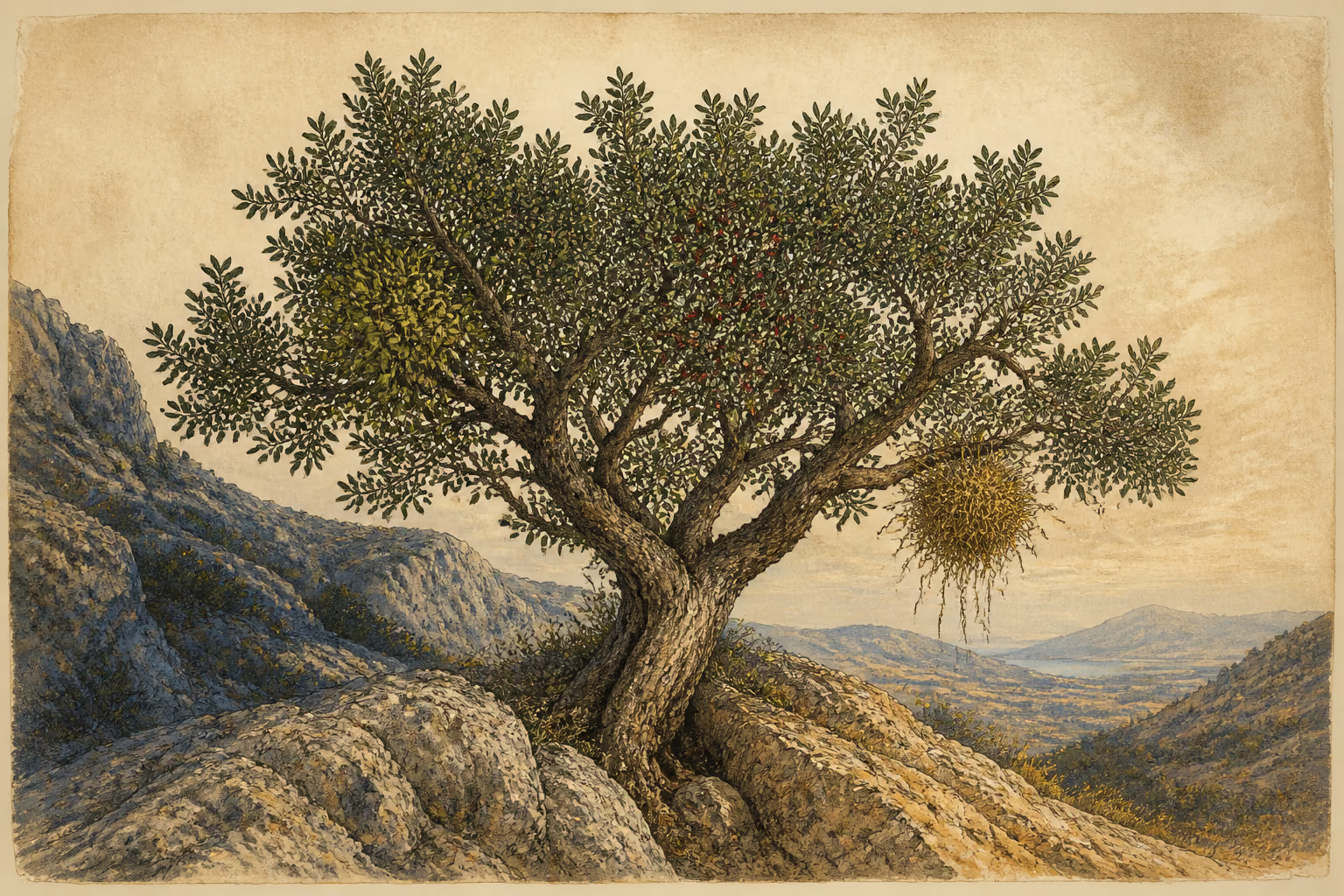
plurima vero ilices, nam et semen suum et granum, quod crataegum vocant, et a septentrione viscum, a meridie hyphear—de quis plura mox paulo—interdumque pariter res quaternas habent.
Arbores quaedam simplices, quibus a radice caudex unus et rami frequentes, ut olivae, fico, viti. quaedam fruticosi generis, ut paliurus, myrtus, item nux abellana, quin immo melior et copiosior fructu in plures dispersa ramos. hi quibusdam omnino nulli, ut in sato genere buxi, loto transmarinae. quaedam bifurcae atque etiam in quinas partes diffusae, quaedam dividuae nec ramosae, ut sabuci, quaedam individuae, ramosae, ut piceae. quibusdam ramorum ordo, sicut piceae, abieti, aliis inconditus, ut robori, malo, piro. et abieti quidem subrecta divisura ramique in caelum tendentes, non in latera proni. mirum, cacuminibus eorum decisis moritur, totis vero detruncatis durat. et si infra quam rami fuere praecidatur, quod superest vivit, si vero cacumen tantum auferatur, tota moritur. alia ab radice bracchiata, ut ulmus, alia in cacumine ramosa, ut pinus, faba Graeca, quam Romae a suavitate fructus, silvestris quidem, sed cerasorum paene natura, loton appellant. praecipue domibus expetitur ramorum petulantia brevi caudice latissima expatiantium umbra et in vicinas domos saepe transilientium. nulla opacitas brevior, nec auferunt rami solem hieme decidentibus foliis. nullis cortex iucundior aut oculos excipiens blandius, nullis rami longiores validioresque aut plures, ut dixisse totidem arbores liceat. cortice pelles tingunt, radice lanas. malis proprium genus. ferarum enim rostra reddunt adhaerentibus uni maximo minoribus.
Ramorum aliqui caeci, qui non germinant, quod natura fit, si non evaluere, aut poena, cum deputatos cicatrix hebetavit. quae dividuis in ramo natura est, haec viti in oculo, harundini in geniculo. omnium terrae proxima crassiora. in longitudinem excrescunt abies, larix, palma, cupressus, ulmus et si qua unistirpia. ramosarum cerasus etiam in XL cubitorum trabes aequali per totam duum cubitorum crassitudine reperitur. quaedam statim in ramos sparguntur, ut mali.
English · Bostock & Riley 1855–57
But it is the box-tree that supplies us with the greatest number of products, not only its seed, but a berry also, known by the name of cratægum; while on the north side it produces mistletoe, and on the south hyphear; two products of which I shall shortly have to speak more at length. Sometimes, indeed, this tree has all four of these products growing upon it at the same moment.
Some trees are of a simple form, and have but a single trunk rising from the root, together with numerous branches; such as the olive, for instance, the fig, and the vine; others again are of a shrubby nature, such as the paliurus, the myrtle, and the filbert; which last, indeed, is all the better, and the more abundant its fruit, the more numerous its branches. In some trees, again, there is no trunk at all, as is the case with one species of box, and the lotus of the parts beyond sea. Some trees are bifurcated, while there are some that branch out into as many as five parts. Others, again, divide in the trunk but have no branches, as in the case of the elder; while others have no division in the trunk but throw out branches, such as the pitch-tree, for instance.
In some trees the branches are symmetrically arranged, the pitch-tree and the fir, for example; while with others they are dispersed without any order or regularity, as in the robur, the apple, and the pear. In the fir the branches are thrown out from the trunk straight upwards, pointing to the sky, and not drooping downwards from the sides of the trunk. It is a singular thing, but this tree will die if the ends of its branches are cut, though, if taken off altogether, no bad effect is produced. If it is cut, too, below the place where the branches were, the part of the tree which is left will continue to live; but if, on the other hand, the top only of the tree is removed, the whole of it will die.
Some trees, again, throw out branches from the roots, the elm for example; while others are branchy at the top, the pine for instance, and the lotus or Grecian bean, the fruit of which, though wild, resembles the cherry very closely, and is called the lotus at Rome, on account of its sweetness. For sheltering houses these trees are more particularly esteemed, as they throw out their branches to a considerable distance, from a short trunk, thus affording a very extensive shade, and very frequently encroaching upon the neighbouring mansions. There is no tree, however, the shade afforded by which is less long-lived than this, and when it loses its leaves in winter, it affords no shelter from the sun. No tree has a more sightly bark, or one which has greater attractions for the eye; or branches which are longer, stouter, or more numerous; indeed, one might almost look upon them as forming so many trees. The bark of it is used for dyeing skins, and the root for colouring wool.
The branches of the apple-tree have a peculiar conformation; knots are formed which resemble the muzzles of wild beasts, several smaller ones being united to a larger.
Some of the branches are barren, and do not germinate; this takes place either from a natural deficiency of strength, or else some injury received in consequence of having been cut, and the cicatrix impeding the natural functions. The same that the branch is in the trees that spread out, is the eye in the vine, and the joint in the reed. All trees are naturally the thickest in the parts that are nearest the ground. The fir, the larch, the palm, the cypress, and the elm, and, indeed, every tree that has but a single trunk, develope themselves in their remarkable height. Among the branchy trees the cherry is sometimes found to yield a beam forty cubits in length by two in thickness throughout. Some trees divide into branches from the very ground, as in the apple-tree, for example.