LIBER XVI · CAPUT 34
THE IVY.—TWENTY VARIETIES OF IT
Latine · Mayhoff 1906
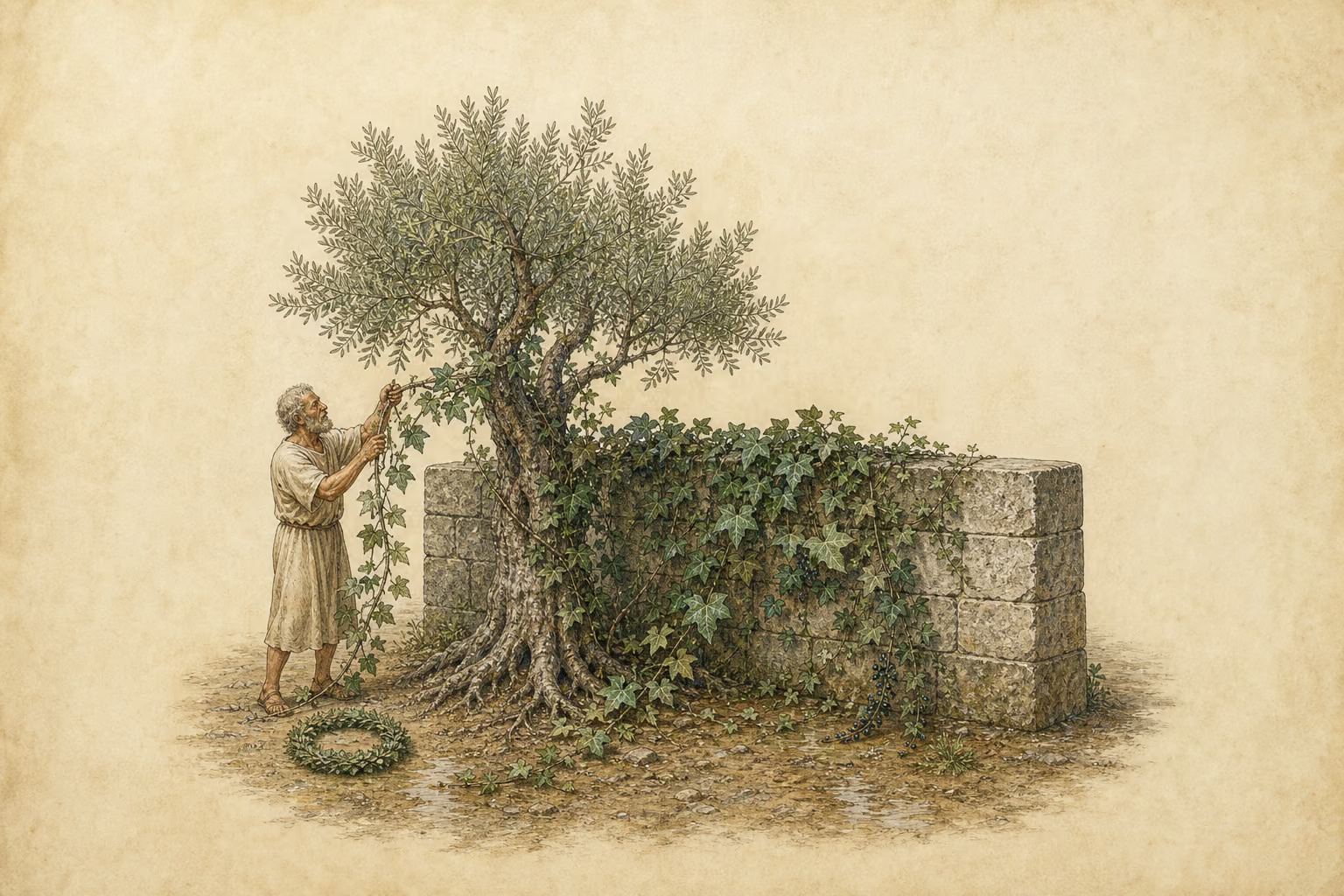
Hedera iam dicitur in Asia nasci. *circiter urbis Romae annum ccccxxxx* negaverat Theophrastus, nec in India nisi in monte Mero, quin et Harpalum omni modo laborasse, ut sereret eam in Medis frustra, Alexandrum vero ob raritatem ita coronato exercitu victorem ex India redisse exemplo Liberi patris. cuius dei et nunc adornat thyrsos galeasque etiam ac scuta in Thraciae populis sollemnibus sacris, inimica arboribus satisque omnibus, sepulchra, muros rumpens, serpentium frigori gratissima, ut mirum sit ullum honorem habitum ei.
Duo genera prima, ut reliquarum, mas atque femina. maior traditur mas et corpore et folio, duriore etiam ac pinguiore et flore ad purpuram accedente; utriusque autem similis est rosae silvestri, nisi quod caret odore. species horum generum tres: est enim candida ant nigra hedera tertiaque vocatur helix. etiamnum haec species dividuntur in alias, quoniam est aliqua fructu tantum candida, alia et folio. fructum quoque candidum ferentium aliis densus acinus et grandior, racemis in orbem circumactis, qui vocantur corymbi, iidem. Silenici, cum est minor acinus, sparsior racemus, simili modo ut in nigra. alicui et semen nigrum, alii crocatum, cuius coronis poetae utuntur, foliis minus nigris, quam quidam Nysiam, alii Bacchicam vocant, maximis inter nigras corymbis. quidam apud Graecos etiamnum duo genera huius faciunt a colore acinorum, erythranum et chrysocarpum.
Plurimas antem habet differentias helix, quoniam folio maxime distat. parva sunt et angulosa concinnioraque, cum reliquorum generum simplicia sint. distat et longitudine internodiorum, praecipue tamen sterilitate, quoniam fructum non gignit. quidam hoc aetatis esse, non generis existimant primoque helicem esse, fieri hederam vetustate. horum error manifestus intellegitur, quoniam helicis plura genera reperiuntur, sed tria maxime insignia: herbacea ac virens, quae plurima est, altera candido folio, tertia versicolori, quae Thracia vocatur. etiamnum herbaceae tenuiora folia et in ordinem digesta densioraque; in alio genere diversa omnia ea. in versicolori alia tenuioribus foliis et similiter ordinatis densioribusque est, alteri generi neglecta haec omnia; maiora quoque aut minora sunt folia macularumque habitu distant. et in candidis aliis sunt candidiora. adulescit in longitudinem maxime herbacea. arbores autem necat candida omnemque sucum auferendo tanta crassitudine augetur, ut ipsa arbor fiat. signa eius folia maxima atque latissima, mammae rigentes, quae sunt ceteris inflexae, racemi stantes ac subrecti. et quamquam omnium hederarum generi radicosa bracchia, huic tamen maxime ramosa ac robusta, ab ea nigrae. sed proprium albae, quod inter media folia emittit bracchia utrimque semper amplectens, hoc et in muris, quamvis ambire non possit. itaque etiam pluribus locis intercisa vivit tamen duratque, et totidem initia radicum habet quot bracchia, quibus incolumis et solida arbores sugit ac strangulat. est et in fructu differentia albae nigraeque hederae, quoniam aliis tanta amaritudo acini, ut aves non attingant. est et rigens hedera, quae sine adminiculo stat sola omnium generum, ob id vocata orthocissos, e diverso numquam nisi humi repens chamaecissos.
English · Bostock & Riley 1855–57
It is said that the ivy now grows in Asia, though Theophrastus has denied that such is the fact, and asserts that it grows nowhere in India, except upon Mount Meros. He says, too, that Harpalus used every possible exertion to naturalize it in Media, but to no purpose; and that Alexander, in consequence of the rarity of this plant, had himself crowned with it, after the example of Father Liber, when returning victorious with his army from India: and at the present day even, it is used to decorate the thyrsus of that god, and the casques and bucklers employed by the nations of Thrace in their sacred ceremonials. The ivy is injurious to all trees and plants, and makes its way through tombs and walls; it forms a haunt much frequented by serpents, for its refreshing coolness; so that it is a matter for astonishment that there should have been such remarkable veneration for this plant.
The two principal kinds in the ivy, as in other plants, are the male tree and the female. The male is said to have a larger trunk than the female, and a leaf that is harder and more unctuous, with a flower nearly approaching to purple: indeed, the flower of both the male and female tree strongly resembles the wild -rose, were it not destitute of smell. Each of these kinds of ivy is divided into three other varieties; the white ivy, the black, and a third known as the helix. These varieties are again subdivided into others, as there is one in which the fruit only is white, and another in which it is only the leaf that is so. In those which have a white fruit, the berry in some cases is closely packed and large, the clusters, which are known as “corymbi,” being of a spherical form. So, too, with the selenitium, which has a smaller berry, and fewer clusters; and the same is the case with the black ivy. One kind has a black seed, and another a seed of a saffron colour—it is this last that poets use for their chaplets, and the leaves of it are not so black as in the other kinds: by some it is known as the ivy of Nysa, by others as that of Bacchus: it is the one that among the black varieties has the largest clusters of all. Some of the Greek writers even distinguish in this last kind two varieties, according to the colour of the berries, the erythranum and the chrysocarpus.
It is the helix, however, that has the most peculiarities of all, and in the appearance of the leaf more particularly, which is small, angular, and of a more elegant shape, the leaf in all the other kinds being plain and simple. It differs, too, in the distance between the joints, and in being barren more especially, as it never bears fruit. Some authors, however, think that this difference exists solely in respect of age and not of kind, and are of opinion that what is the helix when young, becomes the ordinary ivy when old. This, however, is clearly proved to be an error upon their part, for we find more varieties of the helix than one, and three in particular—that of a grass-green colour, which is the most abundant of all, the kind with a white leaf, and a third, which is parti-coloured, and known as the Thracian helix. In that of a grass-green colour, the leaves are smaller, more closely packed together, and symmetrically arranged; while in the other kinds the features are altogether different. In the parti-coloured kind, also, one variety has a smaller leaf than usual, similarly arranged, and lying closer together, while in the other none of these features are observed. The leaves, too, are either greater or smaller and differ in the disposition of the spots upon them, and in the white helix some of them are whiter than others: the grass-green variety, however, is the one that grows to the greatest height.
The white helix is in the habit of killing trees by depriving them of their juices, and increases to such a degree of density as to be quite a tree itself. Its characteristics are, a very large, broad, leaf, and projecting buds, which in all the other kinds are bent inwards; its clusters, too, stand out erect. Although, too, all the ivies have arms that throw out a root, those of this variety are particularly branchy and strong; next to it in strength, are those of the black ivy.
It is a peculiarity of the white ivy to throw out arms from the middle of the leaves, with which it invariably embraces any object that may be on either side of it; this is the case, too, with walls, even though it should not be able to clasp them. If the trunk is cut across in ever so many places, it will still live and thrive, having as many fresh roots as it has arms, by means of which it ensures safety and impunity, while at the same time it sucks and strangles the trees to which it clings. There are great differences also in the fruit of both the white ivy and the black; for in some of them the berry is so bitter that birds will not touch it. There is an ivy also which grows upright, and stands without any support; being the only one that does so among all the varieties, it has thence obtained the distinctive name of “cissos.” The chamæcissos, on the other hand, is never found except creeping upon the ground.