LIBER XVI · CAPUT 36
WATER PLANTS: THE RUSH: TWENTY-EIGHT VARIETIES OF THE REED
Latine · Mayhoff 1906
Inter ea, quae frigidis gaudent, et aquaticos frutices dixisse conveniat. principatum in his tenebunt harundines belli pacisque experimentis necessariae atque etiam deliciis gratae.
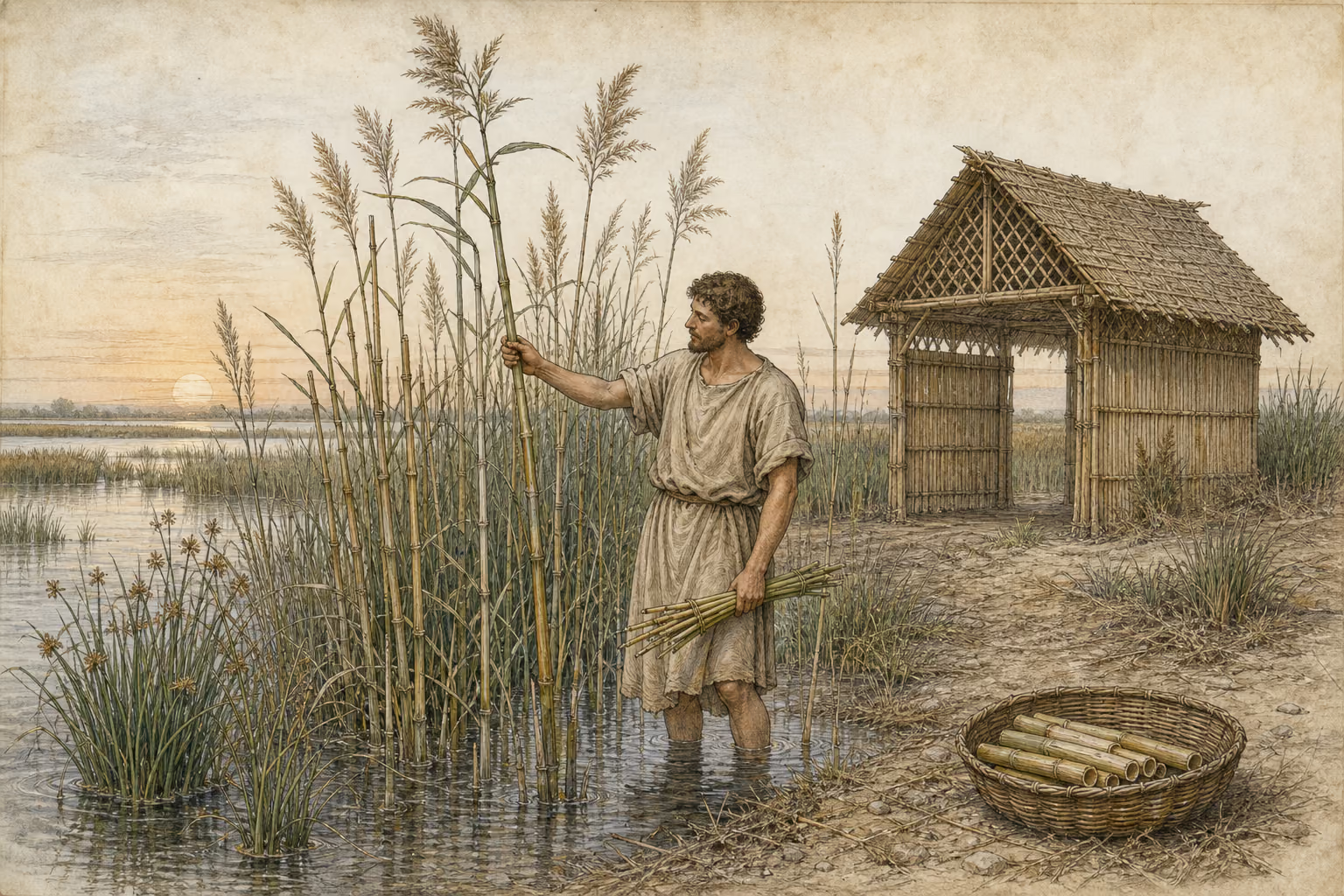
Tegulo earum domus suas septentrionales populi operiunt, durantque aevis tecta talia; et in reliquo vero orbe et camaras levissime suspendunt. chartisque serviunt calami, Aegyptii maxime cognatione quadam papyri. probatiores tamen Cnidii et qui in Asia circa Anaeticum lacum nascuntur. nostratibus fungosior subest natura, cartilagine bibula, quae cavo corpore intus, superne tenui inarescit ligno, fissilis, praeacuta semper acie. geniculata cetero gracilitas nodisque distincta leni fastigio tenuatur in cacumina, crassiore paniculae coma, neque hac supervacua. aut enim pro pluma strata cauponarum replet aut, ubi lignosiore induruit callo, sicut in Belgis, contusa et interiecta navium commissuris feruminat textus glutino tenacior rimisque explendis fidelior pice.
Calamis orientis populi bella conficiunt, calamis* mortem adcelerant pinna addita, calamis *spicula addunt inrevocabili hamo noxia* fitque et ex ipso telum aliud fracto in vulneribus. his armis solem ipsum obumbrant. propter hoc maxime serenos dies optant, odere ventos et imbres, qui inter illos pacem esse cogunt. ac si quis Aethiopas, Aegyptum, Arabas, Indos, Scythas, Bactros, Sarmatarum tot gentes et orientis omniaque Parthorum regna diligentius conputet, aequa ferme pars hominum in toto mundo calamis superata degit. praecipuus hic usus in Creta bellatores suos nobilitavit. sed in hoc quoque, ut ceteris in rebus, vicit Italia, quando nullus sagittis aptior calamus quam in Rheno Bononiensi amne, cui plurima inest medulla pondusque volucre et contra flatus quoque pervicax libra. quippe non eadem gratia Belgicis haec et Creticis commendatioribus. quamquam praeferuntur Indici, quorum alia quibusdam videtur natura, quando et hastarum vicem praebent additis cuspidibus. harundini quidem Indicae arborea amplitude, quales vulgo in templis videmus. differre mares ac feminas in his quoque Indi tradunt. spissius mari corpus, feminae capacius. navigiorumque etiam vicem praestant, si credimus, singula internodia. circa Acesinen amnem maxime nascitur.
Harundo omnis ex una stirpe numerosa, atque etiam recisa fecundius resurgit. radix natura vivax, geniculata et ipsa. folia Indicis tantum brevia, omnibus vero a nodo orsa conplexu tenues per ambitum inducunt tunicas, atque a medio internodio cum plurimum desinunt vestire procumbuntque. latera harundini calamoque in rotunditate bina, super nodos alterno semper inguine, ut alterum a dextera fiat, alterum superiore geniculo ab laeva per vices. inde exeunt aliquando rami, qui sunt calami tenues.
Plura autem genera. alia spissior densiorque geniculis, brevibus internodiis, alia rarior maioribus, tenuiorque et ipsa. calamus vero alius totus concavus, quem vocant syringian, utilissimus fistulis, quoniam nihil est ei cartilaginis atque carnis. Orchomenio et nodi continuo foramine pervii, quem auleticon vocant. hic tibiis utilior, fistulis ille. est alius crassiore ligno et tenui foramine. hunc totum fungosa replet medulla. alius brevior, alius procerior, exilior crassiorque. fruticosissimus, qui vocatur donax, non nisi in aquaticis natus, quoniam et haec differentia est, multum praelata harundine quae in siccis proveniat. suum genus sagittario calamo, ut diximus, sed Cretico longissimis internodiis, obsequiumque quo libeat flecti calefacto. differentias faciunt et folia non multitudine tantum et longitudine, verum et colore. varia Laconicis et ab ima parte densiora, quales in totum circa stagna gigni putant dissimiles amnicis longisque vestiri foliis spatiosius a nodo scandente complexu. est et obliqua harundo, non in excelsitatem nascens, sed iuxta terram fruticis modo se spargens, suavissima in teneritate animalibus. vocatur a quibusdam eletia. est et in Italia* palustris ex cortice tantum sub ipsa coma *nascens, adarea nomine*, utilissima dentibus, quoniam vis eadem est quae sinapi.
De Orchomenii lacus harundinetis accuratius dici cogit admiratio antiqua. characian vocabant crassiorem firmioremque, plocimon vero subtiliorem, hanc in insulis fluvitantibus natam, illam in ripis exspatiantis lacus. tertia est harundo tibialis calami, quem auleticon dicebant. nono hic anno nascebat.ur. nam et lacus incrementa hoc temporis spatio servabat, prodigiosus, si quando amplitudinem biennio extendisset, quod notatum apud Chaeroniam infausto Atheniensium proelio est... aepe... Lebadia... vocatur influente Cephiso. cum igitur anno permansit inundatio, proficiunt in aucupatoriam quoque amplitudinem. vocabantur zeugitae, contra bombyciae maturius reciproco; graciles, feminarum latiore folio atque candidiore, modica lanugine; at omnino nulla spadonum nomine insignibus. hinc erant armamenta ad inclutos cantus, non silendo et reliquo curae miraculo, ut venia sit argento iam potius cani. caedi solebant tempestivae usque ad Antigeniden tibicinem, cum adhuc simplici musica uterentur, sub arcturo. sic praeparatae aliquot post annos utiles esse incipiebant, tunc quoque multa domandae exercitatione et canere tibiae ipsae edocendae, comprimentibus se linguis, quod erat illis theatrorum moribus utilius. postquam varietas accessit et cantus quoque luxuria, caedi ante solstitia coeptae et fieri utiles in trimatu, apertioribus earum lingulis ad flectendos sonos, quae inde sunt et hodie. sed tum ex sua quamque tantum harundine congruere persuasum erat, et eam, quae radicem antecesserat, laevae tibiae convenire, quae cacumen, dexterae, inmensum quantum praelatis quas ipse Cephisus abluisset. nunc sacrificae Tuscorum e buxo, ludicrae vero e loto ossibusque asininis et argento fiunt.—Aucupatoria harundo e Panhormo laudatissima, piscatoria Abaritana ex Africa.
Harundinis Italiae usus ad vineas maxime. Cato seri eam iubet in umidis agris bipalio subacto prius solo, oculis dispositis intervallo ternorum pedum, simul et corrudae, unde asparagi fiant, concordare amicitiam, salicis vero circa.
English · Bostock & Riley 1855–57
Among those plants which thrive best in cold localities, it will be only proper to mention the aquatic shrubs. In the first rank, we find the reed, equally indispensable for the emergencies of war and peace, and used among the appliances of luxury even. The northern nations make use of reeds for roofing their houses, and the stout thatch thus formed will last for centuries even; in other countries, too, they make light vaulted ceilings with them. Reeds are employed, too, for writing upon paper, those of Egypt more particularly, which have a close affinity to the papyrus: the most esteemed, however, are the reeds of Cnidos, and those which grow in Asia, on the margin of the Anaitic Lake there.
The reed of our country is naturally of a more fungous nature, being formed of a spongy cartilage, which is hollow within, and covered by a thin, dry, woody coat without; it easily breaks into splinters, which are remarkably sharp at the edge. In other respects, it is of a thin, graceful shape, articulated with joints, and tapering gradually towards the top, which ends in a thick, hairy tuft. This tuft is not without its uses, as it is employed for filling the beds used in taverns, in place of feathers; or else, when it has assumed a more ligneous consistency, it is pounded, as we see done among the Belgæ, and inserted between the joints of ships, to close the seams, a thing that it does most effectually, being more tenacious than glue, and adhering more firmly than pitch.
It is by the aid of the reed that the nations of the East decide their wars; fixing in it a barbed point, they inflict a wound from which the arrow cannot be withdrawn. By the addition of feathers they accelerate the flight of this instrument of death, and the weapon, if it breaks in the wound, furnishes the combatants with a weapon afresh. With these missiles the warriors darken the very rays of the sun. It is for this reason more particularly that they desire a clear and serene sky, and hold in abhorrence all windy and rainy weather, which has the effect of compelling them, in spite of themselves, to be at peace with one another.
If a person were carefully to enumerate the peoples of Æthiopia, Egypt, Arabia, India, Scythia, Bactria, and Sarmatia, together with all the numerous peoples of the East, and the vast realms of the Parthians, he would find that fully one-half of mankind throughout the whole world live under a dominion imposed by the agency of the arrow. It was their surpassing excellence in this arm that so ennobled the warriors of Crete, though in this respect, as well as in all others, Italy has gained the mastery; there being no reed in existence better adapted for making arrows than that found in the Rhenus, a river of the territory of Bononia: filled with a greater quantity of pith than any of the others, it is light, and easily cleaves the air, while at the same time it has sufficient weight to resist the action of the wind; an advantage that is not possessed in an equal degree by those employed among the Belgæ. These advantages, however, are possessed by the most approved kinds that are found in Crete, although those of India are preferred; in the opinion of some persons, however, these last are of a totally different nature, for by adding a point to them, the natives are able to use them as lances even. Indeed, we find that in India the reed grows to the thickness of a tree, a fact which is proved by the specimens which are everywhere to be seen in our temples. The Indians assure us that in this plant, too, there is the distinction of male and female; the body of the male being more compact, and that of the female of a larger size. In addition to this, if we can credit the fact, a single compartment between the joints is sufficiently large to answer the purposes of a boat. These reeds are found more particularly on the banks of the river Acesines.
In every variety of the reed a single root gives birth to numerous stems, and if cut down, they will shoot again with increased fecundity. The root, which is naturally tenacious of life, is also jointed as well as the stem. The reeds of India are the only ones in which the leaves are short; but in all the varieties these leaves take their rise at the joints, and surround the stem with a fine tissue about half way upwards to the next joint, and then leave the stem and droop downwards. The reed, as well as the calamus, although rounded, has two sides, which throw out leaves alternately from above the joints, in such a way that when one springs from the right side, the next issues from the joint above it on the left, and so in turns. Branches, too, shoot occasionally from the stem, being themselves reeds of diminutive growth.
The varieties of the reed are numerous. Some are more compact than others, thicker at the joints, and with a shorter interval between them; while others, again, are less compact, with longer intervals between the joints, and not so straight. Another kind of reed is quite hollow; it is known as the “syringia,” and is particularly useful for making flutes, having neither pith in it nor any fleshy substance. The reed of Orchomenus has a passage in it open from one end to the other, and is known as the auleticon; this last is best for making pipes, the former for the syrinx. There is another reed, the wood of which is thicker, and the passage very contracted, being entirely filled with a spongy kind of pith. One kind, again, is shorter, and another longer, the one thinner, the other more thick. That known as the donax, throws out the most shoots, and grows only in watery localities; indeed, this is a point which constitutes a very considerable difference, those reeds being greatly preferred which grow in a dry soil. The archer’s reed forms a peculiar species, as we have already stated; but that of Crete has the longest intervals between the joints, and when subjected to heat is capable of being rendered perfectly pliable at pleasure. The leaves, too, constitute different varieties, not only by their number, but their colour also. The reed of Laconia is spotted, and throws out a greater number of shoots at the lower extremities; being very similar in nature, it is thought, to the reeds that we find growing about stagnant waters, and unlike those of the rivers, in being covered with leaves of considerable length; which, climbing upwards, embrace the stem to a considerable distance above the joints. There is also an obliquely-spreading reed, which does not shoot upwards to any height, but spreads out like a shrub, keeping close to the earth; this reed is much sought by animals when young, and is known by some persons as the elegia. There is in Italy, too, a substance found in the marsh-reeds, called by the name of adarca: it is only to be found issuing from the outer skin, below the flossy head of the plant, and is particularly beneficial to the teeth, having, in fact, an equal degree of pungency with mustard.
The terms of admiration in which they are spoken of by the ancients compels me to enter into some more minute details relative to the reed-beds of Lake Orchomenus. Characias was the name given there to a reed of stout and compact quality, while a thinner one was known as the plotias; this last was to be found growing on the floating islands there, while the former grew upon the banks that were covered by the waters of the lake. A third kind again, which had the name of “auleticon,” was the same that is now known as the musical pipe reed. This reed used to take nine years to grow, as it was for that period that the waters of the lake were continually on the increase; it used to be looked upon as a prodigy of evil omen, if at the end of its rise its waters remained overflowing so long as a couple of years; a thing that was observed at the period of the Athenian disasters at Cheronæa, and on various other occasions. This lake has the name of Lebaida, at the part where the river Cephisus enters it.
When this inundation has lasted so long as a year, the reed is found large enough to be available for the purposes of fowling: at this period it used to be called zeugites. On the other hand, when the waters subsided at an earlier period, the reeds were known as bombyciæ, being of a more slender form. In this variety, too, the leaf of the female plant was broader and whiter than that of the others, while that upon which there was little or no down bore the name of the eunuch reed. The stem of this last variety was used for the manufacture of concert flutes. I must not here pass by in silence the marvellous care which the ancients lavished upon these instruments, a thing which will, in some measure, plead as an apology for the manufacture of them at the present day of silver in preference. The reed used to be cut, as it was then looked upon as being in the best condition, at the rising of Arcturus; an usage which prevailed down to the time of Antigenides, the musician, and while flute-playing was of a more simple style. Being thus prepared, the reeds became fit for use in the course of a few years. At that period even the reed required considerable seasoning to render it pliable, and to be instructed, as it were, in the proper modulation of its sounds; the mouth-piece and stops being naturally contracted, and so producing a music better adapted to the theatrical taste of the day. But in later times, when the music became more varied, and luxury began to exercise its influence upon the musical taste, it became the general usage to cut the reeds before the summer solstice, and to make them fit for use at the end of three months; the stops and mouth-piece being found, when the reeds were cut at that period, to be more open and better adapted for the modifications of sound: it is in this state that the reed is used for similar purposes at the present day. In those times it was a very general persuasion also, that every pipe ought to have the tongue of its own mouth-piece cut from the same reed as itself, and that a section from the part nearest the root was best adapted to form the left-handed flute, and from the part adjoining the top the right-handed one: those reeds, too, were considered immeasurably superior, which had been washed by the waters of Cephisus itself.
At the present day the sacrificial pipes used by the Tuscans are made of box-wood, while those employed at the games are made of the lotus, the bones of the ass, or else silver. The fowler’s reeds of the best quality are those of Panormus, and the best reeds for fishing-rods come from Abarita in Africa.
The reed is employed in Italy more particularly, as a support for the vine. Cato recommends that it should be planted in a damp situation, the soil being first turned up with a double mattock, and a distance of three feet left between the young layers; he says, too, that the wild asparagus from which the cultivated species is produced, may be planted together with it, as they agree particularly well together.