LIBER XVI · CAPUT 37
THE WILLOW: EIGHT VARIETIES OF IT
Latine · Mayhoff 1906
qua nulla aquaticarum utilior, licet populi vitibus placeant et Caecuba educent, licet alni saepibus muniant contraque erumpentium amnium impetus riparum muro in tutela ruris excubent in aqua satae densius caesaeque innumero herede prosint.
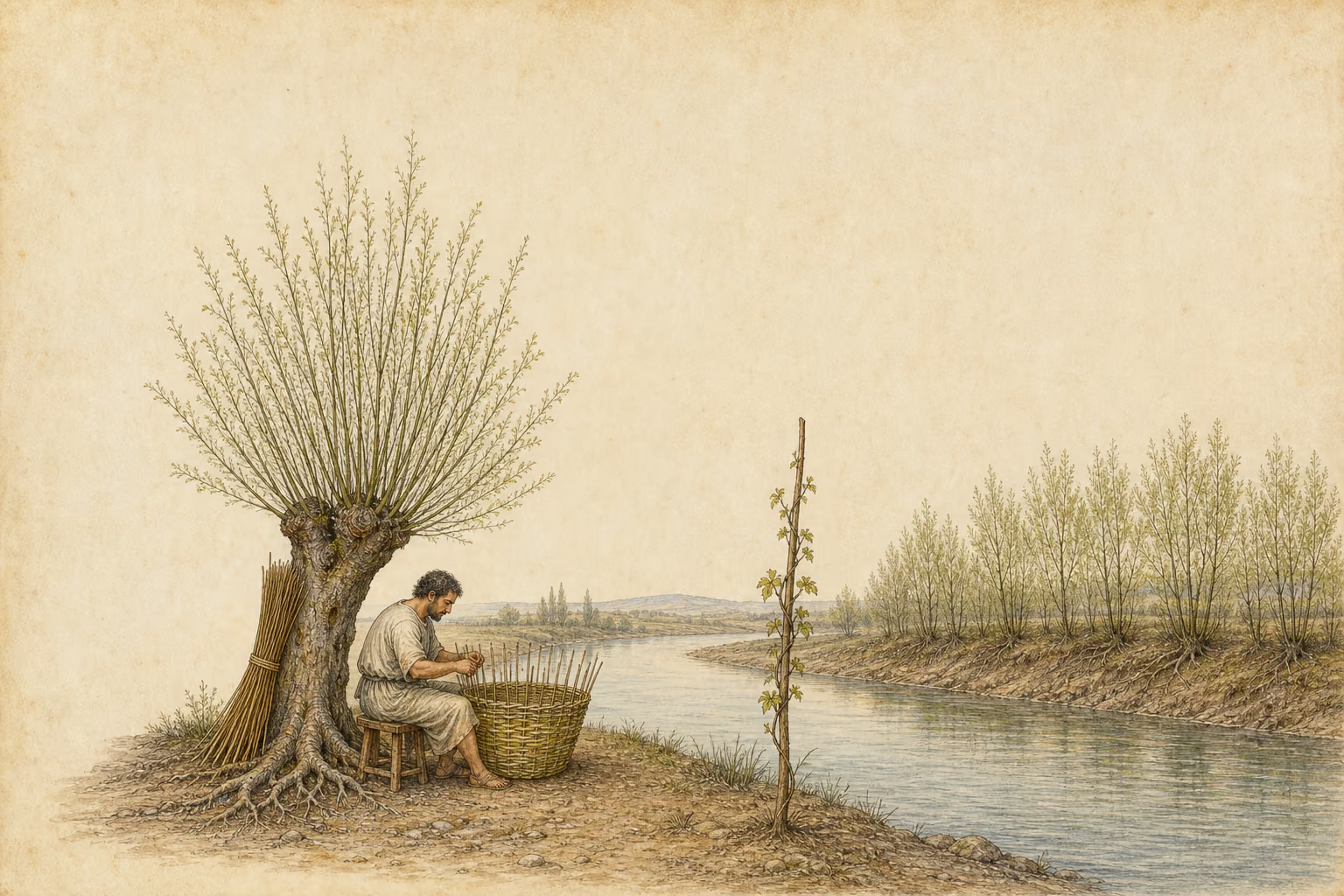
Salicis etiam plura genera. namque et in proceritatem magnam emittunt iugis vinearum perticas pariuntque balteo corticis vincula, et aliae virgas sequacis ad vincturas lentitiae, aliae praetenues viminibus texendis spectabili subtilitate, rursus aliae firmiores corbibus ac plurimae agricolarum supellectili, candidiores ablato cortice lenique tractatu maioribus vasis, quam ut e corio fiant eadem, atque etiam supinarum in delicias cathedrarum aptissimae. caedua salici fertilitas densiorque tonsura ex brevi pugno verius quam ramo, non, ut remur, in novissimis curanda arbore. nullius quippe tutior reditus est minorisve inpendi ant tempestatium securior.
Tertium locum ei in aestimatione ruris Cato adtribuit prioremque quam olivetis quamque frumento aut pratis, nec quia desint alia vincula. siquidem et genistae et populi et ulmi et sanguinei frutices et betullae et harundo fissa et harundinum folia, ut in Liguria, et vitis ipsa recisisque aculeis rubi alligant et intorta corylus— mirumque contuso ligno alicui maiores ad vincula esse vires—, salici tamen praecipua dos. finditur Graeca rubens, candidior Amerina, sed paulo fragilior, ideo solido ligat nexu. in Asia tria genera observant: nigram utiliorem viminibus, candidam agricolarum usibus, tertiam, quae brevissima est, helicem vocant. apud nos quoque multi totidem generibus nomina inponunt, viminalem vocant eandemque purpuream, alteram nitelinam a colore, quae sit tenuior, tertiam Gallicam, quae tenuissima.
Nec in fruticum nec in veprium cauliumve neque in herbarum aut alio ullo quam suo genere numerentur iure scirpi fragiles palustresque*, e quibus *[et] tegulum tegetesque*, detracto cortice candelae luminibus et funeribus serviunt. firmior quibusdam in locis eorum rigor. namque iis velificant non in Pado tantum nautici, verum et in mari piscator Africus praepostero more velum intra malos suspendens, et mapalia sua Mauri tegunt, proximeque aestimanti hoc videantur esse, quod in interiore parte mundi papyrum.
Sui, sed frutectosi generis sunt inter aquaticas et rubi atque sabuci, fungosi generis, aliter tamen quam ferulae, quippe plus ligni est, utique sabuco, ex qua magis canoram bucinam tubamque credit pastor ibi caesa, ubi gallorum cantum frutex ille non exaudiat. rubi mora ferunt et alio genere similitudinem rosae quae vocatur cynosbatos. tertium genus Idaeum vocant Graeci a loco, teneri us quam cetera minoribusque spinis et minus aduncis. flos eius contra lippitudines inlinitur ex melle et igni sacro; contra stomachi quoque vitia bibitur ex aqua. sabuci acinos habent nigros atque parvos, umoris lenti, inficiendo maxime capillo. qui et ipsi aqua decocti manduntur.
English · Bostock & Riley 1855–57
He says also that the willow may be planted in its vicinity, than which there is no aquatic plant of more general utility, although the poplar may be preferred for the training of the vine, and the support of the Cæcuban grape; although, too, the alder affords a more efficient protection by the hedges it forms, and, planted in the very water, makes a rampart along the banks in defence of the adjoining country against the violence of the rivers when they overflow; when cut down, too, this last tree is useful for the innumerable suckers which it throws out.
Of the willow, too, there are several varieties. One of them throws out its branches to a considerable height; and these, coupled together, serve as perches for the vine, while the bark around the tree itself is used for withes. Others, again, of a more pliable nature, supply a flexible twig, which is used for the purpose of tying; while others throw out osiers of remarkable thinness, adapted by their suppleness and graceful slenderness for the manufacture of wicker-work. Others, again, of a stouter make, are used for weaving panniers, and many other utensils employed in agriculture; while from a whiter willow the bark is peeled off, and, being remarkably tractable, admits of various utensils being made of it, which require a softer and more pliable material than leather: this last is also found particularly useful in the construction of those articles of luxury, reclining chairs. The willow, when cut, continues to thrive, and, indeed, throws out more thickly from the top, which, when closely clipped, bears a stronger resemblance to a closed fist than the top of a stump. It is a tree, which, in my opinion, deserves to be placed by no means in the lowest rank of trees; for there is none that will yield a more certain profit, which can be cultivated at less expense, or which is less liable to be influenced by changes in the weather.
Cato considers the culture of the willow as deserving to hold the third rank in estimation, and he gives it precedence to the cultivation of the olive, tillage for corn, or laying out land for pasture. It is not, however, because the willow is the only tree that produces withes; for they may be procured also from the broom, the poplar, the elm, the blood-red cornel, the birch, and the reed itself when split, or else the leaves of that plant, as we know to be the case in Liguria. The vine, also, will furnish them; the bramble, too, with the thorns removed, as well as the twisted hazel. It is a very singular thing, that a wood after it has been beaten and pounded should be found all the stronger for making withes, but such is a striking peculiarity that exists in the willow. The Greek red willow is split for this purpose: while the willow of Ameria is whiter but more brittle, for which reason it is used in an uncut state for tying. In Asia there are three varieties known of the willow; the black willow, which is best adapted for making withes, the white willow, employed for various agricultural purposes, and a third, which is shorter than the others, and known as the helix.
With us, also, there is the same number of denominations given to as many varieties of the willow; one being known as the viminal or purple willow, another as the nitelina, from its resemblance to the colour of the nitela, thinner in the trunk than the preceding one, and the third as the Gallic kind, being the thinnest of them all.
The rush, so frail in form, and growing in marshy spots, cannot be reckoned as belonging to the shrubs, nor yet to the brambles or the stalk plants; nor, indeed, in strict justice, to any of the classes of plants except one that is peculiarly its own. It is extensively used for making thatch and matting, and, with the outer coat taken off, for making candles and funeral torches. In some places, however, the rush is more hard and firm: thus, for instance, it is employed not only by the sailors on the Padus for making the sails of boats, but for the purposes of sea-fishing as well, by the fishermen of Africa, who, in a most preposterous manner, hang the sails made of it behind the masts. The people, too, of Mauritania thatch their cottages with rushes; indeed, if we look somewhat closely into the matter, it will appear that the rush is held in pretty nearly the same degree of estimation there as the papyrus is in the inner regions of the world.
Of a peculiar nature, too, though to be reckoned among the water -plants, is the bramble, a shrub-like plant, and the elder, which is of a spongy nature, though not resembling giant fennel, from having upon it a greater quantity of wood. It is a belief among the shepherds that if they cut a horn or trumpet from the wood of this tree, it will give all the louder sound if cut in a spot where the shrub has been out of hearing of the crowing of the cock. The bramble bears mulberries, and one variety of it, known as the cynosbatos, bears a flower similar to the rose. There is a third variety, known to the Greeks as the Idæan bramble, from the place where it grows: it is slighter than the others, with smaller thorns, and not so hooked. Its flower, mixed with honey, is employed as an ointment for sore eyes and erysipelas: and an infusion of it in water is used for diseases of the stomach.
The elder bears a small black berry, which contains a viscous juice, employed more particularly for staining the hair. The berries, too, are boiled in water and eaten.