LIBER XVI · CAPUT 39
THE FELLING OF TREES
Latine · Mayhoff 1906
larix femina habet quam Graeci vocant aegida mellei coloris. *hoc lignum proximum medullae est. in abiete lusson Graeci vocant*. inventum pictorum tabellis inmortale nullisque fissile rimis. * cedri quoque durissima quae medullae proxima, ut in corpore ossa, deraso modo limo. et sabuci interiora mire firma traduntur, quidamque venabula ex ea praeferunt omnibus, constat enim ex cute et ossibus.
Caedi tempestivum quae decorticentur et teretes ad templa ceteraque usus rotundi, cum germinant, alias cortice inextricabili et carie subnascente ei materiaque nigrescente; tigna et quibus aufert securis corticem a bruma ad favonium aut, si praevenire cogamur, arcturi occasu et ante eum fidiculae, novissima ratione solstitio. dies siderum horum reddentur suo loco. vulgo satis putant observare, ne qua dedolanda sternatur ante editos suos fructus. robur vere caesum teredinem sentit, bruma autem neque vitiatur neque pandatur, alias obnoxium etiam, ut torqueat sese findatque, quod in subere tempestive quoque caeso evenit. infinitum refert et lunaris ratio, nec nisi a xx in xxx caedi volunt. inter omnes vero convenit utilissime in coitu eius sterni, quem diem alii interlunii, alii silentis lunae appellant. sic certe Tiberius Caesar concremato ponte naumachiario larices ad restituendum caedi in Raetia praefinivit. quidam dicunt, ut in coitu et sub terra sit luna, quod fieri non potest nisi noctu. si competant coitus in novissimum diem brumae, illa fit aeterna materies; proxime, cum supra dictis sideribus. quidam et canis ortum addunt, et sic caesas materias in forum Augustum. nec novellae autem ad materiem nec veteres utilissimae. circumcisas quoque in medullam aliqui non inutiliter relinquunt, ut omnis umor stantibus defluat. mirum apud antiquos primo Punico bello classem Duilli imperatoris ab arbore LX die navigavisse, contra vero Hieronem regem ccxx naves effectas diebus XLV tradit L. Piso. secundo quoque Punico Scipionis classis XL die a securi navigavit. tantum tempestivitas etiam in rapida celeritate pollet.
Cato hominum summus in omni usu de materiis haec adicit: Prelum ex sappino atra potissimum facito. ulmeam, pineam, nuceam, hanc atque aliam materiem omnem cum ecfodies, luna decrescente eximito post meridiem sine vento austro. tum erit tempestiva, cum semen suum maturum erit. cavetoque per rorem trahas aut doles. idemque mox: Nisi intermestri lunaque dimidiata ne tangas materiem. quam effodias aut praecidas abs terra. diebus VII proximis, quibus luna plena fuerit, optime eximitur. omnino caveto ni quam materiem doles neve caedas neve tangas nisi siccam, neve gelidam neve rorulentam. —Tiberius item et in capillo tondendo servavit interlunia. M. Varro adversus defluvia praecipit observandum id a pleniluniis.—
<1> Larici et magis abieti succisis umor diu defluit. haec omnium arborum altissimae ac rectissimae. navium malis antemnisque propter levitatem praefertur abies. communia his pinoque, ut quadripertitos venarum cursus bifidosve habeant vel omnino simplices. fabrorumin intestina opera medulla sectilis optima quadripertitis,.... materies et mollior quam ceterae. intellectus in cortice protinus peritis. abietis quae pars a terra fuit, enodis est. haec qua diximus ratione fluviata detoratur atque ita sappinus vocatur, superior pars nodosa duriorque fusterna. et in ipsis autem arboribus robustiores aquiloniae partes, et in totum deteriores ex umidis opacisque, spissiores ex apricis ac diuturnae. ideo Romae infernas abies supernati praefertur.
Est per se gentium quoque in his differentia. Alpibus Appenninoque laudatissimae, in Gallia Iuribus ac monte Vosego, in Corsica, Bithynia, Ponto, Macedonia. deterior Aenianica et Arcadica, pessima Parnasia et Euboica, quoniam ramosae ibi et contortae putrescentesque facile. at cedrus in Creta, Africa, Syria laudatissima. cedri oleo peruncta materies nec tiniam nec cariem sentit. iunipero eadem virtus quae cedro. vasta haec in Hispania maximeque Vaccaeis. medulla eius ubicumque solidior etiam quam cedris. publicum omnium vitium vocant spiras, ubi convolvere se venae atque nodi. inveniuntur in quibusdam, sicut in marmore, centra, id est duritia clavo similis, inimica serris. et quaedam forte accidunt, ut lapide comprehenso aut recepto in corpus aut alterius arboris ramo. <2> Megaris diu stetit oleaster in foro, cui viri fortes adfixerant arma, quae cortice ambiente aetas longa occultaverat, fuitque arbor illa fatalis excidio urbis praemonitae oraculo, cum arbor arma peperisset, quod succisae accidit ocreis galeisque intus repertis. ferunt lapides ita inventos ad continendos partus esse remedio.
English · Bostock & Riley 1855–57
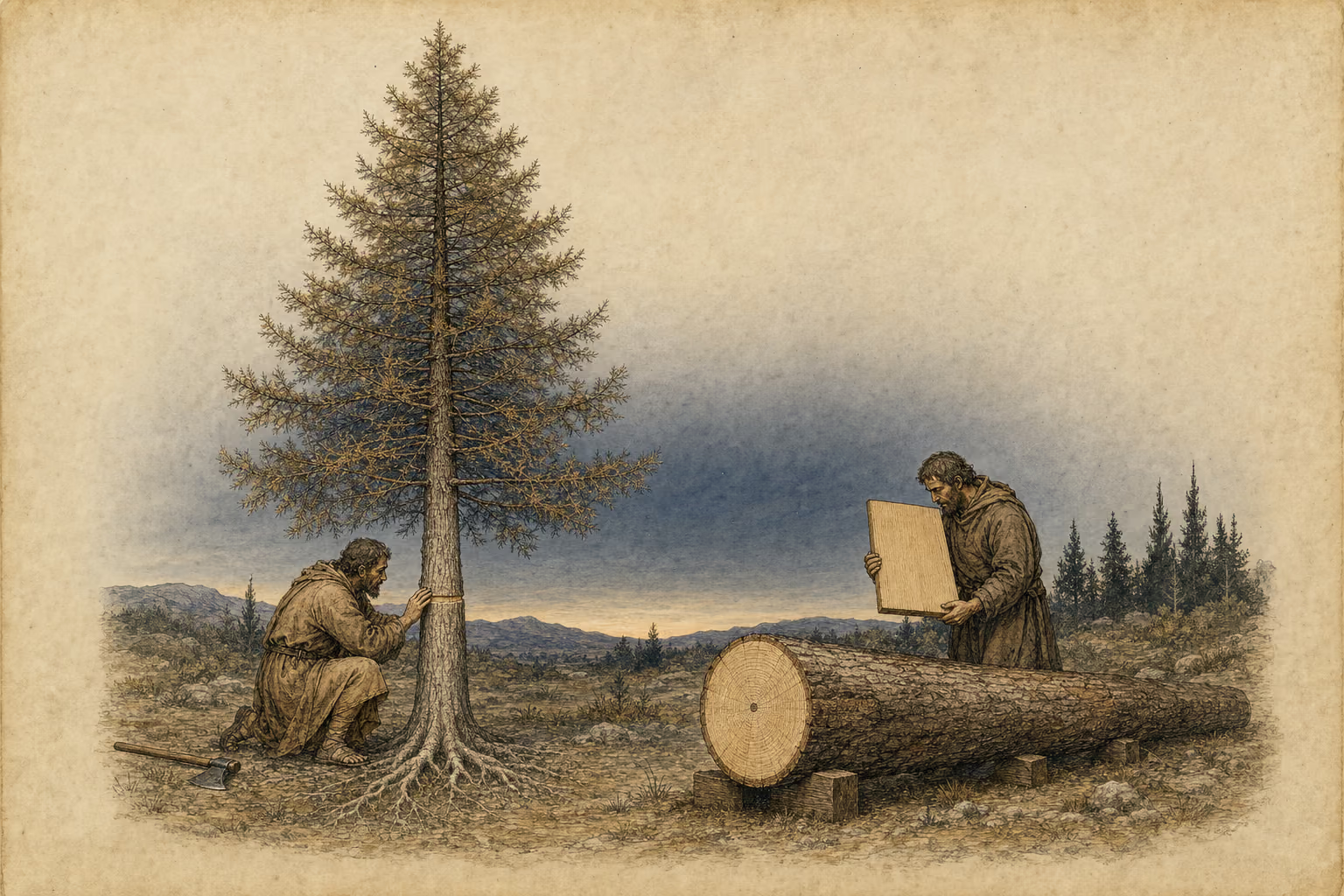
In Greece the female larch furnishes a wood which is known as ægis, and is just the colour of honey. This wood has been found to be proof against decay, and forms the pannels used by painters, being never known to gape or split; the portion thus employed is that which lies nearest to the pith. In the fir-tree this part is called “leuson” by the Greeks. In the cedar, too, the hardest part is the wood that lies nearest to the sap: after the slimy pith has been carefully removed, it has a similar degree of hardness to the bones in the bodies of animals. It is said, too, that in Greece the inner part of the elder is remarkably firm: indeed, those whose business it is to make hunting spears, prefer this material to all others, it being a wood composed wholly of skin and bone.
The proper time for felling trees that are wanted for barking, the round, tapering trees, for instance, that are employed in temples and for other purposes, is at the period of germination: for at other times it is quite impossible to detach the bark from the rotten wood that adheres to it, while the wood itself assumes a blackish hue. Squared logs, and wood from which the bark has been lopped, are generally cut in the period that intervenes between the winter solstice and the prevalence of the west winds; or else, if it is necessary to anticipate that period, at the setting of Arcturus and before that of the Lyre, the very earliest period being the summer solstice: the days of these respective constellations will be mentioned in the appropriate place.
In general it is looked upon as quite sufficient to use all due precaution that a tree is not rough-hewn before it has borne its yearly crop. The robur, if cut in spring, is subject to the attacks of wood-worm, but if cut in winter, will neither rot nor warp: otherwise it is very liable to bend and become awry, as well as to crack; the same is the case, too, with the cork-tree, even if cut down at the proper time. The state of the moon, too, is of infinite importance, and it is generally recommended that trees should be cut only between the twentieth and the thirtieth days of the month. It is generally agreed, however, by all, that it is the very best time for felling timber, when the moon is in conjunction with the sun, a day which is called by some persons the interlunium, and by others the moon’s silence. At all events, it was under these circumstances that Tiberius Cæsar gave orders for the larches to be cut in Rhætia, that were required for the purpose of rebuilding the bridge of the Naumachia after it had been destroyed by fire. Some persons say that the moon ought not only to be in conjunction, but below the horizon as well, a thing that can only happen in the night. If the conjunction should chance to fall on the very day of the winter solstice, the timber, they say, that is then felled will be of everlasting duration; the next best being the timber that is cut when the conjunction coincides with the constellations previously mentioned. There are some, too, who add the rising of the Dog-star as a favourable time, and say that it was at this period that the timber was cut which was employed in building the Forum of Augustus.
Wood which is intended for timber ought to be cut neither when too young nor too old. Some persons, too—and the practice is by no means without its utility—cut round the tree as far as the pith, and then leave the timber standing, so that all the juices may be enabled to escape. Going back to ancient times, it is a remarkable fact, that in the first Punic War the fleet commanded by Duillius was on the water within sixty days from the time the timber was cut: and, what is still more so, Piso relates that King Hiero had two hundred and twenty ships wholly constructed in forty-five days: in the second Punic War, too, the fleet of Scipio was at sea the fortieth day after the axe had been put to the tree. Such is the energy and dispatch that can be displayed on occasions of emergency.
Cato, a man of consummate authority in all practical matters, expresses himself in relation to timber to the following effect:—“For making presses, employ the wood of the sappinus in preference. When you root up the elm, the pine, the nut-tree, or, indeed, any other kind of tree, mind and do so when the moon is on the wane, after midday, and when there is no south wind blowing. The proper time for cutting a tree is when the seed is ripe, but be careful not to draw it away or plane it while the dew is falling.” He then proceeds to say —“Never touch the timber, except when the moon is on the change, or else at the end of the second quarter: at those periods you may either root up the tree, or fell it as it stands. The next seven days after the full moon are the best of all for grubbing up a tree. Be particularly careful, too, not to rough-hew timber, or, indeed, to cut or touch it, unless it is perfectly dry; and by no means while it is covered with frost or dew.”
The Emperor Tiberius used also to observe the changes of the moon for cutting his hair. M. Varro has recommended that the hair should be cut at full moon only, if we would avoid baldness.
From the larch, and still more the fir, after it has been cut, a liquid flows for a considerable period: these are the loftiest and straightest of all the trees. The fir is preferred for making the masts and sailyards of ships, on account of its comparative lightness. It is a common feature with these trees, in common with the pine, to have four rows of veins running along the wood, or else two, or sometimes only one. The heart of these trees is peculiarly well adapted for joiners’ work, and the best wood of all is that which has four layers of veins, it being softer than the rest: men of experience in these matters can instantly form a judgment of the quality from the bark. That part in the fir which is nearest to the ground is free from knots: when soaked in river water in the way we have already mentioned, and then barked, the wood of this part is known as sappinus; while that of the upper part, which is harder and knotty, goes by the name of “fusterna.” In trees, the side which looks towards the north-east is the most robust, and it is universally the case, that those which grow in moist and damp localities are of inferior quality, while in those which grow in warm and sunny spots, the wood is more compact and durable; hence it is, that at Rome the fir is preferred that grows on the shores of the Tyrrhenian Sea to that of the shores of the Adriatic.
There are also considerable differences in the qualities of these trees according to the country of their growth: the most esteemed are those of the Alps and the Apennines; in Gaul, those of Jura and Mount Vogesus; those also of Corsica, Bithynia, Pontus, and Macedonia; while the firs of Ænea and Arcadia are of inferior quality. Those, however, of Parnassus and Eubœa are the worst of all, the trees being branchy and knotted, and the wood very apt to rot. As for the cedar, those of Crete, Africa, and Syria are the most esteemed. Wood, if well rubbed with oil of cedar, is proof against wood-worm and decay. The juniper, too, has the same virtues as the cedar; in Spain it grows to a very considerable size, in the territory of the Vaccæi more particularly: the heart of this tree, too, is universally more firm and solid than cedar even. A general fault in all wood is that known as cross-grain, which is formed by contortions of the knots and veins. In the wood of some trees there are to be found knurs, like those in marble; these knurs are remarkably hard, and offer a resistance like that of a nail, to the great injury of the saw: in some cases, also, they are formed accidentally, from either a stone, or the branch of another tree lodging there, and being absorbed in the body of the tree.
In the Forum at Megara there long stood a wild olive upon which warriors who had distinguished themselves by their martial powers had been in the habit of suspending their arms. In the lapse of time the bark of this tree had closed, and quite concealed these arms from view. Upon it, however, depended the fate of the city; for it had been announced by an oracle, that when a tree there should bring forth arms, the fall of the city would be close at hand: and such, in fact, was the result, when the tree was cut down and greaves and helmets were found within the wood. It is said that stones found under these circumstances have the property of preventing abortion.