LIBER XVI · CAPUT 40
METHODS OF OBTAINING FIRE FROM WOOD
Latine · Mayhoff 1906
Amplissima arborum ad hoc aevi existimatur Romae visa, quam propter miraculum Tiberius Caesar in eodem ponte naumachiario exposuerat advectam cum reliqua materie, duravitque ad Neronis principis amphitheatrum. fruit autem trabs ea e larice, longa pedes cxx, bipedali crassitudine aequalis, quo intellegebatur vix credibilis reliqua altitudo fastigium ad cacumen aestimantibus. fuit memoria nostra et in porticibus saeptorum a M. Agrippa relicta aeque miraculi causa, quae diribitorio superfuerat, XX pedibus brevior, sesquipedali crassitudine. abies admirationis praecipuae visa est in nave, quae ex Aegypto Gai principis iussu obeliscum in Vaticano circo statutum quattuorque truncos lapidis eiusdem ad sustinendum eum adduxit. qua nave nihil admirabilius visum in mari certum est. CXX modium lentis pro saburra ei fuere. longitudo spatium obtinuit magna ex parte Ostiensis portus latere laevo. ibi namque demersa est Claudio principe cum tribus molibus turrium altitudine in ea exaedificatis obiter Puteolano pulvere advectisque. arboris eius crassitudo quattuor hominum ulnas conplectentium implebat, vulgoque auditur LXXX nummum et pluris malos venundari ad eos usus, rates vero conectiXL sestertium plerasque. at in Aegypto ac Syria reges inopia abietis cedro ad classes feruntur usi. maxima [ea] in Cypro traditur ad undeciremem Demetri succisa CXXX pedum, crassitudinis vero ad trium hominum conplexum. Germaniae praedones singulis arboribus cavatis navigant, quarum quaedam et xxx homines ferunt. <3> spississilma ex omni materie, ideo et gravissima iudicatur hebenus et buxus, graciles natura. neutra in aquis fluvitat, nec suber, si dematur cortex, nec larix. ex reliquis spississima lotos, quae Romae ita appellatur, dein robur exalburnatum. et huic nigricans color magisque etiam cytiso, quae proxime accedere hebenum videtur, quamquam non desunt qui Syriacas terebinthos nigriores adfirment. celebravit et Thericles nomine calices ex terebintho solitus facere torno; perquam probatur materies. omnium haec sola ungui vult meliorque fit oleo. colos mire adulteratur iuglande ac piro silvestri tinctis atque in medicamine decoctis. omnibus quae diximus spissa firmitas. ab iis proxima est cornus, quamquam non potest videri materies propter exilitatem, sed lignum non alio paene quam ad radios rotarum utile aut si quid cuneandum sit in ligno clavisve figendum ceu ferreis. ilex item et oleaster et olea atque castanea, carpinus, populus. haec et crispa aceris modo, si ulla materies idonea esset ramis saepe deputatis. castratio ilia est adimitque vires. de cetero plerisque horum, sed utique robori, tanta duritia, ut terebrari nisi madefactum non queat et ne sic quidem adactus avelli clavus. e diverso clavum non tenet cedrus. mollissima tilia. eadem videtur et calidissima. argumentum adferunt quod citissime ascias retundat. calidae et morus, laurus, hederae et omnia, e quibus igniaria fiunt.
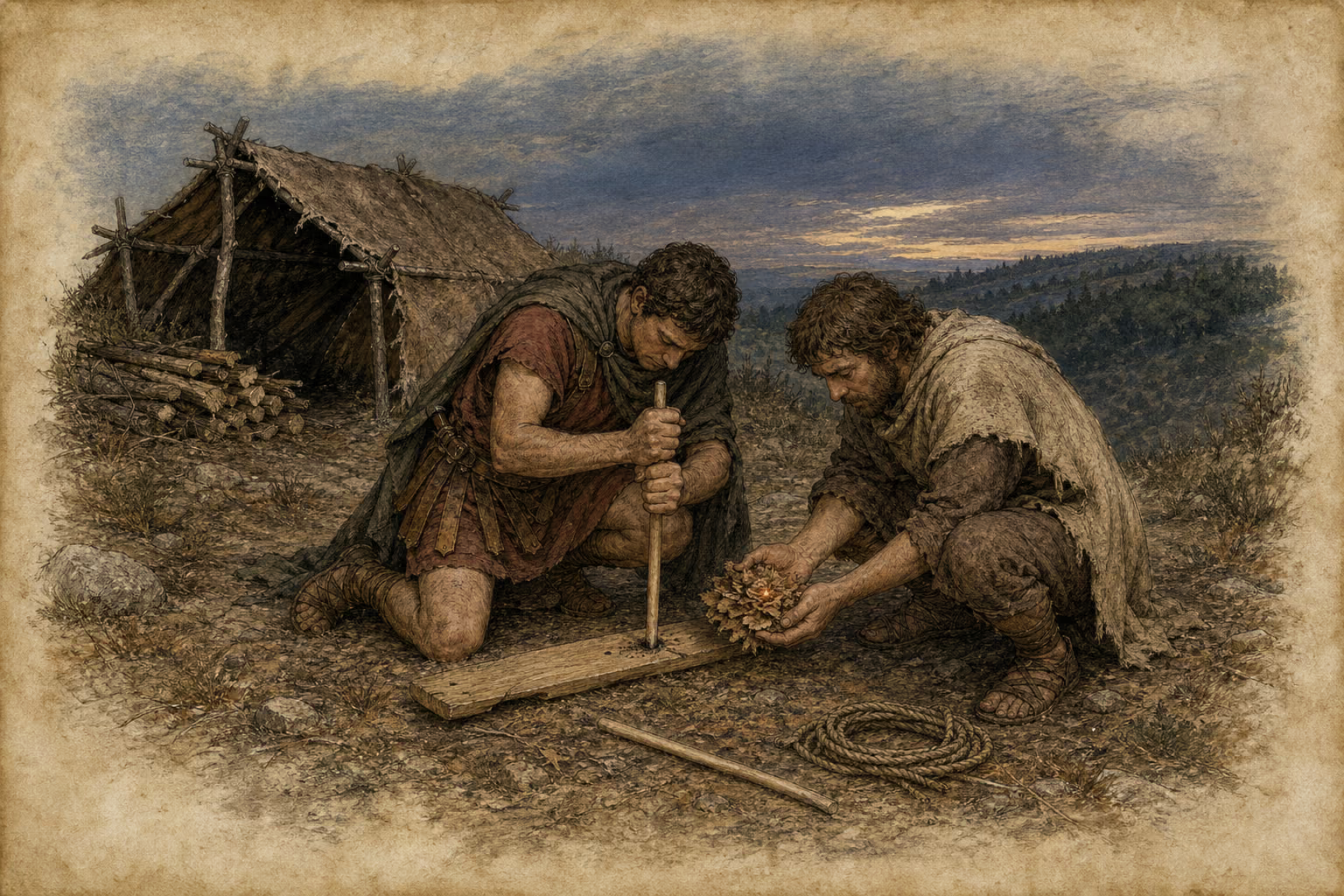
Exploratorum hoc usus in castris pastorumque repperit, quoniam ad excudendum ignem non semper lapidis occasio est. teritur ergo lignum ligno ignemque concipit adtritu, excipiente materie aridi fomitis, fungi vel foliorum facillimo conceptu. sed nihil hedera praestantius quae teratur, lauro quae terat. probatur et vitis e silvestribus —alia quam labrusca—, et ipsa hederae modo arborem scandens. frigidissima quaecumque aquatica, lentissima autem et ideo scutis faciendis aptissima quorum plaga contrahit se protinus cluditque suum vulnus et ob id contumacius tramittit ferrum, in quo sunt genere vitis, vitex, salix, tilia, betulla, sabucus, populus utraque. levissimae ex his vitex, salix ideoque utilissimae; omnes autem ad cistas quaeque flexili crate constent. habent et candorem, rigorem et in sculpturis facilitatem. est len- titia platano, sed madida, sicut alno. siccior eadem ulmo, fraxino, moro, ceraso, sed ponderosior. rigorem fortissime servat ulmus, ob id cardinibus coassamentisque portarum utilissima, quoniam minime torquetur, permutanda tantum sic, ut cacumen ab inferiore sit cardine, radix superior. palma est.... similis et suberis materies, spissae et malus pirusque, nec non acer, sed fragile, et quaecumque crispa. in omnibus silvestria et mascula differentia m cuiusque generis augent. et infecunda firmiora fertilibus, nisi quo in genere mares ferunt, sicut cupressus et cornus.
Cariem vetustatemque non sentiunt cupressus, cedrus, hebenus, lotus, buxum, taxus, iuniperus, oleaster, olea, e reliquis tardissime larix, robur, suber, castanea, iuglans. rimam fissuramque non capit sponte cedrus, cupressus, olea, buxum.
Maxime aeternam putant hebenum et cupressum cedrumque, claro de omnibus materiis iudicio in templo Ephesiae Dianae, utpote cum tota Asia extruente cxx annis peractum sit. convenit tectum eius esse e cedrinis trabibus. de simulacro ipso deae ambigitur. ceteri ex hebeno esse tradunt, Mucianus III cos. ex iis, qui proxime viso eo scripsere, vitigineum et numquam mutatum septies restituto templo, hanc materiam elegisse Endoeon, etiam nomen artificis nuncupans, quod equidem miror, cum antiquiorem Minerva quoque, non modo Libero patre, vetustatem ei tribuat. adicit multis foraminibus nardo rigari, ut medicatus umor alat teneatque iuncturas—quas et ipsas esse modico admodum miror—, valvas esse e cupresso et iam CCCC prope annis durare materiem omnem novae similem. id quoque notandum, valvas in glutinis compage quadriennio fuisse. cupressus in eas electa, quoniam praeter cetera in uno genere materiae nitor maxime valeat aeternus. non et simulacrum Veiovis in arce e cupresso durat a condita urbe DLXI anno dicatum? memorabile et Uticae templum Apollinis, ubi cedro Numidica trabes durant ita, ut positae fuere prima urbis eius origine annis MCLXXVIII, et in Hispania Sagunti templum Dianae a Zacyntho advectae cum conditoribus annis cc ante excidium Troiae, ut auctor est Bocchus; infra ipsum oppidum id habent—pepercit religione inductus Hannibal —iuniperi trabibus etiam nunc durantibus. super omnia memoraturaedis Aulide eiusdem deae saeculis ante Troianum bellum exaedificata, quonam genere materiae, scientia oblitterata. in plenum dici potest utique quae odore praecellant, eas et aeternitate praestare. a praedictis morus proxume laudatur, quae vetustate etiam nigrescit. et quaedam tamen in aliis diuturniora sunt usibus quam alia: ulmus in perflatu firma, robur defossum et in aquis quercus obruta. eadem supra terram rimosa facit opera torquendo sese. larix in umore praecipua et alnus nigra. robur marina aqua conrumpitur. non inprobatur et fagus in aqua et iuglans, hae quidem in iis quae defodiuntur vel principales, item iuniperus, eadem et subdialibus aptissima. fagus et cerrus celeriter marcescunt. aesculus quoque umoris inpatiens. contra adacta in terram in palustribus alnus aeterna onerisque quantilibet patiens. cerasus firma, ulmus et fraxinus lentae, sed facile pandantur, flexiles tamen, stantesque ac circumcisura siccatae fideliores. laricem in maritimis navibus obnoxiam teredini tradunt, omniaque praeterquam oleastrum et oleam. quaedam enim in mari, quaedam in terra vitiis opportuniora.
English · Bostock & Riley 1855–57
It is generally thought that the largest tree that has ever been seen, was the one that was exhibited at Rome, by Tiberius Cæsar, as an object of curiosity, upon the bridge of the Naumachia previously mentioned. It had been brought thither along with other timber, and was preserved till the construction of the amphitheatre of the Emperor Nero: it was a log of larch, one hundred and twenty feet long, and of an uniform thickness of a couple of feet. From this fact we can form an estimate of the original height of the tree; indeed, measured from top to bottom it must have been originally of a length that is almost incredible. In our own time, too, in the porticos of the Septa, there was a log which had been left there by M. Agrippa, as being equally an object of curiosity, having been found too large to be used in the building of the vote office there: it was twenty feet shorter than the one previously mentioned, and a foot-and-a-half in thickness. There was a fir, too, that was particularly admired, when it formed the mast of the ship, which brought from Egypt, by order of the Emperor Caius, the obelisk that was erected in the Vaticanian Circus, with the four blocks of stone intended for its base. It is beyond all doubt that there has been seen nothing on the sea more wonderful than this ship: one hundred and twenty thousand modii of lentils formed its ballast; and the length of it took up the greater part of the left side of the harbour at Ostia. It was sunk at that spot by order of the Emperor Claudius, three moles, each as high as a tower, being built upon it; they were constructed with cement which the same vessel had conveyed from Puteoli. It took the arms of four men to span the girth of this tree, and we not unfrequently hear of the price of masts for such purposes, as being eighty thousand sesterces or more: rafts, too, of this wood are sometimes put together, the value of which is forty thousand. In Egypt and Syria, it is said, the kings, for want of fir, used to employ cedar for building their ships: the largest cedar that we find mentioned is said to have come from Cyprus, where it was cut to form the mast of a galley of eleven tiers of oars that belonged to Demetrius: it was one hundred and thirty feet in length, and took three men to span its girth. The pirates of Germany navigate their seas in vessels formed of a single tree hollowed out: some of these will hold as many as thirty men.
Of all woods, the most compact, and consequently the heaviest, are the ebony and the box, both of them of a slender make. Neither of these woods will float in water, nor, indeed, will that of the cork tree, if the bark is removed; the same is the case, too, with the wood of the larch. Of the other woods, the driest is that of the tree known at Rome as the lotus, and next, that of the robur, when the white sap has been removed. The wood of the robur is dark, and that of the cytisus still more so, approaching, in fact, the nearest of all to the colour of ebony; though there are not wanting writers who assert that the wood of the Syrian terebinth is darker. An artist of the name of Thericles is highly spoken of for his skill in turning goblets from the wood of the terebinth: and, indeed, that fact is a proof of the goodness of the wood. Terebinth is the only wood that requires to be rubbed with oil, and is improved thereby. Its colour is imitated remarkably well with the walnut and the wild pear, which have its peculiar tint imparted to them by being boiled in colouring liquid. The wood of all the trees of which we have here made mention is firm and compact. Next after them comes the cornel, although it can hardly be looked upon as timber, in consequence of its remarkable slimness; the wood of it, in fact, is used for hardly any other purpose than the spokes of wheels, or else for making wedges for splitting wood, and pins or bolts, which have all the hardness of those of iron. Besides these, there are the holm-oak, the wild and the cultivated olive, the chesnut, the yoke-elm, and the poplar. This last is mottled similarly to the maple, and would be used for joiners’ work if wood could be good for anything when the branches are so often lopped: that acting upon the tree as a sort of castration, and depriving it of its strength. In addition to these facts, most of these trees, but the robur more particularly, are so extremely hard, that it is quite impossible to bore the wood till it has been soaked in water; and even then, a nail once driven home cannot be drawn out again. On the other hand, a nail has no hold in cedar. The wood of the lime is the softest of all, and, as it would appear, the hottest by nature; a proof of this, they say, is the fact that it will turn the edge of the adze sooner than any other wood. In the number, also, of the trees that are hot by nature, are the mulberry, the laurel, the ivy, and all those woods from which fire is kindled by attrition.
This is a method which has been employed by the outposts of armies, and by shepherds, on occasions when there has not been a stone at hand to strike fire with. Two pieces of wood are rubbed briskly together, and the friction soon sets them on fire; which is caught on dry and inflammable substances, funguses and leaves being found to ignite the most readily. There is nothing superior to the wood of the ivy for rubbing against, or to that of the laurel for rubbing with. A species of wild vine, too—not the same as the labrusca—which climbs up other trees like the ivy, is highly approved of. The coldest woods of all are those of the aquatic trees; but they are the most flexible also, and for that reason the best adapted for the construction of bucklers. On an incision being made in them, they will contract immediately, and so close up their wounds, at the same time rendering it more difficult for the iron to penetrate: in the number of these woods are the fig, the willow, the lime, the birch, the elder, and both varieties of the poplar.
The lightest of all these woods, and consequently the most useful, are the fig and the willow. They are all of them employed, however, in the manufacture of baskets and other utensils of wicker-work; while, at the same time, they possess a degree of whiteness and hardness which render them very well adapted for carving. The plane has considerable flexibility, but it is moist and slimy like the alder. The elm, too, the ash, the mulberry, and the cherry, are flexible, but of a drier nature; the wood, however, is more weighty. The elm is the best of all for retaining its natural toughness, and hence it is more particularly employed for socket beams for hinges, and cases for the pannelling of doors, being proof against warping. It is requisite, however, that the beam to receive the hinge should be inverted when set up, the top of the tree answering to the lower hinge, the root to the upper. The wood of the palm and the cork-tree is soft, while that of the apple and the pear is compact. Such, however, is not the case with the maple, its wood being brittle, as, in fact, all veined woods are. In every kind of tree, the varieties in the wood are still more augmented by the wild trees and the males. The wood, too, of the barren tree is more solid than that of the fruit-bearing ones, except in those species in which the male trees bear fruit, the cypress and the cornel, for instance.
The following trees are proof against decay and the otherwise injurious effects of age—the cypress, the cedar, the ebony, the lotus, the box, the yew, the juniper, and both the wild and cultivated olive. Among the others, the larch, the robur, the cork-tree, the chesnut, and the walnut are also remarkably durable. The cedar, cypress, olive, and box are never known to split or crack spontaneously.
Of all the woods, the ebony, the cypress, and the cedar are considered to be the most durable, a good proof of which is to be seen in the timber of which the Temple of Diana at Ephesus is built: it being now four hundred years since it was erected, at the joint expense of the whole of Asia; and, what is a well-known fact, the roof is wholly constructed of planks of cedar. As to the statue of the goddess, there is some doubt of what wood it is made; all the writers say that it is ebony, with the exception of Mucianus, who was three times consul, one of the very latest among the writers that have seen it; he declares that it is made of the wood of the vine, and that it has never been changed all the seven times that the temple has been rebuilt. He says, too, that it was Endæus who made choice of this wood, and even goes so far as to mention the artist’s name, a thing that really surprises me very much, seeing that he attributes to it an antiquity that dates before the times of Father Liber, and of Minerva even. He states, also, that, by the aid of numerous apertures, it is soaked with nard, in order that the moist nature of that drug may preserve the wood and keep the seams close together: I am rather surprised, however, that there should be any seams in the statue, considering the very moderate size it is. He informs us, also, that the doors are made of cypress, and that the wood, which has now lasted very nearly four hundred years, has all the appearance of new. It is worthy of remark, too, that the wood of these doors, after the pieces had been glued together, was left to season four years before they were put up: cypress was made choice of from the circumstance that it is the only kind of wood that maintains its polish to all future time.
And have we not the statue of Vejovis, also, made of cypress, still preserved in the Capitol, where it was consecrated in the year of the City 661? The Temple of Apollo, too, at Utica, is equally celebrated: there we may see beams of cedar still in existence, and in just the same condition in which they were when erected at the first building of that city, eleven hundred and seventy-eight years ago. At Saguntum, too, in Spain, there is a temple of Diana, which was brought thither by the original founders of the place, from the island of Zacynthus, in the year 200 before the taking of Troy, Bocchus says—It is preserved beneath the town, they say. Hannibal, being induced thereto by feelings of religious veneration, spared this temple, and its beams, made of juniper, are still in existence at this very day. But the most memorable instance of all is that of the temple which was dedicated to the same goddess at Aulis, several ages before the Trojan War: of what wood, however, it was originally built is a fact that has been long lost in oblivion. Speaking in general terms, we may say that those woods are of the greatest durability which are the most odoriferous.
Next to those woods of which we have just spoken, that of the mulberry is held in the highest degree of esteem, and it will even turn black when old. There are some trees, again, that are more durable than others, when employed for certain purposes. The wood of the elm lasts the best in the open air, that of the robur when buried in the ground, and that of the quercus when exposed to the action of water: indeed, the wood of this last, if employed in works above ground, is apt to split and warp. The wood of the larch thrives best in the midst of moisture; the same is the case, too, with that of the black alder. The wood of the robur spoils by exposure to the action of sea-water. The beech and the walnut are far from disapproved of for constructions under water, and, in fact, these are the principal woods, too, that are used for works under ground: the same is the case, also, with the juniper; which is equally serviceable when exposed to the atmosphere. The woods of the beech and the cerrus very quickly deteriorate, and that of the æsculus will not withstand the action of water. On the other hand, the alder, when driven into the ground in marshy localities, is of everlasting duration, and able to support the very heaviest weights. The wood of the cherry is strong, while those of the elm and the ash are pliable, though apt to warp: these last will still retain their flexibility, and be less liable to warp, if the wood is left to stand and dry upon the trunk after the pith has been cut around. It is said that the larch, when used for sea-going ships, is liable to the attacks of the teredo, as, in fact, all the woods are, with the exception of the wild and cultivated olive. It is a fact, too, that there are some woods that are more liable to spoil in the sea, and others in the ground.