LIBER XVII · CAPUT 10
THE MODES IN WHICH TREES BEAR
Latine · Mayhoff 1906
Et abunde praedicta ratione caeli ac terrae nunc de iis arboribus dicemus, quae cura hominum atque arte proveniunt. nec pauciora prope sunt genera; tam benigne naturae gratiam retulimus. aut enim semine proveniunt aut plantis radicis aut propagine aut avolsione aut surculo aut insito aut consecto arboris trunco. nam folia palmarum apud Babylonios seri atque ita arborem provenire Trogum credidisse demiror. quaedam autem pluribus generibus seruntur, quaedam omnibus.
Ac pleraque ex his natura ipsa docuit et in primis semen serere, cum decidens exceptumque terra vivesceret. sed quaedam non aliter proveniunt, ut castaneae, iuglandes, caeduis dumtaxat exceptis; et semine autem, quamquam dissimili, ea quoque, quae aliis modis seruntur, ut vites et mala atque pira. namque his pro semine nucleus, non, ut supra dictis, fructus ipse. et mespila semine nasci possunt. omnia haec tarda proventu ac degenerantia et insito restituenda, interdumque etiam castaneae.
Quibusdam natura contra omnino non degenerandi, quoquo modo serantur, ut cupressis, palmae, lauris. namque et laurus pluribus modis seritur. genera eius diximus. ex his Augusta et bacalis et tinus simili modo seruntur. bacae mense lanuario aquilonis adflatu siccatae leguntur expandunturque rarae, ne calefiant acervo. postea quidam fimo ad satum praeparatas urina madefaciunt, alii in qualo pedibus in profluente deculcant, donec auferatur cutis, quae alioqui uligine infestat nec patitur partum. in sulco repastinato palmi altitudine vicenae fere acervatim *seruntur*, mense Martio. eaedem et propagine*, triumphalis talea tantum. myrti genera omnia in Campania bacis seruntur, Romae propagine. Tarentinam Democritus et alio modo seri docet, grandissimis bacarum tusis leviter, ne grana frangantur,..... eaque intrita restem circumlini atque ita seri. parietem fore... densitatis, ex quo virgulae differantur. sic et spinas saepis causa serunt, tomice moris spinarum circumlita. pilas autem laurus et myrti inopia a trimatu tempestivum est transferre.
Inter ea, quae semine seruntur, Mago in nucibus operosus est. amygdalam in argilla molli meridiem spectante seri iubet; gaudere et dura calidaque terra, in pingui aut umida mori aut sterilescere; serendas quam maxime falcatas et e novella fimoque diluto maceratas per triduum aut pridie, quam serantur, aqua mulsa; mucrone defigi, aciem lateris in aquilonem spectare; ternas simul serendas, triangula ratione palmo inter se distantes; denis diebus adaquari, donec grandescant. iuglandes nuces porrectae seruntur commissuris iacentibus, pineae nucleis septenis fere in ollas perforatas additis aut ut laurus, quae bacis seritur. citrea grano et propagine, sorba semine et a radice planta et avolsione proveniunt, sed illa in calidis, sorba in frigidis et umidis.
Natura et plantaria demonstravit multarum radicibus pullulante subole densa et pariente matre, quas necet: eius quippe umbra turba indigesta premitur, ut in lauris, punicis, platanis, cerasis, prunis. Paucarum in hoc genere rami parcunt suboli, ut ulmorum palmarumque. nullis vero tales pulluli proveniunt nisi quarum radices amore solis atque imbris in summa tellure spatiantur. omnia ea non statim moris est in sua locari, sed prius nutrici dari atque in seminariis adolescere iterumque migrare, qui transitus mirum in modum mitigat etiam silvestres, sive arborum quoque, ut hominum, natura novitatis ac peregrinationis avida est, sive discedentes virus relincunt mansuescuntque tractatu ceu ferae, dum radici avellitur planta.
Et aliud genus simile monstravit, avolsique arboribus stolones vixere, quo in genere et cum perna sua avelluntur partemque aliquam e matris quoque corpore auferunt secum fimbriato corpore. hoc modo plantantur punicae, coryli, mali, sorbi, mespilae, fraxini, fici inprimisque vites. cotoneum ita satum degenerat. ex eodem inventum est surculos abscisos serere. hoc primo saepis causa factum, sabucis, cotoneo et rubis depactis, mox et culturae, ut populis, alnis, salici, quae vel inverso surculo seritur. iam haec ibi disponuntur, ubi libeat esse eas. quamquam seminarii curam ante convenit dici, quam transeatur ad alia genera.
Namque ad id praecipuum eligi solum refert, quoniam nutricem indulgentiorem esse quam matrem saepe convenit. sit ergo siccum sucosumque, bipalio subactum, advenis hospitale et quam simillimum terrae ei, in quam transferendae sint, ante omnia elapidatum munitumque ab incursu etiam gallinacei generis, quam minime rimosum, ne penetrans sol exurat fibras. intervallo sesquipedum seri—nam si inter se contingant, praeter alia vitia etiam verminosa fiunt—, sariri convenit saepius herbasque evelli, praeterea semina ipsa fruticantia supputare ac falcem pati consuescere. Cato et furcis crates inponi iubet altitudine hominis ad solem recipiendum atque integi culmo ad frigora arcenda. sic pirorum malorumque semina nutriri, sic pineas nuces, sic cupressos semine satas et ipsas. minimis id granis constat, vix ut perspici quaedam possint, non omittendo naturae miraculo e tam parvo gigni arbores, tanto maiore tritici et hordei grano, ne quis fabam reputet. quid simile origini suae habent malorum pirorumque semina? his principiis respuentem securis materiem nasci, indomita ponderibus inmensis prela, arbor es velis, turribus murisque inpellendis arietes! haec est naturae vis, haec potentia. super omnia erit e lacrima nasci aliquid, ut suo loco dicemus.
.Ergo e cupresso femina—mas enim, ut diximus, non gignit—pilulae collectae quibus docui mensibus siccantur sole, ruptaeque emittunt semen formicis mire expetitum, ampliato etiam miraculo tantuli animalis cibo absumi natalem tantarum arborum. seritur Aprili mense, area aequata cylindris aut volviculis, densum, terraque cribris superincernitur pollicis crassitudine. contra maius pondus attollere se non valet torqueturque sub terra. ob hoc et pavitur vestigiis. Leniter rigatur a solis occasu in trinis diebus, ut aequaliter bibat, donec erumpant. differuntur post annum dodrantali filo, custodita temperie, ut viridi caelo serantur ac sine aura. mirumque dictu, periculum eo tantum die est, si roravit quantulumcumque imbris, aut si adflavit. de reliquo tutae sunt perpetua securitate aquasque postea odere. et zizipha grano seruntur Aprili mense. tubures melius inseruntur in pruno silvestri et malo cotoneo et in calabrice. ea est spina silvestris; quaecumque optime et myxas recipit; utiliter et sorbos.
English · Bostock & Riley 1855–57
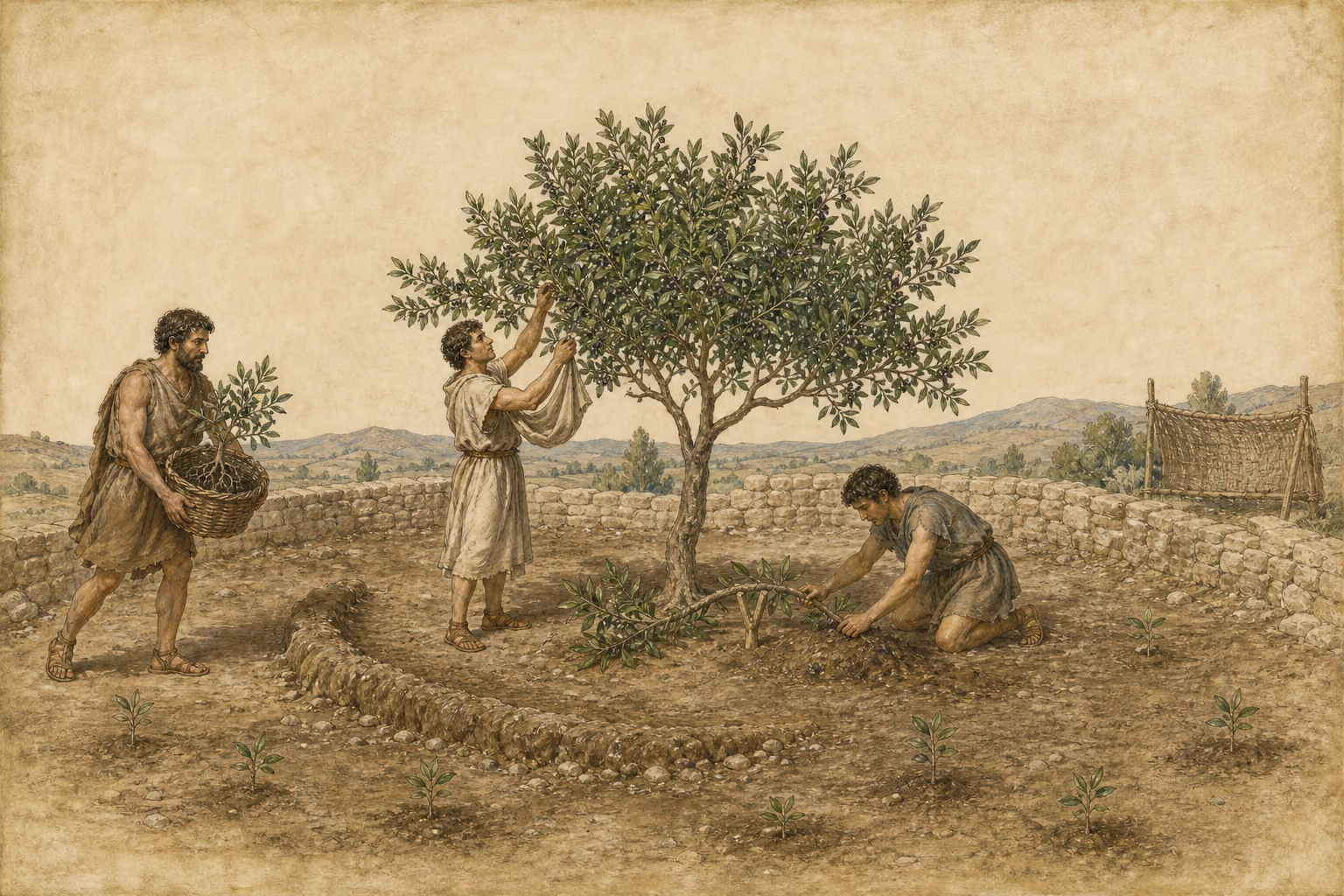
Having now treated at sufficient length of the requisite conditions of the weather and the soil, we shall proceed to speak of those trees which are the result of the care and inventive skill of man. Indeed, the varieties of them are hardly less numerous than of those which are produced by Nature, so abundantly have we testified our gratitude in return for her numerous bounties. For these trees, we find, are reared either from seed, or else by transplanting, by layers, by slips torn from the stock, by cuttings, by grafting, or by cutting into the trunk of the tree. But as to the story that the leaves of the palm are planted by the Babylonians, and so give birth to a tree, I am really surprised that Trogus should have ever believed it. Some of the trees are reproduced by several of the methods above enumerated, others, again, by all of them.
It is Nature herself that has taught us most of these methods, and more particularly that of sowing seed, as it was very soon evident how the seed on falling to the ground revived again in germination. Indeed, there are some trees that are capable of being propagated in no other way, the chesnut and the walnut, for instance; with the sole exception, of course, of such as are employed for coppice wood. By this method, too, as well as the others, some trees are propagated, though from a seed of a different nature, such, for instance, as the vine, the apple, and the pear; the seed being in all these cases in the shape of a pip, and not the fruit itself, as in that of the chesnut and the walnut. The medlar, too, can also be propagated by the agency of seed. All trees, however, that are grown by this method are very slow in coming to maturity, degenerate very rapidly, and must often be renewed by grafting: indeed, the chesnut even sometimes requires to be grafted.
On the other hand, there are some trees which have the property of never degenerating, in whatever manner they are reproduced, the cypress, palm, and laurel, for instance: for we find that the laurel is capable of being propagated in several ways. We have already made mention of the various kinds of laurel; those known as the Augustan, the baccalis, and the tinus are all reproduced in a similar manner. The berries are gathered in the month of January, after they have been dried by the north-east winds which then prevail; they are then kept separate and exposed to the action of the air, being liable to ferment if left in a heap. After this, they are first seasoned with smoke, and then steeped in urine, preparatory to sowing. Some persons put them in baskets of osier, and tread them down with the feet in running water, until the outer skin is removed, as it is found that the moisture which they contain is detrimental to them, and prevents them from germinating. A trench is then dug, about a palm in depth, and somewhere about twenty of the berries are then put into it, being laid in a heap: this is usually done in the month of March. These kinds of laurel admit of being propagated from layers also; but the triumphal laurel can be reproduced from cuttings only.
All the varieties of the myrtle are produced in Campania from the berry only, but at Rome from layers. Democritus, however, says that the Tarentine myrtle may be re-produced another way. They take the largest berries and pound them lightly so as not to crush the pips: with the paste that is thus made a rope is covered, and put lengthwise in the ground; the result of which is that a hedge is formed as thick as a wall, with plenty of slips for transplanting. In the same way, too, they plant brambles to make a hedge, by first covering a rope of rushes with a paste made of bramble-berries. In case of necessity, it is possible at the end of three years to transplant the suckers of the laurel and the myrtle that have been thus re-produced.
With reference to the plants that are propagated from seed, Mago treats at considerable length of the nut-trees—he says that the almond should be sown in a soft argillaceous earth, upon a spot that looks towards the south—that it thrives also in a hard, warm soil, but that in a soil which is either unctuous or moist, it is sure to die, or else to bear no fruit. He recommends also for sowing those more particularly which are of a curved shape like a sickle, and the produce of a young tree, and he says that they should be steeped for three days in diluted manure, or else the day before they are sown in honey and water. He says, also, that they should be put in the ground with the point downwards, and the sharp edge towards the north-east; and that they should be sown in threes and placed triangularly, at the distance of a palm from each other, care being taken to water them for ten days, until such time as they have germinated.
Walnuts when sown are placed lengthwise, lying upon the sides where the shells are joined; and pine nuts are mostly put, in sevens, into perforated pots, or else sown in the same way as the berries are in the laurels which are re-produced by seed. The citron is propagated from pips as well as layers, and the sorb from seed, by sucker, or by slip: the citron, however, requires a warm site, the sorb a cold and moist one.
Nature, too, has taught us the art of forming nurseries; when from the roots of many of the trees we see shooting up a dense forest of suckers, an offspring that is destined to be killed by the mother that has borne them. For by the shade of the tree these suckers are indiscriminately stifled, as we often see the case in the laurel, the pomegranate, the plane, the cherry, and the plum. There are some few trees, the elm and the palm for instance, in which the branches spare the suckers; however, they never make their appearance in any of the trees except those in which the roots, from their fondness for the sun and rain, keep close, as they range, to the surface of the ground. It is usual not to place all these suckers at once in the ground upon the spot which they are finally to occupy, but first to entrust them to the nursery, and to allow them to grow in seed-plots, after which they are finally transplanted. This transplanting softens down, in a most remarkable manner, those trees even which grow wild; whether it is that trees, like men, are naturally fond of novelty and change of scene, or that, on leaving the spots of their original growth, or to which they have been transplanted, they lay aside their bad qualities and become tame, like the wild animals, the moment they are separated from the parent stock.
Nature has also discovered another method, which is very similar to the last—for slips torn away from the tree will live. In adopting this plan, care should be taken to pull out the haunch of the slip where it adheres to the stock, and so remove with it a portion of the fibrous body of the parent tree. It is in this way that the pomegranate, the hazel, the apple, the sorb, the medlar, the ash, the fig, and more particularly the vine, are propagated. The quince, however, if planted in this way will degenerate, and it has been consequently found a better plan to cut slips and plant them: a method which was at first adopted for making hedges, with the elder, the quince, and the bramble, but came afterwards to be applied to cultivated trees, such as the poplar, the alder, and the willow, which last will grow if even the slip is planted upside down. In the case of cuttings, they are planted at once in the spot which it is intended they should occupy: but before we pass on to the other methods of propagation, it seems as well to mention the care that should be expended upon making seed-plots.
In laying out a seed-plot it is necessary that a soil of the very highest quality should be selected; for it is very often requisite that a nurse should be provided for the young plants, who is more ready to humour them than their parent soil. The ground should therefore be both dry and nutritious, well turned up with the mattock, replete with hospitality to the stranger plants, and as nearly as possible resembling the soil to which it is intended they should be transplanted. But, a thing that is of primary importance, the stones must be carefully gathered from off the ground, and it should be walled in, to ensure its protection from the depredations of poultry; the soil, too, should have as few chinks and crannies as possible, so that the sun may not be enabled to penetrate and burn up the roots. The young trees should be planted at distances of a foot and a-half, for if they happen to touch one another, in addition to other inconveniences, they are apt to breed worms; for which reason it is that they should be hoed as often as possible, and all weeds pulled up, the young plants themselves being carefully pruned, and so accustomed to the knife.
Cato recommends, too, that hurdles should be set up upon forks, the height of a man, for the purpose of intercepting the rays of the sun, and that they should be covered with straw to keep off the cold. He says that it is in this way that the seeds of the apple and the pear are reared, the pine-nut also, and the cypress, which is propagated from seed as well. In this last, the seed is remarkably small, so much so, in fact, as to be scarcely perceptible. It is a marvellous fact, and one which ought not to be overlooked, that a tree should be produced from sources so minute, while the grains of wheat and of barley are so very much larger, not to mention the bean. What proportion, too, is there between the apple and the pear tree, and the seeds from which they take their rise? It is from such beginnings, too, as these that springs the timber that is proof against the blows of the hatchet, presses that weights of enormous size even are unable to bend, masts that support the sails of ships, and battering-rams that are able to shake even towers and walls! Such is the might, such is the power that is displayed by Nature. But, a marvel that transcends all the rest, is the fact of a vegetable receiving its birth from a tear-like drop, as we shall have occasion to mention in the appropriate place.
To resume, however: the tiny balls which contain the seed are collected from the female cypress—for the male, as I have already stated, is barren. This is done in the months which I have previously mentioned, and they are then dried in the sun, upon which they soon burst, and the seed drops out, a substance of which the ants are remarkably fond; this fact, too, only serves to enhance the marvel, when we reflect that an insect so minute is able to destroy the first germ of a tree of such gigantic dimensions. The seed is sown in the month of April, the ground being first levelled with rollers, or else by means of rammers; after which the seed is thickly sown, and earth is spread upon it with a sieve, about a thumb deep. If laid beneath a considerable weight, the seed is unable to spring up, and is consequently thrown back again into the earth; for which reason it is often trodden only into the ground. It is then lightly watered after sunset every three days, that it may gradually imbibe the moisture until such time as it appears above ground. The young trees are transplanted at the end of a year, when about three-quarters of a foot in length, due care being taken to watch for a clear day with no wind, such being the best suited for the process of transplanting. It is a singular thing, but still it is a fact, that if, on the day of transplanting, and only that day, there is the slightest drop of rain or the least breeze stirring, it is attended with danger to the young trees; while for the future they are quite safe from peril, though at the same time they have a great aversion to all humidity. The jujube-tree is propagated from seed sown in the month of April. As to the tuber, it is the best plan to graft it upon the wild plum, the quince, and the calabrix, this last being the name that is given to a wild thorn. Every kind of thorn, too, will receive grafts remarkably well from the myxa plum, as well as from the sorb.