LIBER XVII · CAPUT 11
THE MODE OF PROPAGATING THE ELM
Latine · Mayhoff 1906
Plantas ex seminario transferre in aliud, priusquam suo loco ponantur, operose praecipi arbitror, licet translatione folia latiora fieri spondeant.
Ulmorum, priusquam foliis vestiantur, samara colligenda est circa Martias kalendas, cum flavescere incipit. dein, biduo in umbra siccata, serenda densa in refracto, terra super minuta incribrata crassitudine, qua in cupressis. pluviae si non adiuvent, rigandum. differendae ex arearum venis post annum in ulmaria intervallo pedali in quamque partem. Atinias ulmos autumno serere utilius, quia carentes semine plantis seruntur. in arbustum quinquennes sub urbe transferunt aut, ut quibusdam placet, quae vicenum pedum esse coeperunt. sulco, qui novenarius dicitur, altitudine pedum III, pari latitudine et eo amplius circa positas pedes terni undique e solido adaggerantur. arulas id vocant in Campania. intervalla ex loci natura sumuntur. rariores serendas in campestribus convenit. populos et fraxinos, quia festinantius germinant, disponi quoque maturius convenit, hoc est ab idibus Februariis, plantis et ipsas nascentes. in disponendis arboribus arbustisque ac vineis quincuncialis ordinum ratio vulgata et necessaria, non perflatu modo utilis, verum et aspectu grata, quoquo modo intueare, in ordinem se porrigente versu. populos eadem ratio semine quae ulmos serendi, transferendi quoque e seminariis eadem et silvis.
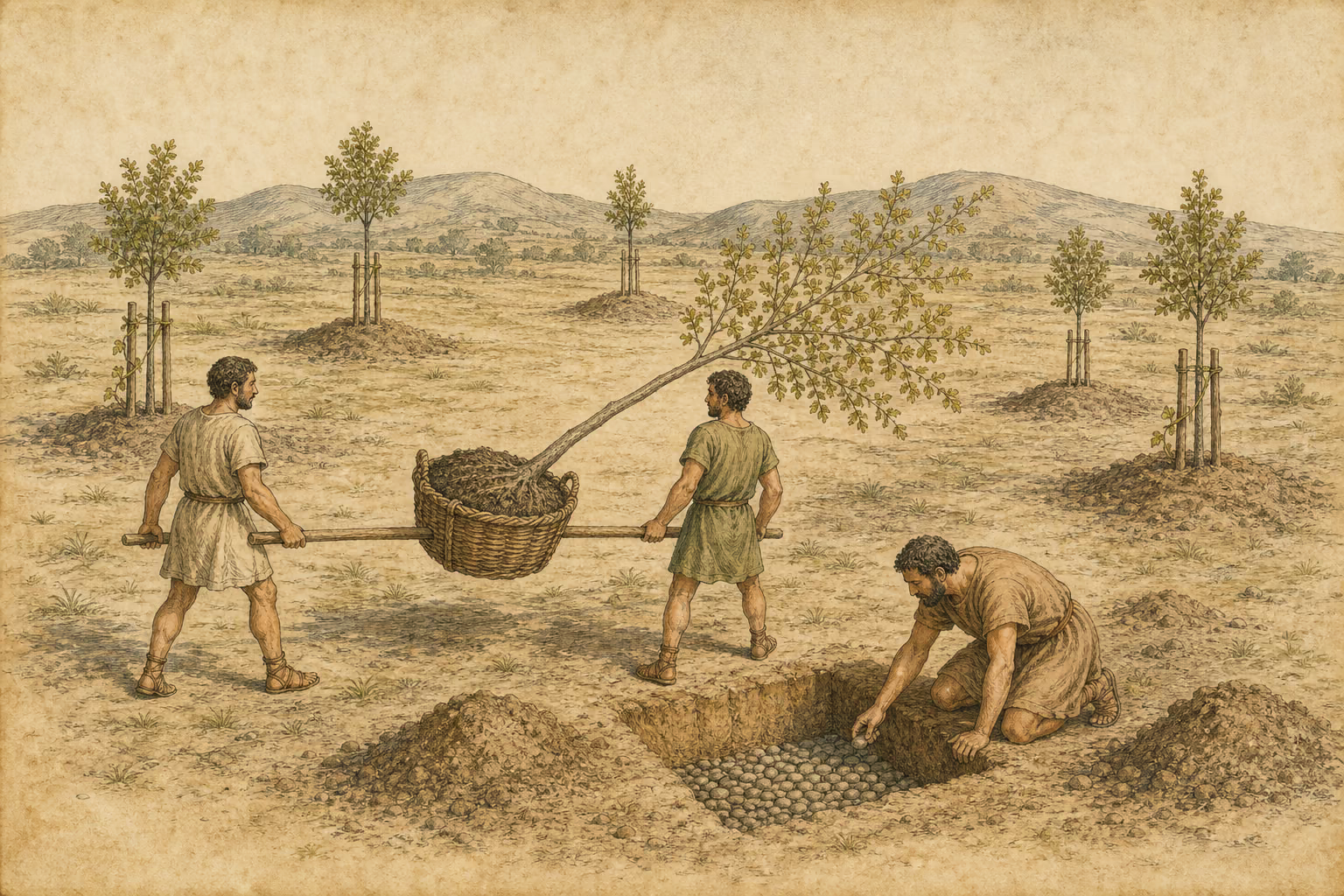
Ante omnia igitur in similem transferri terram aut meliorem oportet, nec ex tepidis aut praecocibus in frigidos aut serotinos situs, ut neque ex his in illos; praefodere scrobes ante; si fieri possit, tanto, donec pingui caespite obducantur. Mago ante annum iubet, ut solem pluviasque conbibant, aut, si id condicio largita non sit, ignes in mediis fieri ante menses duos, nec nisi post imbres in his seri, altitudinem eorum in argilloso aut duro solo trium cubitorum esse in quamque partem, in pronis palmo amplius, iubetque caminata fossura ore conpressiore esse, in nigra vero terra duo cubita et palmum quadratis angulis eadem mensura. Graeci auctores consentiunt non altiores quino semipede esse debere nec latiores II pedibus, nusquam vero semisquipede minus altos. quoniam in umido solo ad vicina aquae perveniatur, Cato, si locus aquosus sit, latos pedes ternos in faucibus imosque palmum et pedem, altitudine IIII pedum, eos lapide consterni aut, si non sit, perticis salignis viridibus, si neque hae sint, sarmentis, ita ut in altitudinem semipes detrahatur. nobis adiciendum videtur ex praedicta arborum natura, ut altius demittantur ea, quae summa tellure gaudent, tamquam fraxinus, olea. haec et similia quaternos pedes oporteat demitti. ceteris altitudinis pedes terni suffecerint. *est innoxium adradi partes, quae se nudaverint.* Excide radicem, inquit, istam, Papirius Cursor imperator, ad terrorem Praenestinorum praetoris destringi securi iussa.* testas, aliqui lapides rotundos subici malunt, qui et contineant umorem et transmittant, non idem planos facere et a terreno arcere radicem existimantes. glarea substrata inter utramque sententiam fuerit.
Arborem nec minorem bima nec maiorem trima transferre quidam praecipiunt, alii cum manum conpleat, Cato crassiorem v digitis. non omisisset idem, si attineret, meridianam caeli partem signare in cortice, ut translatae isdem et adsuetis statuerentur horis, ne aquiloniae meridianis oppositae solibus finderentur et algerent meridianae aquilonibus. quod e diverso adfectant etiam quidam in vite ficoque, permutantes in contrarium. densiores enim folio ita fieri magisque protegere fructum et minus amittere, ficumque sic etiam scansilem fieri. plerique id demum cavent, ut plaga deputati cacuminis meridiem spectet, ignari fissuris nimii vaporis opponi. id quidem in horam diei quintam vel octavam spectare maluerim. aeque latet non neglegendum, ne radices mora inarescant neve a septentrionibus aut ab ea parte caeli usque ad exortum brumalem vento flante effodiantur arbores, aut certe non adversae his ventis radices praebeantur, propter quod emoriuntur ignaris causae agricolis. Cato omnes ventos et imbrem quoque in tota translatione damnat. et ad haec proderit quam plurimum terrae, in qua vixerint, radicibus cohaerere ac totas cum caespite circumligari cum ob id Cato in corbibus transferri iubeat, procul dubio utilissime. qui quidem summam terram contentus est subdi. quidam punicis malis substrato lapide non rumpi pomum in arboribus tradunt.radices inflexas poni melius; arborem ipsam ita locari, ut media sit totius scrobis, necessarium. ficus si in scilla—bulborum hoc genus est— seratur, ocissime ferre traditur pomum neque vermiculationi obnoxium, quo vitio carent et reliqua poma similiter sata. radicum filis magnam adhibendam curam, ut exemptas appareat, non evolsas, quis dubitet? qua ratione et reliqua confessa omittimus, sicuti terram circa radices festuca cospissandam, quod Cato primum in ea re esse censet, plagam quoque a trunco oblini fimo et foliis praeligari praecipiens.
English · Bostock & Riley 1855–57
As to recommending transferring the young plants from the seed-plot to another spot before finally planting them out, I look upon it as advice that would only lead to so much unnecessary trouble, although it is most confidently urged that by this process the leaves are sure to be considerably larger than they otherwise would.
The elm seed is collected about the calends of March, before the tree is covered with leaves, but is just beginning to have a yellow tint. It is then left to dry two days in the shade, after which it is thickly sown in a broken soil, earth that has been riddled through a fine sieve being thrown upon it, to the same thickness as in the case of the cypress. If there should happen to be no rain, it is necessary to water the seed. From the nursery the young plants are carried at the end of a year to the elm-plots, where they are planted at intervals of a foot each way. It is better to plant elms in autumn that are to support the vine, as they are destitute of seed and are only propagated from plants. In the vicinity of the City, the young elms are transplanted into the vineyard at five years old, or, according to the plan adopted by some, when they are twenty feet in height. A furrow is first drawn for the purpose, the name given to which is “novenarius,” being three feet in depth, and the same in breadth or even more; into this the young tree is put, and the earth is moulded up around it to the height of three feet every way. These mounds are known by the name of “arula” in Campania. The intervals are arranged according to the nature of the spot; but where the country is level, it is requisite that the trees should be planted wider apart. Poplars and ashes, too, as they germinate with greater rapidity, ought to be planted out at an earlier period, or, in other words, immediately after the ides of February. In arranging trees and shrubs for the support of the vine, the form of the quincunx is the one that is generally adopted, and, indeed, is absolutely necessary: it not only facilitates the action of the wind, but presents also a very pleasing appearance, for whichever way you look at the plantation, the trees will always present themselves in a straight line. The same method is employed in propagating the poplar from seed as the elm, and the mode of transplanting it from the seed-plot is the same as that adopted in transplanting it from the forests.
But it is more particularly necessary in transplanting, that the trees should always be removed to a soil that is similar, or else superior, to the one in which they grew before. If taken from warm or early ripening localities, they ought not to be removed to cold or backward sites, nor yet, on the other hand, from these last to the former. If the thing can possibly be done, the holes for transplanting should be dug sufficiently long before to admit of their being covered throughout with a thick coat of grass. Mago recommends that they should be dug a whole year beforehand, in order that they may absorb the heat of the sun and the moisture of the showers; or, if circumstances do not admit of this, that fires should be made in the middle of them some two months before transplanting, that being only done just after rain has fallen. He says, too, that in an argillaceous or a hard soil, the proper measurement is three cubits every way, and on declivitous spots one palm more, care being taken in every case to make the hole like the chimney of a furnace, narrower at the orifice than at the bottom. Where the earth is black, the depth should be two cubits and a palm, and the hole dug in a quadrangular form.
The Greek writers agree in pointing out much the same proportions, and are of opinion that the holes ought not to be more than two feet and a half in depth, or more than two feet wide: at the same time, too, they should never be less than a foot and a half in depth, even though the soil should be wet, and the vicinity of water preclude the possibility of the soil going any deeper. “If the soil is watery,” says Cato, “the hole should be three feet in width at the orifice, and one palm and a foot at the bottom, and the depth four feet. It should be paved, too, with stones, or, if they are not at hand, with stakes of green willow, or, if these cannot be procured, with a layer of twigs; the depth of the layer so made being a foot and a half.”
It appears to me that I ought here to add, after what has been said with reference to the nature of trees, that the holes should be sunk deeper for those which have a tendency to run near the surface of the earth, such as the ash and the olive, for instance. These trees, in fact, and others of a similar nature, should be planted at a depth of four feet, while for the others three feet will be quite sufficient. “Cut down that stump,” said Papirius Cursor, the general, when to the great terror of the prætor of Præneste, he had ordered the lictors to draw their axes. And, indeed, there is no harm in cutting away those portions [of the root] which have become exposed. Some persons recommend that a bed should be formed at the bottom, of potsherds or round pebbles, which both allow the moisture to pass and retain as much as is wanted; while at the same time they are of opinion that flat stones are of no use in such a case, and only prevent the root from penetrating the earth. To line the bottom with a layer of gravel would be to follow a middle course between the two opinions.
Some persons recommend that a tree should not be transplanted before it is two years old, nor yet after three, while others, again, are of opinion that if it is one year old it is quite sufficient; Cato thinks that it ought to be more than five fingers in thickness at the time. The same author, too, would not have omitted, if it had been of any importance, to recommend that a mark should be made on the bark for the purpose of pointing out the southern aspect of the tree; so that, when transplanted, it may occupy exactly the same position that it has previously done; from an apprehension that the north side of the tree, on finding itself opposite to a southern sun, might split, and the south side be nipped by the north-eastern blasts. Indeed, there are some persons who follow a directly opposite practice even in the vine and the fig, by placing the north side of the tree, when transplanted, towards the south, and vice versâ; being of opinion that by adopting this plan the foliage becomes all the thicker and the better able to protect the fruit, which is less liable to fall off in consequence, and that the tree is rendered all the better for climbing. Most people, however, take the greatest care to turn to the south that part of the tree from which the branches have been lopped at the top, little thinking that they expose it thereby to a chance of splitting from the excessive heat. For my own part, I should prefer that this part of the tree should face that point of the heavens which is occupied by the sun at the fifth or even the eighth hour of the day. People are also equally unaware that they ought not, through neglect, to let the roots be exposed to the air long enough to get dry; and that the ground should not be worked about the roots of trees while the wind is blowing from the north, or, indeed, from any point of the heavens that lies between north and south-east; or, at all events, that the roots should not be left to lie exposed to these winds; the result of such modes of proceeding being, that the trees die, the grower being all the while in total ignorance of the cause.
Cato disapproves, too, of all wind and rain whenever the work of transplanting is going on. When this is the case, it will be beneficial to let as much adhere to the roots as possible of the earth in which the tree has grown, and to cover them all round with clods of earth: it is for this reason that Cato recommends that the young trees should be conveyed in baskets, a very desirable method, no doubt. The same writer, too, approves of the earth that has been taken from the surface being laid at the bottom of the hole. Some persons say, that if a layer of stones is placed beneath the root of the pomegranate, the fruit will not split while upon the tree. In transplanting, it is the best plan to give the roots a bent position, but it is absolutely necessary that the tree should be placed in such a manner as to occupy exactly the centre of the hole. The fig-tree, if the slip when planted is stuck in a squill —such being the name of a species of bulb—is said to bear with remarkable rapidity, while the fruit is exempt from all attacks of the worm: the same precaution, too, in planting, will preserve the fruit of all other trees in a similar manner. Who is there, too, that can entertain a doubt that the very greatest care ought to be taken of the roots of the fig-tree when transplanted?—indeed, it ought to bear every mark of being taken, and not torn, from out of the earth. Upon this subject I omit various other practical precepts, such, for instance, as the necessity of moulding up the roots with a rammer, a thing that Cato looks upon as of primary importance; while, at the same time, he recommends that the wound made in the stock should be first covered with dung, and then bound with a layer of leaves.