LIBER XVII · CAPUT 14
GRAFTING: THE FIRST DISCOVERY OF IT
Latine · Mayhoff 1906
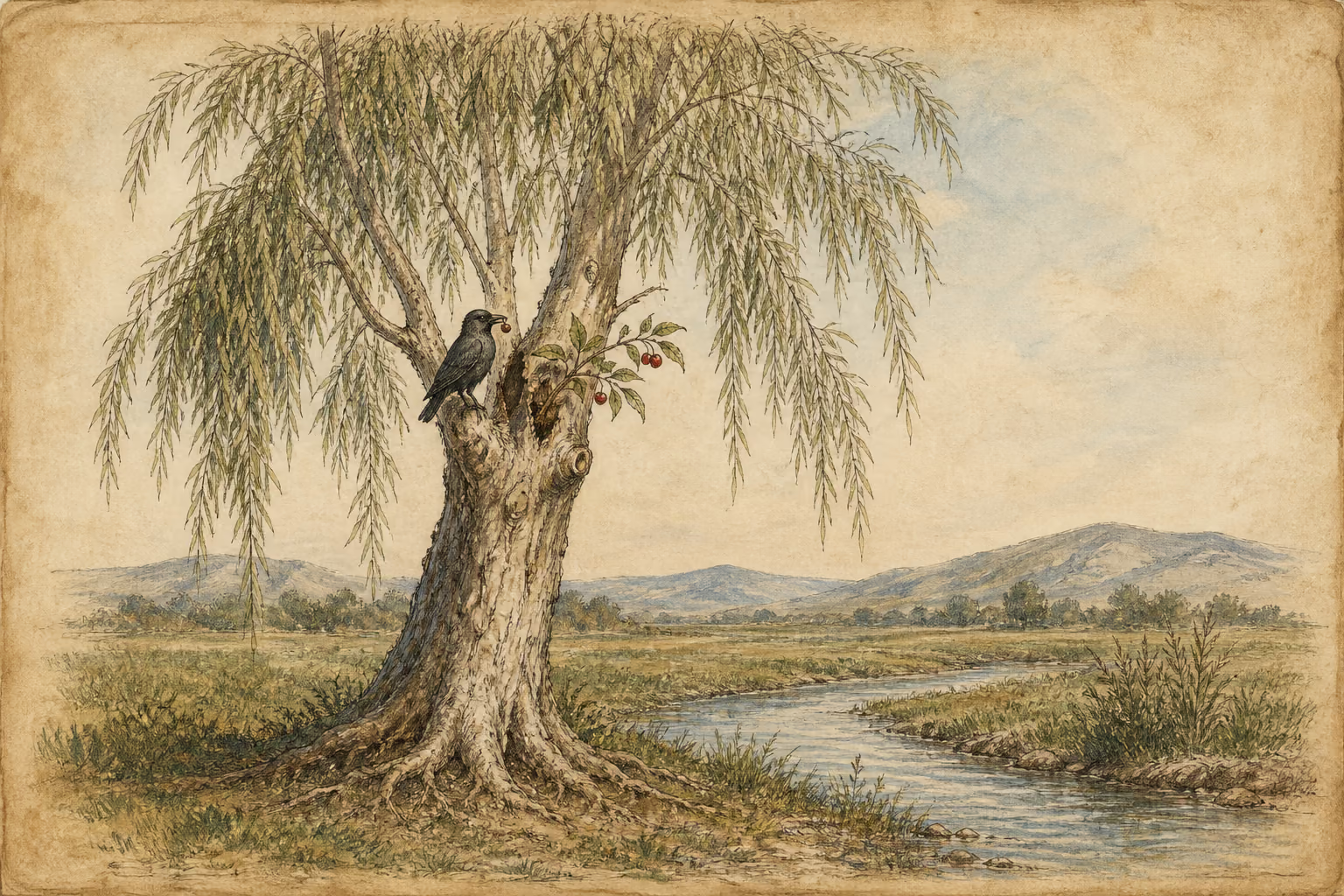
Semine quoque inserere natura docuit raptim avium fame devorato solidoque et alvi tepore madido cum fecundo fimi medicamine abiecto in mollibus arborum lecticis et ventis saepe translato in aliquas corticum rimas, unde vidimus cerasum in salice, platanum in lauru, laurum in ceraso et bacas simul discolores. tradunt et monedulam condentem semina in thensauros cavernarum eiusdem rei praebere causas.
Hinc nata inoculatio sutoriae simili fistula ape-100 riendi in arbore oculum cortice exciso semenque includendi eadem fistula sublatum ex alia. in ficis et malis haec fuit inoculatio antiqua. Vergiliana quaerit sinum in nodo germine expulsi corticis gemmamque ex alia arbore includit.
Et hactenus natura ipsa docuit, insitionem autem casus, magister alius et paene numerosior, ad hunc modum: agricola sedulus casam saepis munimento cingens, quo minus putrescerent sudes, limen subdidit ex hedera. at illae vivaci morsu adprehensae suam ex aliena fecere vitam, apparuitque truncum esse pro terra. aufertur ergo serra aequaliter superficies, levigatur falce truncus. ratio postea duplex, et prima inter corticem lignumque inserendi. timebant prisci truncum findere, mox inforare ausi medio ipsique in eo medullae calamum imprimebant, unum inserentes, neque enim plures capiebat medulla. subtilior postea ratio vel senos addi, mortalitati eorum et numero, per media trunco leniter fisso cuneoque tenui fissuram custodiente, donec cuspidatim decisus descendat in rimam calamus.
Multa in hoc servanda: primum omnium, quae patiatur coitum talem arbor et cuius arboris. varie quoque et non isdem in partibus subest omnibus sucus. vitibus ficisque media sicciora et e summa parte conceptus; ideo illinc surculi petuntur. oleis circa media sucus, inde et surculi; cacumina sitiunt. facillime coalescunt quibus eadem corticis natura quaeque pariter florentia eiusdem horae cognationem sucorumque societatem habent. lenta res, quotiens umidis repugnant sicca, mollibus corticum duri. reliqua observatio, ne fissura in nodo fiat—repudiat quippe advenam inhospitalis duritia—, ut in parte nitidissima, ne longior multo tribus digitis, ne obliqua, ne tralucens. Vergilius e cacumine inseri vetat, ceitumque est ab umeris arborum orientem aestivum spectantibus surculos petendos, et e feracibus et e germine novello, nisi vetustae arbori inserantur: ii enim robustiores esse debent. praeterea ut praegnates, hoc est germinatione turgentes et qui parere illo speraverint anno, bimi utique nec tenuiores digito minimo. inseruntur autem et inversi, cum id agitur, ut minor altitudo in latitudinem se fundat. ante omnia gemmantes nitere conveniet; nihil usquam ulcerosum aut retorridum spei favet. medulla calami commissurae in matre ligni corticisque iungatur, id enim satius quam foris cortici aequari. calami exacutio medullam ne nudet, tamen tenui fistula detegat. fastigatio levi descendat cuneo tribus non ampliore digitis, quod facillime contingit tinctum aqua radentibus. ne exacuatur in vento, ne cortex a ligno decedat alterutri. calamus ad corticem usque suum deprimatur. ne luxetur, dum deprimitur, neve cortex replicetur in rugas. ideo lacrimantes calamos inseri non oportet, non, Hercules, magis quam aridos, quia illo modo labat umore nimio cortex, hoc vitali defectu non umescit neque concorporatur. id etiam religionis servant, ut luna crescente, ut calamus utraque deprimatur manu. et alioqui hoc in opere duae simul manus minus nituntur, necessario temperamento. validius demissi tardius ferunt, fortius durant, contraria ex diverso. ne hiscat nimium rima laxeque capiat, aut ne parum et exprimat aut conpressum necet; hoc maxime cavendum in praevalide accipientis trunco.ut media fissura relinquatur, quidam vestigio fissurae falce in truncis facto salice praeligant marginem ipsum, postea cuneo findunt continente vinculo libertatem dehiscendi.— (quaedam in plantario insita eodem die transferuntur).— si crassior truncus inseratur, inter corticem et lignum inseri melius, cuneo optime osseo, cortexne rumpatur, laxato. cerasi libro dempto finduntur. hae solae et post brumam inseruntur. dempto libro habent veluti lanuginem, quae si conprehendit insitum, putrefacit. vinculun cuneo adacto utilissime adstringitur. inserere aptissimum, quam proxime terrae patiatur nodorum truncique ratio. eminere calami VI digitorum longitudine non amplius debent. Cato argillae vel cretae harenam fimumque bubulum admiscet atque ita usque ad lentorem subigi iubet idque interponi et circumlini. ex iis, quae commentatus est, facile apparet illa aetate inter lignum et corticem nec alio modo inserere solitos aut ultra latitudinem II digitorum calamos demittere. inseri autem praecipit pira ac mala per ver et post solstitium diebus L et post vindemiam, oleas autem et ficos per ver tantum, luna sitiente, [hoc est sicca] praeterea post meridiem ac sine vento austro. mirum quod non contentus insitum munisse, ut dictum est, et caespite ab imbre frigoribusque protexisse ac mollibus bifidorum viminum fasciis, lingua bubula — herbae id genus est—insuper optegi iubet eamque inligari opertam stramentis. nunc abunde arbitrantur paleato luto sarcireet libro II digitos insito exstante. verno inserentes tempus urguet, incitantibus se gemmis praeterquam in olea, cuius dintissime oculi parturiunt, minimumque suci habet sub cortice, qui nimius insitis nocet. punica vero et ficum quaeque alia sicca sunt recrastinare minime utile. pirum vel florentem inserere licet et in Maium quoque mensem protendere insitiones. quod si longius adferantur pomorum calami, rapo infixos optime custodire sucum arbitrantur, servari inter duos imbrices iuxta rivos vel piscinas utrimque terra obstructos,
English · Bostock & Riley 1855–57
Nature has also taught us the art of grafting by means of seed. We see a seed swallowed whole by a famished bird; when softened by the natural heat of the crop, it is voided, with the fecundating juices of the dung, upon some soft couch formed by a tree; or else, as is often the case, is carried by the winds to some cleft in the bark of a tree. Hence it is that we see the cherry growing upon the willow, the plane upon the laurel, the laurel upon the cherry, and fruits of various tints and hues all springing from the same tree at once. It is said, too, that the jack-daw, from its concealment of the seeds of plants in holes which serve as its store-houses, gives rise to a similar result.
In this, too, the art of inoculating took its rise. By the aid of an instrument similar to a shoe-maker’s paring-knife an eye is opened in a tree by paring away the bark, and another bud is then enclosed in it, that has been previously removed with the same instrument from another tree. This was the ancient mode of inoculation with the fig and the apple. That again, described by Virgil, requires a slight fissure to be made in the knot of a bud which has burst through the bark, and in this is enclosed a bud taken from another tree. Thus far has Nature been our instructor in these matters.
A different mode of engrafting, however, has been taught us by chance, another great instructor, and one from whom, perhaps, we have learnt a still greater number of lessons. A careful husbandman, being desirous, for its better protection, to surround his cottage with a palisade, thrust the stakes into growing ivy, in order to prevent them from rotting. Seized by the tenacious grasp of the still living ivy, the stakes borrowed life from the life of another wood, and it was found that the stock of a tree acted in place of earth.
For this method of grafting the surface is made level with a saw, and the stock carefully smoothed with the pruning-knife. This done, there are two modes of proceeding, the first of which consists in grafting between the bark and the wood. The ancients were fearful at first of cutting into the wood, but afterwards they ventured to pierce it to the very middle, and inserted the graft in the pith, taking care to enclose but one, because the pith, they thought, was unable to receive more. An improved method has, however, in more recent times, allowed of as many as six grafts being inserted, it being considered desirable by additional numbers to make a provision for the contingency of some of them not surviving. With this view, an incision is carefully made in the middle of the stock, a thin wedge being inserted to prevent the sides from closing, until the graft, the end of which is first cut to a point, has been let into the fissure. In doing this many precautions are necessary, and more particularly every care should be taken that the stock is that of a tree suitable for the purpose, and that the graft is taken from one that is proper for grafting. The sap, too, is variously distributed in the several trees, and does not occupy the same place in all. In the vine and the fig the middle of the tree is the driest, and it is in the summit that the generative power resides; hence it is, that from the top the grafts are selected. In the olive, again, the sap lies in the middle of the tree, and the grafts are accordingly taken from thence: the upper part being comparatively dry. The graft takes most easily in a tree, the bark of which is of a similar nature to its own, and which, blossoming at the same time as itself, has an affinity with it in the development of the natural juices. On the other hand, the process of uniting is but slow where the dry is brought in contact with the moist, and the hard bark with the soft.
The other points to be observed are the following: the incision must not be made in a knot, as such an inhospitable rigidity will certainly repel the stranger plant; the incision should be made, too, in the part which is most compact, and it must not be much more than three fingers in length, not in a slanting direction, nor yet such as to pierce the tree from side to side. Virgil is of opinion, that the grafts should not be taken from the top, and it is universally agreed that it is best to select them from the shoulders of the tree which look towards the north-east; from a tree, too, that is a good bearer, and from a young shoot, unless, indeed, the graft is intended for an old tree, in which case it should be of a more robust growth. In addition to this, the graft ought to be in a state of impregnation, that is to say, swelling with buds, and giving every promise of bearing the same year; it ought, too, to be two years old, and not thinner than the little finger. The graft is inserted at the smaller end, when it is the object of the grower that it should not grow to any considerable length, but spread out on either side. But it is more particularly necessary that the buds upon the graft should be smooth and regular, and there must be nothing upon it at all scabbed or shrivelled. Success may be fully reckoned on if the pith of the graft is brought in contact with the wood and bark of the stock; that being a much better plan than merely uniting them bark to bark. In pointing the graft, the pith ought not to be laid bare; still, however, it should be pared with a small knife, so that the point may assume the form of a fine wedge, not more than three fingers in length, a thing that may be very easily effected by first steeping it in water and then scraping it. The graft, however, must not be pointed while the wind is blowing, and care must be taken that the bark is not rubbed off from either graft or stock. The graft must be thrust into the stock up to the point where the bark begins; care, too, must be taken not to wrench off the bark during the process of insertion, nor must it be thrust back so as to form any folds or wrinkles. It is for this reason that a graft should not be used that is too full of sap, no, by Hercules! no more than one that is dry and parched; for by doing so, in the former case, from the excess of moisture, the bark becomes detached, and in the latter, from want of vitality, it yields no secretions, and consequently will not incorporate with the stock.
It is a point most religiously observed, to insert the graft during the moon’s increase, and to be careful to push it down with both hands; indeed, it is really the fact, that in this operation, the two hands, acting at the same moment, are of necessity productive of a more modified and better regulated effort. Grafts that have been inserted with a vigorous effort are later in bearing, but last all the longer; when inserted more tenderly, the contrary is the result. The incision in the stock should not be too open or too large; nor ought it to be too small, for in such case it would either force out the graft or else kill it by compression. But the most necessary precaution of all is to see that the graft is fairly inserted, and that it occupies exactly the middle of the fissure in the stock.
Some persons are in the habit of making the place for the fissure in the stock with the knife, keeping the edges of the incision together with bands of osier bound tightly round the stock; they then drive in the wedges, the bands keeping the stock from opening too wide. There are some trees that are grafted in the seed-plot and then transplanted the very same day. If the stock used for grafting is of very considerable thickness, it is the best plan to insert the graft between the bark and the wood; for which purpose a wedge made of bone is best, for fear lest when the bark is loosened the wood should be bruised. In the cherry, the bark is removed before the incision in the stock is made; this, too, is the only tree that is grafted after the winter solstice. When the bark is removed, this tree presents a sort of downy substance, which, if it happens to adhere to the graft, will very speedily destroy it. When once the graft is safely lodged by the aid of the wedge, it is of advantage to drive it home. It is an excellent plan, too, to graft as near the ground as possible, if the conformation of the trunk and knots will admit of it. The graft should not project from the stock more than six fingers in length.
Cato recommends a mixture of argil or powdered chalk, and cow-dung, to be stirred together till it is of a viscous consistency, and then inserted in the fissure and rubbed all round it. From his writings on the subject it is very evident that at that period it was the practice to engraft only between the wood and the bark, and in no other way; and that the graft was never inserted beyond a couple of fingers in depth. He recommends, too, that the pear and the apple should be grafted in spring, as also during fifty days at the time of the summer solstice, and during the time of vintage; but that the olive and the fig should be grafted in spring only, in a thirsting, or in other words, a dry moon: he says also, that it should be done in the afternoon, and not while a south wind is blowing. It is a singular thing, that, not content with protecting the graft in the manner already mentioned, and with sheltering it from showers and frosts by means of turfs and supple bands of split osiers, he recommends that it should be covered with bugloss as well—a kind of herb so called—which is to be tied over it and then covered up with straw. At the present day, however, it is thought sufficient to cover the bark with a mixture of mud and chaff, allowing the graft to protrude a couple of fingers in length.
Those who wait for spring to carry on these operations, will find themselves pressed for time; for the buds are then just bursting, except, indeed, in the case of the olive, the buds of which are remarkably long in developing themselves, the tree itself having extremely little sap beneath the bark; this, too, is apt, when in too large quantities, to injure the grafts. As to the pomegranate, too, the fig, and the rest of the trees that are of a dry nature, it is far from beneficial to them to put off the process of grafting till a late period. The pear may be grafted even when in blossom, so that with it the operation may be safely delayed to the month of May even. If grafts of fruit trees have to be carried to any distance, it is considered the best plan, with the view of preserving the juices, to insert them in a turnip; they may also be kept alive by placing them near a stream or a pond, between two hollow tiles covered up at each end with earth.