LIBER XVII · CAPUT 20
WILLOW-BEDS
Latine · Mayhoff 1906
restat earum ratio, quae propter alias seruntur ac vineas maxime, caeduo ligno.
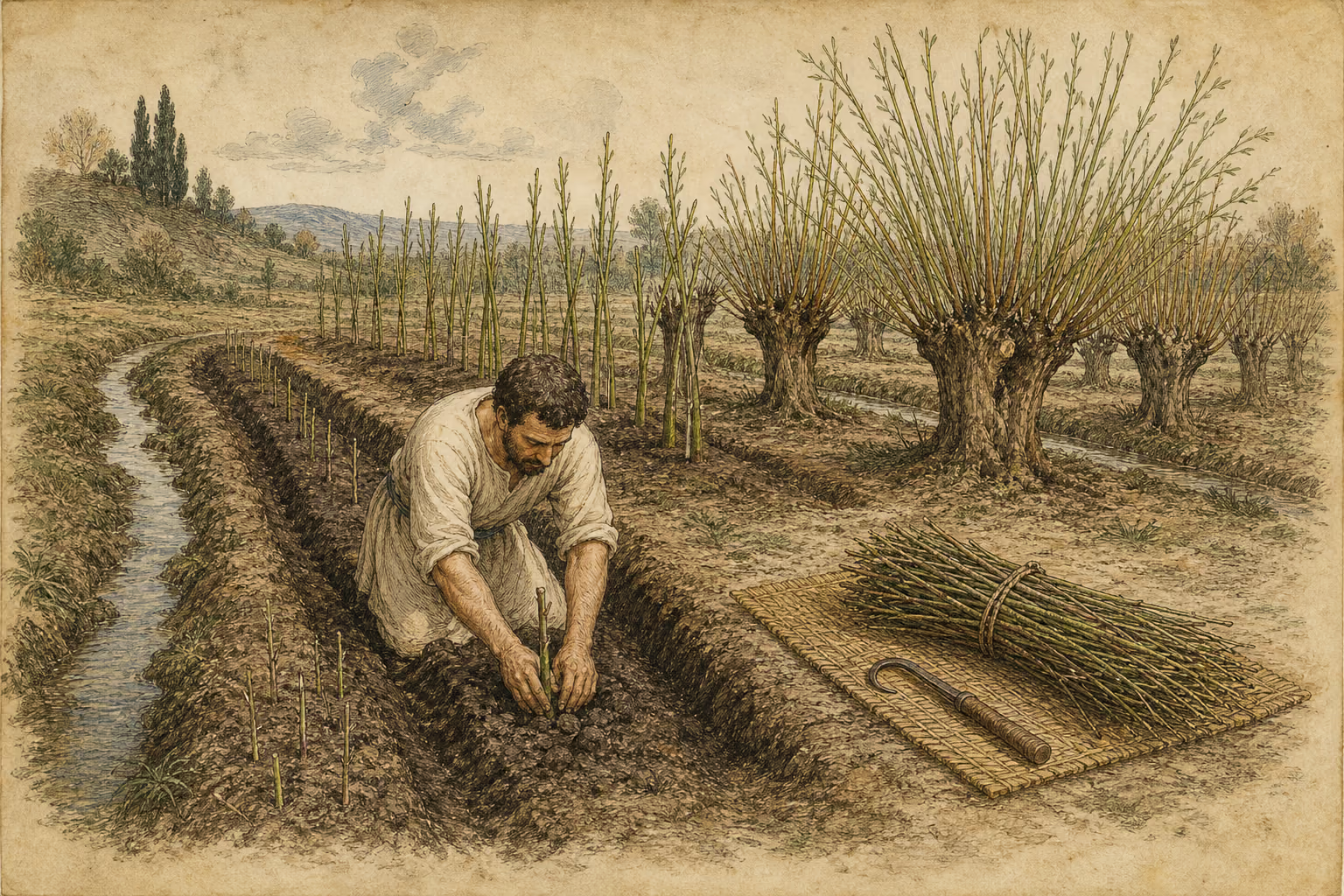
Principatum in his optinent salices, quas serunt loco madido, tamen refosso pedes II et semipedem, talea sesquipedali vel pertica, quae utilior, quo plenior. intervallo esse debent pedes seni. trimae pedibus binis a terra putatione coercentur, ut se in latitudinem fundant ac sine scalis tondeantur. salix enim fecundior, quo terrae propior. has quoque omnibus annis confodi iubent mense Aprili. haec est viminalium cultura. perticalis et virga et talea seritur, fossura eadem. perticas ex ea caedi iustum est quarto fere anno. et hae autem senescentium locum propagine sarciunt praecisa post annum. salicis viminalis iugera singula sufficient xxv vineae iugeribus. eiusdem rei causa populus alba seritur bipedaneo pastinato, talea sesquipedali, biduo siccata, palmipedi intervallo, terra superiniecta II cubitorum crassitudine.
Harundo etiamnum dilutiore quam hae solo gaudet. seritur bulbo radicis, quod alii oculum vocant, dodrantali scrobe, intervallo II pedum et semipedis, reficiturque ex sese vetere harundineto exstirpato, quod utilius repertum quam castrare, sicut antea. namque inter se radices serpunt mutuoque discursu necantur. tempus conserendi, priusquam oculi harundinum intumescant, ante kal. Martias. crescit ad brumam usque desinitque, cum durescere incipit. hoc signum tempestivam habet caesuram. et hanc autem, quotiens et vineam, fodiendam putant. seritur et traversa, non alte terra condita, erumpuntque e singulis oculis totidem plantae. seritur et deplantata pedali sulco, binis obrutis gemmis, ut tertius nodus terram attingat, prono cacumine, ne rores concipiat. caeditur decrescente luna. vineis anno siccata utilior quam viridis.
Castanea pedamentis omnibus praefertur facilitate tractatus, perdurandi pervicacia; regerminatione caedua vel salice laetior. quaerit solum facile nec tamen harenosum, maximeque sabulum umidum aut carbunculum vel tofi etiam farinam, quamlibet opaco septentrionalique et praefrigido situ, vel etiam declivi. recusat eadem glaream, rubricam, cretam omnemque terrae fecunditatem. seri nuce diximus, sed nisi ex maximis non provenit, nec nisi quinis acervatim satis. refringi solum debet subea ex Novembri mense in Februarium, quo solutae sponte cadunt ex arbore atque subnascuntur. intervalla sint pedalia, undique sulco dodrantali. ex hoc seminario transferuntur in aliud bipedali intervallo post biennium. sunt et propagines, nulli quidem faciliores. nudata enim radice tota in sulco prosternitur; tur ex cacumine supra terram relicto renascitur et alia ab radice. sed tralata nescit hospitari pavetque novitatem biennio fere; postea prosilit. ideo nucibus potius quam viveradicibus plantaria caedua implentur. cultura non alia quam supra dictis, fodiendo supputandisque per biennium sequens. de cetero ipsa se colit umbra stolones supervacuos enecante. caeditur intra septimum annum. sufficiunt pedamenta iugeri vicenis vinearum iugeribus, quando etiam bifida ex stirpe fiunt, durantque ultra alteram silvae suae caesuram.
Aesculus similiter provenit, caesura triennio serior, minus morosa nasci in quacumque terra seritur vere balano, sed non nisi aesculi, scrobe dodrantali, intervallis II pedum. saritur leviter quater anno. hoc pedamentum minime putrescit caesumque maxime fruticat.
Praeter haec, quae diximus, sunt caedua fraxinus, laurus, persica, corulus, malus, sed tardius nascuntur terramque defixa vix tolerant, non modo umorem. sabucus contra firmissima ad palum taleis seritur, ut populus. nam de cupresso satis diximus.
English · Bostock & Riley 1855–57
It now remains to give an account of those trees which are planted for the sake of others—the vine more particularly—and the wood of which is cut from time to time. Holding the very first rank among these we find the willow, a tree that is always planted in a moist soil. The hole, however, should be two feet and a half in depth, and the slip a foot and a half only in length. Willow stakes are also used for the same purpose, and the stouter they are the better: the distance left between these last should be six feet. When they are three years old their growth is checked by cutting them down within a couple of feet from the ground, the object being to make them spread out, so that by the aid of their branches they may be cleared without the necessity of using a ladder; for the willow is the more productive the nearer its branches are to the ground. It is generally recommended to trench round the willow every year, in the month of April. Such is the mode of cultivation employed for the osier willow.
The stake willow is reproduced both from suckers and cuttings, in a trench of the same dimensions. Stakes may be cut from it at the end of about three years mostly. These stakes are also used to supply the place of the trees as they grow old, being fixed in the ground as layers, and cut away from the trunk at the end of a year. A single jugerum of osier willows will supply osiers sufficient for twenty-five jugera of vines. It is for a similar purpose that the white poplar is grown; the trenches being two feet deep and the cutting a foot and a half in length. It is left to dry for a couple of days before it is planted, and a space is left between the plants a foot and a palm in width, after which they are covered with earth to the depth of a couple of cubits.
The reed requires a soil still moister even than that employed for the willow. It is planted by placing the bulb of the root, that part which some people call the “eye,” in a trench three quarters of a foot in depth, at intervals of two feet and a half. A reed-bed will renew itself spontaneously after the old one has been rooted up, a circumstance which it has been found more beneficial to take advantage of than merely to thin them, as was formerly the practice; the roots being in the habit of creeping and becoming interlaced, a thing that ends eventually in the destruction of the bed. The proper time for planting reeds is before the eyes begin to swell, or, in other words, before the calends of March. The reed continues to increase until the winter solstice, but ceases to do so when it begins to grow hard, a sign that it is fit for cutting. It is generally thought, too, that the reed requires to be trenched round as often as the vine.
The reed also is planted in a horizontal position, and then covered with earth to a very great depth; by this method as many plants spring up as there are eyes. It is propagated, also, by planting out in trenches a foot in depth, care being taken to cover up two of the eyes, while a third knot is left just on a level with the ground; the head, too, is bent downwards, that it may not become charged with dew. The reed is usually cut when the moon is on the wane. When required for the vineyard, it is better dried for a year than used in a green state.
The chesnut is found to produce better stays for the vine than any other tree, both from the facility with which they are worked, their extremely lasting qualities, and the circumstance that, when cut, the tree will bud again more speedily than the willow even. It requires a soil that is light without being gravelly, a moist, sandy one more particularly, or else a charcoal earth, or a fine tufa even; while at the same time a northern aspect, however cold and shady, and if upon a declivity even, greatly promotes its growth. It refuses to grow, however, in a gravelly soil, or in red earth, chalk, or, indeed, any kind of fertilizing ground. We have already stated, that it is reproduced from the nut, but it will only grow from those of the largest size, and then only when they are sown in heaps of five together. The ground above the nuts should be kept broken from the month of November to February, as it is at that period that the nuts lose their hold and fall of themselves from the tree, and then take root. There ought to be intervals of a foot in width left between them, and the hole in which they are planted should be nine inches every way. At the end of two years or more they are transplanted from this seed plot into another, where they are laid out at intervals of a couple of feet.
Layers are also employed for the reproduction of this tree, and there is none to which they are better adapted: the root of the plant is left exposed, and the layer is placed in the trench at full length, with the summit also protruding from the earth; the result being, that it shoots from the top as well as the root. When transplanted, however, it is very hard to be reconciled, as it stands in dread of all change. Hence it is, that it is nearly two years before it will begin to shoot upward; from which circumstance it is generally preferred to rear the slips in the nursery from the nut itself, to obtaining them from quicksets. The mode of cultivation does not differ from that employed with the plants already mentioned. It is trenched around, and carefully lopped for two successive years; after which it is able to take care of itself, the shade it gives sufficing to stifle all superfluous suckers: before the end of the sixth year it is fit for cutting.
A single jugerum of chesnuts will provide stays for twenty jugera of vineyard, and the branches that are taken from near the roots afford a supply of two-forked uprights; they will last, too, till after the next cutting of the tree.
The æsculus, too, is grown in a similar manner, the time for cutting being three years at the latest. Being less difficult, too, to propagate, it may be planted in any kind of earth, the acorn—and it is only with the æsculus that this is done—being sown in spring, in a hole nine inches in depth, with intervals between the plants of two feet in width. This tree is lightly hoed, four times a year. This kind of stay is the least likely to rot of them all; and the more the tree is cut, the more abundantly it shoots. In addition to the above, they also grow other trees for cutting that we have already mentioned—the ash for instance, the laurel, the peach, the hazel, and the apple; but then they are of slower growth, and the stays made from them, when fixed in the ground, are hardly able to withstand the action of the earth, and much less any moisture. The elder, on the other hand, which affords stakes of the very stoutest quality, is grown from cuttings, like the poplar. As to the cypress, we have already spoken of it at sufficient length.