LIBER XVII · CAPUT 22
THE CULTURE OF THE VINE AND THE VARIOUS SHRUBS WHICH SUPPORT IT
Latine · Mayhoff 1906
De pastinatione dictum est; sulco latitudo palae satis est, scrobibus ternorum pedum in quamque partem. altitudo in quocumque genere tripedalis, ideo nec vitis minor transferri debet, exstatura etiamnum duabus gemmis. emolliri terram minutis in scrobe imo sulcis fimoque misceri necessarium. clivosa altiores scrobes poscunt, praeterea pulvinatis a devexitate labris. qui ex his longiores fient, ut vites binas accipiant e diverso, alvei vocabuntur. esse vitis radicem in medio scrobe oportet, sed ipsam innixam solido in orientem aequinoctialem spectare, adminicula prima e calamo accipere; vineas limitari decumano XVIII pedum latitudinis ad contrarios vehiculorum transitus, aliisque traversis limitibus denum pedum distingui per media iugera aut, si maior modus sit, totidem pedum cardine, quot decumano, limitari, semper vero quintanis semitari, hoc est ut quinto quoque palo singulae iugo paginae includantur; <8> solo spisso non nisi repastinato nec nisi viveradicem seri, tenero et soluto vel malleolum sulco vel scrobe. in colles sulcos agere traversos melius quam pastinare, ut defluvia transtris eorum contineantur; aquoso caelo vel sicco solo malleolos serere autumno, nisi si tractus ratio mutabit. siccus enim et calidus autumno poscet, umidus frigidusque etiam veris exitu. in arido solo viveradix quoque frustra seritur, male et in siccis malleolus, nisi post imbrem, at in riguis vel frondens vitis et usque ad solstitium recte, ut in Hispania. quiescere ventos sationis die utilissimum. plerique austros optant, Cato abdicat.
<9> Interesse medio temperamento inter binas vites oportet pedes quinos, minimum autem laeto solo pedes quaternos, tenui plurimum octonos—Umbri et Marsi ad vicenos intermittunt arationis gratia in his, quae vocant porculeta —, pluvio et caliginoso tractu rariores poni, sicco densiores. subtilitas parsimoniae conpendia invenit, cum vinea in pastinato seratur, obiter seminarium faciendi, ut et viveradix loco suo et malleolus, qui transferatur, inter vites et ordines seratur, quae ratio in iugero circiter XVI viveradicum donat. interest autem biennium fructus, quo tardius in sato provenit quam in tralato.
Viveradix posita in vinea post annum resecatur usque ad terram, ut unus tantum emineat oculus, adminiculo iuxta adfixo et fimo addito. simili modo et secundo anno reciditur viresque concipit et intra se pascit suffecturas oneri. alias festinatione pariendi gracilis atque eiuncida, ni cohibeatur castigatione tali, in fetum exeat tota. nihil avidius nascitur ac, nisi ad pariendum vires serventur, tota fit fetus.
<10> Pedamenta optuma, quae diximus, aut ridicaee robore oleaque, si non sint, pali e iunipero, cupresso, laburno, sabuco. reliquorum generum sudes omnibus annis reciduntur. saluberrima in iugo harundo conexa fasciculis durat annis quinis. cum breviores palmites sarmento iunguntur inter se funium modo, ex hoc arcus funeta dicuntur.
<11> Tertius vineae annus palmitem velocem robustumque emittit et quem faciat aetas vitem. hic in iugum insilit. aliqui tum excaecant eum supina falce auferendo oculos, ut longius evocent, noxia iniuria. utilior enim consuetudo pariendi satiusque pampinos adiugatae detergere usque quo placeat roborari eam. sunt qui vetant tangi proximo anno, quam tralata sit, neque ante LX mensem falce curari, tune autem ad III gemmas recidi. alii et proximo quidem anno recidunt, sed ut ternos quaternosve singulis annis adiciant articulos, quarto demum perducant ad iugum. id utrimque fructu tardum, praeterea retorridum et nodosum pumilionum incremento. optimum autem matrem esse firmam, postea fetum audacem. nec tutum est quod cicatricosum, magno imperitiae errore; quidquid est tale, plagis nascitur, non e matre. totas habeat illa vires, dum roboratur, et annuos accipiet tota fetus, cum permissum fuerit nasci. nihil natura portionibus parit. quae excreverit satis firma, protinus in iugo collocari debebit; si etiamnum infirmior erit, sub ipso iugo hospitari recisa. viribus, non aetate, decernitur. temerarium est ante crassitudinem pollicarem viti imperare. sequente anno palmites educentur pro viribus matris singuli aut gemini. iidem et secuto, si coget infirmitas, nutriantur, tertioque demum II adiciantur. nec sunt plures quaternis umquam permittendi, breviterque non indulgendum et semper inhibenda fecunditas est. ea est natura, ut parere malit quam vivere. quidquid materiae adimitur, fructui accedit. illa semina mavult quam fructum gigni, quoniam fructus caduca res est. sic perniciose luxuriat, nec ampliat se, sed egerit.
<12> Dabit consilium et soli natura. in macro, etiamsi vires habebit, recisa intra iugum moretur, ut omnis fetura sub eo exeat. minimum id esse debebit intervallum, ut attingat iugum speretque, non teneat, adeo non recumbat in eo nec delicate se spargat. ita temperetur hic modus, ut crescere etiamnum malit quam parere.
<13> Palmes duas tresve gemmas habere sub iugo debet, ex quibus materia nascatur, tunc per iugum mergi alligarique, ut sustineatur iugo, non pendeat, vinculo mox adstrictius a tertia gemma alligari, quoniam et sic coercetur impetus materiae densioresque citra pampini exultant. cacumen religari vetant. natura haec est: deiecta pars aut praeligata fructum dat, plurimumque ipsa curvatura. quod citra est, materiem emittit, offensante, credo, spiritu et illa quam diximus medulla. quae ita emicuerit materia fructum dabit anno sequente. sic duo genera palmitum: quod e duro exit materiamque in proximum annum promittit, pampinarium vocatur aut, ubi supra cicatricem est, fructuarium; alterum ex anniculo palmite semper fructuarium. relinquitur sub iugo et qui vocatur custos—hic est novellus palmes, non longior tribus gemmis—proximo anno materiam daturus, si vitis luxuria se consumpserit, et alius iuxta eum, verrucae magnitudine, qui furunculus appellatur, si forte custos fallat.
<14> Vitis, antequam septumum annum a surculo conpleat, evocata ad fructum eiuncescit ac moritur. nec veterem placet palmitem in longum et ad quartum usque pedamentum emitti, quod alii dracones, alii funiculos vocant, ut faciant quae masculeta appellant. cum induruit vitis, pessimum in vinea traducere. quinto anno et ipsi palmites intorquentur singulaeque singulis materiae emittuntur ac deinde proximis, prioresque amputantur. semper custodem relinqui melius, sed is proximus viti esse debet, nec longior quam dictum est, et, si luxuriaverint palmites, intorqueri, ut IV materias vel II, si uniiuga erit vinea, emittat.
<15> Si per se vitis ordinabitur sine pedamento, qualecumque initio adminiculum desiderabit, dum stare condiscat et recta surgere, cetera a primordio eadem, dividi autem putatione pollices in aequali examine undique, ne praegravet fructus parte aliqua. obiter idem deprimens prohibebit in excelsum emicare. huic vineae trium pedum altitudo excelsior nutat, ceteris a quinto, dum ne excedat hominis longitudinem iustam. iis quoque, quae sparguntur in terra, breves ad limitandum caveas circumdant, scrobibus per ambitum factis, ne vagi palmites inter se pugnent occursantes, maiorque pars terrarum ita supinam in tellure vindemiam metit, siquidem et in Africa et in Aegypto Syriaque ac tota Asia et multis locis Europae hic mos praevalet. ibi ergo iuxta terram conprimi debet vitis, eodem modo et tempore nutrita radice, quo in iugata vinea, ut semper pollices tantum relinquantur, fertili solo cum tribus gemmis, graciliore binis, praestatque multos esse quam longos. quae de natura soli diximus, tanto potentiora sentientur, quanto propior fuerit uva terrae.
<16> Genera separari ac singulis conseri tractus utilissimum —mixtura enim generum etiam in vino, non modo in musto, discors—aut, si misceantur, non alia quam pariter maturescentia iungi necessarium. iuga altiora, quo laetior ager et quo planior, item roscido, nebuloso minusque ventoso conveniunt, contra humiliora gracili et arido et aestuoso ventisque exposito. iuga ad pedamentum quam artissimo nodo vinciri oportet, vitem levi contineri. quae genera vitium et in quali solo caeloque essent conserenda, cum enumeraremus naturas earum et vinorum, docuimus.
<17> De reliquo cultu vehementer ambigitur. plerique aestate tota post singulos rores confodi iubent vineam, alii vetant gemmantem; decuti enim oculos tractuque intrantium deteri, et ob id arcendum procul omne quidem pecus, sed maxime lanatum, quoniam facillime auferat gemmas. inimicos et pubescente uva rastros, satisque esse vineam ter anno confodi, ab aequinoctio verno ad vergiliarum exortum et canis ortu et nigrescente acino. quidam ita determinant: veterem semel a vindemia ante brumam, cum alii ablaqueare et stercorare satis putent, iterum ab idibus Aprilibus, antequam concipiat, hoc est in VI idus Maias; dein prius quam florere incipiat et cum defloruerit et variante se uva. peritiores adfirmant, si iusto saepius fodiatur, in tantum tenerescere acinos, ut rumpantur. quae fodiantur, ante ferventes horas diei fodiendas convenit, sicuti lutum neque arare neque fodere, fossione pulverem excitatum contra soles nebulasque prodesse.
<18> Pampinatio verna in confesso est ab idibus Maiis, intra dies X, utique antequam florere incipiat, et eam infra iugum debere fieri. de sequente variant sententiae. cum defloruerit, aliqui pampinandum putant, alii sub ipsa maturitate. sed de his Catonis praecepta decernent. namque et putationum tradenda ratio est.
<19> Protinus hanc a vindemia, ubi caeli tepor indulget, adoriuntur. sed et in hoc fieri numquam debet ratione naturae ante exortum aquilae, ut in siderum causis docebimus proximo volumine, immo vero favonio, quo- niam anceps culpa sit praeproperae festinationis. si saucias recenti medicina mordeat quaedam hiemis ruminatio, certum est gemmas earum frigore hebetari plagasque findi et caeli vitio exuri oculos lacrima destillante. nam gelu fragiles fieri quis nescit? operarum ista conputatio est in latifundis, non legitima naturae festinatio. quo maturius putantur aptis diebus, eo plus materiae fundunt; quo serius, eo fructum uberiorem. quare macras prius conveniet putare, validas novissime, plagam omnem obliquam fieri, ut facile decidant imbres, et ad terram verti quam levissima cicatrice acie falcis exacuta plagaque conlevata, recidi autem semper inter II gemmas, ne sit vulnus oculis in recisa parte. nigram esse eam existimant et, donec ad sincera veniatur, recidendam, quoniam e vitioso materia utilis non exeat. si macra vitis idoneos palmites non habeat, ad terram recidi eam novosque elici utilissimum, in pampinatione non hos detrahere pampinos, qui cum uva sint; id enim et uvas supplantat praeterquam in novella vinea. inutiles iudicantur in latere nati, non ab oculo, quippe etiam uva, quae nascatur e duro, rigescente, ut nisi ferro detrahi non possit. pedamentum quidam inter II vites utilius putant statui, et facilius ablaqueantur ita, meliusque est uniiugae vineae, si tamen et ipsi iugo sint vires nec flatu infesta regio. in quadripertita quam proximum oneri adminiculum esse debet, ne tamen inpedimentum sentiat ablaqueatio, cubito abesse non amplius, ablaqueari autem prius quam putari iubent.
<20> Cato de omni cultura vitium ita praecipit: Quam altissimam vineam facito alligatoque recte, dum ne nimium constringas. hoc modo eam curato: capita vitium per sementim ablaqueato. vineam putatam circumfodito, arare incipito, ultro citroque sulcos perpetuos ducito. vites teneras quam primum propagato, sicoccato: veteres quam minimum castrato; potius, si opus erit, deicito biennioque post praecidito. vitem novellam resecari tum erit tempus, ubi valebit. si vinea ab vite calvata erit, sulcos interponito ibique vivam radicem serito. umbram a sulcis removeto, crebroque fodito. in vinea vetere serito ocinum, si macra erit—quod granum capit ni serito—, et circum capita addito stercus, paleas, vinaceas, aliquid horumce. ubi vinea frondere coeperit, pampinato. vineas novellas alligato crebro, ne caulis praefringatur, et quae iam in perticam ibit, eius pampinos teneros alligato leviter porrigitoque, uti recte stent. ubi uva varia fieri coeperit, vites subligato.... <21> Vitis insitio una est per ver, altera cum uva floret; ea optima est.—Vineam veterem si in alium locum transferre voles, dumtaxat bracchium crassam licebit. primum deputato; binas gemmas ne amplius relinquito. ex radicibus bene exfodito et cave, ne radices saucies. ita uti fuerit, ponito in scrobe aut in sulco operitoque et bene occulcato, eodemque modo vineam statuito, alligato flexatoque, uti fuerit, crebroque fodito.—Ocinum, quod in vinea seri iubet, antiqui appellabant pabulum umbrae patiens, quod celerrime proveniat.
English · Bostock & Riley 1855–57
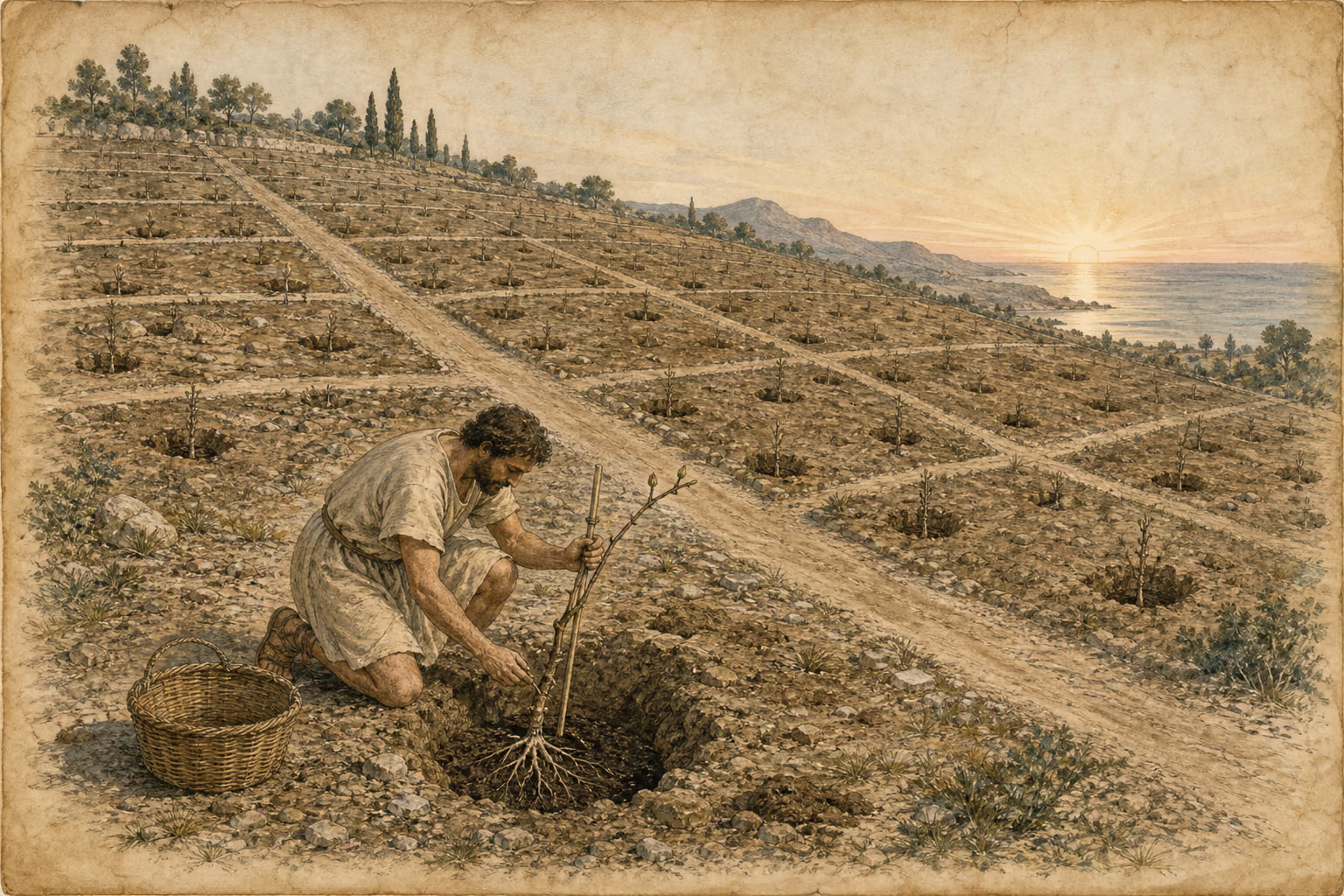
In preparing the furrows for the vine it will be quite sufficient if they are a spade in breadth; but if holes are employed for the purpose, they should be three feet every way. The depth required for every kind of vine is three feet; it should, therefore, be made a point not to transplant any vine that is less than three feet in length, allowing then two buds to be above the ground. It will be necessary, too, to soften the earth by working little furrows at the bottom of the hole, and mixing it up with manure. Where the ground is declivitous, it is requisite that the hole should be deeper, in addition to which it should be artificially elevated on the edge of the lower side. Holes of this nature, which are made a little longer, to receive two vines, are known as “alvei,” or beds. The root of the vine should occupy the middle of the hole, and when firmly fixed in the ground it should incline at the top due east; its first support it ought to receive from a reed. The vineyard should be bounded by a decuman path eighteen feet in width, sufficiently wide, in fact, to allow two carts to pass each other; others, again, should run at right angles to it, ten feet in width, and passing through the middle of each jugerum; or else, if the vineyard is of very considerable extent, cardinal paths may be formed instead of them, of the same breadth as the decuman path. At the end, too, of every five of the stays a path should be made to run, or, in other words, there should be one continuous cross-piece to every five stays; each space that is thus included from one end to the other forming a bed.
Where the soil is dense and hard it must be turned up only with the spade, and nothing but quicksets should be planted there; but where, on the other hand, it is thin and loose, mallet-shoots even may be set either in hole or furrow. Where the ground is declivitous it is a better plan to draw furrows across than to turn up all the soil with the spade, so that the falling away of the earth may be counteracted by the position of the cross-pieces. It will be best, too, where the weather is wet or the soil naturally dry, to plant the mallet-shoots in autumn, unless, indeed, there is anything in the nature of the locality to counteract it; for while a dry, hot soil makes it necessary to plant in autumn, in a moist, cold one it may be necessary to defer it until the end of spring even. In a parched soil, too, it would be quite in vain to plant quicksets, and it is far from advantageous to set mallet-shoots in a dry ground, except just after a fall of rain. On the other hand, in moist localities, a vine in leaf even may be transplanted and thrive very well, and that, too, even as late as the summer solstice, in Spain, for example. It is of very considerable advantage that there should be no wind stirring on the day of planting, and, though many persons are desirous that there should be a south wind blowing at the time, Cato is of quite a different way of thinking.
In a soil of medium quality, it is best to leave an interval of five feet between every two vines; where it is very fertile the distance should be five feet at least, and where it is poor and thin eight at the very most. The Umbri and the Marsi leave intervals between their vines of as much as twenty feet in length, for the purpose of ploughing between them; such a plot of ground as this they call by the name of “porculetum.” In a rainy, foggy locality, the plants ought to be set wider apart, but in dry spots nearer to one another. Careful observation has discovered various methods of economizing space; thus, for instance, when a vineyard is planted in shaded ground, a seed-plot is formed there as well; or, in other words, at the same time that the quickset is planted in the place which it is finally to occupy, the mallet-shoot intended for transplanting is set between the vines, as well as between the rows. By adopting this method, each jugerum will produce about sixteen thousand quicksets; and the result is, that two years’ fruit is gained thereby, a cutting planted being two years later in bearing than a quickset transplanted. Quicksets, when growing in a vineyard, are cut down at the end of a year, leaving only a single eye above ground; some manure is then placed upon the spot, and a stay driven in close to the plant. In the same manner it is again cut down at the end of the second year, and from this it acquires additional strength, and receives nutriment to enable it to endure the onerous task of reproduction. If this is neglected, in its over-haste to bear it will shoot up slim and meagre, like a bulrush, and from not being subjected to such a training, will grow to nothing but wood. In fact, there is no tree that grows with greater eagerness than the vine, and if its strength is not carefully husbanded for the bearing of fruit, it will be sure to grow to nothing but wood.
The best props for supporting the vine are those which we have already mentioned, or else stays made of the robur and the olive; if these cannot be procured, then props of juniper, cypress, laburnum, or elder, must be employed. If any other wood is used for the purpose, the stakes should be cut at the end each year: reeds tied together in bundles make excellent cross-rails for the vine, and will last as long as five years. Sometimes the shorter stock-branches of the vines are brought together and tied with vine-cuttings, like so many cords: by this method an arcade is formed, known to us by the name of “funetum.”
The vine, by the end of the third year, throws out strong and vigorous stock-branches with the greatest rapidity, and these in due time form the tree; after this, it begins to mount the cross-piece. Some persons are in the habit of “blinding” the vine at this period, by removing the eyes with the end of the pruning-knife turned upwards, their object being to increase the length of the branches—a most injurious practice, however; for it is far better to let the tree become habituated to grow of itself, and to prune away the tendrils every now and then when they have reached the cross-rail, so long as it may be deemed proper to add to its strength. There are some persons who forbid the vine to be touched for a whole year after it has been transplanted, and who say that the pruning-knife ought never to be used before it is five years old; and then at that period they are for cutting it down so completely as to leave three buds only. Others, again, cut down the vine within a year even after it has been transplanted, but then they take care to let the stem increase every year by three or four joints, bringing it on a level with the cross-piece by the fourth. These two methods, however, both of them, retard the fruit and render the tree stunted and knotty, as we see the case in all dwarf trees. The best plan is to make the parent stem as robust and vigorous as possible, and then the wood will be sure to be strong and hardy. It is far from safe, too, to take slips from a cicatrized stem; such a practice is erroneous, and only the result of ignorance. All cuttings of this nature are sure to be the offspring of acts of violence, and not in reality of the tree itself. The vine, while growing, should be possessed of all its natural strength; and we find that when left entirely to itself, it will throw out wood in every part; for there is no portion of it that Nature does not act upon. When the stem has grown sufficiently strong for the purpose, it should at once be trained to the cross-piece; if, however, it is but weak, it should be cut down so as to lie below the hospitable shelter of the cross-piece. Indeed, it is the strength of the stem, and not its age, that ought to decide the matter. It is not advisable to attempt to train a vine before the stem has attained the thickness of the thumb; but in the year after it has reached the frame, one or two stock-branches should be preserved, according to the strength developed by the parent tree. The same, too, must be done the succeeding year, if the weakness of the stem demands it; and in the next, two more should be added. Still, however, there should never be more than four branches allowed to grow; in one word, there must be no indulgence shown, and every exuberance in the tree must in all cases be most carefully repressed; for such is the nature of the vine, that it is more eager to bear than it is to live. It should be remembered, too, that all that is subtracted from the wood is so much added to the fruit. The vine, in fact, would much rather produce shoots and tendrils than fruit, because its fruit, after all, is but a transitory possession: hence it is that it luxuriates to its own undoing, and instead of really gaining ground, exhausts itself.
The nature, too, of the soil will afford some very useful suggestions. Where it is thin and hungry, even though the vine should display considerable vigour, it should be pruned down below the cross-piece and kept there, so that all the shoots may be put forth below it. The interval, however, between the top of the vine and the cross-piece ought to be but very small; so much so, indeed, as to leave it hopes, as it were, of reaching it, which, however, it must never be suffered to do; for it should never be allowed to recline thereon and spread and run on at its ease. This mode of culture ought, in fact, to be so nicely managed, that the vine should show an inclination rather to grow in body than to run to wood.
The main branch should have two or three buds left below the cross-piece that give promise of bearing wood, and it should be carefully trained along the rail, and drawn close to it in such a manner as to be supported by it, and not merely hang loosely from it. When this is done, it should be tightly fastened also with a binding three buds off, a method which will greatly contribute to check the too abundant growth of the wood, while stouter shoots will be thrown out below the ligature: it is absolutely forbidden, however, to tie the extremity of the main branch. When all this is done, Nature operates in the following way—the parts that are allowed to fall downward, or those which are held fast by the ligature, give out fruit, those at the bend of the branch more particularly. On the other hand, the portion that lies below the ligature throws out wood; by reason, I suppose, of the interception of the vital spirit and the marrow or pith, previously mentioned: the wood, too, that is grown under these circumstances will bear fruit in the following year. In this way there are two kinds of stock branches: the first of which, issuing from the solid stock, gives promise of wood only for this year, and is known as the leaf stock-branch; while that which grows beyond the mark made by the ligature is a fruit stock-branch. There are other kinds, again, that shoot from the stock-branches when they are a year old, and these are in all cases fruit stock-branches. There is left, also, beneath the cross-piece a shoot that is known as the reserve shoot, being always a young stock-branch, with not more than three buds upon it. This is intended to give out wood the next year, in case the vine by over-luxuriance should happen to exhaust itself. Close to it there is another bud left, no bigger than a wart; this is known as the “furunculus,” and is kept in readiness in case the reserve shoot should fail.
The vine, if enticed to bear fruit before the seventh year from its being planted as a slip, will pine away, become as slim as a bulrush, and die. It is thought equally undesirable, too, to let an old stock-branch range far and wide, and extend as far as the fourth stay from the stem; to such a branch the name of dragon -branch is given by some, and of juniculus by others; if these are allowed to spread, they will run to wood only, and make male vines, as they are called. When a vine has become quite hard, it is an extremely bad plan to use it for reproduction by layers. When the vine is five years old the stock-branches are twisted, but each is allowed to throw out some new wood; and so from one to another, care being taken to prune away the old wood. It is always the best plan, however, to leave a reserve shoot; but this should always be very near the main stem of the vine, not at a greater distance, in fact, than that already mentioned. If, too, the stock branches should throw out too luxuriantly, they must be twisted, the object being that the vine may put forth no more than four secondary branches, or even two only, if it happens to be a single cross-railed vine.
If the vine is to be trained to grow without any stay at all, still it will stand in need, at first, of some support or other, until it has learnt to support itself: in all other respects the mode of proceeding will be the same at first. When pruning, it will be necessary that the thumb-branches should be arranged in equal numbers on either side, in order that the fruit may not overload one side of the tree; and we may here remark by the way, that the fruit by its weight is apt to bear down the tree and counteract any tendency to increase in height. The vine, unsupported, when more than three feet in height, begins to bend, but the others do not, until they are five feet high at the least; care should be taken, however, never to let them exceed the height of a man of moderate stature. Growers are in the habit of surrounding the vines that creep along the ground with a low fence for them to lean upon; and round this fence they dig a trench by way of precaution, for fear lest the branches in their range should meet one another and so come into collision. The greater part of the world, in fact, gather grapes at their vintage, grown in this fashion, and lying upon the ground—at all events, it is so in Africa, Egypt, and Syria; throughout the whole of Asia, too, and in many parts of Europe as well, this method prevails. In such cases the vine ought to be kept down close to the ground, and the root should be nurtured at the same time and in just the same way as in the case of the vine that grows on the cross-piece. Care, too, should be taken to leave only the young thumb-shoots, together with three buds, where it is a prolific soil, two where it is poor and thin: it is better, too, that the shoots should be numerous than individually long. The influences of soil, of which we have made mention already, will make themselves felt all the more powerfully the nearer the grapes grow to the ground.
It is a very advantageous plan to separate the various species of vines and to set them in different compartments—for the mixture of different varieties is apt to deteriorate the flavour not only of the must, but the wine even as well. If, again, for some reason or other, the different kinds must be intermingled, it will be requisite to keep all those together which ripen at exactly the same period. The more fertile and the more level the soil, the higher the cross-pieces must be placed. High cross-pieces, too, are best suited to localities that are subject to heavy dews and fogs, but not to those that are exposed to high winds; on the other hand, where the soil is thin, parched, and arid, or exposed to the wind, the cross-pieces should be set lower. The cross-piece should be fastened to the stay with cords tied as tight as possible, while the bindings used for tying the vine should be thin. As to the various species of vines, and the soils and climates requisite for the growth of each, we have already treated of them, when enumerating the several varieties of the vine and the wines which they produce.
With reference to other points connected with the culture of the vine, there are very considerable doubts. Many persons recommend that the vineyard should be turned up with the spade after every dew that falls in the summer. Others, again, forbid this practice when the vine is in bud; for the clothes, they say, of the people coming and going to and fro are apt to catch the buds, and either knock or rub them off; it is for this reason, too, that they are so careful to keep all animals away from the vines, those with long wool in particular, as it is very apt to pull off the buds. Raking, too, they say, is very injurious to the vine while the grape is forming; and it will be quite sufficient, they assure us, if the ground is turned up three times in the year, after the vernal equinox—first, at the rising of the Vergiliæ, the second at the rising of the Dog-star, and the third time just as the grape is turning black. Some persons make it a rule that an old vineyard shall have one turning up between the time of vintage and the winter solstice, though others, again, are of opinion that it is quite sufficient to bare the roots and manure them. They turn up the ground again after the ides of April, but before the time for germination, or, in other words, the sixth of the ides of May; then again before the tree begins to blossom, after it has shed its blossom, and, last of all, when the grape is just on the turn. The most skilful growers say that if the ground is dug up oftener than necessary, the grapes will become so remarkably thin-skinned as to burst. When the ground is turned up, care should be taken to do it before the hot hours of the day; a clayey soil, too, should never be ploughed or dug. The dust that is raised in digging is beneficial to the vine, it is said, by protecting it from the heat of the sun and the injurious effects of fogs.
The spring clearing ought to be done, it is universally admitted, within ten days after the ides of May, and before the blossoming begins; in addition to which, it should always be done below the cross-piece. As to the second clearing, opinions differ very considerably. Some think it ought to be done when the blossoming is over, others, again, when the grapes are nearly at maturity. This point, however, may be decided by following the advice of Cato on the subject; for we must now pass on to a description of the proper mode of pruning the vine.
Immediately after the vintage, and while the weather is still warm, the work of pruning begins; this, however, ought never to be done, for certain physical reasons, before the rising of the Eagle, as we shall have occasion to explain in the following Book. Nor should it be done either when the west winds begin to prevail, for even then there is great doubt whether a fault may not be committed by being in too great haste to commence the work. If any return of wintry weather should chance to nip the vines, while still labouring under the wounds recently inflicted on them in pruning, there is little doubt that their buds will become quite benumbed with cold, the wounds will open again, and the eyes, moistened by the juices that distil from the tree, will become frost-bitten by the rigour of the weather. For who is there, in fact, that does not know that the buds are rendered brittle by frost? All this, however, depends upon accurate calculations in the management of large grounds, and the blame of precipitation cannot with any justice be laid upon Nature. The earlier the vine is pruned, in suitable weather, the greater is the quantity of wood, while the later the pruning, the more abundant is the fruit. Hence it is that it is most advisable to prune the poor meagre vines first, and to defer pruning the more thriving ones to the very last. In pruning, due care should always be taken to cut in a slanting direction, in order that the rain may run off with all the greater facility. The wounds, too, should look downwards towards the ground, and should be made as lightly as possible, the edge of the knife being well-sharpened for the purpose, so as to make a clean cut each time. Care should be taken, too, to cut always between two buds, and that the eyes are not injured in the operation. It is generally thought that wherever the vine is black, all those parts may be cut off, the healthy parts not being touched; as no useful shoots can be put forth by wood that is bad in itself. If a meagre vine has not good stock-shoots, the best plan is to cut it down to the ground, and then to train new ones. In clearing away the leaves, too, those leaves should not be removed which accompany the clusters, for by so doing the grapes are made to fall off, except where the vine happens to be young. Those leaves are regarded as useless which grow on the sides of the trunk and not from an eye; and so, too, are the bunches which shoot from the hard, strong wood, and are only to be removed by the aid of the knife.
Some persons are of opinion that it is a better plan to fix the stay midway between two vines; and, indeed, by the adoption of this method the roots are cleared with greater facility. It is best, however, where the vine needs but a single cross-rail, due care being taken that the rail is a strong one, and the locality not exposed to high winds. In the case of those vines which require trellissed cross-rails, the stay should be placed as near as possible to the burden it has to support; in order, however, that there may be no impediment thrown in the way of clearing the roots, it may be placed at the distance of one cubit from the stock, but not more. It is generally recommended to clear the roots before the pruning is commenced.
Cato gives the following general precepts in relation to the culture of the vine:—“Let the vine grow as high as possible, and fasten it firmly, but not too tight. You should treat it in the following manner. Clean the roots of the vine at seed-time, and after pruning it dig about it, and then begin to labour at the ground, by tracing with the plough continuous furrows every way. Plant the young vines in layers as early as possible, and then break up the ground about them. If the vine is old, take care and prune it as little as possible. In preference, bend the vine into the ground for layers, if necessary, and cut it at the end of two years. The proper time for cutting the young vine, is when it has gained sufficient strength. If the vineyard is bald of vines, then draw furrows between them, and plant quicksets there: but let no shadow be thrown on the furrows, and take care and dig them often. If the vineyard is old, sow ocinum there, in case the trees are meagre: but take care and sow there nothing that bears seed. Put manure, chaff, and grape-husks about the roots, or, indeed, anything of a similar nature that will give the tree additional strength. As soon as the vine begins to throw out leaves, set about clearing them. Fasten the young trees in more places than one, so that the stem may not break. As soon as it begins to run along the stay, fasten down the young branches lightly, and extend them, in order that they may gain the right position. When the grape begins to be mottled, then tie down the vine. The first season for grafting the vine is the spring, the other when the grape is in blossom; the last period is the best. If it is your wish to transplant an old vine, you will only be able to do so in case it is no thicker than the arm: first, however, you must prune it, taking care not to have more than two buds upon the stem. Then dig it well up by the roots, being careful to trace them, and using every possible precaution not to injure them. Place it in the hole or furrow exactly in the position in which it has stood before, then cover it with earth, which should be well trodden down. You must then prop it up, fasten it, and turn it in the same direction as before; after which, dig about it repeatedly.” The ocinum that Cato here recommends to be sown in the vineyards, is a fodder known by that name by the ancients; it thrives in the shade remarkably well, and received its name from the rapidity with which it grows.