LIBER XVII · CAPUT 23
HOW GRAPES ARE PROTECTED FROM THE RAVAGES OF INSECTS
Latine · Mayhoff 1906
<22> Sequitur arbusti ratio mirum in modum damnata Sasernae patri filioque, celebrata Scrofae, vetustissimis post Catonem peritissimisque, ac ne a Scrofa quidem nisi Italiae concessa, cum tam longo iudicetur aevo nobilia vina non nisi in arbustis gigni et in his quoque laudatiora summis sicut uberiora imis. adeo excelsitate proficitur. hac ratione et arbores eliguntur. prima omnium ulmus, excepta propter nimiam frondem Atinia. dein populus nigra, eadem de causa, minus densa folio. non spernunt plerique et fraxinum ficumque, etiam oleam, si non sit umbrosa ramis. harum satus cultusque abunde tractatus est. ante XXXVI mensem attingi falce vetantur. alterna servantur bracchia, alternis putantur annis, sexto anno maritantur. Transpadana Italia praeter supra dictas cornu, opulo, tilia, acere, orno, carpino, quercu arbustat agros, Venetia salice propter uliginem soli. et ulmus detruncata media in tria ramorum scamna digeritur, nulla fere XX pedum altiore arbore. tabulata earum ab octavo pede altitudinis dilatantur in collibus siccisque agris, a duodecumo in campestribus et umidis. meridianum solem spectare palmae debent, rami a proiectu digitorum modo subrigi, tonsili in his tenuium quoque virgultorum barba, ne obumbrent. Intervallum iustum arborum, si aretur solum, quadrageni pedes in terga frontemque, in latera viceni; si non aretur, hoc in omnes partes. singulis denas saepe adnutriunt vites, damnato agricola minus ternis. maritare nisi validas inimicum, enecante veloci vitium incremento. serere tripedaneo scrobe necessarium distantes inter sese arboremque singulis pedibus. nihil ibi malleoli atque pastinationis, nulla fodiendi inpendia, utpote cum arbusti ratio hac peculiari dote praestet, quod ab eodem solo ferri fruges et vitibus prodest, superque quodvindicans se altitudo non, ut in vinea, ad arcendas animalium iniurias pariete vel saepe vel fossarum utique inpendio muniri se cogit.
<23> In arbusto e praedictis sola viveradicum ratio, item propaginum, et haec gemina, ut diximus: qualorum ex ipso tabulato maxime probata, quoniam a pecore tutissima est, altera deflexa vite vel palmite iuxta suam arborem aut circa proximam caelibem. quod supra terram est e matre, radi iubetur, ne fruticet. in terra non pauciores IV gemmae obruuntur ad radicem capiendam, extra in capite binae relincuntur. vitis in arbusto IV pedes longo constat [omnis] sulco, tres lato, alto duos cum semipede. post annum propago inciditur ad medullam, ut paulatim radicibus suis adsuescat; caulis a capite ad duas gemmas reciditur; tertio totus mergus absciditur repetiturque altius in terram, ne ex reciso frondeat. tolli viveradix a vindemia protinus debet.
<24> Nuper repertum draconem serere iuxta arborem; ita appellamus palmitem emeritum pluribusque induratum annis. hunc praecisum quam maxima amplitudine, tribus partibus longitudinis deraso cortice, quatenus obruatur — unde et rasilem vocant—, deprimere sulco, reliqua parte ad arborem erecta, ocissimum in vite. si gracilis sit vitis aut terra, usitatum est quam proxime solum decidi, donec firmetur radix, sicuti neque roscidam seri neque a septentrionis flatu. vites aquilonem spectare debent ipsae, palmites autem earum meridiem.
<25> Non est festinandum ad putationem novellae, sed primo in circulos materies colligenda, nec nisi validae putatio admovenda, seriore anno fere ad fructum arbusta vite quam iugata. sunt qui omnino putari vetent, priusquam arborem longitudine aequaverit. prima falce VI pedes a terra recidatur, flagello infra relicto et nasci coacto incurvatione materiae. III ei gemmae, non amplius, deputato supersint. ex his omissi palmites proximo anno imis digerantur scamnis ac per singulos annos ad superiora scandant, relicto semper duramento in singulis tabulatis et emissario uno, qui subeat usque quo placuerit. de cetero putatione omnia flagella, quae proxime tulerint, recidantur, nova circumcisis undique capreolis spargantur in tabulatis. vernacula putatio deiectis per ramos vitium crinibus circumvestit arborem crinesque ipsos uvis, Gallica in traduces porrigitur, Aemiliae viae in ridicas Atiniarum ambitu, frondem earum fugiens.
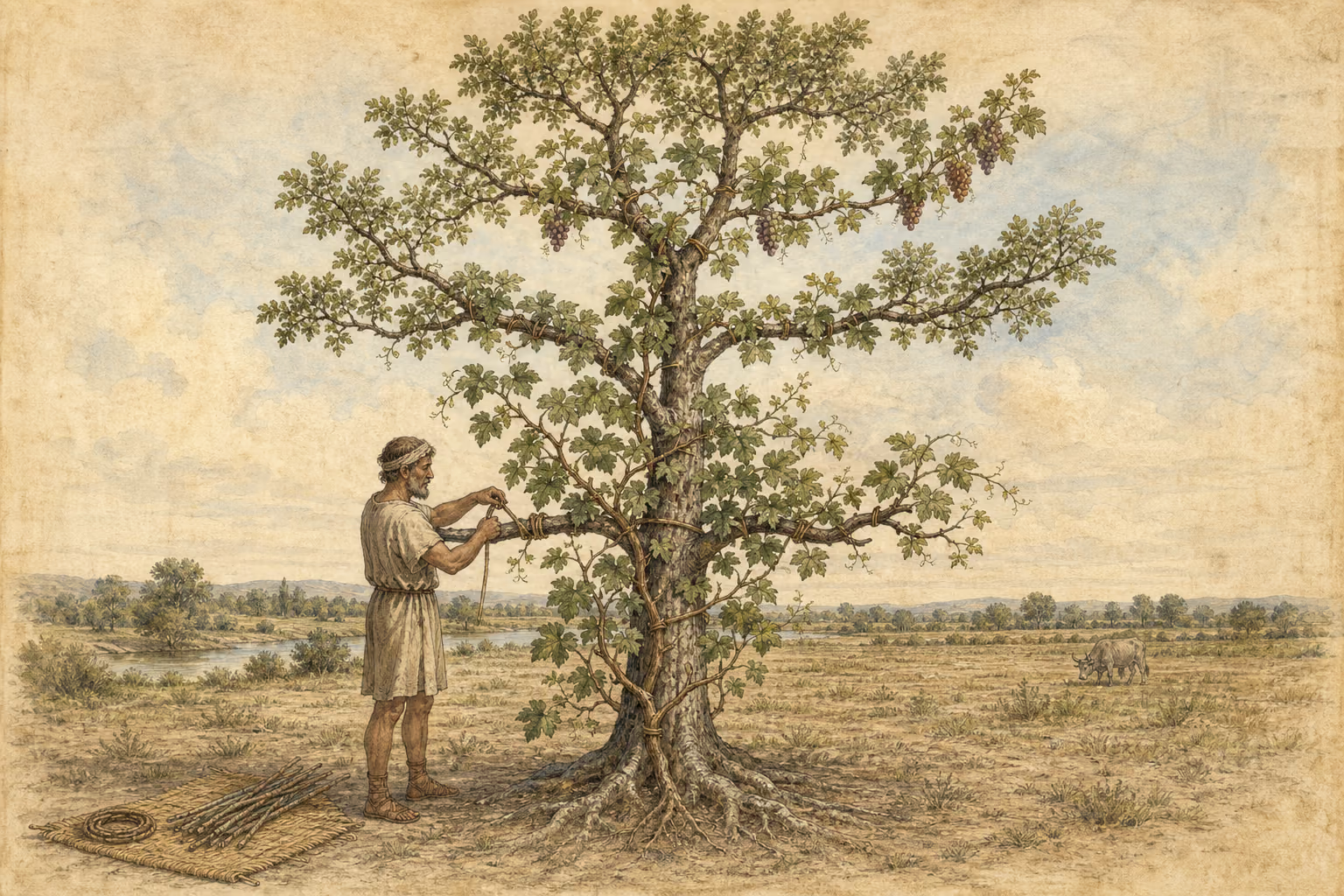
<26> Est quorundam inperitia sub ramo vitem vinculo suspendendi, suffocante iniuria. contineri debet vimine, non artari; quin immo etiam quibus salices supersunt, molliore hoc vinculo facere malunt, herbaque Siculi, quam vocant ampelodesmon, Graecia vero universa iunco, cypero, ulva. liberata quoque vinculo per aliquot dies vagari et incondita spargi atque in terra, quam per totum annum spectaverit, recumbere; namque ut veterina a iugo et canes a cursu volutatio iuvat, ita tum et vitium porrigi lumbos. arbor quoque ipsa gaudet adsiduo levata onere, similis respiranti, nihilque est in opere naturae, quod non exemplo dierum noctiumque aliquas vices feriarum velit. ob id protinus a vindemia putari et lassas etiamnum fructu edito inprobatur. putatae rursus alligentur alio loco, namque orbitas vinculi sentiunt vexatione non dubia.
Traduces Gallicae culturae bini utrimque e lateribus, si par quadrageno distet spatio, quaterni, si viceno, inter se obvii miscentur alliganturque una conciliati, virgultorum comitatu obiter rigorati, qua deficiant, aut, si brevitas non patiatur ipsornm, adalligato protenduntur in viduam arborem unco. traducem bimum praecidere solebant— onerat enim vetustate—; melius donare tempus, ut rasilem faciant, si largiatur crassitudo. alias utile toros futuri draconis pasci.
<27> Unum etiamnum genus est medium inter hoc et propaginem, totas supplantandi in terram vites cuneisque findendi et in sulcos plures simul ex una propagandi, gracilitate singularum firmata circumligatis hastilibus nec recisis, qui a lateribus excurrant, pampinis. Novariensis agricola, traducum turba non contentus nec copia ramorum, inpositis etiamnum patibulis palmites circumvolvit; itaque praeter soli vitia cultura quoque torva fiunt vina. alia culpa iuxta urbem Aricinis, quae alternis putantur annis, non quia id viti conducat, sed quia vilitate reditum inpendia exuperent. medium temperamentum in Carsulano secuntur cariosasque tantum vitis partes incipientesque inarescere deputando, ceteris ad uvam relictis. detracto onere supervacuo pro nutrimento omni est raritas volneris; sed nisi pingui solo talis cultura degenerat in labruscam.
<28> Arbusta arari quam altissime desiderant, tametsi frumenti ratio non exigit. pampinari ea non est moris; et hoc conpendium operae. deputantur cum vite pariter interlucata densitate ramorum, qui sint supervacui et absumant alimenta. plagas ad septentriones aut ad meridiem spectare vetuimus; melius, si neque in occasus solis. diu dolent talia quoque ulcera et difficile sanescunt algendo nimis aestuandove. non eadem ut in vite libertas, quoniam certa latera, sed facilius abscondere et detorquere, quo velis, plagas. in arborum tonsura supiniore velut calices faciendi, ne consistat umor.
Viti adminicula addenda, quae scandat adprehensa, si maiora sint.
English · Bostock & Riley 1855–57
We come now to speak of the method of growing vines upon trees, a mode that has been condemned in the strongest terms by the Saserna’s, both father and son, and up-held by Scrofa, these being our most ancient writers on agriculture next to Cato, and men of remarkable skill. Indeed, Scrofa himself will not admit that it is beneficial anywhere except in Italy. The experience of ages, however, has sufficiently proved that the wines of the highest quality are only grown upon vines attached to trees, and that even then the choicest wines are produced by the upper part of the tree, the produce of the lower part being more abundant; such being the beneficial results of elevating the vine. It is with a view to this that the trees employed for this purpose are selected. In the first rank of all stands the elm, with the exception of the Atinian variety, which is covered with too many leaves; and next comes the black poplar, which is valued for a similar reason, being not so densely covered with leaves. Most people, too, by no means hold the ash and the fig in disesteem, as also the olive, if it is not overshadowed with branches. We have treated at sufficient length already of the planting and culture of these several trees.
They must not be touched with the knife before the end of three years; and then the branches are preserved, on each side in its turn, the pruning being done in alternate years. In the sixth year the vine is united to the tree. In Italy beyond the Padus, in addition to the trees already mentioned, they plant for their vines the cornel, the opulus, the linden, the maple, the ash, the yoke-elm, and the quercus; while in Venetia they grow willows for the purpose, on account of the humidity of the soil. The top of the elm is lopped away, and the branches of the middle are regularly arranged in stages; no tree in general being allowed to exceed twenty feet in height. The stories begin to spread out in the tree at eight feet from the ground, in the hilly districts and upon dry soils, and at twelve in champaign and moist localities. The hands of the trunk ought to have a southern aspect, and the branches that project from them should be stiff and rigid like so many fingers; at the same time due care should be taken to lop off the thin beardlike twigs, in order to check the growth of all shade. The interval best suited for the trees, if it is the grower’s intention to keep the soil turned up with the plough, is forty feet back and front, and twenty at the side; if it is not to be turned up, then twenty feet every way will do. A single tree is often made to support as many as ten vines, and the grower is greatly censured who attaches less than three. It is worse than useless to attach the vine before the tree has gained its full strength, as in such case its rapidity of growth would only tend to kill the tree. It is necessary to plant the vine in a trench three feet in depth, leaving an interval of one foot between it and the tree. In this case there is no necessity for using mallet shoots, or for going to any expense in spading or digging; for this method of training on trees has this advantage in particular, that it is beneficial even to the vine that corn should be sown in the same soil; in addition to which, from its height, it is quite able to protect itself, and does not call for the necessity, as in the case of an ordinary vineyard, of enclosing it with walls and hedges or ditches, made at a considerable expense, to protect it from injury by animals.
In the method of training upon trees, reproduction from quicksets or from layers is the only mode employed of all those that have been previously described; the growing by layers being effected two different ways, as already mentioned. The plan, however, of growing from layers in baskets set upon the stages of the tree is the most approved one, as it ensures an efficient protection from the ravages of cattle; while, according to another method, a vine or else a stock-branch is bent into the ground near the tree it has previously occupied, or else the nearest one that may be at liberty. It is recommended that all parts of the parent tree that appear above ground should then be scraped, so that it may not throw out wood; while at the same time there are never less than four buds on the part that is put into the ground for the purpose of taking root; there are also two buds left above ground at the head. The vine intended for training on a tree is planted in a furrow four feet long, three broad, and two and a half in depth. At the end of a year the layer is cut to the pith, to enable it to strengthen gradually at the root; after which, the end of the branch is pruned down to within two buds from the ground. At the end of two years the layer is completely separated from the stock, and buried deeper in the ground, that it may not shoot at the place where it has been cut. As to the quicksets, they ought to be removed directly after the vintage.
In more recent times, a plan has been discovered of planting a dragon branch near the tree—that being the name given to an old stock-branch that has become hard and tough in the course of years. For this purpose, it is cut as long as possible, and the bark is taken off from three-fourths of its length, that being the portion which is to be buried in the ground; hence it is, too, that it is called a “barked” plant. It is then laid at full length in the furrow, the remaining part protruding from the ground and reclining against the tree. This method is the most speedy one that can be adopted for growing the vine. If the vine is meagre or the soil impoverished, it is usual to keep it cut down as near to the ground as possible, until such time as the root is strengthened. Care, too, should be taken not to plant it covered with dew, nor yet while the wind is blowing from the north. The vine itself ought to look towards the north-east, but the young stock-shoots should have a southern aspect.
There should not be too great haste in pruning a young vine, but a beginning should be made by giving the wood and foliage a circular form, care being taken not to prune it until it has become quite strong; it should be remembered, too, that the vine, when trained upon a tree, is generally a year later in bearing fruit than when grown on the cross-piece. There are some persons, again, who altogether forbid that a vine should be pruned until such time as it equals the tree in height. At the first pruning it may be cut to within six feet from the ground, below which a shoot must be left, and encouraged to run out by bending the young wood. Upon this shoot, when pruned, there should not be more than three buds left. The branches that take their rise from these buds should be trained in the following year upon the lowermost stages of the tree, and so in each successive year taught to climb to the higher ones. Care, too, should always be taken to leave one hard, woody branch at each stage, as well as one breeding shoot, at liberty to mount as high as it pleases. In addition to these precautions, in all pruning, those shoots should be cut off which have borne fruit the last year, and after the tendrils have been cut away on every side fresh branches should be trained to run along the stages. In Italy the pruning is so managed that the shoots and tendrils of the vines are arranged so as to cover the branches of the tree, while the shoots of the vine in their turn are surrounded with clusters of grapes. In Gallia, on the other hand, the vine is trained to pass from tree to tree. On the Æmilian Way, again, the vine is seen embracing the trunks of the Atinian elms that line the road, while at the same time it carefully avoids their foliage.
It is a mark of ignorance in some persons to suspend the vine with a cord beneath the branches of the tree, to the great risk of stifling it; for it ought to be merely kept up with a withe of osier, and not tightly laced. Indeed, in those places where the willow abounds, the withes that it affords are preferred, on account of their superior suppleness, while the Sicilians employ for the purpose a grass, which they call “ampelodesmos:” throughout the whole of Greece, rushes, cyperus, and sedge are similarly employed. When at any time the vine has been liberated from its bonds, it should be allowed to range uncontrolled for some days, and to spread abroad at pleasure, as well as to recline upon the ground which it has been looking down upon the whole year through. For in the same manner that beasts of burden when released from the yoke, and dogs when they have returned from the chase, love to roll themselves on the ground, just so does the vine delight to stretch its loins. The tree itself, too, seems to rejoice, and, thus relieved from the continuous weight which has burdened it, to have all the appearance of now enjoying a free respiration. Indeed, there is no object in all the economy of Nature that does not desire certain alternations for the enjoyment of rest, witness the succession of night and day, for instance. It is for this reason that it is forbidden to prune the vine directly the vintage is over, and while it is still exhausted by the process of reproduction.
Directly the vine has been pruned, it ought to be fastened again to the tree, but in another place; for there is no doubt that it feels very acutely the indentations that are made in it by the holdfasts. In the Gallic method of cultivation they train out two branches at either side, if the trees are forty feet apart, and four if only twenty; where they meet, these branches are fastened together and made to grow in unison; if, too, they are anywhere deficient in number or strength, care is taken to fortify them by the aid of small rods. In a case, however, where the branches are not sufficiently long to meet, they are artificially prolonged by means of a hook, and so united to the tree that desires their company. The branches thus trained to unite they used to prune at the end of the second year. But where the vine is aged, it is a better plan to give them a longer time to reach the adjoining tree, in case they should not have gained the requisite thickness; besides which, it is always good to encourage the growth of the hard wood in the dragon branches.
There is yet another method, which occupies a middle place between this mode of propagation and that by layers. It consists of laying the entire vine in the earth, and then splitting the stock asunder by means of wedges; the fibrous portions are then trained out in as many furrows, care being taken to support each of the slender plants by fastening it to a stake, and not to cut away the branches that shoot from the sides. The growers of Novara, not content with the multitude of shoots that run from tree to tree, nor yet with an abundance of branches, encourage the stock-branches to entwine around forks planted in the ground for the purpose; a method, however, which, in addition to the internal defects arising from the soil, imparts a harshness to the wine.
There is another fault, too, that is committed by the people of Varracina, near Rome—they only prune their vines every other year; not, indeed, because it is advantageous to the tree, but from a fear lest, from the low prices fetched by their wines, the expense might exceed the profits. At Carseoli they adopt a middle course, by pruning away only the rotten parts of the vine, as well as those which are beginning to wither, and leaving the rest to bear fruit, after thus clearing away all superfluous incumbrances. The only nutriment they give it is this exemption from frequent pruning; but unless the soil should happen to be a very rich one, the vine, under such a method of cultivation, will very soon degenerate to a wild state.
The vine that is thus trained requires the ground to be ploughed very deep, though such is not the case for the sowing there of grain. It is not customary to cut away the leaves in this case, which, of course, is so much labour spared. The trees themselves require pruning at the same period as the vine, and are thinned by clearing away all useless branches, and such parts as would only absorb the nutriment. We have already stated that the parts that are lopped should never look north or south: and it will be better still, if they have not a western aspect. The wounds thus made are very susceptible for a considerable time, and heal with the greatest difficulty, if exposed to excesses of cold or heat. The vine when trained on a tree enjoys advantages that are not possessed by the others; for the latter have certain fixed aspects, while in the former, it is easy to cover up the wounds made in pruning, or to turn them whichever way you please. When trees are pruned at the top, cup-like cavities should be formed there, to prevent the water from lodging.
Stays, too, should be given to the vine for it to take hold of and climb upwards, if they are taller than it.