LIBER XVII · CAPUT 27
INCISIONS MADE IN TREES
Latine · Mayhoff 1906
Carbunculi ac robiginum remedia demonstrabimus volumine proximo. interim est et scariphatio quaedam in remediis, cum macie corticis ex aegritudine adstringente se iustoque plus vitalia arborum conprimente exacutam falcis aciem utraque manu inprimentes perpetuis incisuris diducunt ac veluti cutem laxant. salutare id fuisse argumento sunt dilatatae cicatrices et internato corpore expletae, magnaque ex parte similis hominum medicina et arborum est, quando earum quoque terebrantur ossa. amygdalae ex amaris dulces fiunt, si circumfosso stipite et ab ima parte circumforato defluens pituita abstergeatur. et ulmis detrahitur sucus inutilis, supra terram foratis usque ad medullam, in senecta aut cum alimento nimio abundare sentiuntur. idem et ficorum turgido cortice incisuris in oblicum levibus emittitur. ita fit, ne decidant fructus. pomiferis, quae germinant nec ferunt fructum, fissa radice inditur lapis fertilesque fiunt, hoc idem in amygdalis e robore cuneo adacto, in piris sorbisque e taeda ac cinere et terra cooperto. etiam radices circumcidisse prodest vitium luxuriantium ficorumque et circumcisis cinerem addidisse. fici serotinae fiunt, si primae grossi, cum fabae magnitudinem excessere, detrahantur. subnascuntur enim quae serius maturescunt. eaedem, cum frondere incipiunt, si cacumina rami cuiusque detrahantur, firmiores fertilioresque fiunt, nam caprificatio maturat.
In ea culices nasci e grossis manifestum, quoniam, cum evolavere, non inveniuntur intus grana, quae in eos versa apparet. exeundi tanta est aviditas, ut plerique aut pede relicto aut pinnae parte erumpant. est et aliud genus culicum, quos vocant, centrinas, fucis apium similes ignavia malitiaque cum pernicie verorum et utilium; interemunt enim illos atque ipsi commoriuntur. vexant et tineae semina ficorum, contra quas remedium in eodem scrobe defodere taleam lentisci inversa parte, quae fuerit a cacumine. uberrimas autem ficus rubrica amurca diluta et cum fimo infusa radicibus frondere incipientium facit. caprificorum laudantur maxime nigrae et in petrosis, quoniam frumenta plurima habeant. caprificatio ipsa post imbrem.
In primis autem cavendum, ne ex remediis vitia fiant, quod evenit nimia aut intempestiva medicina. interlucatio arboribus prodest, sed omnium annorum trucidatio inutilissima. vitis tantum tonsuram annuam quaerit, alternam vero myrtus, punicae, oleae, quia celeriter fruticescunt. ceterae rarius tondeantur, nulla autumn, ac ne radantur quidem nisi vere. putatione plaga ad vitalia... sunt omnia, quaecumque non supervacua.
Similis fimi ratio. gaudent eo, sed cavendum, ne in fervore solis admoveatur, ne inmaturum, ne validius quam opus sit. urit vineas suillum nisi quinquennio interposito, praeterquam si riguis diluatur, et e coriariorum sordibus nisi admixta aqua, item largius. iustum existimant in denos pedes quadratos III modios. id quidem soli natura decernet.
Columbino ac suillo plagis quoque arborum medentur. si mala punica acida nascantur, ablaqueatis radicibus fimum suillum addi iubent. eo anno vinolenta, proximo dulcia futura. alii urina hominis aqua mixta riganda censent quater anno, singulis amphoris, aut cacumina spargi vino lasere diluto; si findantur in arbore, pediculum intorqueri; ficis utique amurcam adfundi, ceteris arboribus aegris faecem vini, aut lupinum circum radices earum seri. aqua quoque lupini decocti circumfusa pomis prodest. fici, cum Volcanalibus tonuit, cadunt. remedium est, ut ante stipula hordeacea areae stringantur. cerasos praecoces facit cogitque maturescere calx admota radicibus. et haec autem, ut omnia poma, intervelli melius est, ut quae relicta sint grandescant.
English · Bostock & Riley 1855–57
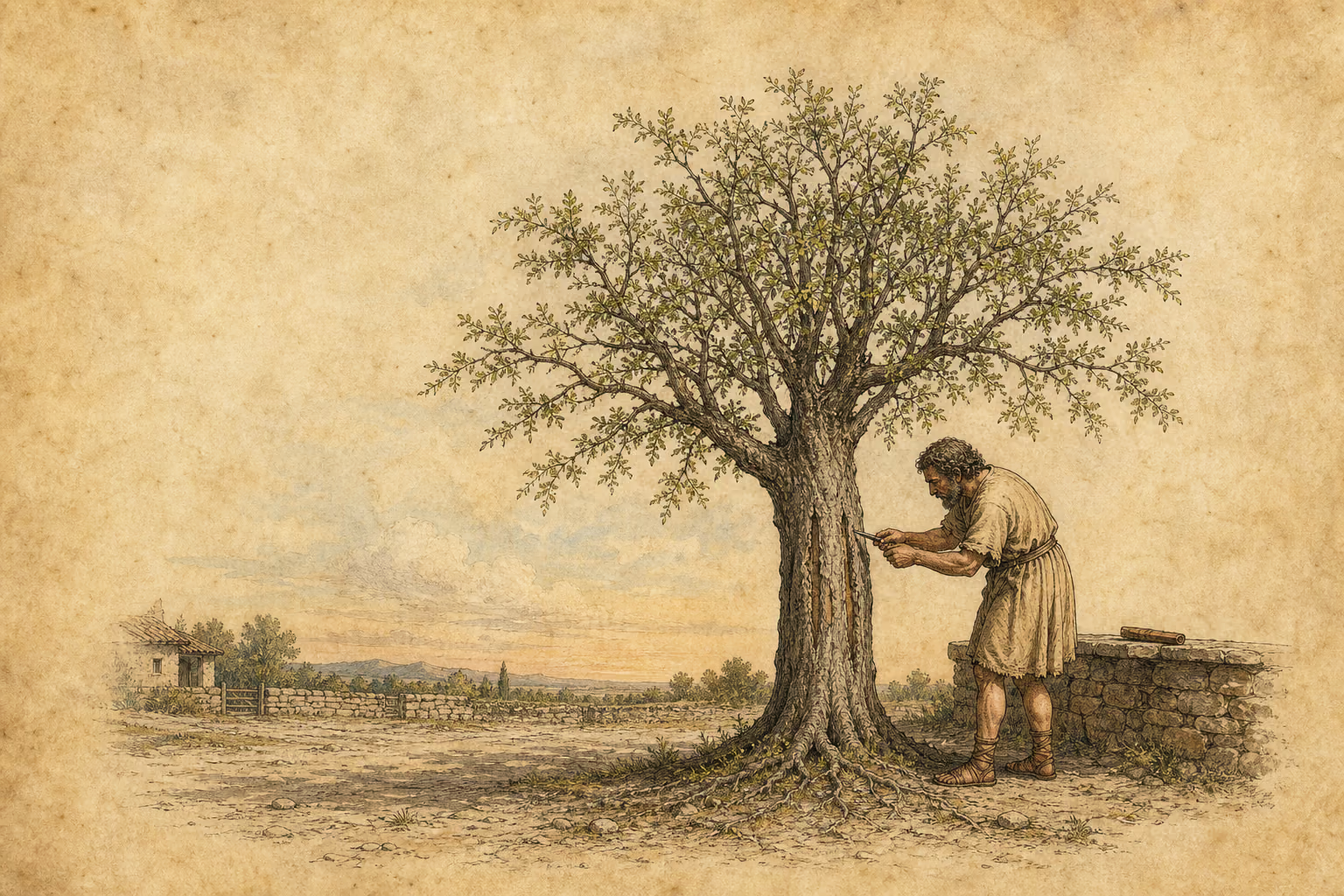
The proper remedies for charcoal-blight and mildew will be pointed out in the succeeding Book. In the meantime, however, we may here observe that among the remedies may be placed that by scarification. When the bark becomes meagre and impoverished by disease, it is apt to shrink, and so compress the vital parts of the tree to an excessive degree: upon which, by means of a sharp pruning knife held with both hands, incisions are made perpendicularly down the tree, and a sort of looseness, as it were, imparted to the skin. It is a proof that the method has been adopted with success, when the fissures so made remain open and become filled with wood of the trunk growing between the lips.
The medical treatment of trees in a great degree resembles that of man, seeing that in certain cases the bones of them both are perforated even. The bitter almond will become sweet, if, after spading round the trunk and cleaning it, the lowermost part of it is pierced all round, so that the humours may have a passage for escape and ensure being removed. In the elm, too, the superfluous juices are drawn off, by piercing the tree above ground to the pith when it is old, or when it is found to suffer from an excess of nutriment. So, too, when the bark of the fig is turgid and swollen, the confined juices are discharged by means of light incisions made in a slanting direction; by the adoption of which method the fruit is prevented from falling off. When fruit-trees bud but bear no fruit, a fissure is made in the root, and a stone inserted; the result of which is, that they become productive. The same is done also with the almond, a wedge of robur being employed for the purpose. For the pear and the service tree a wedge of torch-wood is used, and then covered over with ashes and earth. It is even found of use, too, to make circular incisions around the roots of the vine and fig, when the vegetation is too luxuriant, and then to throw ashes over the roots. A late crop of figs is ensured, if the first fruit is taken off when green and little larger than a bean; for it is immediately succeeded by fresh, which ripens at a later period than usual. If the tops of each branch are removed from the fig, just as it is beginning to put forth leaves, its strength and productiveness are greatly increased. As to caprification, the effect of that is to ripen the fruit.
It is beyond all doubt that in caprification the green fruit gives birth to a kind of gnat; for when they have taken flight, there are no seeds to be found within the fruit: from this it would appear that the seeds have been transformed into these gnats. Indeed, these insects are so eager to take their flight, that they mostly leave behind them either a leg or a part of a wing on their departure. There is another species of gnat, too, that grows in the fig, which in its indolence and malignity strongly resembles the drone of the bee-hive, and shows itself a deadly enemy to the one that is of real utility; it is called centrina, and in killing the others it meets its own death.
Moths, too, attack the seeds of the fig: the best plan of getting rid of them, is to bury a slip of mastich, turned upside down, in the same trench. The fig, too, is rendered extremely productive by soaking red earth in amurca, and laying it, with some manure, upon the roots of the tree, just as it is beginning to throw out leaves. Among the wild figs, the black ones, and those which grow in rocky places, are the most esteemed, from the fact of the fruit containing the most seed. Caprification takes place most advantageously just after rain.
But, before everything, especial care should be taken that intended remedies are not productive of ill results; as these may arise from either remedial measures being applied in excess or at unseasonable times. Clearing away the branches is of the greatest benefit to trees, but to slaughter them this way every year, is productive of the very worst results. The vine is the only tree that requires lopping every year, the myrtle, the pomegranate, and olive every other; the reason being that these trees shoot with great rapidity. The other trees are lopped less frequently, and none of them in autumn; the trunk even is never scraped, except in spring. In pruning a tree, all that is removed beyond what is absolutely necessary, is so much withdrawn from its vitality.
The same precautions, too, are to be regarded in manuring. Though manure is grateful to the tree, still it is necessary to be careful not to apply it while the sun is hot, or while it is too new, or more stimulating than is absolutely necessary. The dung of swine will burn up the vine, if used at shorter intervals than those of five years; unless, indeed, it is mixed with water. The same is the case, too, with the refuse of the currier’s workshop, unless it is well diluted with water: manure will scorch also, if laid on land too plentifully. It is generally considered the proper proportion, to use three modii to every ten feet square; this, however, the nature of the soil must decide.
Wounds and incisions of trees are treated also with pigeon dung and swine manure. If pomegranates are acid, the roots of the tree are cleared, and swine’s dung is applied to them: the result is, that in the first year the fruit will have a vinous flavour, but in the succeeding one it will be sweet. Some persons are of opinion that the pomegranate should be watered four times a year with a mixture of human urine and water, at the rate of an amphora to each tree; or else that the extremities of the branches should be sprinkled with silphium steeped in wine. The stalk of the pomegranate should be twisted, if it is found to split while on the tree. The fig, too, should be drenched with the amurca of olives, and other trees when they are ailing, with lees of wine; or else lupines may be sown about the roots. The water, too, of a decoction of lupines is beneficial to the fruit, if poured upon the roots of the tree. When it thunders at the time of the Vulcanalia, the figs fall off; the only remedy for which is to have the area beneath ready covered with barley-straw. Lime applied to the roots of the tree makes cherries come sooner to maturity, and ripen more rapidly. The best plan, too, with the cherry, as with all other kinds, is to thin the fruit, so that that which is left behind may grow all the larger.