LIBER XVIII · CAPUT 10
THE FRUITFULNESS OF AFRICA IN WHEAT
Latine · Mayhoff 1906
<2> Similago e tritico fit, laudatissima ex Africo. iustum est e modiis redire semodios et pollinis sextarios V—ita appellant in tritico quod florem in siligine; hoc aerariae officinae chartariaeque utuntur—, praeterea secundarii sextarios IV furfurumque tantundem, panis vero e modio similaginis p. XXII, e floris modio p. XVI. pretium huic annona media in modios farinae XL asses, similagini octonis assibus amplius, siligini castratae duplum. est et alia distinctio semel..... pollinatam XVII p. panis reddere, bis XVIII, ter XIX cum triente et secundarii panis quinas selibras, totidem cibarii et furfurum sextarios VI.
<3> Siligo numquam maturescit pariter, nec ulla segetum minus dilationem patitur propter teneritatem, iis quae maturuere protinus granum dimittentibus. sed minus quam cetera frumenta in stipula periclitatur, quoniam semper rectam habet spicam nec rorem continet, qui robiginem faciat. <4> Ex arinca dulcissimus panis. ipsa spissior quam far, et maior spica, eadem et ponderosior. raro modius grani non XVI libras implet. exteritur in Graecia difficulter, ob id iumentis dari ab Homero dicta. haec enim est quam olyram vocat. eadem in Aegypto facilis fertilisque.
Far sine arista est, item siligo, excepta quae Laconica appellatur. adiciuntur his genera bromos et tragos, externa omnia, ab oriente invectae oryzae similia. tiphe et ipsa eiusdem est generis, ex qua fit in nostro orbe oryza. apud Graecos est et zea, traduntque eam ac tiphen, cum sint degeneres, redire ad frumentum, si pistae serantur, nec protinus, sed tertio anno.
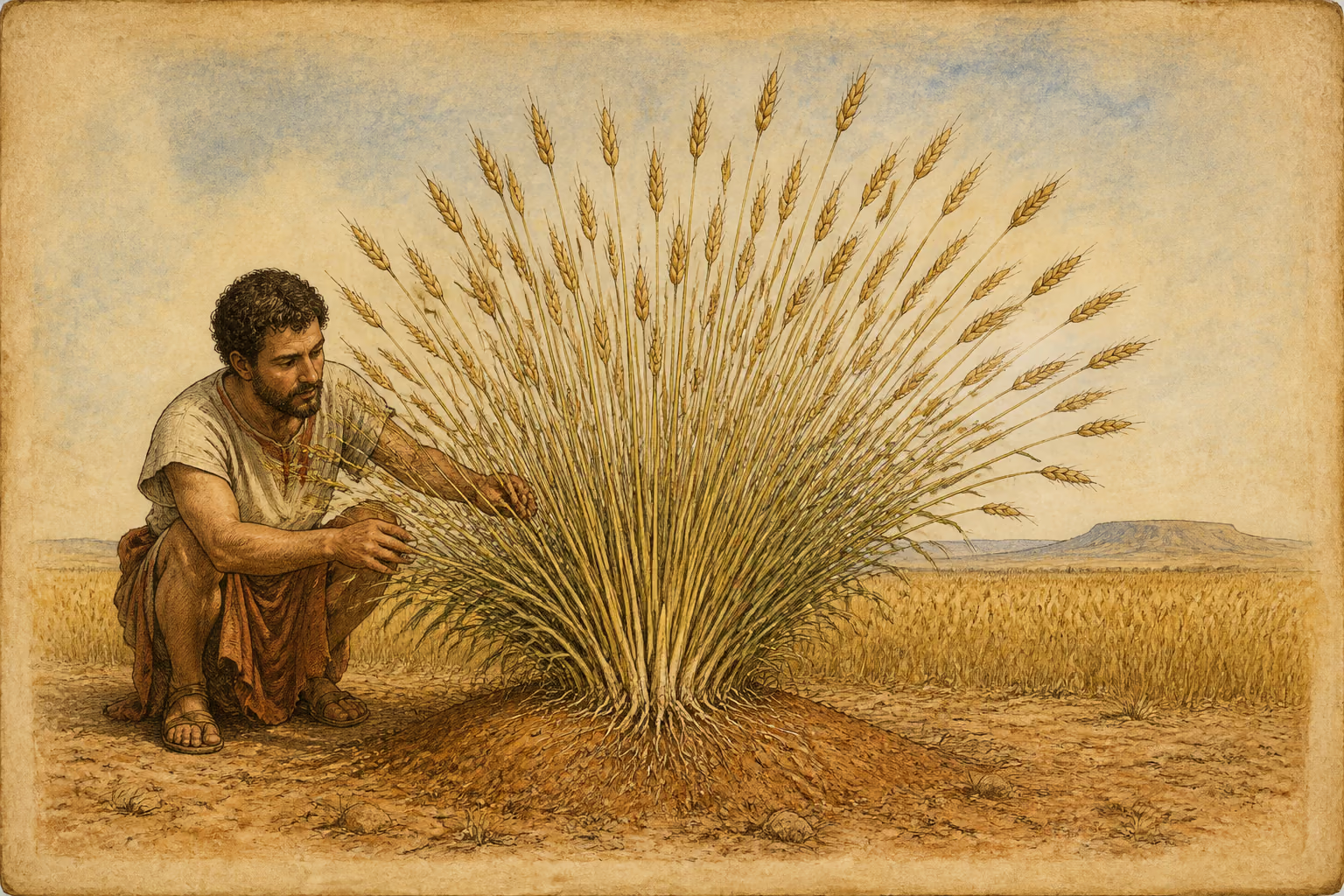
Tritico nihil est fertilius—hoc ei natura tribuit, quoniam eo maxime alebat hominem —, utpote cum e modio, si sit aptum solum, quale in Byzacio Africae campo, centeni quinquageni modii reddantur. misit ex eo loco divo Augusto procurator eius ex uno grano, vix credibile dictu, cccc paucis minus germina, exstantque de ea re epistulae. misit et Neroni simililer CCCLX stipulas ex uno grano. cum centesimo quidem et Leontini Siciliae campi fundunt aliique et. tota Baetica et in primis Aegyptus. fertilissima tritici genera ramosum ac quod centigranium vocant. inventus est iam et scapus unus centum fabis onustus.
Aestiva frumenta diximus sesamam, milium, panicum. sesama ab Indis venit. ex ea et oleum faciunt; colos eius candidus. huic simile est in Asia Graeciaque erysimum, idemque erat, nisi pinguius esset, quod apud nos vocant irionem, medicaminibus adnumerandum potius quam frugibus. eiusdem naturae ethorminum Graecis dictum, sed cumino simile; seritur cum sesama. hac et irione nullum animal vescitur virentibus.
Pistura non omnium facilis, quippe Etruria spicam farris tosti pisente pilo praeferrato fistula serrata et stella intus denticulata, ut, si intenti pisant, concidantur grana ferrumque frangatur. maior pars Italiae nudo utitur pilo, rotis etiam, quas aqua verset, obiter et mola. de ipsa ratione pisendi Magonis proponemus sententiam: triticum ante perfundi aqua multa iubet, postea evalli, dein sole siccatum in pila repeti, simili modo hordeum. huius sextarios XX spargi II sextariis aquae. lentem torreri prius, dein cum furfuribus leviter pisi aut addito in sextarios XX lateris crudi frusto et harenae semodio. erviliam iisdem modis, quibus lentem. sesamam in calida maceratam exporrigi, dein confricari et frigida mergi, ut paleae fluctuentur, iterumque exporrigi in sole super lintea, quod nisi festinato peragatur, lurido colore mucescere. et ipsa autem, quae evalluntur, variam pistrinarum rationem habent. acus vocatur, cum per se pisitur spica tantum, aurificum ad usus, si vero in area teritur cum stipula, palea, in maiore terrarum parte ad pabula iumentorum. mili et panici et sesamae purgamenta adpludam vocant et alibi allis nominibus.
Milio Campania praecipue gaudet pultemque candidam ex eo facit. fit et panis praedulcis. Sarmatarum quoque gentes hac maxime pulte aluntur et cruda etiam farina, equino lacte vel sanguine e cruris venis admixto. Aethiopes non aliam frugem quam mili hordeique novere,
Panico et Galliae quidem, praecipue Aquitania utitur, sed et circumpadana Italia addita faba, sine qua.... Ponticae gentes nullum panico praeferunt cibum.—Cetera aestiva frumenta riguis magis etiam quam imbribus gaudent, milium et panicum aquis minime, cum in folia exeunt. vetant ea inter vites arboresve frugiferas seri, terram emaciari hoc satu existimantes.
English · Bostock & Riley 1855–57
Wheat yields a fine flour of the very highest quality. In African wheat the modius ought to yield half a modius of fine flour and five sextarii of pollen, that being the name given to fine wheat meal, in the same way that that of winter wheat is generally known as “flos,” or the “flower.” This fine meal is extensively used in copper works and paper manufactories. In addition to the above, the modius should yield four sextarii of coarse meal, and the same quantity of bran. The finest wheaten flour will yield one hundred and twenty-two pounds of bread, and the fine meal of winter wheat one hundred and seventeen, to the modius of grain. When the prices of grain are moderate, meal sells at forty asses the modius, bolted wheaten flour at eight asses more, and bolted flour of winter wheat, at sixteen asses more. There is another distinction again in fine wheaten flour, which originated formerly in the days of L. Paulus. There were three classes of wheat; the first of which would appear to have yielded seventeen pounds of bread, the second eighteen, and the third nineteen pounds and a third: to these were added two pounds and a half of seconds, and the same quantity of brown bread, with six sextarii of bran.
Winter wheat never ripens all at once, and yet there is none of the cereals that can so ill brook any delay; it being of so delicate a nature, that the ears directly they are ripe will begin to shed their grain. So long, however, as it is in stalk, it is exposed to fewer risks than other kinds of wheat, from the fact of its always having the ear upright, and not retaining the dew, which is a prolific cause of mildew.
From arinca a bread of remarkable sweetness is made. The grains in this variety lie closer than they do in spelt; the ear, too, is larger and more weighty. It is rarely the case that a modius of this grain does not weigh full sixteen pounds. In Greece they find great difficulty in threshing it; and hence it is that we find Homer saying that it is given to beasts of burden, this being the same as the grain that he calls “olyra.” In Egypt it is threshed without any difficulty, and is remarkably prolific. Spelt has no beard, and the same is the case with winter wheat, except that known as the Laconian variety. To the kinds already mentioned we have to add bromos, the winter wheat just excepted, and tragos, all of them exotics introduced from the East, and very similar to rice. Tiphe also belongs to the same class, from which in our part of the world a cleaned grain resembling rice is prepared. Among the Greeks, too, there is the grain known as zea; and it is said that this, as well as tiphe, when cleaned from the husk and sown, will degenerate and assume the form of wheat; not immediately, but in the course of three years.
There is no grain more prolific than wheat, Nature having bestowed upon it this quality, as being the substance which she destined for the principal nutriment of man. A modius of wheat, if the soil is favourable, as at Byzacium, a champaign district of Africa, will yield as much as one hundred and fifty modii of grain. The procurator of the late Emperor Augustus sent him from that place—a fact almost beyond belief—little short of four hundred shoots all springing from a single grain; and we have still in existence his letters on the subject. In a similar manner, too, the procurator of Nero sent him three hundred and sixty stalks all issuing from a single grain. The plains of Leontium in Sicily, and other places in that island, as well as the whole of Bætica, and Egypt more particularly, yield produce a hundred-fold. The most prolific kinds of wheat are the ramose wheat, and that known as the “hundred-grain” wheat. Before now, as many as one hundred beans, too, have been found on a single stalk.
We have spoken of sesame, millet, and panic as belonging to the summer grains. Sesame comes from India, where they extract an oil from it; the colour of its grain is white. Similar in appearance to this is the erysimum of Asia and Greece, and indeed it would be identical with it were it not that the grain is better filled. It is the same grain that is known among us as “irio;” and strictly speaking, ought rather to be classed among the medicaments than the cereals. Of the same nature, too, is the plant called “horminum” by the Greeks, though resembling cummin in appearance; it is sown at the same time as sesame: no animal will eat either this or irio while green.
All the grains are not easily broken. In Etruria they first parch the spelt in the ear, and then pound it with a pestle shod with iron at the end. In this instrument the iron is notched at the bottom, sharp ridges running out like the edge of a knife, and concentrating in the form of a star; so that if care is not taken to hold the pestle perpendicularly while pounding, the grains will only be splintered and the iron teeth broken. Throughout the greater part of Italy, however, they employ a pestle that is only rough at the end, and wheels turned by water, by means of which the corn is gradually ground. I shall here set forth the opinions given by Mago as to the best method of pounding corn. He says that the wheat should be steeped first of all in water, and then cleaned from the husk; after which it should be dried in the sun, and then pounded with the pestle; the same plan, he says, should be adopted in the preparation of barley. In the latter case, however, twenty sextarii of grain require only two sextarii of water. When lentils are used, they should be first parched, and then lightly pounded with the bran; or else, adopting another method, a piece of unbaked brick and half a modius of sand should be added to every twenty sextarii of lentils.
Ervilia should be treated in the same way as lentils. Sesame should be first steeped in warm water, and then laid out to dry, after which it should be rubbed out briskly, and then thrown into cold water, so that the chaff may be disengaged by floating to the surface. After this is done, the grain should again be spread out in the sun, upon linen cloths, to dry. Care, however, should be taken to lose no time in doing this, as it is apt to turn musty, and assume a dull, livid colour. The grains, too, which are just cleaned from the husk, require various methods of pounding. When the beard is ground by itself, without the grain, the result is known as “acus,” but it is only used by goldsmiths. If, on the other hand, it is beaten out on the threshing-floor, together with the straw, the chaff has the name of “palea,” * * * * and in most parts of the world is employed as fodder for beasts of burden. The residue of millet, panic, and sesame, is known to us as “apluda;” but in other countries it is called by various other names.
Campania is particularly prolific in millet, and a fine white porridge is made from it: it makes a bread, too, of remarkable sweetness. The nations of Sarmatia live principally on this porridge, and even the raw meal, with the sole addition of mares’ milk, or else blood extracted from the thigh of the horse. The Æthiopians know of no other grain but millet and barley.
The people of Gaul, and of Aquitania more particularly, make use of panic; the same is the case, too, in Italy beyond the Padus, with the addition, however, of the bean, without which they prepare none of their food. There is no aliment held in higher esteem than panic by the nations of Pontus. The other summer grains thrive better in well-watered soils than in rainy localities; but water is by no means beneficial to millet or panic when they are coming into blade. It is recommended not to sow them among vines or fruit-trees, as it is generally thought that these crops impoverish the soil.