LIBER XVIII · CAPUT 11
THE VARIOUS KINDS OF LEAVEN
Latine · Mayhoff 1906
Mili praecipuus ad fermenta usus e musto subacti in annuum tempus. simile fit e tritici ipsius furfuribus minutis et optimis e musto albo triduo maceratis, subactis ac sole siccatis. inde pastillos in pane faciendo dilutos cum similagine seminis fervefaciunt atque ita farinae miscent, sic optimum panem fieri arbitrantes. Graeci in binos semodios farinae satis esse bessem fermenti constituere. et haec quidem genera vindemiis tantum fiunt; quo libeat vero tempore ex aqua hordeoque bilibres offae ferventi foco vel fictili patina torrentur cinere et carbone, usque dum rubeant. postea operiuntur in vasis, donec acescant. hinc fermentum diluitur. cum fieret autem panis hordeacius, ervi aut cicerculae farina ipse fermentabatur; iustum erat II librae in v semodios. nunc fermentum fit ex ipsa farina, quae subigitur priusquam addatur sal, ad pultis modum decocta et relicta, donec acescat. vulgo vero nec suffervefaciunt, sed tantum pridie adservata materia utuntur, palamque est naturam acore fermentari, sicut evalidiora esse corpora, quae fermentato pane alantur, quippe cum apud veteres ponderosissimo cuique tritico praecipua salubritas perhibita sit.
Panis ipsius varia genera persequi supervacuum videtur, alias ab opsoniis appellati, ut ostrearii, alias a deliciis, ut artolagani, alias a festinatione, ut speustici, nec non a coquendi ratione, ut furnacei vel artopticii aut in clibanis cocti, non pridem etiam e Parthis invecto quem aquaticum vocant, quoniam aqua trahitur ad tenuem et spongiosam inanitatem, alii Parthicum. summa laus siliginis bonitate et cribri tenuitate constat. quidam ex ovis aut lacte subigunt, butyro vero gentes etiam pacatae, ad operis pistorii genera transeunte cura. durat sua Piceno in panis inventione gratia ex alicae materia. eum novem diebus maceratum decumo ad speciem tractae subigunt uvae passae suco, postea in furnis ollis inditum, quae rumpantur ibi, torrent. neque est ex eo cibus nisi madefacto, quod fit lacte maxime mulso.
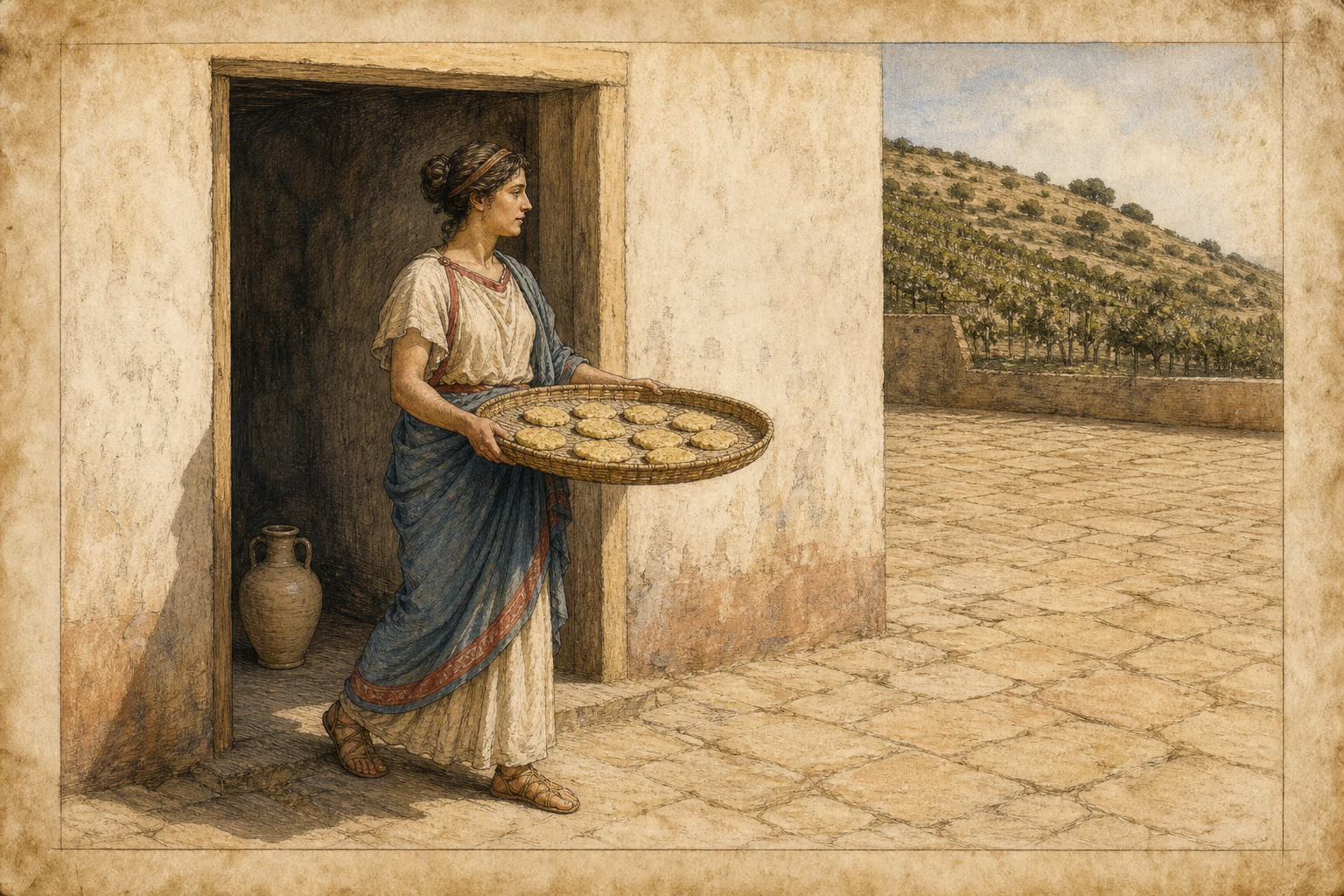
Pistores Romae non fuere ad Persicum usque bellum annis ab urbe condita super DLXXX. ipsi panem faciebant Quirites, mulierumque id opus maxime erat, sicut etiam nunc in plurimis gentium. artoptas iam Plautus appellat in fabula, quam Aululariaminscripsit, magna ob id concertatione eruditorum, an is versus poetae sit illius, certumque fit Atei Capitonis sententia cocos tum panem lautioribus coquere solitos, pistoresque tantum eos, qui far pisebant, nominatos. nec cocos vero habebant in servitiis, eosque ex macello conducebant. cribrorum genera Galliae saetis equorum invenere, Hispaniae lino excussoria et pollinaria, Aegyptus papyro atque iunco.
<1> Sed inter prima dicatur et alicae ratio praestantissimae saluberrimaeque, quae palma frugum indubitata Italiae contingit. fit sine dubio et in Aegypto, sed admodum spernenda, in Italia vero pluribus locis, sicut Veronensi Pisanoque agro, in Campania tamen laudatissima. campus est subiacens montibus nimbosis, totus quidem XL p. planities. terra eius, ut protinus soli natura dicatur, pulverea summa, inferior bibula et pumicis vice fistul osa quoque. montium culpa in bonum cedit. crebros enim imbres percolat atque transmittit, nec dilui aut madere voluit propter facilitatem culturae, eadem acceptum umorem nullis fontibus reddit, sed temperate concoquens intra se vice suci continet. seritur toto anno, panico semel, bis farre. et tamen vere segetes, quae interquievere, fundunt rosam odoratiorem sativa. adeo terra non cessat parere, unde volgo dictum, plus apud Campanos unguenti quam apud ceteros olei fieri. quantum autem universas terras campus Campanus antecedit, tantum ipsum pars eius, quae Leboriae vocantur, quem Phlegraeum Graeci appellant. finiuntur Leboriae via ab utroque latere consulari, quae a Puteolis et quae a Cumis Capuam ducit.
<2> Alica fit e zea, quam semen appellavimus. tunditur granum eius in pila lignea, ne lapidis duritia conterat, mobili, ut notum est, pilo vinctorum poenali opera. primori inest pyxis ferrea. excussis inde tunicis iterum isdem armamentis nudata conciditur medulla. ita fiunt alicae tria genera: minimum ac secundarium, grandissimum vero aphaerema appellant. nondum habent candorem suum, quo praecellunt, iam tamen Alexandrinae praeferuntur. postea, mirum dictu, admiscetur creta, quae transit in corpus coloremque et teneritatem adfert. invenitur haec inter Puteolos et Neapolim in colle Leucogaeo appellato, extatque divi Augusti decretum, quo annua ducena milia Neapolitanis pro eo numerari iussit e fisco suo, colonial deducens Capuam, adiecitque causam adserendi, quoniam negassent Campani alicam confici sine eo metallo posse. — (In eodem reperitur et sulpur, emicantque fontes Araxi oculorum claritati et volnerum medicinae dentiumque firmitati.) —
<3> Alica adulterina fit maxime quidem e zea, quae in Africa degenerat. latiores eius spicae nigrioresque et brevi stipula. pisunt cum harena et sic quoque difficulter deterunt utriculos, fitque dimidia nudi mensura, posteaque gypsi pars quarta inspargitur atque, ut cohaesit, farinario cribro subcernunt. quae in eo remansit, excepticia appellatur et grandissima est. rursus, quae transit, artiore cernitur et secundaria vocatur, item cribraria, quae simili modo in tertio remansit cribro angustissimo et tantum harenas transmittente. alia ratio ubique adulterandi ex tritico: candidissima et grandissima eligunt grana ac semicocta in ollis postea arefaciunt sole ad dimidium rursusque leviter adspersa molis frangunt. ex zea pulchrius quam e tritico fit tragum, quamvis id alicae vitium sit. candorem autem ei pro creta lactis incocti mixtura confert.
English · Bostock & Riley 1855–57
Millet is more particularly employed for making leaven; and if kneaded with must, it will keep a whole year. The same is done, too, with the fine wheat-bran of the best quality; it is kneaded with white must three days old, and then dried in the sun, after which it is made into small cakes. When required for making bread, these cakes are first soaked in water, and then boiled with the finest spelt flour, after which the whole is mixed up with the meal; and it is generally thought that this is the best method of making bread. The Greeks have established a rule that for a modius of meal eight ounces of leaven is enough.
These kinds of leaven, however, can only be made at the time of vintage, but there is another leaven which may be prepared with barley and water, at any time it may happen to be required. It is first made up into cakes of two pounds in weight, and these are then baked upon a hot hearth, or else in an earthen dish upon hot ashes and charcoal, being left till they turn of a reddish brown. When this is done, the cakes are shut close in vessels, until they turn quite sour: when wanted for leaven, they are steeped in water first. When barley bread used to be made, it was leavened with the meal of the fitch, or else the chicheling vetch, the proportion being, two pounds of leaven to two modii and a half of barley meal. At the present day, however, the leaven is prepared from the meal that is used for making the bread. For this purpose, some of the meal is kneaded before adding the salt, and is then boiled to the consistency of porridge, and left till it begins to turn sour. In most cases, however, they do not warm it at all, but only make use of a little of the dough that has been kept from the day before. It is very evident that the principle which causes the dough to rise is of an acid nature, and it is equally evident that those persons who are dieted upon fermented bread are stronger in body. Among the ancients, too, it was generally thought that the heavier wheat is, the more wholesome it is.
It seems to me quite unnecessary to enter into an account of the various kinds of bread that are made. Some kinds, we find, receive their names from the dishes with which they are eaten, the oyster-bread, for instance: others, again, from their peculiar delicacy, the artolaganus, or cake-bread, for example; and others from the expedition with which they are prepared, such as the “speusticus,” or “hurry-bread.” Other varieties receive their names from the peculiar method of baking them, such as oven-bread, tin-bread, and mould-bread. It is not so very long since that we had a bread introduced from Parthia, known as water-bread, from a method in kneading it, of drawing out the dough by the aid of water, a process which renders it remarkably light, and full of holes, like a sponge: some call this Parthian bread. The excellence of the finest kinds of bread depends principally on the goodness of the wheat, and the fineness of the bolter. Some persons knead the dough with eggs or milk, and butter even has been employed for the purpose by nations that have had leisure to cultivate the arts of peace, and to give their attention to the art of making pastry. Picenum still maintains its ancient reputation for making the bread which it was the first to invent, alica being the grain employed. The flour is kept in soak for nine days, and is kneaded on the tenth with raisin juice, in the shape of long rolls; after which it is baked in an oven in earthen pots, till they break. This bread, however, is never eaten till it has been well soaked, which is mostly done in milk mixed with honey.
There were no bakers at Rome until the war with King Perseus, more than five hundred and eighty years after the building of the City. The ancient Romans used to make their own bread, it being an occupation which belonged to the women, as we see the case in many nations even at the present day. Plautus speaks of the artopta, or bread-tin, in his Comedy of the Aulularia, though there has been considerable discussion for that very reason among the learned, whether or not that line really belongs to him. We have the fact, too, well ascertained, in the opinion of Ateius Capito, that the cooks in those days were in the habit of making the bread for persons of affluence, while the name of “pistor” was only given to the person who pounded, or “pisebat,” the spelt. In those times, they had no cooks in the number of their slaves, but used to hire them for the occasion from the market. The Gauls were the first to employ the bolter that is made of horse-hair; while the people of Spain make their sieves and meal-dressers of flax, and the Egyptians of papyrus and rushes.
But among the very first things of all, we ought to speak of the method employed in preparing alica, a most delightful and most wholesome food, and which incontestably confers upon Italy the highest rank among the countries that produce the cereals. This delicacy is prepared, no doubt, in Egypt as well, but of a very inferior quality, and not worth our notice. In Italy, however, it is prepared in numerous places, the territories of Verona and Pisæ, for example; but that of Campania is the most highly esteemed. There, at the foot of mountains capped with clouds, runs a plain, not less in all than forty miles in extent. The land here—to give a description first of the nature of the soil—is dusty on the surface, but spongy below, and as porous as pumice. The inconveniences that generally arise from the close vicinity of mountains are here converted into so many advantages: for the soil, acting on it as a sort of filter, absorbs the water of the abundant rains that fall; the consequence of which is, that the water not being left to soak or form mud on the surface, the cultivation is greatly facilitated thereby. This land does not return, by the aid of any springs, the moisture it has thus absorbed, but thoroughly digests it, by warming it in its bosom, in a heated oven as it were. The ground is kept cropped the whole year through, once with panic, and twice with spelt; and yet in the spring, when the soil is allowed to have a moment’s repose, it will produce roses more odoriferous by far than the cultivated rose: for the earth here is never tired of producing, a circumstance in which originated the common saying, that Campania produces more unguents than other countries do oil.
In the same degree, however, that the Campanian soil excels that of all other countries, so does that part of it which is known to us as Laboriæ, and to the Greeks as Phlegræum, surpass all the rest. This district is bounded on two sides by the consular high road, which leads from Puteoli to Capua on the one side, and from Cumæ on the other.
Alica is prepared from the grain called zea, which we have already mentioned as being known to us as “seed” wheat. The grain is cleansed in a wooden mortar, for fear lest stone, from its hardness, should have the effect of grating it. The motive power for raising the pestle, as is generally known, is supplied by slaves working in chains, the end of it being enclosed in a case of iron. After the husks have been removed by this process, the pure grain is broken to pieces, the same implements being employed. In this way, there are three different kinds of alica made, the finest, the seconds, and the coarse, which last is known as “aphærema.” Still, however, these various kinds have none of them that whiteness as yet for which they are so distinguished, though even now they are preferable to the Alexandrian alica. With this view—a most singular fact—chalk is mixed with the meal, which, upon becoming well incorporated with it, adds very materially to both the whiteness and the shortness of the mixture. This chalk is found between Puteoli and Neapolis, upon a hill called Leucogæum; and there is still in existence a decree of the late Emperor Augustus, (who established a colony at Capua), which orders a sum of twenty thousand sesterces to be paid annually from his exchequer to the people of Neapolis, for the lease of this hill. His motive for paying this rent, he stated, was the fact that the people of Campania had alleged that it was impossible to make their alica without the help of this mineral. In the same hill, sulphur is found as well, and the springs of Araxus issue from its declivities, the waters of which are particularly efficacious for strengthening the sight, healing wounds, and preventing the teeth from becoming loose.
A spurious kind of alica is made, more particularly of a degenerate kind of zea grown in Africa; the ears of it are larger and blacker than those of the genuine kind, and the straw is short. This grain is pounded with sand, and even then it is with the greatest difficulty that the outer coats are removed; when stripped, the grain fills one half only of the original measure. Gypsum, in the proportion of one fourth, is then sprinkled over it, and after the mixture has been well incorporated, it is bolted through a meal-sieve. The portion that remains behind, after this is done, is known as “excepticia,” and consists of the coarser parts; while that which has passed through is submitted to a second process, with a finer sieve; and that which then refuses to pass has the name of “secundaria.” That, again, which, in a similar manner, is submitted to a third sifting, with a sieve of the greatest fineness, which will only admit of sand passing through it, is known as “cribraria,” when it remains on the top of the sieve.
There is another method, again, that is employed every where for adulterating it. They pick out the whitest and largest grains of wheat, and parboil them in earthen pots; these are then dried in the sun till they have regained their original size, after which they are lightly sprinkled with water, and then ground in a mill. A better granæum is made from zea than from wheat, although it is nothing else, in fact, but a spurious alica: it is whitened by the addition of boiled milk, in place of chalk.