LIBER XVIII · CAPUT 12
THE LEGUMINOUS PLANTS: THE BEAN
Latine · Mayhoff 1906
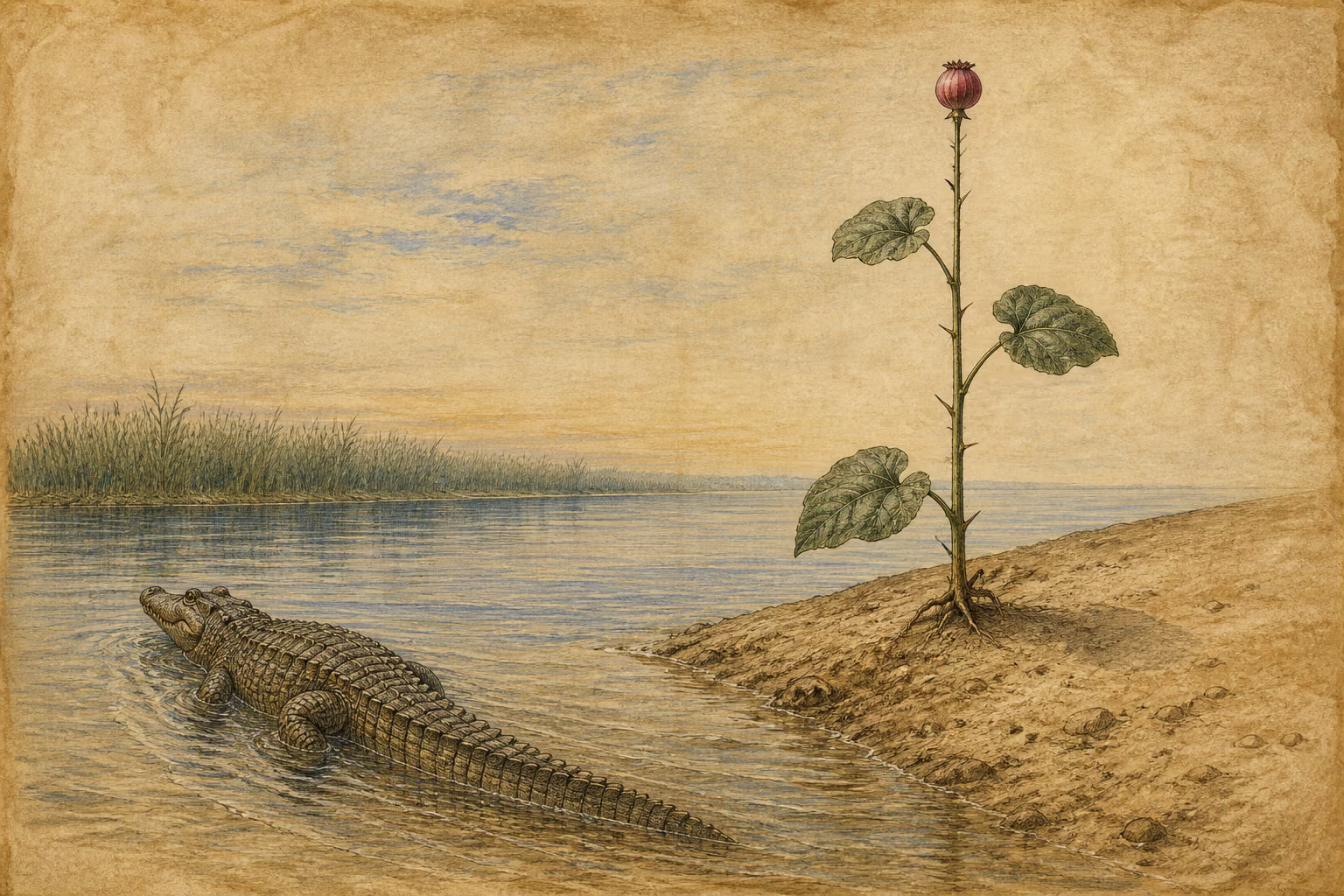
Sequitur legunminlum natura, inter quae maxime honos fabae, quippe ex qua temptatus sit etiam panis. lomentum appellatur farina ex ea, adgravaturque pondus illa et omni legumine, iam vero et pabulo, in pane venali. fabae multiplex usus omnium quadripedum generi, praecipue homini. frumento etiam miscetur apud plerasque gentes, et maxime panico solida ac delicatius fracta. quin et prisco ritu puls fabata suae religionis diis in sacro est. praevalens pulmentari cibo, set hebetare sensus existimata, insomnia quoque facere, ob haec Pythagoricae sententiae damnata, ut alii tradidere, quoniam mortuorum animae sint in ea, qua de causa parentando utique adsumitur. Varro et ob haec flaminem ea non vesci tradit et quoniam in flore eius litterae lugubres reperiantur. in eadem peculiaris religio, namque fabam utique ex frugibus referre mos est auspici causa, quae ideo referiva appellatur. et auctionibus adhibere eam lucrosum putant. sola certe frugum etiam exesa repletur crescente luna. aqua marina aliave salsa non percoquitur. seritur ante vergiliarum occasum leguminum prima, ut antecedat hiemem. Vergilius eam per ver seri iubet circumpadanae Italiae ritu, sed maior pars malunt fabalia maturae sationis quam trimestrem fructum. eius namque siliquae caulesque gratissimo sunt pabulo pecori. aquas in flore maxime concupiscit, cum vero defloruit, exiguas desiderat. solum, in quo sata est, laetificat stercoris vice. ideo circa Macedoniam Thessaliamque, cum florere coepit, vertunt arva. nascitur et sua sponte plerisque in locis, sicut septentrionalis oceani insulis, quas ob id nostri Fabarias appellant, item in Mauretania silvestris passim, sed praedura et quae percoqui non possit. nascitur et in Aegypto spinoso caule, qua de causa crocodili oculis timentes refugiunt. longitudo scapo quattuor cubitorum est amplissima, crassitudo digiti. ni genicula abessent, molli calamo similis; caput papaveri, colore roseo, in eo fabae non supra tricenas; folia ampla, fructus ipse amarus et odore, sed radix perquam grata incolarum cibis, cruda et omni modo cocta, harundinum radicibus similis. nascitur et in Syria Ciliciaque et in Toronae Chalcidi ces lacu.
Ex leguminibus autumno vereve seruntur lens et in Graecia pisum. lens amat solum tenue magis quam pingue, caelum utique siccum. duo genera eius Aegypto, alterum rotundius nigriusque, alterum sua figura, unde vario usu tralatum est in lenticulas nomen. invenio apud auctores aequanimitatem fieri vescentibus ea. pisum in apricis seri debet frigorum inpatientissimum. ideo in Italia et in austeriore caelo non nisi verno tempore terra facili, soluta.
Ciceris natura est gigni cum salsilagine, ideo solum urit nec nisi madefactum pridie seri debet. differentiae plures, magnitudine, colore, figura, sapore. est enim arietino capiti simile, unde ita appellatur, album igrumque; est et columbinum, quod alii Venerium appel-???candidum, rotundum, leve, arietino minus, quod religio???vigiliis adhibet. est et cicercula minuti ciceris, inaequalis, angulosi, veluti pisum, dulcissimum autem id quod ervo simillimum, firmiusque quod nigrum et rufum quam quod album.
Siliquae rotundae ciceri, ceteris leguminum Iongae et ad figuram seminis. latae, piso cylindratae. passiolorum cum ipsis manduntur granis. serere eos qua velis terra licet ab idibus Octobr. in kal. Novembris. legumina, cum maturescere coeperunt, rapienda sunt, quoniam cito exiliunt latentque, cum decidere, sicut et lupinum.
English · Bostock & Riley 1855–57
We now come to the history of the leguminous plants, among which the place of honour must be awarded to the bean; indeed, some attempts have even been made to use it for bread. Bean meal is known as “lomentum;” and, as is the case with the meal of all leguminous plants, it adds considerably, when mixed with flour, to the weight of the bread. Beans are on sale at the present day for numerous purposes, and are employed for feeding cattle, and man more particularly. They are mixed, also, among most nations, with wheat, and panic more particularly, either whole or lightly broken. In our ancient ceremonials, too, bean pottage occupies its place in the religious services of the gods. Beans are mostly eaten together with other food, but it is generally thought that they dull the senses, and cause sleepless nights attended with dreams. Hence it is that the bean has been condemned by Pythagoras; though, according to some, the reason for this denunciation was the belief which he entertained that the souls of the dead are enclosed in the bean: it is for this reason, too, that beans are used in the funereal banquets of the Parentalia. According to Varro, it is for a similar cause that the Flamen abstains from eating beans: in addition to which, on the blossom of the bean, there are certain letters of ill omen to be found.
There are some peculiar religious usages connected with the bean. It is the custom to bring home from the harvest a bean by way of auspice, which, from that circumstance, has the name of “referiva.” In sales by public auction, too, it is thought lucky to include a bean in the lot for sale. It is a fact, too, that the bean is the only one among all the grains that fills out at the increase of the moon, however much it may have been eaten away: it can never be thoroughly boiled in sea-water, or indeed any other water that is salt.
The bean is the first leguminous plant that is sown; that being done before the setting of the Vergiliæ, in order that it may pass the winter in the ground. Virgil recommends that it should be sown in spring, according to the usage of the parts of Italy near the Padus: but most people prefer the bean that has been sown early to that of only three months’ growth; for, in the former case, the pods as well as the stalk afford a most agreeable fodder for cattle. When in blossom more particularly, the bean requires water; but after the blossom has passed off, it stands in need of but very little. It fertilizes the ground in which it has been sown as well as any manure; hence it is that in the neighbourhood of Thessaly and Macedonia, as soon as it begins to blossom, they turn up the ground.
The bean, too, grows wild in most countries, as in those islands of the Northern Ocean, for instance, which for that reason have been called by us the “Fabariæ.” In Mauritania, also, it is found in a wild state in various parts, but so remarkably hard that it will never become soft by boiling.
In Egypt there is a kind of bean which grows upon a thorny stalk; for which reason the crocodiles avoid it, being apprehensive of danger to their eyes. This stalk is four cubits in length, and its thickness, at the very most, that of the finger: were it not for the absence of articulations in it, it would resemble a soft reed in appearance. The head is similar to that of the poppy, being of a rose colour: the beans enclosed in this head are not above thirty in number; the leaves are large, and the fruit is bitter and odoriferous. The root, however, is highly esteemed by the natives as a food, whether eaten raw or well boiled; it bears a strong resemblance to that of the reed. This plant grows also in Syria and Cilicia, and upon the banks of Lake Torone in Chalcidice.
Among the leguminous plants the lentil is sown in the month of November, and the pea, among the Greeks. The lentil thrives best in a soil that is rather thin than rich, and mostly stands in need of dry weather. There are two kinds of lentil grown in Egypt; one of which is rounder and blacker than the other, which has a peculiar shape of its own. The name of this plant has been applied to various uses, and among others has given origin to our word “lenticula.” I find it stated in some authors that a lentil diet is productive of evenness of temper. The pea requires to be sown in a warm, sunny spot, and is ill able to endure cold; hence in Italy and the more rigorous climates, it is sown in the spring only, a light, loose soil being chosen for the purpose.
The chick-pea is naturally salt, for which reason it is apt to scorch the ground, and should only be sown after it has been steeped a day in water. This plant presents considerable differences in reference to size, colour, form, and taste. One variety resembles in shape a ram’s head, from which circumstance it has received the name of “arietinum;” there are both the white and the black arietinum. There is also the columbine chick-pea, by some known as the “pea of Venus;” it is white, round, and smooth, being smaller than the arietinum, and is employed in the observances of the night festivals or vigils. The chicheling vetch, too, is a diminutive kind of chick-pea, unequal and angular, like the pea. The chick-pea that is the sweetest in flavour is the one that bears the closest resemblance to the fitch; the pod in the black and the red kinds is more firmly closed than in the white ones.
The pod of the chick-pea is rounded, while in other leguminous plants it is long and broad, like the seed which it contains; in the pea, again, it is of a cylindrical form. In the case of the kidney-bean it is usual to eat the pod together with the seed. This last may be sown in all kinds of soils indifferently, between the ides of October and the calends of November. As soon as ever the leguminous plants begin to ripen, they ought to be plucked, for the pods will very soon open and the seed fall out, in which case it is very difficult to find: the same is the case, too, with the lupine. But before we pass on to the lupine, it will be as well to make some mention of the rape.