LIBER XVIII · CAPUT 17
THE DISEASES OF GRAIN: THE OAT
Latine · Mayhoff 1906
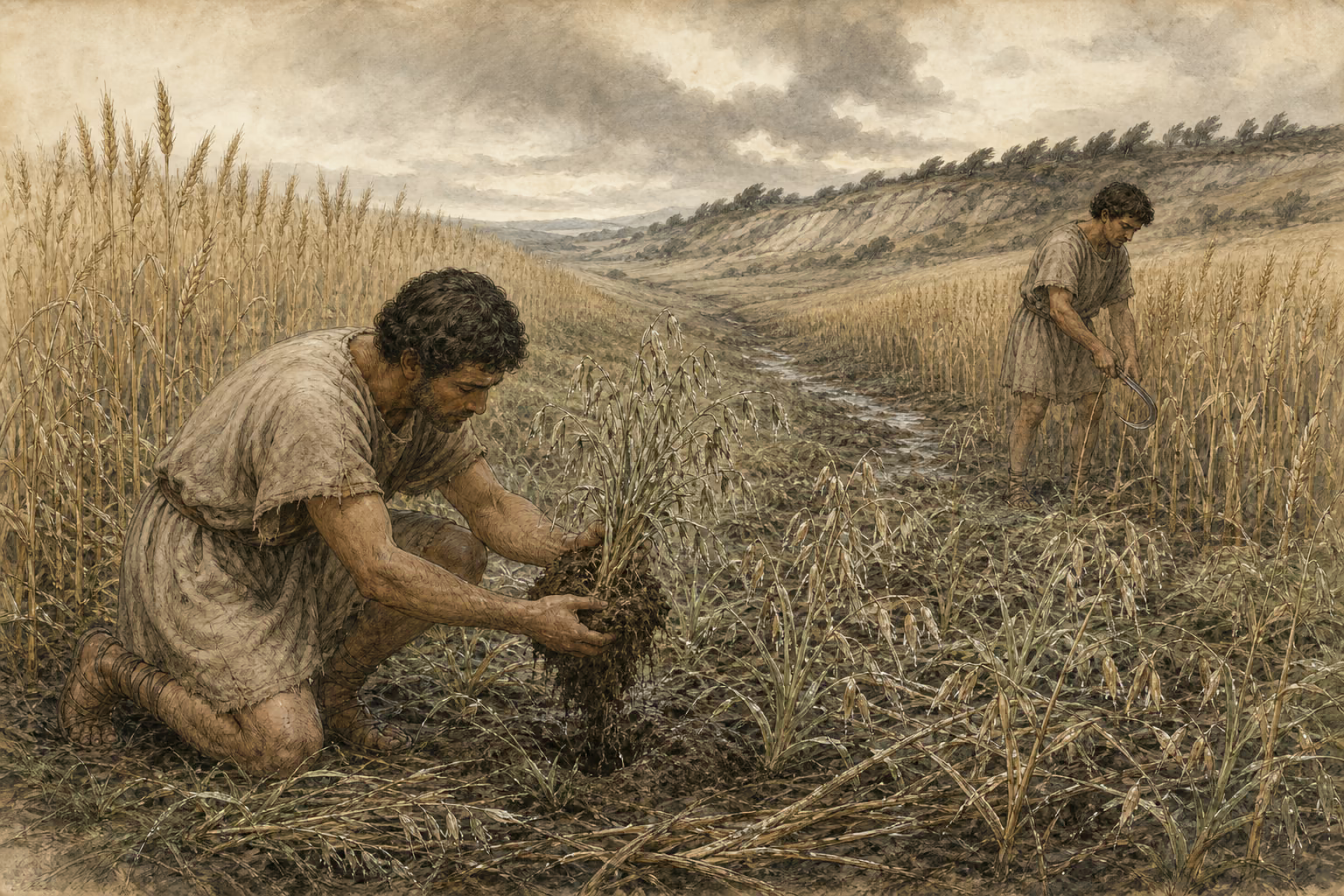
primum omnium frumenti vitium avena est, et hordeum in eam degenerat sic, ut ipsa frumenti sit instar, quippe cum germaniae populi serant eam neque alia pulte vivant. soli maxime caelique umore hoc evenit vitium. sequentem causam habet inbecillitas seminis, si diutius retentum est terra, priusquam erumpat.
eadem ratio et si cariosum fuit, cum sereretur. prima autem statim eruptione agnoscitur, ex quo apparet in radice esse causam. est et aliud ex vicino avenae vitium, cum amplitudine inchoata granum, sed nondum matura, prius quam roboret corpus, adflatu noxio cassum et inane in spica evanescit quodam abortu.
venti autem tribus temporibus nocent frumento et hordeo: in flore aut protinus cum defloruere vel maturescere incipientibus. tum enim exinaniunt grana, prioribus causis nasci prohibent. nocet et sol creber ex nube. nascuntur et vermiculi in radice, cum sementem imbribus secutis inclusit repentinus calor umorem.
gignuntur et in grano, cum spica e pluviis calore infervescit. est et cantharis dictus scarabaeus parvus, frumenta erodens. omnia ea animalia cum cibo deficiunt. oleum, pix, adips contraria seminibus, cavendumque ne contacta eis serantur. imber in herba utilis a partu, florentibus autem frumento et hordeo nocet, leguminibus innocuus praeterquam ciceri. maturescentia frumenta imbre laeduntur et hordeum magis.
nascitur et herba alba, panico similis, occupans arva, pecori quoque mortifera. nam lolium et tribulos et carduos lappasque non magis quam rubos inter frugum morbos potius quam inter ipsius terrae pestes numeraverim.
caeleste frugum vinearumque malum nullo minus noxium est robigo. frequentissima haec in roscido tractu convallibusque ac perflatum non habentibus; e diverso carent ea ventosa et excelsa. inter vitia segetum et luxuria est, cum oneratae fertilitate procumbunt. commune autem omnium satorum vitium uricae, etiam ciceris, cum salsilaginem eius abluendo imber dulcius id facit.
<3> Est herba, quae cicer enecat et ervum circumligando se; vocatur orobanche. tritico simili modo aera, hordeo festuca, quae vocatur aegilops, lenti herba securiclata, quam Graeci a similitudine pelecinum vocant; et hae conplexu necant. circa Philippos ateramum nominant in pingui solo herbam, qua faba necatur, teramum, qua in macro, cum udam quidam ventus adflavit. aerae granum minimum est in cortice aculeato. cum est in pane, celerrime vertigines facit, aiuntque in Asia et Graecia balneatores, cum velint turbam pellere, carbonibus id semen inicere. nascitur et phalangion in ervo, bestiola aranei generis, si hiems aquosa sit. limaces nascuntur in vicia et aliquando e terra, cocleae minutae, mirum in modum erodentes eam. et morbi quidem fere hi sunt.
Remedia eorum, quaecumque pertinent ad herbas, in sarculo et, cum semen iactatur, cinere. quae vero in semine et circa radicem consistunt, praecedente cura caventur. vino ante semina perfusa minus aegrotare existimant. Vergilius nitro et amurca perfundi iubet fabam; sic etiam grandescere promittit. quidam vero, si triduo ante satum urina et aqua maceretur, praecipue adolescere putant; ter quidem saritam modium fractae e modio solidae reddere. reliqua semina, cupressi foliis tusis si misceantur, non esse vermiculis ohnoxia, nec si interlunio serantur. multi ad mili remedia rubetam noctu arvo circumferri iubent, priusquam sariatur, defodique in medio inclusam fictili. ita nec passerem nec vermes nocere, sed eruendam, priusquam metatur; alioquin amarum fieri. quin et armo talpae contacta semina uberiora esse. Democritus suco herbae, quae appellatur aizoum, in tegulis nascens, et ab aliis aesum, Latine vero sedum aut digitillum, medicata seri iubet omnia semina. vulgo vero, si dulcedo noceat et vermes radicibus inhaereant, remedium est amurca pura ac sine sale spargere, dein sarire, si in articulum seges ire coeperit, runcare, ne herbae vincant. pestem a milio atque panico, sturnorum passerumve agmina, scio abigi herba, cuius nomen ignotum est, in quattuor angulis segetis defossa, mirum dictu, ut omnino nulla avis intret. mures abiguntur cinere mustelae vel felis dilute et semine sparso vel decoctarum aqua. sed redolet virus animalium eorum etiam in pane. ob id felle bubulo semina attingi utilius putant. rubigo quidem, maxima segetum pestis, lauri ramis in arvo defixis transit in ea folia ex arvis. luxuria segetum castigatur dente pecoris in herba dumtaxat, et depastae quidem vel saepius nullam in spica iniuriam sentient. retonsarum etiam semel omnino certum est granum longius fieri et inane cassumque ac satum non nasci. Babylone tamen bis secant, tertium depascunt; alioquin folia tantum fierent. sic quoque cum quinquagesimo fenore messes reddit eximia fertilitas soli, diligentioribus vel cum centesimo. neque est cura difficilis quam diutissime aqua rigandi, ut praepinguis et densa ubertas diluatur. limum autem non invehunt Euphrates Tigrisque sic ut in Aegypto Nilus, nec terra ipsa herbas gignit. ubertas tamen tanta est, ut sequente anno sponte restibilis fiat seges inpressis vestigio seminibus. quae tanta soli differentia admonet terrae genera in fruges discribere.
Igitur Catonis haec sententia est: in agro crasso et laeto frumentum seri, si vero nebulosus sit idem, rapa, raphanos, milium, panicum. in frigido, aquoso prius serendum, postea in calido, in solo autem rubricoso vel pullo vel harenoso, si non sit aquosum, lupinum; in creta et rubrica et aquosiore agro adoreum; in sicco et non herboso nec umbroso triticum; in solo valido fabam; viciam vero quam minime aquoso herbidoque; siliginem et triticum in loco aperto, edito, qui sole quam diutissime torreatur; lentem in rudecto et rubricoso, qui non sit herbidus; hordeum in novali et in arvo, quod restibile possit fieri; trimestre, ubi sementem maturam facere non possis et cuius crassitudo sit restibilis.
Subtilis et illa sententia: serenda ea in tenuiore terra, quae non multo indigent suco, ut cytisus et cicere excepto legumina quae velluntur e terra, non subsecantur—unde et legumina appellata, quia ita leguntur—, in pingui autem quae cibi sunt maioris, ut olus, triticum, siligo, linum. sic ergo tenue solum hordeo dabitur—minus enim alimenti radix poscit—, laetior terra densiorque tritico. in loco umidiore far adoreum potius quam triticum seretur, temperato et triticum et hordeum. colles robustius, sed minus reddunt triticum. far, siligo et cretosum et uliginosum solum patiuntur.
English · Bostock & Riley 1855–57
The foremost feature of disease in wheat is the oat. Barley, too, will degenerate into the oat; so much so, in fact, that the oat has become an equivalent for corn; for the people of Germany are in the habit of sowing it, and make their porridge of nothing else. This degeneracy is owing more particularly to humidity of soil and climate; and a second cause is a weakness in the seed, the result of its being retained too long in the ground before it makes its appearance above it. The same, too, will be the consequence, if the seed is decayed when put in the ground. This may be known, however, the moment it makes its appearance, from which it is quite evident that the defect lies in the root. There is another form of disease, too, which closely resembles the oat, and which supervenes when the grain, already developed to its full size, but not ripe, is struck by a noxious blast, before it has acquired its proper body and strength; in this case, the seed pines away in the ear, by a kind of abortion, as it were, and totally disappears.
The wind is injurious to wheat and barley, at three periods of the year in particular: when they are in blossom, directly the blossom has passed off, and just as the seed is beginning to ripen. In this last case, the grain wastes away, while in the two former ones it is prevented from being developed. Gleams of sunshine, every now and then, from the midst of clouds, are injurious to corn. Maggots, too, breed in the roots, when the rains that follow the seed-time are succeeded by a sudden heat, which encloses the humidity in the ground. Maggots make their appearance, also, in the grain, when the ear ferments through heat succeeding a fall of rain. There is a small beetle, too, known by the name of “cantharis,” which eats away the blade. All these insects die, however, as soon as their nutriment fails them. Oil, pitch, and grease are prejudicial to grain, and care should be taken not to let them come in contact with the seed that is sown. Rain is only beneficial to grain while in the blade; it is injurious to wheat and barley while they are in blossom, but is not detrimental to the leguminous plants, with the exception of the chick-pea. When grain is beginning to ripen, rain is injurious, and to barley in particular. There is a white grass that grows in the fields, very similar to panic in appearance, but fatal to cattle. As to darnel, the tribulus, the thistle, and the burdock, I can consider them, no more than the bramble, among the maladies that attack the cereals, but rather as so many pests inflicted on the earth. Mildew, a malady resulting from the inclemency of the weather, and equally attacking the vine and corn, is in no degree less injurious. It attacks corn most frequently in localities which are exposed to dews, and in vallies which have not a thorough draught for the wind; windy and elevated spots, on the other hand, are totally exempt from it. Another evil, again, in corn, is over-luxuriance, when it falls to the ground beneath the weight of the grain. One evil, however, to which all crops in common, the chick-pea even, are exposed, is the attacks of the caterpillar, when the rain, by washing away the natural saltness of the vegetation, makes it all the more tempting for its sweetness.
There is a certain plant, too, which kills the chick-pea and the fitch, by twining around them; the name of it is “orobanche.” In a similar manner, also, wheat is attacked by darnel, barley by a long-stalked plant, called “ægilops,” and the lentil by an axe-leafed grass, to which, from the resemblance of the leaf, the Greeks have given the name of “pelecinon.” All these plants, too, kill the others by entwining around them. In the neighbourhood of Philippi, there is a plant known as ateramon, which grows in a rich soil, and kills the bean, after it has been exposed, while wet, to the blasts of a certain wind: when it grows in a thin, light soil, this plant is called “teramon.” The seed of darnel is extremely minute, and is enclosed in a prickly husk. If introduced into bread, it will speedily produce vertigo; and it is said that in Asia and Greece, the bath-keepers, when they want to disperse a crowd of people, throw this seed upon burning coals. The phalangium, a diminutive insect of the spider genus, breeds in the fitch, if the winter happens to be wet. Slugs, too, breed in the vetch, and sometimes a tiny snail makes its way out of the ground, and eats it away in a most singular manner.
These are pretty nearly all the maladies to which grain is subject.
The best remedy for these maladies, so long as grain is in the blade, is the weeding-hook, and, at the moment of sowing, ashes. As to those diseases which develope themselves in the seed and about the root, with due care precautions may be effectually employed against them. It is generally supposed that if seed has been first steeped in wine, it will be less exposed to disease. Virgil recommends that beans should be drenched with nitre and amurca of olives; and he says that if this is done, they will be all the larger. Some persons, again, are of opinion, that they will grow of increased size, if the seed is steeped for three days before it is sown in a solution of urine and water. If the ground, too, is hoed three times, a modius of beans in the pod, they say, will yield not less than a modius of shelled beans. Other seeds, again, it is said, will be exempt from the attacks of maggots, if bruised cypress leaves are mixed with them, or if they are sown just at the moon’s conjunction. Many persons, for the more effectual protection of millet, recommend that a bramble-frog should be carried at night round the field before the hoeing is done, and then buried in an earthen vessel in the middle of it. If this is done, they say, neither sparrows nor worms will attack the crop. The frog, however, must be disinterred before the millet is cut; for if this is neglected, the produce will be bitter. It is pretended, too, that all seeds which have been touched by the shoulders of a mole are remarkably productive.
Democritus recommends that all seeds before they are sown should be steeped in the juice of the herb known as “aizoüm,” which grows on tiles or shingles, and is known to us by the Latin name of “sedum” or “digitellum.” If blight prevails, or if worms are found adhering to the roots, it is a very common remedy to sprinkle the plants with pure amurca of olives without salt, and then to hoe the ground. If, however, the crop should be beginning to joint, it should be stubbed at once, for fear lest the weeds should gain the upper hand. I know for certain that flights of starlings and sparrows, those pests to millet and panic, are effectually driven away by means of a certain herb, the name of which is unknown to me, being buried at the four corners of the field: it is a wonderful thing to relate, but in such case not a single bird will enter it. Mice are kept away by the ashes of a weasel or a cat being steeped in water and then thrown upon the seed, or else by using the water in which the body of a weasel or a cat has been boiled. The odour, however, of these animals makes itself perceived in the bread even; for which reason it is generally thought a better plan to steep the seed in ox-gall. As for mildew, that greatest curse of all to corn, if branches of laurel are fixed in the ground, it will pass away from the field into the leaves of the laurel. Over-luxuriance in corn is repressed by the teeth of cattle, but only while it is in the blade; in which case, if depastured upon ever so often, no injury to it when in the ear will be the result. If the ear, too, is once cut off, the grain, it is well known, will assume a larger form, but will be hollow within and worthless, and if sown, will come to nothing.
At Babylon, however, they cut the blade twice, and then let the cattle pasture on it a third time, for otherwise it would run to nothing but leaf. Even then, however, so fertile is the soil, that it yields fifty, and, indeed, with care, as much as a hundred, fold. Nor is the cultivation of it attended with any difficulty, the only object being to let the ground be under water as long as possible, in order that the extreme richness and exuberance of the soil may be modified. The Euphrates, however, and the Tigris do not deposit a slime, in the same way that the Nilus does in Egypt, nor does the soil produce vegetation spontaneously; but still, so great is the fertility, that, although the seed is only trodden in with the foot, a crop springs up spontaneously the following year. So great a difference in soils as this, reminds me that I ought to take this opportunity of specifying those which are the best adapted for the various kinds of grain.
This, then, is the opinion expressed by Cato on the subject: “In a dense and fertile soil wheat should be sown: but if the locality is subject to fogs, rape, radishes, millet, and panic. Where the land is cold and moist, sowing should be commenced earlier; but where it is hot, at a later period. In a red, black, or gravelly soil, provided it is not watery, lupines should be sown; but in chalk, red earth, or a watery soil, spelt. Where a locality is dry, free from weeds, and not overshadowed, wheat should be put in; and where the soil is strong and powerful, beans. Vetches should be grown in a soil as free from water and weeds as possible; while wheat and winter wheat are best adapted to an open, elevated locality, fully exposed to the warmth of the sun. The lentil thrives best in a meagre, red earth, free from weeds. Barley is equally suited for fallow land and for a soil that is not intended to be fallow, and three-month wheat, for a soil upon which a crop of ordinary wheat would never ripen, but strong enough to bear.”
The following, too, is sound advice: Those plants should be sown in a thin soil which do not stand in need of much nutriment, the cytisus, for instance, and such of the leguminous plants, with the exception of the chick-pea, as are taken up by the roots and not cut. From this mode of gathering them—“legere”—the legumina derive their name. Where it is a rich earth, those plants should be grown which require a greater proportion of nutriment, coleworts for instance, wheat, winter-wheat, and flax. The result, then, will be, that a light soil will be given to barley—the root of that grain standing in need of less nutriment—while a more dense, though easily-worked soil, will be assigned to wheat. In humid localities spelt should be sown in preference to wheat; but where the soil is of moderate temperature, either wheat or barley may be grown. Declivities produce a stronger growth of wheat, but in smaller quantities. Spelt and winter-wheat adopt a moist, cretaceous soil in preference to any other.