LIBER XVIII · CAPUT 18
THE DIFFERENT SYSTEMS OF CULTIVATION EMPLOYED BY VARIOUS NATIONS
Latine · Mayhoff 1906
Ex frugibus ostentum semel, quod equidem invenerim, accidit P. Aelio Cn. Cornelio cos., quo anno superatus est Hannibal. in arboribus enim tum nota produntur frumenta.
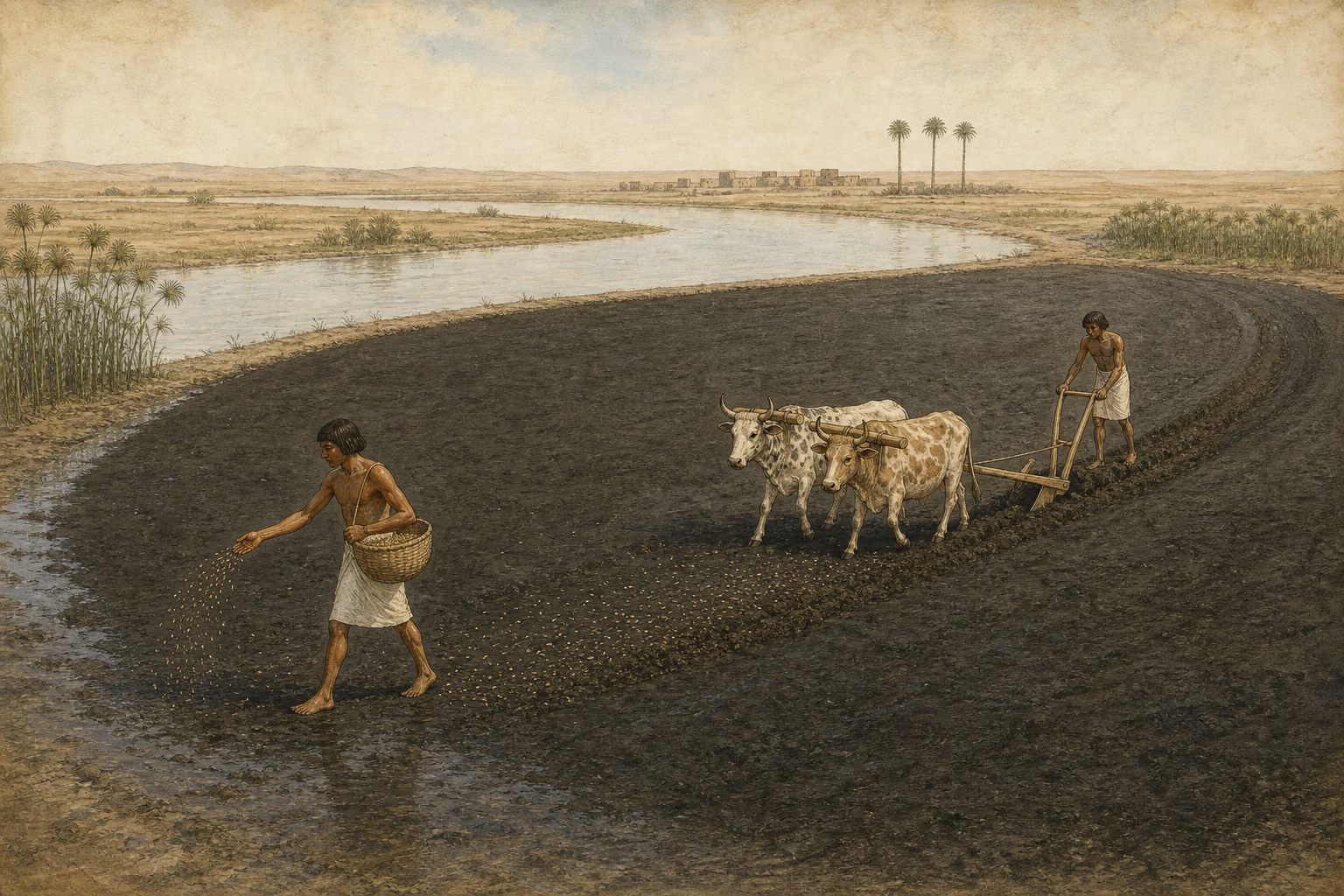
Et quoniam de frugum terraeque generibus abunde diximus, nunc de arandi ratione dicemus, ante omnia Aegypti facilitate conmemorata. Nilus ibi coloni vice fungens evagari incipit, ut diximus, a solstitio ac nova luna, primo lente, dein vehementius, quamdiu in leone sol est. mox pigrescit in virginem transgresso atque in libra residit. si XII cubita non excessit, fames certa est; nec minus si XVI exsuperavit. tanto enim tardius decedit, quanto abundantius crevit, et sementem arcet. vulgo credebatur a decessu eius serere solitos, mox sues inpellere vestigiis semina deprimentes in madido solo, et credo antiquitus factitatum, nunc quoque non multo graviore opera; sed tamen inarari certum est abiecta prius semina in limo degressi amnis. hoc fit Novembri mense incipiente, postea pauci runcant—botanismon vocant—, reliqua pars non nisi cum falce arva visit paulo ante kal. Apriles. peragitur autem messis mense Maio, stipula numquam cubitali, quippe sabulum subest granumque limo tantum continetur. excellentius Thebaidis regioni frumentum, quoniam palustris Aegyptus. similis ratio, sed felicitas maior Babyloniae Seleuciae, Euphrate atque Tigri restagnantibus, quoniam rigandi modus ibi manu temperatur. Syria quoque tenui sulco arat, cum multifariam in Italia octoni boves ad singulos vomeres anhelent. in omni quidem parte culturae, sed in hac maxime valet oraculum illud: quid quaeque regio patiatur.
Vomerum plura genera: culter vocatur inflexus praedensam, priusquam proscindatur, terram secans futurisque sulcis vestigia praescribens incisuris, quas resupinus in arando mordeat vomer. alterun genus est volgare rostrati vectis. tertium in solo facili, nec toto porrectum dentali, sed exigua cuspide in rostro. latior haec quarto generi et acutior in mucronem fastigata eodemque gladio scindens solum et acie laterum radices herbarum secans. non pridem inventum in Raetia Galliae duas addere tali rotulas, quod genus vocant plaumorati. cuspis effigiem palae habet. serunt ita non nisi culta terra et fere nova. latitudo vomeris caespites versat. semen protinus iniciunt cratesque dentatas supertrahunt. nec sarienda sunt hoc modo sata, sed protelis binis ternisque sic arant. uno boum iugo censeri anno facilis soli quadragena iugera, difficilis tricena iustum est.
English · Bostock & Riley 1855–57
The only occasion on which there ever was a prodigy connected with grain, at least that I am aware of, was in the consulship of P. Ælius and Cneius Cornelius, the year in which Hannibal was vanquished: on that occasion, we find it stated, corn was seen growing upon trees.
As we have now spoken at sufficient length of the several varieties of grain and soil, we shall proceed to treat of the methods adopted in tilling the ground, taking care, in the very first place, to make mention of the peculiar facilities enjoyed by Egypt in this respect. In that country, performing the duties of the husbandman, the Nile begins to overflow, as already stated, immediately after the summer solstice or the new moon, gradually at first, but afterwards with increased impetuosity, as long as the sun remains in the sign of Leo. When the sun has passed into Virgo, the impetuosity of the overflow begins to slacken, and when he has entered Libra the river subsides. Should it not have exceeded twelve cubits in its overflow, famine is the sure result; and this is equally the case if it should chance to exceed sixteen; for the higher it has risen, the more slowly it subsides, and, of course, the seed-time is impeded in proportion. It was formerly a very general belief that immediately upon the subsiding of the waters the Egyptians were in the habit of driving herds of swine over the ground, for the purpose of treading the seed into the moist soil—and it is my own impression that this was done in ancient times. At the present day even, the operation is not attended with much greater labour. It is well known, however, that the seed is first laid upon the slime that has been left by the river on its subsidence, and then ploughed in; this being done at the beginning of November. After this is done, a few persons are employed in stubbing, an operation known there as “botanismos.” The rest of the labourers, however, have no occasion to visit the land again till a little before the calends of April, and then it is with the reaping-hook. The harvest is completed in the month of May. The stem is never so much as a cubit in length, as there is a stratum of sand beneath the slime, from which last alone the grain receives its support. The best wheat of all is that of the region of Thebais, Egypt being of a marshy character.
The method adopted at Seleucia in Babylonia is very similar to this, but the fertility there is still greater, owing to the overflow of the Euphrates and Tigris, the degree of irrigation being artificially modified in those parts. In Syria, too, the furrows are made extremely light, while in many parts of Italy, again, it takes as many as eight oxen to pant and blow at a single plough. All the operations of agriculture, but this in particular, should he regulated by the oracular precept—“Remember that every locality has its own tendencies.”
Ploughs are of various kinds. The coulter is the iron part that cuts up the dense earth before it is broken into pieces, and traces beforehand by its incisions the future furrows, which the share, reversed, is to open out with its teeth. Another kind—the common plough-share—is nothing more than a lever, furnished with a pointed beak; while another variety, which is only used in light, easy soils, does not present an edge projecting from the share-beam throughout, but only a small point at the extremity. In a fourth kind again, this point is larger and formed with a cutting edge; by the agency of which implement, it both cleaves the ground, and, with the sharp edges at the sides, cuts up the weeds by the roots. There has been invented, at a comparatively recent period, in that part of Gaul known as Rhætia, a plough with the addition of two small wheels, and known by the name of “plaumorati.” The extremity of the share in this has the form of a spade: it is only used, however, for sowing in cultivated lands, and upon soils which are nearly fallow. The broader the plough-share, the better it is for turning up the clods of earth. Immediately after ploughing, the seed is put into the ground, and then harrows with long teeth are drawn over it. Lands which have been sown in this way require no hoeing, but two or three pairs of oxen are employed in ploughing. It is a fair estimate to consider that a single yoke of oxen can work forty jugera of land in the year, where the soil is light, and thirty where it is stubborn.