LIBER XVIII · CAPUT 28
THE SUMMER SOLSTICE
Latine · Mayhoff 1906
Prata circa kal. Iun. caeduntur, quorum facillima agricolis cura ac minimi inpendii haec de se postulat dici. relinqui debent in laeto solo vel umido vel riguo, eaque aqua pluvia rigari aut publica. utilissimum, si malae herbae, arare, dein cratire, sarire, florem ex fenilibus atque e praesepibus feno delapsum spargere, priusquam cratiantur, nec primo anno rigari, nec pasci ante secunda fenisecia, ne herbae vellantur obtrituque hebetentur. senescunt prata restituique debent faba in iis sata vel rapis vel milio, mox insequente anno frumento, rursusque inarata tertio relinqui, praeterea quotiens secta sint siciliri, hoc est quae feniseces praeterierunt secari. est enim in primis inutile enasci herbas sementaturas. herba optima in prato trifoli, proxima graminis, pessima nummuli siliquam etiam diram ferentis. invisa et equisaeti est, a similitudine equinae saetae. secandi tempus, cum spica deflorescere coepit atque roborari. secandum, antequam inarescat. Cato: fenum, inquit, ne sero seces: prius quam se- men maturum sit. quidam pridie rigant. ubi non sunt rigua, noctibus roscidis secari melius. quaedam partes Italiae post messem secant. <5> Fuit hoc quoque maioris inpendii apud priores, Creticis tantum transmarinisque cotibus notis nec nisi oleo aciem falcis excitantibus; igitur cornu propter oleum ad crus ligato fenisex incedebat. Italia aquarias cotes dedit limae vice imperantes ferro, set aquariae protinus virent. falcium ipsarum duo genera: Italicum brevius ac vel inter vepres quoque tractabile, Galliarum latifundia maioribus.... conpendia, quippe medias caedunt herbas brevioresque praetereunt. Italus fenisex dextra una manu secat. iustum est una opera in die iugerum desecari, alligarique manipulos Mcc quaterna pondo. sectum verti ad solem nec nisi siccum construi oportet. ni fuerit observatum hoc diligenter, exhalare matutino nebulam quandam metas, mox sole accendi et conflagrare certum est. rursus rigari desecta oportet, ut secetur autumnale fenum, quod vocant cordum. Interamnae in Umbria quater anno secantur, etiam non rigua; rigua vero ter plerisque in locis, et postea in ipso pabulo non minus emolumenti est quam e feno. armentorum ideo cura iumentorumque progeneratio suum cuique consilium dabit, opimo maxime quadrigarum quaestu.
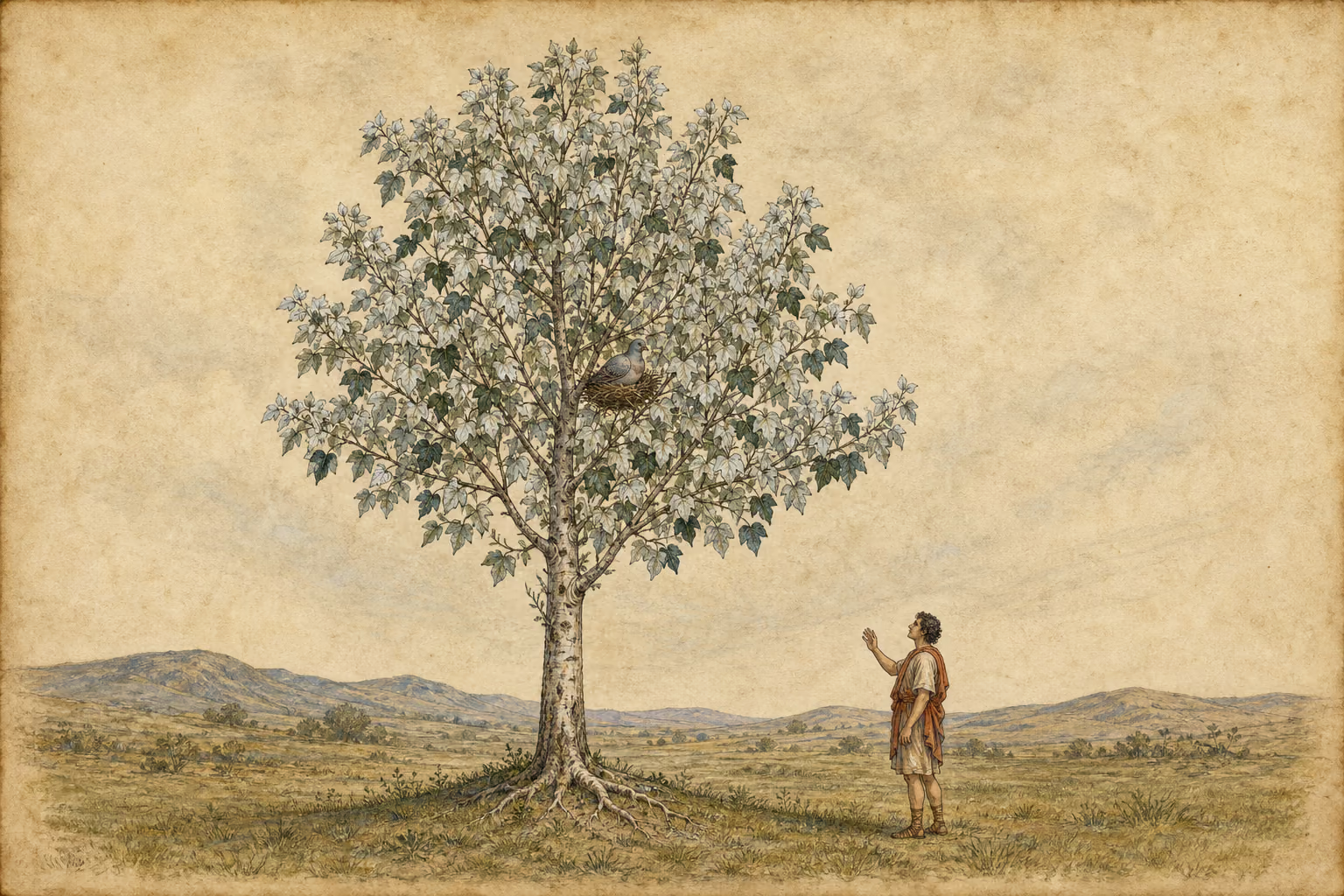
<1> Solstitium peragi in octava parte cancri et VIII kal. Iul. diximus. magnus hic anni cardo, magna res mundi. in hoc usque a bruma crescunt dies [creverunt sex mensibus], sol ipse ad aquilonem scandens ac per ardua enisus ab ea meta incipit flecti ac degredi ad austrum, aucturus noctes aliis sex mensibus ablaturusque diei mensuram. ex hoc deinde rapiendi convehendique fructus alios atque alios tempus, et praeparandi se contra saevam feramque hiemem, decebatque hoc discrimen indubitatis notis signasse naturam. quam ob rem eas manibus ipsis agricolarum ingessit vertique iussit ipsa die folia et esse confecti sideris signum, nec silvestrium arborum remotarumque, ut in saltus devios montesque eundum esset quaerentibus signa, non rursus urbanarum quaeque topiario tantum coluntur, quamquam his et in villa visendis. vertit oleae ante pedes satae, vertit tiliae ad mille usus petendae, vertit populi albae etiam vitibus nuptae. adhuc parum est. ' ulmum, inquit, vite dotatam habes: et huius vertam. pabulo folia eius stringis aut deputas: aspice et tenes sidus. alia parte caelum respiciunt quam qua spectavere pridie. salice omnia alligas, humillima arborum, ipse toto capite altior: et huius circumagam. quid te rusticum quereris? non stat per me, quo minus caelum intellegas et caelestia scias. dabo et auribus signum: palumbium utique exaudi gemitus. transisse solstitium caveto putes, nisi cum incubantem videris palumbem.'
<2> Ab solstitio ad fidiculae occasum VI kal. Iul. Caesari Orion exoritur, zona autem eius IIII non. Assyriae, Aegypto vero procyon matutino aestuosus, quod sidus apud Romanos non habet nomen, nisi caniculam hanc volumus intellegi, hoc est minorem canem, ut in astris pingitur, ad aestum magno opere pertinens, sicut paulo mox docebimus. IIII non. Chaldaeis corona occidit matutino, Atticae Orion totus eo die exoritur. prid. id. Iul. Aegyptiis Orion desinit exoriri, XVI kal. Aug. Assyriae procyon exoritur, dein post triduum fere ubique confessum inter omnes sidus ingens, quod canis ortum vocamus, sole partem primam leonis ingresso. hoc fit post solstitium XXIII die. sentiunt id maria et terrae, multae vero et ferae, ut suis locis diximus. neque est minor ei veneratio quam discriptis in deos stellis, accenditque solem et magnam aestus obtinet causam. XIII kal. Aegypto aquila occidit matutino etesiarumque prodromi flatus incipiunt, quod Caesar x kal. sentire Italiam existimavit. aquila Atticae matutino occidit, III kal. regia in pectore leonis stella matutino Caesari emergit. VIII id. Aug. arcturus medius occidit, III id. fidicula occasu suo autumnum inchoat, ut is adnotavit, sed vera ratio id fieri invenit VI id. easdem.
<3> In hoc temporis intervallo res summa vitium agitur decretorio uvis sidere illo, quod caniculam appellavimus, unde carbunculare dicuntur ut quodam uredinis carbone exustae. non conparantur huic malo grandines, procellae quaeque umquam annonae intulere caritatem. agrorum quippe mala sunt illa, carbunculus autem regionum late patentium, non difficili remedio, nisi calumniari naturam rerum homines quam sibi prodesse mallent. ferunt Democritum, qui primus intellexit ostenditque caeli cum terris societatem, spernentibus hanc curam eius opulentissimis civium, praevisa olei caritate futura ex vergiliarum ortu qua diximus ratione ostendemusque iam planius, magna tum vilitate propter spem olivae coemisse in toto tractu omne oleum, mirantibus qui paupertatem quietemque doctrinarum ei sciebant in primis cordi esse, atque ut apparuit causa et ingens divitiarum cursus, restituisse mercedem anxiae et avidae dominorum poenitentiae, contentum probavisse opes sibi in facili, cum vellet, fore. hoc postea Sextius e Romanis sapientiae adsectatoribus Athenis fecit eadem ratione. tanta litterarum occasio est. quas equidem miscebo agrestibus negotiis quam potero dilucide atque perspicue.
Plerique dixere rorem inustum sole acri frugibus robiginis causam esse et carbunculi vitibus, quod ex parte falsum arbitror omnemque uredinem frigore tantum constare sole innoxio. id manifestum fiet adtendentibus. nam primum omnium non hoc evenire nisi noctibus et ante solis ardorem deprehenditur totumque lunari ratione constat, quoniam talis iniuria non fit nisi interlunio plenave luna, hoc est praevalente. utroque enim habitu plena est, ut saepius diximus, sed interlunio omne lumen, quod a sole accepit, caelo regerens. differentia utriusque habitus magna, sed manifesta. namque interlunio aestate calidissima est, hieme gelida. e diverso in plenilunio aestate frigidas facit noctes, hieme tepidas. causa evidens, sed alia quam redditur a Fabiano Graecisque auctoribus. aestate enim interlunio necesse est cum sole proximo nobis circulo currat, igne eius comminus recepto candens, eadem interlunio absit hieme, quoniam abscedit et sol; item in plenilunio aestivo procul abeat adversa soli, hieme autem ad nos per aestivum circulum accedat. ergo per se roscida, quotiens alget, infinitum quantum illo tempore cadentes pruinas congelat.
<1> Ante omnia autem duo genera esse caelestis iniuriae meminisse debemus: unum quod tempestates vocamus, in quibus grandines, procellae ceteraque similia intelleguntur, quae cum acciderint, vis maior appellatur. haec ab horridis sideribus exeunt, ut saepius diximus, veluti arcturo, Orione, haedis. alia sunt illa, quae silente caelo serenisque noctibus fiunt, nullo sentiente nisi cum facta sunt. publica haec et magnae differentiae a prioribus, aliis robiginem, aliis uredinem, aliis carbunculum appellantibus, omnibus vero sterilitatem. de his nunc dicemus a nullo ante nos prodita, priusque causas reddemus.
English · Bostock & Riley 1855–57
About the calends of June the meadows are mown; the cultivation of which, the one which is the easiest of all, and requires the smallest outlay, leads me to enter into some further details relative to it. Meadow lands should be selected in a rich, or else a moist or well-watered, soil, and care should be taken to drain the rain-water upon them from the high-road. The best method of ensuring a good crop of grass, is first to plough the land, and then to harrow it: but, before passing the harrow over it, the ground should be sprinkled with such seed as may have fallen from the hay in the hay-lofts and mangers. The land should not be watered, however, the first year, nor should cattle be put to graze upon it before the second hay-harvest, for fear lest the blade should be torn up by the roots, or be trodden down and stunted in its growth. Meadow land will grow old in time, and it requires to be renovated every now and then, by sowing upon it a crop of beans, or else rape or millet, after which it should be sown the next year with corn, and then left for hay the third. Care, too, should be taken, every time the grass is cut, to pass the sickle over the ground, and so cut the aftermath which the mowers have left behind; for it is a very bad plan to leave any of the grass and let it shed its seed there. The best crop for meadow land is trefoil, and the next best is grass; nummulus is the very worst of all, as it bears a pod which is particularly injurious; equisætis, too, which derives its name from its resemblance to horse-hair, is of a noxious character. The proper time for mowing grass is when the ear begins to shed its blossom and to grow strong: care must be taken to cut it before it becomes dry and parched. “Don’t mow your hay too late,” says Cato; “but cut it before the seed is ripe.” Some persons turn the water upon it the day before mowing, where it is practicable to do so. It is the best plan to cut hay in the night while the dews are falling. In some parts of Italy the mowing is not done till after harvest.
This operation, too, was a very expensive one in ancient times. In those days the only whetstones known were those of Crete and other places beyond sea, and they only used oil to sharpen the scythe with. For this purpose the mower moved along, with a horn, to hold the oil, fastened to his thigh. Italy has since furnished us with whetstones which are used with water, and give an edge to the iron quite equal to that imparted by the file; these water-whetstones, however, turn green very quickly. Of the scythe there are two varieties; the Italian, which is considerably shorter than the other, and can be handled among underwood even; and the Gallic, which makes quicker work of it, when employed on extensive domains, for there they cut the grass in the middle only, and pass over the shorter blades. The Italian mowers cut with one hand only. It is a fair day’s work for one man to cut a jugerum of grass, and for another to bind twelve hundred sheaves of four pounds each. When the grass is cut it should be turned towards the sun, and must never be stacked until it is quite dry. If this last precaution is not carefully taken, a kind of vapour will be seen arising from the rick in the morning, and as soon as the sun is up it will ignite to a certainty, and so be consumed. When the grass has been cut, the meadow must be irrigated again, for the purpose of ensuring a crop in the autumn, known to us as the “cordum,” or aftermath. At Interamna in Umbria the grass is cut four times a-year, and this although the meadows there are not irrigated,—in most places, three. After all this has been done, too, the pasturage of the land is found no less lucrative than the hay it has produced. This, however, is a matter of consideration for those more particularly who rear large herds of cattle, and every one whose occupation it is to breed beasts of burden, will have his own opinions upon the subject: it is found, however, the most lucrative of all by those whose business it is to train chariot-horses.
We have already stated that the summer solstice arrives at the eighth degree of Cancer, and upon the eighth day before the calends of July: this is an important crisis in the year, and of great interest to the whole earth. Up to this period from the time of the winter solstice the days have gone on increasing, and the sun has continued for six months making his ascension towards the north; having now surmounted the heights of the heavens, at this point he reaches the goal, and after doing so, commences his return towards the south; the consequence of which is, that for the next six months he increases the nights and subtracts from the length of the days. From this period, then, it is the proper time to gather in and store away the various crops in succession, and so make all due preparations for the rigour and severity of the winter.
It was only to be expected that Nature should point out to us the moment of this change by certain signs of an indubitable character; and she has accordingly placed them beneath the very hands of the agriculturist, bidding the leaves turn round upon that day, and so denote that the luminary has now run its course. And it is not the leaves of trees only that are wild and far remote that do this, nor have those persons who are on the look-out for these signs to go into devious forests and mountain tracts to seek them. Nor yet, on the other hand, are they to be seen in the leaves of trees only that are grown in the vicinity of cities or reared by the hand of the ornamental gardener, although in them they are to be seen as well. Nature upon this occasion turns the leaf of the olive which meets us at every step; she turns the leaf of the linden, sought by us, as it is, for a thousand purposes; she turns the leaf of the white poplar, too, wedded to the vine that grows upon its trunk. And still, for her, all this is not enough. “You have the elm,” she says, “reared for the support of the vine, and the leaf of that I will make to turn as well. The leaves of this tree you have to gather for fodder, the leaves of the vine you prune away. Only look upon them, and there you behold the solstice; they are now pointing towards a quarter of the heavens the reverse of that towards which they looked the day before. The twigs of the withy, that most lowly of trees, you employ for tying things without number. You are a head taller than it—I will make its leaves to turn round as well. Why complain, then, that you are but a rustic peasant? It shall be no fault of mine if you do not understand the heavens and become acquainted with the movements of the celestial bodies. I will give another sign, too, that shall address itself to your ear—only listen for the cooing of the ring-doves; and beware of supposing that the summer solstice is past, until you see the wood-pigeon sitting on her eggs.”
Between the summer solstice and the setting of the Lyre, on the sixth day before the calends of July, according to Cæsar’s reckoning, Orion rises, and upon the fourth before the nones of July, his Belt rises to the people of Assyria. Upon the morning of the same day, also, the scorching constellation of Procyon rises. This last constellation has no name with the Romans, unless, indeed, we would consider it as identical with Canicula, or Lesser Dog, which we find depicted among the stars; this last is productive of excessive heat, as we shall shortly have further occasion to state. On the fourth before the nones of July, the Crown sets in the morning to the people of Chaldæa, and in Attica, the whole of Orion has risen by that day. On the day before the ides of July, the rising of Orion ends to the Egyptians also; on the sixteenth before the calends of August, Procyon rises to the people of Assyria, and, the day but one after, of nearly all other countries as well, indicating a crisis that is universally known among all nations, and which by us is called the rising of the Dog-star; the sun at this period entering the first degree of Leo. The Dog-star rises on the twenty-third day after the summer solstice; the influence of it is felt by both ocean, and earth, and even by many of the animals as well, as stated by us elsewhere on the appropriate occasions. No less veneration, in fact, is paid to this star, than to those that are consecrated to certain gods; it kindles the flames of the sun, and is one great source of the heats of summer.
On the thirteenth day before the calends of August, the Eagle sets in the morning to the people of Egypt, and the breezes that are the precursors of the Etesian winds, begin to blow; these, according to Cæsar, are first perceived in Italy, on the tenth before the calends of August. The Eagle sets in the morning of that day to the people of Attica, and on the third before the calends of August, the Royal Star in the breast of Leo rises in the morning, according to Cæsar. On the eighth before the ides of August, one half of Arcturus has ceased to be visible, and on the third before the ides the Lyre, by its setting, opens the autumn,—according to Cæsar at least; though a more exact calculation has since shown, that this takes place on the sixth day before the ides of that month.
The time that intervenes between these periods is one that is of primary importance in the cultivation of the vine; as the constellation of which we have spoken, under the name of Canicula, has now to decide upon the fate of the grape. It is at this period that the grapes are said to be charred, a blight falling upon them which burns them away, as though red-hot coals had been applied to them. There is no hail that can be compared with this destructive malady, nor yet any of those tempests, which have been productive of such scarcity and dearth. For the evil effects of these, at the very utmost, are only felt in isolated districts, while the coal blight, on the other hand, extends over whole countries, far and wide. Still, however, the remedy would not be very difficult, were it not that men would much rather calumniate Nature, than help themselves. It is said that Democritus, who was the first to comprehend and demonstrate that close affinity which exists between the heavens and the earth, finding his laborious researches upon that subject slighted by the more opulent of his fellow-citizens, and presaging the high price of oil, which was about to result upon the rising of the Vergiliæ, (as we have already mentioned, and shall have to explain more fully hereafter), bought up all the oil in the country, which was then at a very low figure, from the universal expectation of a fine crop of olives; a proceeding which greatly surprised all who knew that a life of poverty and learned repose was so entirely the object of his aspirations. When, however, his motives had been fully justified by the result, and vast riches had flowed in upon him apace, he returned all his profits to the disappointed proprietors, whose avarice had now taught them to repent, thinking it quite sufficient to have thus proved how easy it was for him to acquire riches whenever he pleased. At a more recent period, again, Sextius, a Roman philosopher residing at Athens, made a similar application of his knowledge. Such, then, is the utility of science, the instruction provided by which it shall be my aim, as clearly and as perspicuously as possible, to apply to the various occupations of a country life.
Most writers have said that it is the dew, scorched by a burning sun, that is the cause of mildew in corn, and of coal blight in the vine; this, however, seems to me in a great measure incorrect, and it is my opinion that all blights result entirely from cold, and that the sun is productive of no injurious effects whatever. This, in fact, will be quite evident, if only a little attention is paid to the subject; for we find that the blight makes its appearance at first in the night time only, and before the sun has shone with any vigour. The natural inference is, that it depends entirely upon the moon, and more particularly as such a calamity as this is never known to happen except at the moon’s conjunction, or else at the full moon, periods at which the influence of that heavenly body is at its greatest height. For at both of these periods, as already stated by us more than once, the moon is in reality at the full; though during her conjunction she throws back to the heavens all the light which she has received from the sun. The difference in the effects produced by the moon at these two periods is very great, though at the same time equally apparent; for at the conjunction, that body is extremely hot in summer, but cold in winter; while, on the other hand, at the full moon, the nights are cold in summer, but warm in winter. The reason of this, although Fabianus and the Greek writers adopt another method of explaining it, is quite evident. During the moon’s conjunction in summer, she must of necessity move along with the sun in an orbit nearer to the earth, and so become warmed by the heat which she receives by reason of her closer vicinity to the sun. In winter, again, at the time of the conjunction, she is farther off from us, the sun being also removed to a greater distance. On the other hand, again, when the moon is at the full in summer, she is more remote from the earth, and in opposition with the sun; while, in winter, she approaches nearer to us at that period, by adopting the same orbit as at her conjunction in summer. Naturally humid herself, as often as from her position she is cold, she congeals to an unlimited extent the dews which fall at that period of the year.
But we ought always to bear in mind, more particularly, that there are two varieties of evils that are inflicted upon the earth by the heavens. The first of these, known by us under the name of “tempests,” comprehends hail-storms, hurricanes and other calamities of a similar nature; when these take place at the full moon, they come upon us with additional intensity. These tempests take their rise in certain noxious constellations, as already stated by us on several occasions, Arcturus, for instance, Orion, and the Kids.
The other evils that are thus inflicted upon us, supervene with a bright, clear sky, and amid the silence of the night, no one being sensible of them until we have perceived their effects. These dispensations are universal and of a totally different character from those previously mentioned, and have various names given to them, sometimes mildew, sometimes blast, and sometimes coal blight; but in all cases sterility is the infallible result. It is of these last that we have now to speak, entering into details which have not hitherto been treated of by any writer; and first of all we will explain the causes of them.