LIBER XIX · CAPUT 8
THE NATURE AND VARIETIES OF TWENTY-THREE GARDEN PLANTS. THE LETTUCE; ITS DIFFERENT VARIETIES
Latine · Mayhoff 1906
id enim, quod sponte in umidis nascitur, helioselinum vocatur, uno folio nec hirsutum, rursus in siccis hipposelinum, pluribus foliis, simile helioselino. tertium est oreoselinum, cicutae foliis, radice tenui, semine aneti, minutiore tantum. et sativi autem differentiae in folio denso, crispo aut rariore et leviore, item caule tenuiore aut crassiore, et caulis aliorum candidus est, aliorum purpureus, aliorum varius.
Lactucae Graeci tria fecere genera: unum lati caulis, adeo ut ostiola olitoria ex iis factitari prodiderint — folium his paulo maius herbaceo et angustissimum, ut alibi consumpto incremento —, alterum rotundi caulis, tertium sessile, quod Laconicum vocant. alii colore et tempore satus genera discrevere; esse enim nigras, quarum semen mense Ianuario seratur, albas, quarum Martio, rubentes, quarum Aprili, et omnium earum plantas post binos menses differri. diligentiores plura genera faciunt: purpureas, crispas, Cappadocias, Graecas, longioris has folii caulisque lati, praeterea longi et angusti, intubis similis. pessimum autem genus cum exprobratione amaritudinis appellavere πικρίδα. est etiamnum alia distinctio albae, quae μηκωνὶς vocatur a copia lactis soporiferi, quamquam omnes somnum parere creduntur. apud antiquos Italiae hoc solum genus earum fuit, et ideo lactucis nomen a lacte. purpuream maximae radicis Caecilianam vocant, rotundam vero ac minima radice, latis foliis ἀστυτίδα quidamque εὐνουχεῖον, quoniam haec maxime refragetur veneri. est quidem natura omnibus refrigeratrix et ideo aestate gratia. stomacho fastidium auferunt cibique adpetentiam faciunt. divus certe Augustus lactuca conser15 vatus in aegritudine fertur prudentia Musae medici, cum prioris C. Aemili religio nimia eam negaret, in tantum recepta commendatione, ut servari etiam in alienos menses eas oxymeli tum repertum sit. sanguinem quoque augere creduntur. est etiamnum quae vocatur caprina lactuca, de qua dicemus inter medicas, et ecce cum maxime coepit inrepere sativis admodum probata quae Cilicia vocatur, folio Cappadociae, ni crispum latiusque esset.
Neque ex eodem genere possint dici neque ex alio intubi, hiemis hi patientiores virusque praeferentes, sed caule non minus grati. seruntur ab aequinoctio verno, plantae eorum ultimo vere transferuntur. est et erraticum intubum, quod in Aegypto cichorium vocant, de quo plura alias.
Inventum omnes thyrsos vel folia lactucarum prorogare urceis conditos et recentes in patinis coquere. seruntur lactucae anno toto laetis et irriguis stercoratisque, binis mensibus inter semen plantamque et maturitatem. legitimum tamen a bruma semen iacere, plantam favonio transferre aut semen favonio, plantam aequinoctio verno. albae maxime hiemem tolerant. umore omnia hortensia gaudent et stercore, praecipue lactucae et magis intubi. seri etiam radices inlitas fimo interest et repleri ablaqueatas humo. quidam et aliter amplitudinem augent, recisis, cum ad semipedem excreverint, fimoque suillo recent inlitis. candorem vero putant contingere his dumtaxat, quae sint seminis albi, si harena de litore a primo incremento congeratur in medias atque increscentia folia contra ipsa religentur.
Beta hortensiorum levissima est. eius quoque a colore duo genera Graeci faciunt, nigrum et candidius, quod praeferunt—parcissimi seminis—appellantque Siculum, candoris sane discrimine praeferentes et lactucam. nostri betae genera vernum et autumnale faciunt a temporibus satus. quamquam et lunio seritur; transfertur autumno planta. hae quoque et oblini fimo radices suas locumque similiter madidum amant. usus his et cum lenti ac faba idemque qui oleris, et praecipuus, ut lenitas excitetur acrimonia sinapis. medici nocentiorem quam olus esse iudicavere, quamobrem adpositas non nemini degustare etiam religio est, ut validis potius in cibo sint. gemina iis natura, et oleris et capite ipso exilientis bulbi, species summa in latitudine. ea contingit, ut in lactucis, cum coeperint colorem trahere inposito levi pondere. neque alii hortensiorum latitudo maior; in binos pedes aliquando se pandunt, multum et soli natura conferente, siquidem in Circeiensi agro amplissimae proveniunt. sunt qui betas punico malo florente optine seri existiment, transferri autem, cum v foliorum esse coeperint. mira differentia, si vera est, candidis alvum elici, nigris inhiberi, et cum brassica corrumpatur in dolio vini sapor, eodem betae foliis demersis restitui.
<1> Olus caulesque, quibus nune principatus hortorum, apud Graecos in honore fuisse non reperio, sed Cato brassicae miras canit laudes, quas in medendi loco reddemus. genera eius facit: extentis foliis, caule magno, alteram crispo folio, quam apiacam vocant, tertiam minutis caulibus, lenem, teneram minimeque probat. brassica toto anno seritur, quoniam et toto secatur, utilissime tamen ab aequinoctio autumni, transferturque, cum v foliorum est. cymam a prima satione praestat proximo vere. hic est quidam ipsorum caulium delicatior teneriorque cauliculus, Apici luxuriae et per eum Druso Caesari fastiditus, non sine castigatione Tiberi patris. post cymam ex eadem brassica contingunt aestivi autumnalesque cauliculi, mox hiberni, iterumque cymae, nullo aeque genere multifero, donec fertilitate sua consumatur. altera satio ab aequinoctio verno est, cuius planta extremo vere plantatur, ne prius cyma quam caule pariat. tertia circa solstitium, ex qua, si umidior locus sit, aestate, si siccior, autumno plantatur. umor fimumque si defuere, maior saporis gratia est; si abundavere, laetior fertilitas. fimun asininum maxime convenit.
<2> Est haec quoque res inter opera ganeae, quapropter non pigebit verbosius persequi. praecipuus fit caulis sapore ac magnitudine, primum omnium si in repastinato seras, dein si terram fugientes cauliculos sequare terraadtollentesque se proceritate luxuriosa exaggerando aliam accumules ita, ne plus quam cacumen emineat. Tritanum hoc genus vocatur bis conputabili inpendio taedioque. <3> Cetera genera complura sunt: Cumanum sessile folio, capite patulum; Aricinum altitudine non excelsius, folio numerosius quam tenerius; hoc utilissimum existimatur, quia sub omnibus paene foliis fruticat cauliculis peculiaribus. Pompeianum procerius, caule ab radice tenui, intra folia crassescit; rariora haec angustioraque, sed teneritas in dote est. frigora non tolerat, quibus etiam aluntur Bruttiani praegrandes foliis, caule tenues, sapore acuti. Sabellico usque in admirationem crispa sunt folia, quorum crassitudo caulem ipsum extenuet, sed dulcissimi perhibentur ex omnibus. nuper subiere Lacuturnenses ex convalle Aricina, capite praegrandes, folio innumeri, alii in orbem conlecti, alii in latitudinem torosi; nec plus ullis capitis post Tritianum, cui pedale aliquando conspicitur, et cyma nullis serior. cuicumque autem generi pruinae plurimum suavitatis conferunt, at nisi obliquo vulnere defendatur medulla, plurimum nocent. semini destinati non secantur. est etiam sua gratia numquam plantae habitum excedentibus; ἁλμυρίδια vocant, quoniam nisi in maritumis non proveniunt. aiunt navigatione quoque longinqua virides adservari, si statim desecti ita, ne humum adtingant, in cados olei quam proxime siccatos opturatosque condantur omni spiritu excluso. sunt qui plantam in transferendo alga subdita pediculo nitrive triti quod tribus digitis capiatur celeriorem ad mafuritatem fieri putent. sunt qui semen trifolii nitrumque simul tritum adspergant foliis. nitrum in coquendo etiam viriditatem custodit, ut et Apiciana coctura, oleo ac sale, priusquam coquantur, maceratis. est inter herbas genus inserendi praecisis germinibus caulis et in medullam semine ex aliis addito. hoc et in cucumere silvestri. nec non olus quoque silvestre est, triumpho divi Iuli carminibus praecipue iocisque militaribus celebratum; alternis quippe versibus exprobravere lapsana se vixisse aput Dyrrachium, praemiorum parsimoniam cavillantes. est autem id cyma silvestris.
Omnium in hortis rerum lautissima cura asparagis. de origine eorum e silvestribus corrudis abunde dictum et quomodo eas iuberet Cato in harundinetis seri. est et aliud genus incultius asparago, mitius corruda, passim etiam in montibus nascens, refertis superioris Germaniae campis, non inficeto Ti. Caesaris dicto, herbam ibi quandam nasci simillimam asparago. nam quod in Neside Campaniae insula sponte nascitur, longe optimum existimatur. hortensium seritur spongeis. est enim plurimae radicis altissimeque germinat. viret thyrso primum emicante, qui caulem educens tempore ipso fastigatur in toros striatos. potest et semine seri.
Nihil diligentius comprehendit Cato, novissimumque libri est, ut appareat rem repentem ac noviciam fuisse. locum subigi iubet umidum aut crassum, -semipedali undique intervallo seri, ne calcetur, praeterea ad lineam grana bina aut terna paxillo demitti—videlicet semine tum tantum serebantur —, id fieri secundum aequinoctium vernum, stercore satiari, crebro purgari, caveri ne cum herbis evellatur asparagus; primo anno stramento ab hieme protegi, vere aperiri, sariri, runcari, tertio incendi verno. quo maturius incensus est, hoc melius provenit. itaque harundinetis maxime convenit, quae festinant incendi. sariri iubet idem non antequam asparagus natus fuerit, ne in sariendo radices vexentur. ex eo velli asparagum ab radice, nam si defringatur, stirpescere et intermori; velli, donec in semen eat—id autem maturescere ad ver —, incendique ac rursus, cum apparuerit asparagus, sariri ac stercorari, ac post annos VIII, cum iam vetus sit, digeri subacto stercoratoque, tum spongeis seri singulorum pedum intervallo. quin et ovillo fimo nominatim uti, quoniam aliud herbas creet. nec quicquam postea temptatum utilius apparuit, nisi quod circa id. Feb. defosso semine acervati m parvulis scrobibus serunt, plurimum maceratum fimo. biennio dein nexis inter se radicibus spongeas factas post aequinoctium autumni disponunt pedalibus intervallis, fertilitate in denos annos durante. nullum gratius his solum quam Ravennatium hortorum indicavimus. corrudam —hunc enim intellego silvestrem asparagum, quem Graeci ὄρμινον aut μυάκανθον vocant aliisque nominibus—invenio nasci et arietis cornibus tunsis atque defossis.
Poterant videri dicta omnia, quae in pretio sunt, ni restaret res maximi quaestus non sine pudore dicenda. certum est quippe carduos apud Carthaginem Magnam Cordubamque praecipue sestertium sena milia e parvis reddere areis, quoniam portenta quoque terrarum in ganeam vertimus serimusque etiam ea, quae refugiunt cunctae quadripedes. carduos ergo duobus modis, autumno planta et semine ante nonas Martias, plantaeque ex eo disponuntur ante id. Novemb. aut in locis frigidis circa favonium. stercorantur etiam, si dis placet, laetiusque proveniunt. condiuntur quoque aceto melle diluto addita laseris radice et cumino, ne quis dies sine carduo sit.
Cetera in transcursu dici possunt. ocimum Parilibus optime seri ferunt, quidam et autumno iubentque, cum in hiemem seratur, aceto semen perfundi. eruca quoque et nasturtium vel aestate vel hieme facillime nascuntur. eruca praecipue frigorum contemptrix diversae est quam lactuca naturae concitatrixque veneris. idcirco iungitur illi fere in cibis, ut nimio frigori par fervor inmixtus temperamentum aequet. nasturtium nomen accepit a narium tormento, et inde vigoris significatio proverbio usurpavit id vocabulum veluti torporem excitantis. in Arabia mirae amplitudinis dicitur gigni.
Ruta quoque seritur favonio et ab aequinoctio autumni. odit hiemem et umorem ac fimum, apricis gaudet ac siccis terraque quam maxime lateraria, cinere vult nutriri. hic et semini miscetur, ut careat urucis. auctoritas ei peculiaris apud antiquos fiit. invenio mulsum rutatum populo datum a Cornelio Cethego, in consulatu collega Quinti Flaminini, comitiis peractis. amicitia ei cum fico tanta, ut nusquam laetior proveniat quam sub hac arbore. seritur et surculo, melius in perforatam fabam indito, quae suco nutrit conprehendendo surculum. serit et se ipsa, namque incurvato cacumine alicuius rami cum attigit terram, statim radicatur. eadem et ocimo natura, nisi quod difficilius arescit semen. ruta runcatur non sine difficultate, pruritivis ulceribus, ni munitis manibus id fiat oleove defensis. condiuntur autem et eius folia servanturque fasciculis.
Ab aequinoctio verno seritur apium semine paulum in pila pulsato. crispius sic putant fieri aut si satum calcetur cylindro pedibusve. proprium ei, quod colorem mutat. honos in Achaia coronare victores sacri certaminis Nemeae.
Eodem tempore seritur menta planta vel, si nondum germinet, spongea. non minus haec umido gaudet. aestate viret, hieme flavescit. genus eius silvestre mentastrum; ex hoc propagatur ut vitis vel si inversi rami serantur. mentae nomen suavitas odoris apud Graecos mutavit, cum alioqui mintha vocaretur, unde veteres nostri nomen declinaverunt; nunc autem coepit dici ἡδύοσμον. grata tomento mensas odore percurrit in rusticis dapibus. semel sata diutina aetate durat. congruit puleio, cuius natura in carnariis reflorescens saepius dicta est. haec quoque servantur simili genere, mentam dico puleiumque et nepetam. condimentorum tamen omnium, quae fastidiis..., cuminum amicissimum. nascitur in summa tellure vix haerens et in sublime tendens in putribus et calidis maxime locis, medio serendum vere. alterum eius genus silvestre, quod rusticum vocant, alii Thebaicum, si tritum ex aqua potetur, in dolore stomachi prodest. in Carpetania nostri orbis maxime laudatur, alioqui Aethiopico Africoque palma est; quidam in hoc Aegyptium praeferunt.
Sed praecipue olusatrum mirae naturae est. hipposelinum Graeci vocant, alii zmyrnium. e lacrima caulis sui nascitur. seritur et radice. sucum eius qui colligunt, murrae saporem habere dicunt, auctorque est Theophrastus murra sata natum. hipposelinum veteres praeceper unt in locis incultis, lapidosis iuxta maceriam seri—nun et repastinato seritur et a favonio post aequinoctium autumnum —, quippe cum capparis quoque seratur sic, siccis maxime, area ideo fossainclusa ripisque undique circumstructis lapide; alias evagatur per agros et cogit solum sterilescere. floret aestate, viret usque ad vergiliarum occasum, sabulosis familiarissimum. vitia eius, quod trans maria nascitur, diximus inter peregrinos frutices.
Peregrinum et careum gentis suae nomine appellatum, culinis principale. in quacumque terra seri vult ratione eadem, qua olusatrum, laudatissimum tamen in Caria, proximum Phrygia.
Ligusticum silvestre est in Liguriae suae montibus; seritur etiam ubique. suavius sativum, sed sine viribus. panacem aliqui vocant. Crateuas apud Graecos cunilam bubulam eo nomine appellat, ceteri vero conyzam, id est cunilaginem, thymbram vero quae sit cunila. haec aput nos habet vocabulum et aliud, satureia dicta in condimentario genere. seritur menseFebruario. origano aemulo nusquam utrumque additur, quippe similis effectus. sed cunilae Aegyptium origanum tantum praefertur.
Peregrinum fruit et lepidium. seritur a favonio, dein, cum fruticavit, iuxta terrain praeciditur, tunc runcatur stercoraturque. per biennium hoc postea, iisdem fruticibus, utuntur, si non saevitia hiemis ingruat, quando inpatientissimum est frigorum. exit et in cubitalem altitudinem, foliis lauri, sed mollius. usus eius non sine lacte.
Git pistrinis, anesum et anetum culinis et medicis nascuntur; sacopenium, quo laser adulteratur, et ipsum in hortis quidem, sed medicinae tantum.
Sunt quaedam comitantia aliorum satus; papaver namque cum brassica seritur ac porcillaca, et eruca cum lactuca. papaveris sativi tria genera: candidum, cuius semen tostum in secunda mensa cum melle apud antiquos dabatur; hoc et panis rustici crustae inspergitur, adfuso ovo inhaerens, ubi inferiorem crustam apium gitque cereali sapore condiunt. alterum genus est papaveris nigrum, cuius scapo inciso lacteus sucus excipitur. tertium genus rhoean vocant Graeci, id nostri erraticum; sponte quidem, sed in arvis cum hordeo maxime nascitur, erucae simile, cubitali altitudine, flore rufo et protinus deciduo, unde et nomen a Graecis accepit. de reliquis generibus papaveris sponte nascentis dicemus in medicinae loco. fuisse autem in honore apud Romanos semper indicio est Tarquinius Superbus, qui legatis a filio missis decutiendo papavera in horto altissima sanguinarium illud responsum hac facti ambage reddidit.
Rursus alio comitatu aequinoctio autumni seruntur coriandrum, anetum, atriplex, malva, lapathum, caerefolium, quod paederota Graeci vocant, et acerrimum sapore igneique effectus ac saluberrimum corpori sinapi, nulla cultura, melius tamen planta tralata. quin e diverso vix est sato semel eo liberare locum, quoniam semen cadens protinus viret. usus eius etiam pro pulmentario in patellis decocto, citra intellectum acrimoniae. cocuntur et folia, sicut reliquorum olerum. sunt autem trium generum: unum gracile, alterum simile rapi foliis, tertium erucae. semen optimum Aegyptium. Athenienses napy appellaverunt, alii thlaspi, alii saurion.
Serpyllo et sisymbrio montes plerique scatent, sicut Threciae. itaque deferunt ex his avulsos ramos seruntque, item Sicyone ex suis montibus et Athenis ex Hymetto. simili modo et sisymbrium serunt. laetissimum nascitur in puteorum parietibus et circa piscinas ac stagna.
English · Bostock & Riley 1855–57
As to the kind of parsley which grows spontaneously in moist localities, it is known by the name of “helioselinum;” it has a single leaf only, and is not rough at the edges. In dry places, we find growing the kind known as “hipposelinum,” consisting of numerous leaves, similar to helioselinum. A third variety is the oreoselinum, with leaves like those of hemlock, and a thin, fine, root, the seed being similar to that of anise, only somewhat smaller.
The differences, again, that are found to exist in cultivated parsley, consist in the comparative density of the leaves, the crispness or smoothness of their edges, and the thinness or thickness of the stem, as the case may be: in some kinds, again, the stem is white, in others purple, and in others mottled.
The Greeks have distinguished three varieties of the lettuce; the first with a stalk so large, that small garden gates, it is said, have been made of it: the leaf of this lettuce is somewhat larger than that of the herbaceous, or green lettuce, but extremely narrow, the nutriment seeming to be expended on the other parts of the plant. The second kind is that with a rounded stalk; and the third is the low, squat lettuce, generally known as the Laconian lettuce.
Some persons have made distinctions in reference to their respective colours, and the times for sowing them: the black lettuce is sown in the month of January, the white in March, and the red in April; and they are fit for transplanting, all of them, at the end of a couple of months. Those, again, who have pursued these enquiries even further than this, have distinguished a still greater number of varieties of them—the purple, the crisped, the Cappadocian, and the Greek lettuce, this last having a longer leaf than the rest, and a broad stalk: in addition to which, there is one with a long, narrow leaf, very similar to endive in appearance. The most inferior kind, however, of all, is the one to which the Greeks, censuring it for its bitterness, have given the name of “picris.” There is still another variety, a kind of white lettuce, called “meconis,” a name which it derives from the abundance of milk, of a narcotic quality, which it produces; though, in fact, it is generally thought that they are all of them of a soporific tendency. In former times, this last was the only kind of lettuce that was held in any esteem in Italy, the name “lactuca” having been given it on account of the milk which it contains.
The purple kind, with a very large root, is generally known as the Cæcilian lettuce; while the round one, with an extremely diminutive root and broad leaves, is known to some persons as the “astytis,” and to others as the “eunychion,” it having the effect, in a remarkable degree, of quenching the amorous propensities. Indeed, they are, all of them, possessed of cooling and refreshing properties, for which reason it is, that they are so highly esteemed in summer; they have the effect, also, of removing from the stomach distaste for food, and of promoting the appetite. At all events, we find it stated, that the late Emperor Augustus, when ill, was saved on one occasion, thanks to the skill of his physician, Musa, by eating lettuces, a food which the excessive scruples of his former physician, C. Æmilius, had forbidden him. At the present day, however, lettuces have risen into such high estimation, that a method has been discovered even of preserving them during the months in which they are out of season, by keeping them in oxymel. It is generally supposed, also, that lettuces have the effect of making blood.
In addition to the above varieties, there is another kind of lettuce known as the “goats’ lettuce,” of which we shall have occasion to make further mention when we come to the medicinal plants: at the moment, too, that I am writing this, a new species of cultivated lettuce has been introduced, known as the Cilician lettuce, and held in very considerable esteem; the leaf of it is similar to that of the Cappadocian lettuce, except that it is crisped, and somewhat larger.
Endive, though it cannot exactly be said to be of the same genus as the lettuce, still cannot be pronounced to belong to any other. It is a plant better able to endure the rigours of the winter than the lettuce, and possessed of a more acrid taste, though the flavour of the stalk is equally agreeable. Endive is sown at the beginning of spring, and transplanted at the end of that season. There is also a kind of spreading endive, known in Egypt as “cichorium,” of which we shall have occasion to speak elsewhere more at length.
A method has been discovered of preserving all the thyrsi or leaves of the lettuce in pots, the object being to have them fresh when wanted for boiling. Lettuces may be sown all the year through in a good soil, well-watered and carefully manured; two months being allowed to intervene between sowing and transplanting, and two more between transplanting and gathering them when ripe. The rule is, however, to sow them just after the winter solstice, and to transplant when the west winds begin to prevail, or else to sow at this latter period, and to plant out at the vernal equinox. The white lettuce is the best adapted for standing the rigours of the winter.
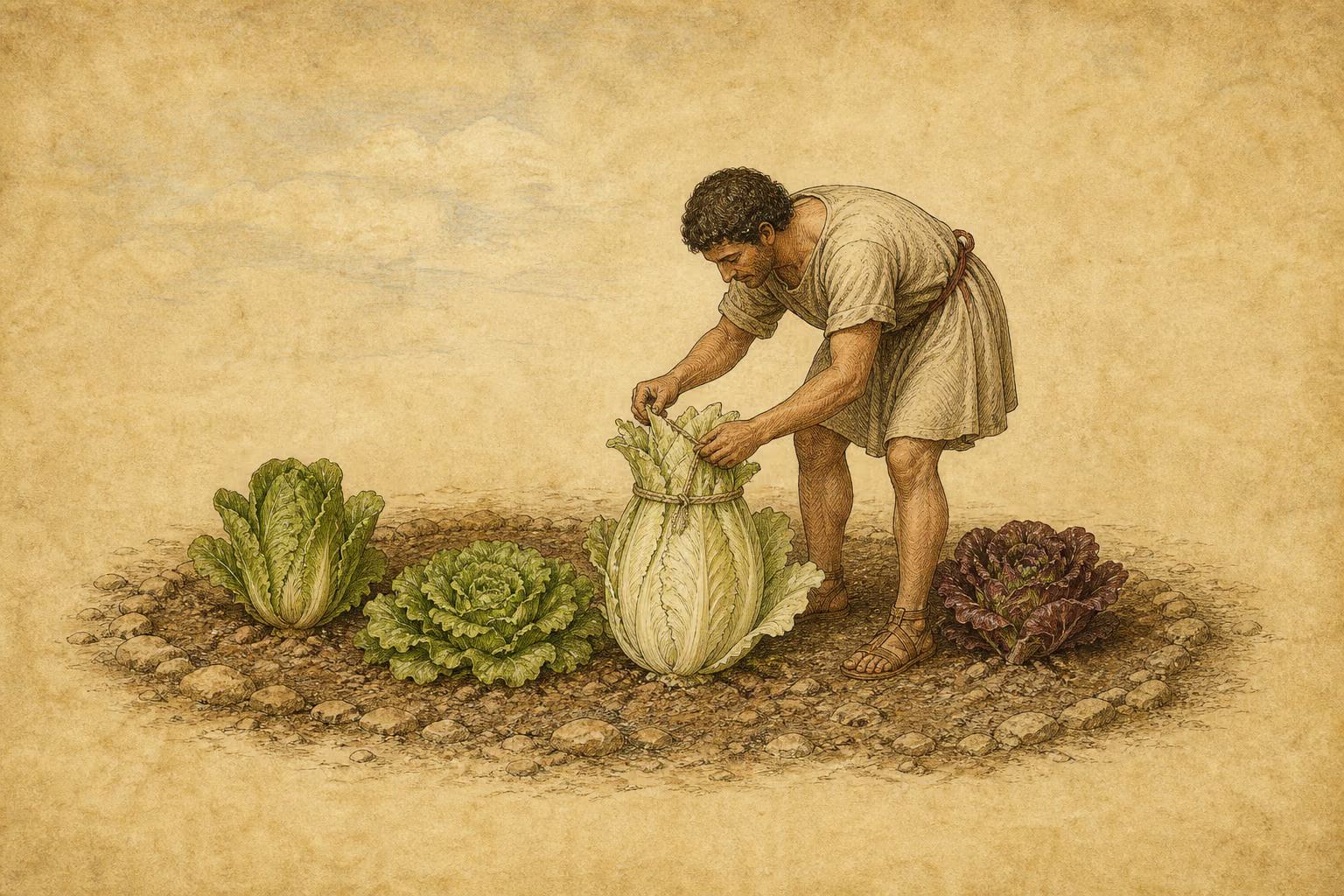
All the garden plants are fond of moisture; lettuces thrive, more particularly, when well manured, and endive even more so. Indeed, it is found an excellent plan to plant them out with the roots covered up in manure, and to keep up the supply, the earth being cleared away for that purpose. Some, again, have another method of increasing their size; they cut them down when they have reached half a foot in height, and cover them with fresh swine’s dung. It is the general opinion that those lettuces only will admit of being blanched which are produced from white seed; and even then, as soon as they begin to grow, sand from the sea-shore should be spread over them, care being taken to tie the leaves as soon as ever they begin to come to any size.
Beet is the smoothest of all the garden plants. The Greeks distinguish two kinds of beet, according to the colour, the black and the white. The last, which is the kind generally preferred, has but very little seed, and is generally known as the Sicilian beet; just as it is the white lettuce that is held in the highest degree of esteem. Our people, also, distinguish two varieties of beet, the spring and the autumn kinds, so called from the periods of sowing; although sometimes we find beet sown in June even. This is a plant, too, that is sometimes transplanted; and it thrives all the better, like the lettuce, if the roots are well covered with manure, in a moist soil. Beet is mostly eaten with lentils and beans; it is prepared also in the same way as cabbage, with mustard more particularly, the pungency of which relieves its insipidity. Medical men are of opinion that beet is a more unwholesome vegetable than cabbage; hence it is that I never remember seeing it served at table. Indeed, there are some persons who scruple to taste it even, from a conviction that it is a food suitable only for persons of a robust constitution.
Beet is a vegetable with twofold characteristics, partaking of the nature of the cabbage in its leaves and resembling a bulb in the root; that which grows to the greatest breadth being the most highly esteemed. This plant, like the lettuce, is made to grow to head by putting a light weight upon it the moment it begins to assume its proper colour. Indeed, there is no garden plant that grows to a larger head than this, as it sometimes spreads to a couple of feet in breadth, the nature of the soil contributing in a very considerable degree to its size: those found in the territory of Circeii attain the largest size. Some persons think that the best time for sowing beet is when the pomegranate is in flower, and are of opinion that it ought to be transplanted as soon as it has thrown out five leaves. There is a singular difference—if indeed it really exists—between the two varieties of beet, the white kind being remarkable for its purgative qualities, and the black being equally astringent. When wine in the vat has been deteriorated by assuming a flavour like that of cabbage, its original flavour is restored, it is said, by plunging beet leaves into it.
Cabbage and coleworts, which at the present day are the most highly esteemed of all the garden vegetables, were held in little repute, I find, among the Greeks; but Cato, on the other hand, sings the wondrous praises of the cabbage, the medicinal properties of which we shall duly enlarge upon when we come to treat of that subject. Cato distinguishes three varieties of the cabbage; the first, a plant with leaves wide open, and a large stalk; a second, with crisped leaves, to which he gives the name of “apiaca;” and a third, with a thin stalk, and a smooth, tender leaf, which with him ranks the lowest of all. Cabbages may be sown the whole year through, as we find that they are cut at all periods of the year; the best time, however, for sowing them is at the autumnal equinox, and they are usually transplanted as soon as five leaves are visible. In the ensuing spring after the first cutting, the plant yields sprouts, known to us as “cymæ.” These sprouts, in fact, are small shoots thrown out from the main stem, of a more delicate and tender quality than the cabbage itself. The exquisite palate, however, of Apicius rejected these sprouts for the table, and his example was followed by the fastidious Drusus Cæsar; who did not escape, however, the censures of his father, Tiberius, for being so over-nice. After the cymæ have made their appearance the cabbage throws out its summer and autumn shoots, and then its winter ones; after which, a new crop of cymæ is produced, there being no plant so productive as this, until, at last, it is quite exhausted by its extreme fertility. A second time for sowing cabbages is immediately after the vernal equinox, the plants of this growth being transplanted at the end of spring, that they may not run up into sprouts before coming to a top: and a third sowing takes place about the summer solstice, the transplanting being done in summer if the soil is moist, but, if too dry, in autumn. When moisture and manure are supplied in small quantities, the flavour of the cabbage is all the more agreeable, but when they are supplied in greater abundance, the plants attain a larger size. Asses’ dung is the best adapted for its growth.
The cabbage, too, is one of those articles so highly esteemed by epicures; for which reason it will not be amiss if we speak of it at somewhat greater length. To obtain plants equally remarkable for their size and flavour, care must be taken first of all to sow the seed in ground that has had a couple of turnings up, and then to follow up the shoots as they appear above ground by moulding them up, care being taken to throw up the earth over them as they increase in luxuriance, and to let nothing but the summit appear above the surface. This kind is known as the Tritian cabbage: in money and labour it costs twice as much as any of the others.
The other varieties of the cabbage are numerous—there is the Cumanian cabbage, with leaves that lie close to the ground, and a wide, open head; the Aricinian cabbage, too, of no greater height, but with more numerous leaves and thinner—this last is looked upon as the most useful of them all, for beneath nearly all of the leaves there are small shoots thrown out, peculiar to this variety. The cabbage, again, of Pompeii is considerably taller, the stalk, which is thin at the root, increasing in thickness as it rises among the leaves, which are fewer in number and narrower; the great merit of this cabbage is its remarkable tenderness, although it is not able to stand the cold. The cabbage of Bruttium, on the other hand, thrives all the better for cold; the leaves of it are remarkably large, the stalk thin, and the flavour pungent. The leaves, again, of the Sabine cabbage are crisped to such a degree as to excite our surprise, and their thickness is such as to quite exhaust the stem; in sweetness, however, it is said to surpass all the others.
There have lately come into fashion the cabbages known as the “Lacuturres;” they are grown in the valley of Aricia, where there was formerly a lake, now no longer in existence, and a tower which is still standing. The head of this cabbage is very large, and the leaves are almost without number, some of them being round and smooth, and others long and sinewy; indeed, there is no cabbage that runs to a larger head than this, with the sole exception of the Tritian variety, which has a head sometimes as much as a foot in thickness, and throws out its cymæ the latest of all.
In all kinds of cabbages, hoar-frost contributes very materially to their sweetness; but it is apt to be productive of considerable injury, if care is not taken to protect the pith by cutting them aslant. Those plants which are intended for seed are never cut.
There is another kind, again, that is held in peculiar esteem, and which never exceeds the height of an herbaceous plant; it is known by the name of “halmyridia,” from the circumstance of its growing on the sea-shore only. It will keep green and fresh during a long voyage even, if care is taken not to let it touch the ground from the moment that it is cut, but to put it into oil-vessels lately dried, and then to bung them so as to effectually exclude all air. There are some who are of opinion, that the plant will come to maturity all the sooner if some sea-weed is laid at the root when it is transplanted, or else as much pounded nitre as can be taken up with three fingers; and others, again, sprinkle the leaves with trefoil seed and nitre pounded together. Nitre, too, preserves the greenness of cabbage when cooked, a result which is equally ensured by the Apician mode of boiling, or in other words, by steeping the plants in oil and salt before they are cooked.
There is a method of grafting vegetables by cutting the shoots and the stalk, and then inserting in the pith the seed of another plant; a plan which has been adopted with the wild cucumber even. There is another kind of wild cabbage, also, the lapsana, which has become famous since the triumphs of the late Emperor Julius, in consequence of the songs and jokes of his soldiers more particularly; for in the alternate lines sung by them, they used to reproach him for having made them live on lapsana at the siege of Dyrrhachium, and to rally him upon the parsimonious scale on which he was in the habit of recompensing their services. The lapsana is nothing more than a wild cyma.
Of all the garden plants, asparagus is the one that requires the most delicate attention in its cultivation. We have already spoken at considerable length of its origin, when treating of the wild plants, and have mentioned that Cato recommends it to be grown in reed-beds. There is another kind, again, of a more uncultivated nature than the garden asparagus, but less pungent than corruda; it grows upon the mountains in different countries, and the plains of Upper Germany are quite full of it, so much so, indeed, that it was a not unhappy remark of Tiberius Cæsar, that a weed grows there which bears a remarkably strong resemblance to asparagus. That which grows spontaneously upon the island of Nesis, off the coast of Campania, is looked upon as being by far the best of all.
Garden asparagus is reproduced from roots, the fibres of which are exceedingly numerous, and penetrate to a considerable depth. When it first puts forth its shoots, it is green; these in time lengthen out into stalks, which afterwards throw out streaked branches from the head: asparagus admits, also, of being grown from seed.
Cato has treated of no subject with greater care than this, the last Chapter of his work being devoted to it, from which we may conclude that it was quite new to him, and a subject which had only very recently occupied his attention. He recommends that the ground prepared for it should be a moist or dense soil, the seed being set at intervals of half a foot every way, to avoid treading upon the heads; the seed, he says, should be put two or three into each hole, these being made with the dibble as the line runs—for in his day, it should be remembered, asparagus was only grown from seed—this being done about the vernal equinox. It requires, he adds, to be abundantly manured, and to be kept well hoed, due care being taken not to pull up the young plants along with the weeds. The first year, he says, the plants must be protected from the severity of the winter with a covering of straw, care being taken to uncover them in the spring, and to hoe and stub up the ground about them. In the spring of the third year, the plants must be set fire to, and the earlier the period at which the fire is applied, the better they will thrive. Hence it is, that as reed-beds grow all the more rapidly after being fired, asparagus is found to be a crop remarkably well suited for growing with them. The same author recommends, however, that asparagus should not be hoed before the plants have made their appearance above-ground, for fear of disturbing the roots; and he says that in gathering the heads, they should be cut close to the root, and not broken off at the surface, a method which is sure to make them run to stalk and die. They should be cut, he says, until they are left to run to seed, and after the seed is ripe, in spring they must be fired, care being taken, as soon as they appear again, to hoe and manure them as before. After eight or nine years, he says, when the plants have become old, they must be renewed, after digging and manuring the ground, by replanting the roots at intervals of a foot, care being taken to employ sheep’s dung more particularly for the purpose, other kinds of manure being apt to produce weeds.
No method of cultivating this plant that has since been tried has been found more eligible than this, with the sole exception that the seed is now sown about the ides of February, by laying it in heaps in small trenches, after steeping it a considerable time in manure; the result of which is that the roots become matted, and form into spongy tufts, which are planted out at intervals of a foot after the autumnal equinox, the plants continuing to be productive so long as ten years even. There is no soil more favourable to the growth of asparagus, than that of the gardens of Ravenna.
We have already spoken of the corruda, by which term I mean the wild asparagus, by the Greeks called “orminos,” or “myacanthos,” as well as by other names. I find it stated, that if rams’ horns are pounded, and then buried in the ground, asparagus will come up.
It really might have been thought that I had now given an account of all the vegetable productions that are held in any degree of esteem, did there not still remain one plant, the cultivation of which is extremely profitable, and of which I am unable to speak without a certain degree of shame. For it is a well-known fact, that some small plots of land, planted with thistles, in the vicinity of Great Carthage and of Corduba more particularly, produce a yearly income of six thousand sesterces; this being the way in which we make the monstrous productions even of the earth subservient to our gluttonous appetites, and that, too, when the very four-footed brutes instinctively refuse to touch them.
Thistles are grown two different ways, from plants set in autumn, and from seed sown before the nones of March; in which latter case they are transplanted before the ides of November, or, where the site is a cold one, about the time that the west winds prevail. They are sometimes manured even, and if such is the will of heaven, grow all the better for it. They are preserved, too, in a mixture of honey and vinegar, with the addition of root of laser and cummin—so that a day may not pass without our having thistles at table.
For the remaining plants a brief description will suffice. The best time for sowing ocimum, it is said, is at the festival of the Parilia; though some say that it may be done in autumn as well, and recommend, when it is sown in winter, to drench the seed thoroughly with vinegar. Rocket, too, and nasturtium may be grown with the greatest facility either in summer or winter. Rocket, more particularly, is able to stand the cold, and its properties are quite different from those of the lettuce, as it is a great provocative of lust. Hence it is that we are in the habit of mixing these two plants in our dishes, the excess of cold in the one being compensated by the equal degree of heat in the other. Nasturtium has received that name from the smarting sensation which its pungency causes to the nostrils, and hence it is that a certain notion of smartness has attached itself to the word, it having become quite a proverbial saying, that a sluggish man should eat nasturtium, to arouse him from his torpidity. In Arabia, it is said, this plant attains a size that is quite marvellous.
Rue, too, is generally sown while the west winds prevail, as well as just after the autumnal equinox. This plant has an extreme aversion to cold, moisture, and dung; it loves dry, sunny localities, and a soil more particularly that is rich in brick clay; it requires to be nourished, too, with ashes, which should be mixed with the seed as well, as a preservative against the attacks of caterpillars. The ancients held rue in peculiar esteem; for I find that honied wine flavoured with rue was distributed to the people, in his consulship, by Cornelius Cethegus, the colleague of Quintus Flamininus, after the closing of the Comitia. This plant has a great liking for the fig-tree, and for that tree only; indeed, it never thrives better than when grown beneath that tree. It is generally grown from slips, the lower end of which is inserted in a perforated bean, which holds it fast, and so nurtures the young plant with its juices. It also reproduces itself; for the ends of the branches bending downwards, the moment they reach the ground, they take root again. Ocimum is of a very similar nature to rue, except that it dries with greater difficulty. When rue has once gained strength, there is considerable difficulty in stubbing it, as it causes itching ulcerations on the hands, if they are not covered or previously protected by being rubbed with oil. Its leaves, too, are preserved, being packed in bundles for keeping.
Parsley is sown immediately after the vernal equinox, the seed being lightly beaten first in a mortar. It is thought that, by doing this, the parsley will be all the more crisped, or else by taking care to beat it down when sown with a roller or the feet. It is a peculiarity of this plant, that it changes colour: it has the honour, in Achaia, of forming the wreath of the victors in the sacred contests of the Nemean Games.
It is at the same season, too, that mint is transplanted; or, if it has not yet germinated, the matted tufts of the old roots are used for the purpose. This plant, too, is no less fond of a humid soil than parsley; it is green in summer and turns yellow in winter. There is a wild kind of mint, known to us as “mentastrum:” it is reproduced by layers, like the vine, or else by planting the branches upside down. It was the sweetness of its smell that caused this plant to change its name among the Greeks, its former name with them being “mintha,” from which the ancient Romans derived their name for it; whereas now, of late, it has been called by them ἡδύοσμον. The mint that is used in the dishes at rustic entertainments pervades the tables far and wide with its agreeable odour. When once planted, it lasts a considerable length of time; it bears, too, a strong resemblance to pennyroyal, a property of which is, as mentioned by us more than once, to flower when kept in our larders.
These other herbs, mint, I mean, and catmint, as well as pennyroyal, are all kept for use in a similar manner; but it is cummin that is the best suited of all the seasoning herbs to squeamish and delicate stomachs. This plant grows on the surface of the soil, seeming hardly to adhere to it, and raising itself aloft from the ground: it ought to be sown in the middle of the summer, in a crumbly, warm soil, more particularly. There is another wild kind of cummin, known by some persons as “rustic,” by others as “Thebaic” cummin: bruised and drunk in water, it is good for pains in the stomach. The cummin most esteemed in our part of the world is that of Carpetania, though elsewhere that of Africa and Æthiopia is more highly esteemed; with some, indeed, this last is preferred to that of Egypt.
But it is olusatrum, more particularly, that is of so singular a nature, a plant which by the Greeks is called “hipposelinum,” and by others “smyrnium.” This plant is reproduced from a tear-like gum which exudes from the stem; it is also grown from the roots as well. Those whose business it is to collect the juice of it, say that it has just the flavour of myrrh; and, according to Theophrastus, it is obtained by planting myrrh. The ancients recommended that hipposelinum should be grown in uncultivated spots covered with stones, and in the vicinity of garden walls; but at the present day it is sown in ground that has been twice turned up, between the prevalence of the west winds and the autumnal equinox.
The caper, too, should be sown in dry localities more particularly, the plot being hollowed out and surrounded with an embankment of stones erected around it: if this precaution is not taken, it will spread all over the adjoining land, and entail sterility upon the soil. The caper blossoms in summer, and retains its verdure till the setting of the Vergiliæ; it thrives the best of all in a sandy soil. As to the bad qualities of the caper which grows in the parts beyond the sea, we have already enlarged upon them when speaking of the exotic shrubs.
The caraway is an exotic plant also, which derives its name, “careum,” from the country in which it was first grown; it is principally employed for culinary purposes. This plant will grow in any kind of soil, and requires to be cultivated just the same way as olusatrum; the most esteemed, however, is that which comes from Caria, and the next best is that of Phrygia.
Lovage grows wild in the mountains of Liguria, its native country, but at the present day it is grown everywhere. The cultivated kind is the sweetest of the two, but is far from powerful; by some persons it is known as “panax.” Crateuas, a Greek writer, gives this name, however, to the plant known to us as “cunila bubula;” and others, again, call the conyza or cunilago, cunila, while they call cunila, properly so called, by the name of “thymbra.” With us cunila has another appellation, being generally known as “satureia,” and reckoned among the seasoning plants. It is usually sown in the month of February, and for utility rivals wild marjoram. These two plants are never used together, their properties being so extremely similar; but it is only the wild marjoram of Egypt that is considered superior to cunila.
Dittander, too, was originally an exotic plant: it is usually sown after the west winds have begun to prevail. As soon as it begins to shoot, it is cut down close to the ground, after which it is hoed and manured, a process which is repeated the succeeding year. After this, the shoots are fit for use, if the rigour of the winter has not injured them; for it is a plant quite unable to withstand any inclemency of the weather. It grows to the height of a cubit, and has a leaf like that of the laurel, but softer; it is never used except in combination with milk.
Gith is employed by bakers, dill and anise by cooks and medical men. Sacopenium, so extensively used for adulterating laser, is also a garden plant, but is only employed for medicinal purposes.
There are certain plants which are grown in company with others, the poppy, for instance, sown with cabbages and purslain, and rocket with lettuce. Of the cultivated poppy there are three kinds, the first being the white poppy, the seed of which, parched, and mixed with honey, used to be served up in the second course at the tables of the ancients; at the present day, too, the country people sprinkle it on the upper crust of their bread, making it adhere by means of the yolk of eggs, the under crust being seasoned with parsley and gith to heighten the flavour of the flour. The second kind is the black poppy, from which, upon an incision being made in the stalk, a milky juice distils; and the third is that known to the Greeks by the name of “rhœas;” and by us as the wild poppy. This last grows spontaneously, but in fields, more particularly, which have been sown with barley: it bears a strong resemblance to rocket, grows to the height of a cubit, and bears a red flower, which quickly fades; it is to this flower that it is indebted for its Greek name.
As to the other kinds of poppies which spring up spontaneously, we shall have occasion to speak of them when treating of the medicinal plants. That the poppy has always been held in esteem among the Romans, we have a proof in the story related of Tarquinius Superbus, who, by striking down the tallest poppies in his garden, surreptitiously conveyed, unknown to them, his sanguinary message through the envoys who had been sent by his son.
There are some other plants, again, which require to be sown together at the time of the autumnal equinox; coriander, for instance, anise, orage, mallows, lapathum, chervil, known to the Greeks as “pæderos,” and mustard, which has so pungent a flavour, that it burns like fire, though at the same time it is remarkably wholesome for the body. This last, though it will grow without cultivation, is considerably improved by being transplanted; though, on the other hand, it is extremely difficult to rid the soil of it when once sown there, the seed when it falls germinating immediately. This seed, when cooked in the saucepan, is employed even for making ragouts, its pungency being rendered imperceptible by boiling; the leaves, too, are boiled just the same way as those of other vegetables.
There are three different kinds of mustard, the first of a thin, slender form, the second, with a leaf like that of the rape, and the third, with that of rocket: the best seed comes from Egypt. The Athenians have given mustard the name of “napy,” others, “thapsi,” and others, again, “saurion.”
Most mountains abound with wild thyme and sisymbrium, those of Thrace, for example, where branches of these wild plants are torn up and brought away for planting. So, too, the people of Sicyon seek for wild thyme on their mountains, and the Athenians on the slopes of Hymettus. Sisymbrium, too, is planted in a similar manner; it grows to the greatest perfection upon the walls of wells, and around fish preserves and ponds.