LIBER II · CAPUT 11
OF THE MAGNITUDE OF THE STARS
Latine · Mayhoff 1906
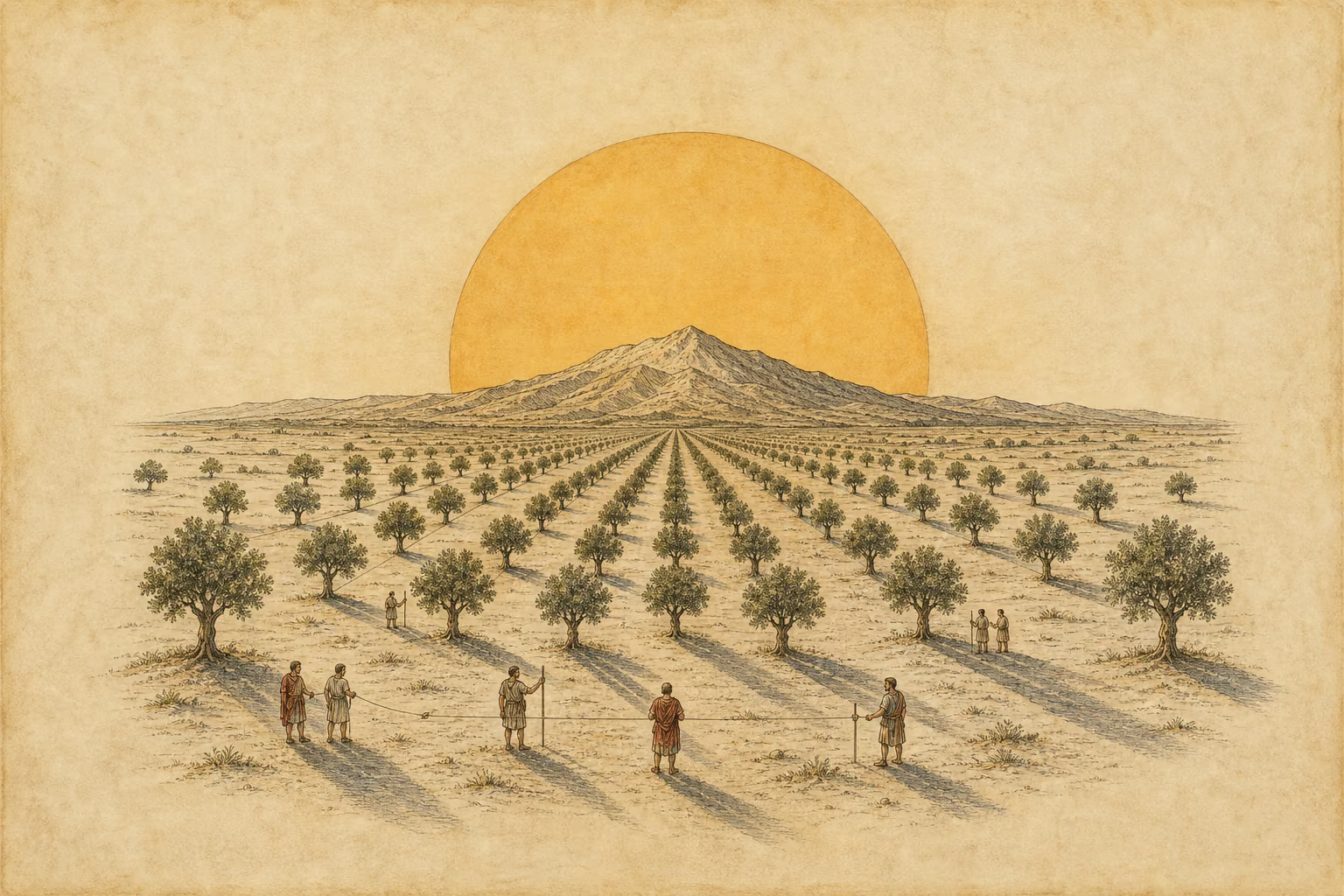
Haec ratio mortales animos subducit in caelum ac velut inde contemplantibus trium maximarum rerum naturae partium magnitudinem detegit. non posset quippe totus sol adimi terris intercedente luna, si terra maior esset quam luna. tertia ex utroque vastitas solis aperietur, ut non sit necesse amplitudinem eius oculorum argumentis atque coniectura animi scrutari: inmenlsum esse, quia arborum in limitibus porrectarum in quotlibet passuum milia umbras paribus iaciat intervallis, tamquam toto spatio medius, et quia per aequinoctium omnibus in meridiana plaga habitantibus simul fiat a vertice, item quia circa solstitialem circulum habitantium meridie ad septentrionem umbrae cadant, ortu vero ad occasum, quae fieri nullo modo possent, nisi multo quam terra maior esset, nec non quod montem Idam exoriens latitudine exsuperet, dextra laevaque large amplectens, praesertim tanto discretus intervallo.
Defectus lunae magnitudinem eius haut dubia ratione declarat, sicut terrae parvitatenm ipse deficiens. namque cum sint tres umbrarum figurae constetque, si par lumini sit materia quae iaciat, umbram columnae effigie iaci nec habere finem, si vero maior materia quam lumen, turbinis recti, ut sit imum eius angustissimum et simili modo infinita longitudo, si minor materia quam lux, metae existere effigiem in cacuminis finem desinentem talemque cerni umbram deficiente luna: palam fit, ut nulla amplius relinquatur dubitatio, superari magnitudinem terrae. id quidem et tacitis naturae ipsius indiciis: cur enim partitis vicibus anni brumalis abscedit aut noctium opacitate terras reficit? exusturus haut dubie, et sic quoque exurens quadam in parte. tanta magnitudo est.
English · Bostock & Riley 1855–57
This kind of reasoning carries the human mind to the heavens, and by contemplating the world as it were from thence, it discloses to us the magnitude of the three greatest bodies in nature. For the sun could not be entirely concealed from the earth, by the intervention of the moon, if the earth were greater than the moon. And the vast size of the third body, the sun, is manifest from that of the other two, so that it is not necessary to scrutinize its size, by arguing from its visible appearance, or from any conjectures of the mind; it must be immense, because the shadows of rows of trees, extending for any number of miles, are disposed in right lines, as if the sun were in the middle of space. Also, because, at the equinox, he is vertical to all the inhabitants of the southern districts at the same time; also, because the shadows of all the people who live on this side of the tropic fall, at noon, towards the north, and, at sunrise, point to the west. But this could not be the case unless the sun were much greater than the earth; nor, unless it much exceeded Mount Ida in breadth, could he be seen when he rises, passing considerably beyond it to the right and to the left, especially, considering that it is separated by so great an interval.
The eclipse of the moon affords an undoubted argument of the sun’s magnitude, as it also does of the small size of the earth. For there are shadows of three figures, and it is evident, that if the body which produces the shadow be equal to the light, then it will be thrown off in the form of a pillar, and have no termination. If the body be greater than the light, the shadow will be in the form of an inverted cone the bottom being the narrowest part, and being, at the same time, of an infinite length. If the body be less than the light, then we shall have the figure of a pyramid, terminating in a point. Now of this last kind is the shadow which produces the eclipse of the moon, and this is so manifest that there can be no doubt remaining, that the earth is exceeded in magnitude by the sun, a circumstance which is indeed indicated by the silent declaration of nature herself. For why does he recede from us at the winter half of the year? That by the darkness of the nights the earth may be refreshed, which otherwise would be burned up, as indeed it is in certain parts; so great is his size.