LIBER XX · CAPUT 18
DILL: NINE REMEDIES
Latine · Mayhoff 1906
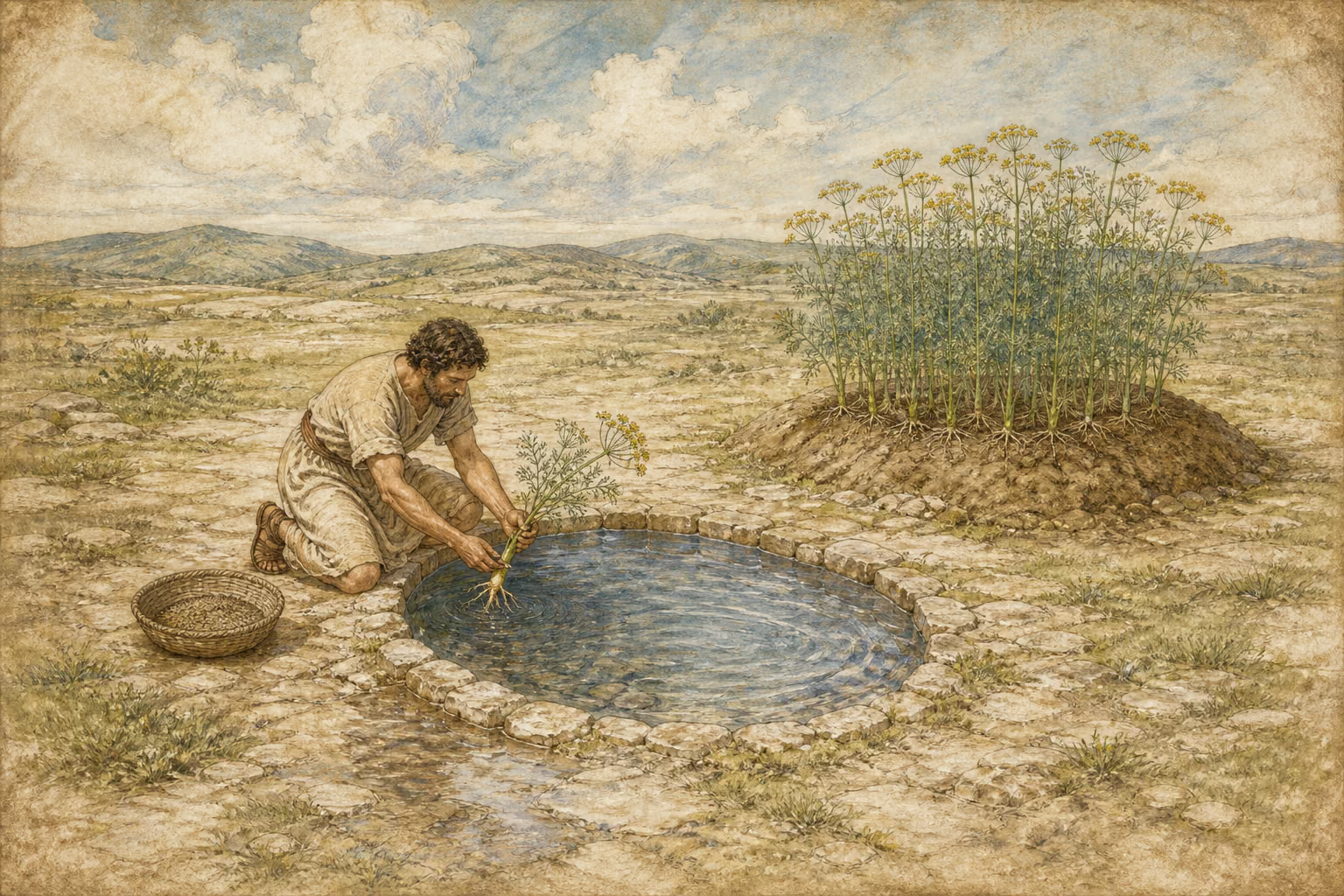
Anetum quoque ructus movet et tormina sedat, alvum sistit. epiphoris radices inlinuntur ex aqua vel vino. singultus cohibet semen fervens olfactu; sumptum ex aqua sedat cruditates. cinis eius uvam in faucibus levat, oculos et genituram hebetat.
Sacopenium, quod apud nos gignitur, in totum transmarino alienatur. illud enim hammoniaci lacrimae simile sagapenon vocatur. prodest laterum et pectoris doloribus, convolsis, tussibus vetustis excreationibusque, praecordiorum tumoribus. sanat et vertigines, tremulos, opisthotonicos, lienes, lumbos, perfrictiones. datur olfactandum ex aceto in strangulatu vulvae; ceteris et potui datur et cum oleo infricatur. prodest et contra mala medicamenta.
Papaveris sativi tria diximus genera, et sponte nascentis alia promisimus. e sativis albi calix ipse teritur et e vino bibitur somni causa. semen elephantiasi medetur. e nigro papavere sopor gignitur scapo inciso, ut Diagoras suadet, cum turgescit, ut lollas, cum deflorescit, hora sereni diei tertia, hoc est cum ros in eo exaruerit. incidi iubent sub capite et calice, nec in alio genere ipsum inciditur caput. sucus et hic et herbae cuiuscumque lana excipitur aut, si exiguus sit, ungue pollicis, ut lactucis, et postero die magis, quod inaruit, [papaveris vero largus] densatus et in pastillos tritus in umbra siccatur, non vi soporifera modo, verum, si copiosior hauriatur, etiam mortifera per somnos. opium vocant. sic scimus interemptum P. Licini Caecinae praetorii viri patrem in Hispania Bavili, cum valetudo inpetibilis odium vitae fecisset; item plerosque alios. qua de causa magna concertatio extitit. Diagoras, Erasistratus in totum damnavere ut mortiferum, infundi vetantes praeterea, quoniam visui noceret. addidit Andreas, ideo non protinus excaecari eo, quoniam adulteraretur Alexandriae. sed postea usus eius non inprobatus est medicamento nobili, quod διὰ κωδυῶν vocant. semine quoque eius trito in pastillos e lacte utuntur ad somnum, item ad capitis dolores cum rosaceo; cum hoc et aurium dolori instillatur. podagris inlinitur cum lacte mulierum—sic et foliis ipsis utuntur—, item ad ignes sacros et vulnera ex aceto. ego tamen damnaverim collyriis addi, multoque magis quas vocantληξιπυρέτους quasque pepticas et coeliacas. nigrum tamen coeliacis in vino datur. sativum omne maius. rotunda ei capita, at silvestri longa ac pusilla, sed ad omnes effectus valentiora. decoquitur et bibitur contra vigilias, eademque aqua fovent ora. optimum in siccis et ubi raro pluat. cum capita ipsa et folia decocuntur, sucus meconium vocatur, multum opio ignavior. experimentum opii est primum in odore—sincerum enim perpeti non est—, mox in lucernis, ut pura luceat flamma et ut extinctum demum oleat, quae in fucato non eveniunt. accenditur quoque difficilius et crebro extinguitur. est sinceri experimentum et in aqua, quoniam ut nubecula innatat, fictum in pusulas coit. sed maxime mirum est aestivo sole deprehendi; sincerum enim sudat et se diluit, done suco recenti simile fiat. Mnesides optime servari putat hyoscyami semine adiecto, alii in faba.
English · Bostock & Riley 1855–57
Dill acts also as a carminative, allays gripings of the stomach, and arrests looseness of the bowels. The roots of this plant are applied topically in water, or else in wine, for defluxions of the eyes. The seed of it, if smelt at while boiling, will arrest hiccup; and, taken in water, it dispels indigestion. The ashes of it are a remedy for swellings of the uvula; but the plant itself weakens the eyesight and the generative powers.
The sacopenium which grows in Italy is totally different from that which comes from beyond sea. This last, in fact, is similar to gum ammoniac, and is known as “sagapenon.”
Sacopenium is good for pains of the sides and chest, for convulsions, coughs of long standing, expectorations, and swellings of the thoracic organs: it is a cure also for vertigo, palsy, opisthotony, affections of the spleen and loins, and for shivering fits. For suffocations of the uterus, this plant is given in vinegar to smell at; in addition to which, it is sometimes administered in drink, or employed as a friction with oil. It is a good antidote, also, for medicaments of a noxious nature.
We have already stated that there are three varieties of the cultivated poppy, and, on the same occasion, we promised to describe the wild kinds. With reference to the cultivated varieties, the calyx of the white poppy is pounded, and is taken in wine as a soporific; the seed of it is a cure, also, for elephantiasis. The black poppy acts as a soporific, by the juice which exudes from incisions made in the stalk—at the time when the plant is beginning to flower, Diagoras says; but when the blossom has gone off, according to Iollas. This is done at the third hour, in a clear, still, day, or, in other words, when the dew has thoroughly dried upon the poppy. It is recommended to make the incision just beneath the head and calyx of the plant; this being the only kind, in fact, into the head of which the incision is made. This juice, like that of any other plant, is received in wool; or else, if it is in very minute quantities, it is scraped off with the thumb nail just as it is from the lettuce, and so again on the following day, with the portion that has since dried there. If obtained from the poppy in sufficiently large quantities, this juice thickens, after which it is kneaded out into lozenges, and dried in the shade. This juice is possessed not only of certain soporific qualities, but, if taken in too large quantities, is productive of sleep unto death even: the name given to it is “opium.” It was in this way, we learn, that the father of P. Licinius Cæcina, a man of Prætorian rank, put an end to his life at Bavilum in Spain, an incurable malady having rendered existence quite intolerable to him. Many other persons, too, have ended their lives in a similar way. It is for this reason that opium has been so strongly exclaimed against by Diagoras and Erasistratus; for they have altogether condemned it as a deadly poison, forbidding it to be used for infusions even, as being injurious to the sight. Andreas says, in addition to this, that the only reason why it does not cause instantaneous blindness, is the fact that they adulterate it at Alexandria. In later times, however, the use of it has not been disapproved of—witness the celebrated preparation known as “diacodion.” Lozenges are also made of ground poppy-seed, which are taken in milk as a soporific. The seed is employed, too, with rose-oil for head-ache; and, in combination with that oil, is injected into the ears for ear-ache. Mixed with woman’s milk, this seed is used as a liniment for gout: the leaves, too, are employed in a similar manner. Taken in vinegar, the seed is prescribed as a cure for erysipelas and wounds.
For my own part, however, I do not approve of opium entering into the composition of eye-salves, and still less of the preparations from it known as febrifuges, digestives, and cœliacs: the black poppy, however, is very generally prescribed, in wine, for cœliac affections. All the cultivated poppies are larger than the others, and the form of the head is round. In the wild poppy the head is elongated and small, but it is possessed of more active properties than the others in every respect. This head is often boiled, and the decoction of it taken to promote sleep, the face being fomented also with the water. The best poppies are grown in dry localities, and where it seldom rains.
When the heads and leaves of the poppy are boiled together, the name given to the decoction is “meconium;” it is much less powerful, however, in its effects than opium.
The principal test of the purity of opium is the smell, which, when genuine, is so penetrating as to be quite insupportable. The next best test is that obtained by lighting it at a lamp; upon which it ought to burn with a clear, brilliant flame, and to give out a strong odour when extinguished; a thing that never happens when opium has been drugged, for, in such case, it lights with the greatest difficulty, and the flame repeatedly goes out. There is another way of testing its genuineness, by water; for, if it is pure, it will float like a thin cloud upon the surface, but, if adulterated, it will unite in the form of blisters on the water. But the most surprising thing of all is the fact, that the sun’s heat in summer furnishes a test; for, if the drug is pure, it will sweat and gradually melt, till it has all the appearance of the juice when fresh gathered.
Mnesides is of opinion that the best way of preserving opium is to mix henbane seed with it; others, again, recommend that it should be kept with beans.