LIBER XX · CAPUT 7
THE LETTUCE: FORTY-TWO REMEDIES. THE GOAT-LETTUCE: FOUR REMEDIES
Latine · Mayhoff 1906
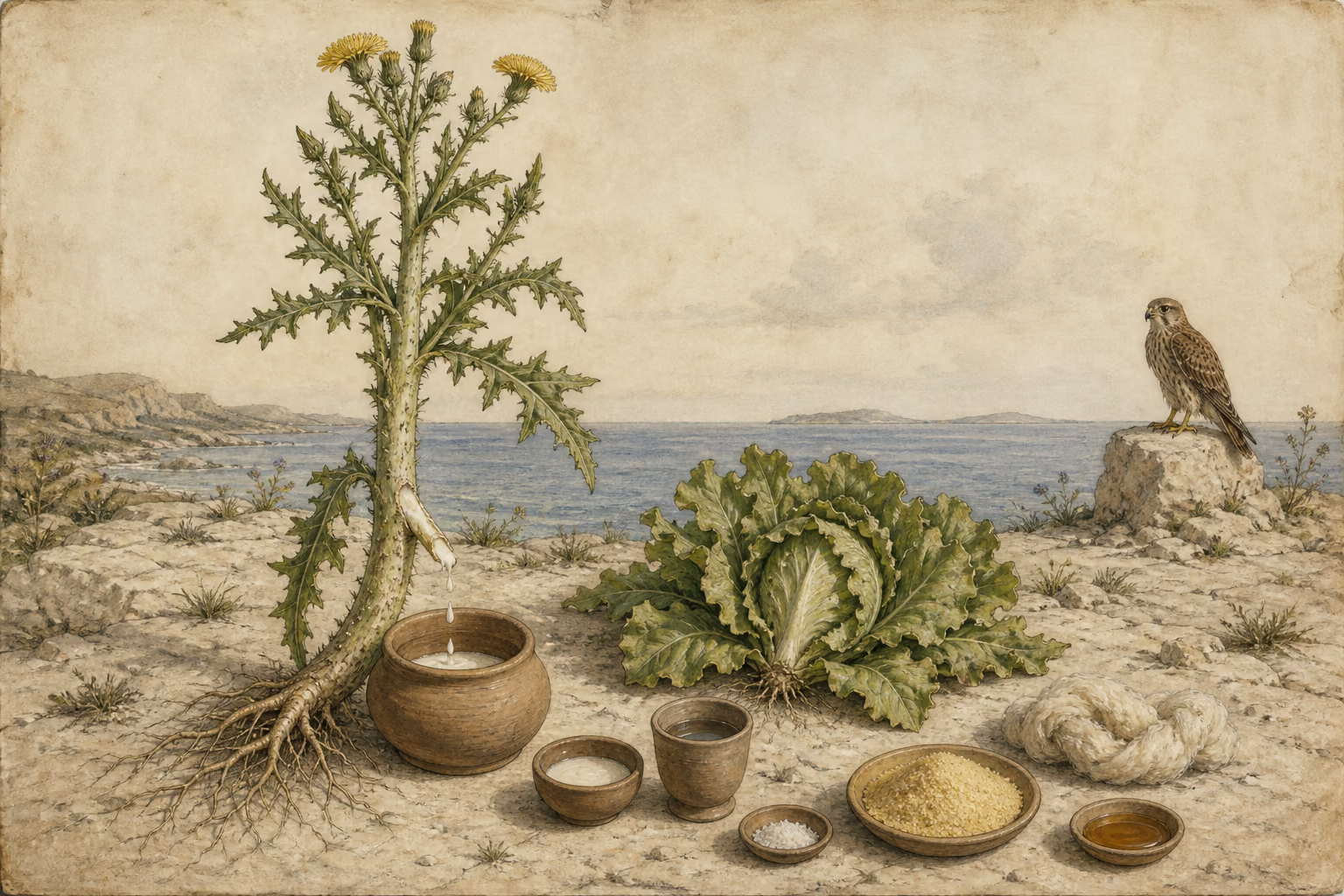
Lactucae sponte nascentis primum genus est eius, quam caprinam vocant, qua pisces in mare deiecta protinus necantur, qui sunt in proximo. huius lac spissatum mox in aceto pondere obolorum duum adiecto aquae uno cyatho hydropicis datur. caule et foliis contusis, asperso sale, nervi incisi sanantur. eadem trita ex aceto conluta matutinis bis mense dentium dolorem prohibent. alterumn est genus quod Graeci caesapon vocant. huius folia trita et cum polenta inlita ulceribus medentur. haec in arvis nascuntur; tertium genus in silvis nascensἰσάτιν vocant. huius folia trita cum polenta vulneribus prosunt. quarto infectores lanarum utuntur. simile id erat lapatho silvestri foliis, nisi plura haberet et nigriora. sanguinem sistit, phagedaenas et putrescentia ulcera aut quae serpunt sanat, item tumores ante suppurationem, ignem sacrum radice vel foliis. prodest vel ad lienes potu. haec propria singulis.
Communia autem sponte nascentibus candor, caulis interdum cubitali longitudine, in thyrso et foliis scabritia. ex iis rotunda folia et brevia habentem sunt qui hieracion vocent, quoniam accipitres scalpendo eam sucoque oculos tinguendo obscuritatem, cum sensere, discutiant. sucus omnibus candidus, viribus quoque papaveri similis; carpitur per messes inciso caule, conditur fictili novo, ad multa praeclarus. sanat omnia oculorum vitia cum lacte mulierum, argema, nubiculas, cicatrices adustionesque omnes, praecipue caligines. inponitur etiam oculis in lana contra epiphoras. idem sucus alvum purgat in posca potus ad duos obolos. serpentium ictibus medetur in vino potus. et folia thyrsique triti ex aceto bibuntur, vulneri inlinuntur, maxime contra scorpionum ictus, contra vero phalangia commixto vino et aceto. aliis quoque venenis resistunt, exceptis quae strangulando necant aut his quae vesicae nocent, item psimithio excepto. inponuntur et ventri ex melle atque aceto ad detrahenda vitia alvi. urinae difficultates sucus emendat. Crateuas eum et hydropicis obolis duobus in aceto et cyatho vini dari iubet. quidam et e sativis colligunt sucum minus efficacem. peculiares earum effectus—praeter iam dictos somnum faciendi veneremque inhibendi, aestum refrigerandi, stomachum purgandi, sanguinem augendi—non pauci restant, quoniam et inflationes discutiunt ructusque lenes faciunt, concoctiones adiuvant, cruditates ipsae numquam faciunt. nec ulla res in cibis magis aviditatem incitat inhibetque eadem. in causa alterutraque modus est: sic et alvum copiosiores solvunt, modicae sistunt. lentitiam pituitae digerunt atque, ut aliqui tradiderunt, sensus purgant, stomachis dissolutis utilissimae. adiuvantur in eos usus et oxypori obolis, asperitatem addito dulci ad intinctum aceti temperantes, si crassior pituita sit, scillite aut vino absinthite, si et tussis sentiatur, hysopite admixto. dantur coeliacis cum intubo erratico et ad duritiam praecordiorum. dantur et melancholicis candidae copiosiores et ad vesicae vitia. Praxagoras et dysintericis dedit. ambustis quoque prosunt recentibus, priusquam pusulae fiant, cum sale inlitae. ulcera etiam, quae serpunt, coercent, initio cum aphronitro, mox in vino. tritae igni sacro inlinuntur. convulsa et luxata caulibus tritis cum polenta ex aqua frigida leniunt, eruptiones papularum ex vino et polenta. in cholera quoque coctas patinis dederunt, ad quod utilissimae quam maximi caulis et amarae. quidam et lacte infundunt. defervefacti hi caules et stomacho utilissimi traduntur, sicut somno aestiva maxime lactuca et amara lactensque, quam meconidem vocavimus. hoc lacte et oculorum claritati cum muliebri lacte utilissimum esse praecipitur, dum tempestivo capite inunguantur oculi, et ad vitia, quae frigore in his facta sint. miras et alias invenio laudes: thoracis vitiis prodesse non secus quam habrotonum cum melle Attico; purgari et feminas hoc cibo; semen sativarum contra scorpiones dari; semine trito ex vino poto et libidinum imaginationes in somno conpesci; temptantes aquas non nocere lactucam edentibus. quidam tamen frequentiores in cibo officere claritati oculorum tradiderunt.
English · Bostock & Riley 1855–57
The first kind of lettuce which grows spontaneously, is the one that is generally known as “goat -lettuce;” thrown into the sea, this vegetable has the property of instantaneously killing all the fish that come into its vicinity. The milky juice of this lettuce, left to thicken and then put into vinegar, is given in doses of two oboli, with the addition of one cyathus of water, to patients for dropsy. The stalk and leaves, bruised and sprinkled with salt, are used for the cure of wounds of the sinews. Pounded with vinegar, and employed as a gargle in the morning twice a month, they act as a preventive of tooth-ache.
There is a second kind of wild lettuce, known by the Greeks is “cæsapon.” The leaves of this lettuce, applied as a liniment with polenta, are used for the cure of ulcerous sores. This plant is found growing in the fields. A third kind, again, grows in the woods; the name given to it is “isatis.” The leaves of this last, beaten up and applied with polenta, are very useful for the cure of wounds. A fourth kind is used by dyers of wool; in the leaves it would resemble wild lapathum, were it not that they are more numerous and darker. This lettuce has the property of stanching blood, and of healing phagedænic sores and putrid spreading ulcers, as well as tumours before suppuration. Both the root as well as the leaves are good, too, for erysipelas; and a decoction of it is drunk for affections of the spleen. Such are the properties peculiar to each of these varieties.
The properties which are common to all the wild varieties are whiteness, a stem sometimes as much as a cubit in length, and a roughness upon the stalk and leaves. Among these plants there is one with round, short leaves, known to some persons as “hieracion;” from the circumstance that the hawk tears it open and sprinkles its eyes with the juice, and so dispels any dimness of sight of which it is apprehensive. The juice of all these plants is white, and in its properties resembles that of the poppy. It is collected at harvest-time, by making incisions in the stalk, and is kept in new earthen vessels, being renowned as a remedy for numerous maladies. Mixed with woman’s milk, it is a cure for all diseases of the eyes, such as argema for instance, films on the eyes, scars and inflammations of all kinds, and dimness of the sight more particularly. It is applied to the eyes, too, in wool, as a remedy for defluxions of those organs.
This juice also purges the bowels, taken in doses of two oboli in vinegar and water. Drunk in wine it is a cure for the stings of serpents, and the leaves and stalk of the plant are pounded and taken in vinegar. They are employed also as a liniment for wounds, the sting of the scorpion more particularly; combined, too, with oil and vinegar, they are similarly applied for the bite of the phalangium. They have the effect, also, of neutralizing other poisons, with the exception of those which kill by suffocation or by attacking the bladder, as also with the exception of white lead. Steeped in oxymel, they are applied to the abdomen for the purpose of drawing out vicious humours of the intestines. The juice is found good, also, in cases of retention of the urine. Crateuas prescribes it to be given to dropsical patients, in doses of two oboli, with vinegar and one cyathus of wine.
Some persons collect the juice of the cultivated lettuce as well, but it is not so efficacious as the other. We have already made mention, to some extent, of the peculiar properties of the cultivated lettuce, such as promoting sleep, allaying the sexual passions, cooling the body when heated, purging the stomach, and making blood. In addition to these, it possesses no few properties besides; for it has the effect of removing flatulency, and of dispelling eructations, while at the same time it promotes the digestion, without ever being indigestible itself. Indeed, there is no article of diet known that is a greater stimulant to the appetite, or which tends in a greater degree to modify it; it being the extent, either way, to which it is eaten that promotes these opposite results. In the same way, too, lettuces eaten in too large quantities are laxative, but taken in moderation they are binding. They have the effect, also, of attenuating the tough, viscous, phlegm, and, according to what some persons say, of sharpening the senses. They are extremely serviceable, too, to debilitated stomachs; for which purpose * * oboli of sour sauce is added to them, the sharpness of which is modified by the application of sweet wine, to make it of the same strength as vinegar-sauce. If, again, the phlegm with which the patient is troubled is extremely tough and viscous, wine of squills or of wormwood is employed; and if there is any cough perceptible, hyssop wine is mixed as well.
Lettuces are given with wild endive for cœliac affections, and for obstructions of the thoracic organs. White lettuces, too, are prescribed in large quantities for melancholy and affections of the bladder. Praxagoras recommends them for dysentery. Lettuces are good, also, for recent burns, before blisters have made their appearance: in such cases they are applied with salt. They arrest spreading ulcers, being applied at first with saltpetre, and afterwards with wine. Beaten up, they are applied topically for erysipelas; and the stalks, beaten up with polenta, and applied with cold water, are soothing for luxations of the limbs and spasmodic contractions; used, too, with wine and polenta, they are good for pimples and eruptions. For cholera lettuces have been given, cooked in the saucepan, in which case it is those with the largest stalk and bitter that are the best: some persons administer them, also, as an injection, in milk. These stalks boiled, are remarkably good, it is said, for the stomach: the summer lettuce, too, more particularly, and the bitter, milky lettuce, of which we have already made mention as the “meconis,” have a soporific effect. This juice, in combination with woman’s milk, is said to be extremely beneficial to the eyesight, if applied to the head in good time; it is a remedy, too, for such maladies of the eyes as result from the action of cold.
I find other marvellous praises lavished upon the lettuce, such, for instance, as that, mixed with Attic honey, it is no less beneficial for affections of the chest than abrotonum; that the menstrual discharge is promoted in females by using it as a diet; that the seed, too, Of the cultivated lettuce is administered as a remedy for the stings of scorpions, and that pounded, and taken in wine, it arrests all libidinous dreams and imaginations during sleep; that water, too, which affects the brain will have no injurious effects upon those who eat lettuce. Some persons have stated, however, that if lettuces are eaten too frequently they will prove injurious to the eyesight.