LIBER XX · CAPUT 9
THE CABBAGE: EIGHTY-SEVEN REMEDIES. RECIPES MENTIONED BY CATO
Latine · Mayhoff 1906
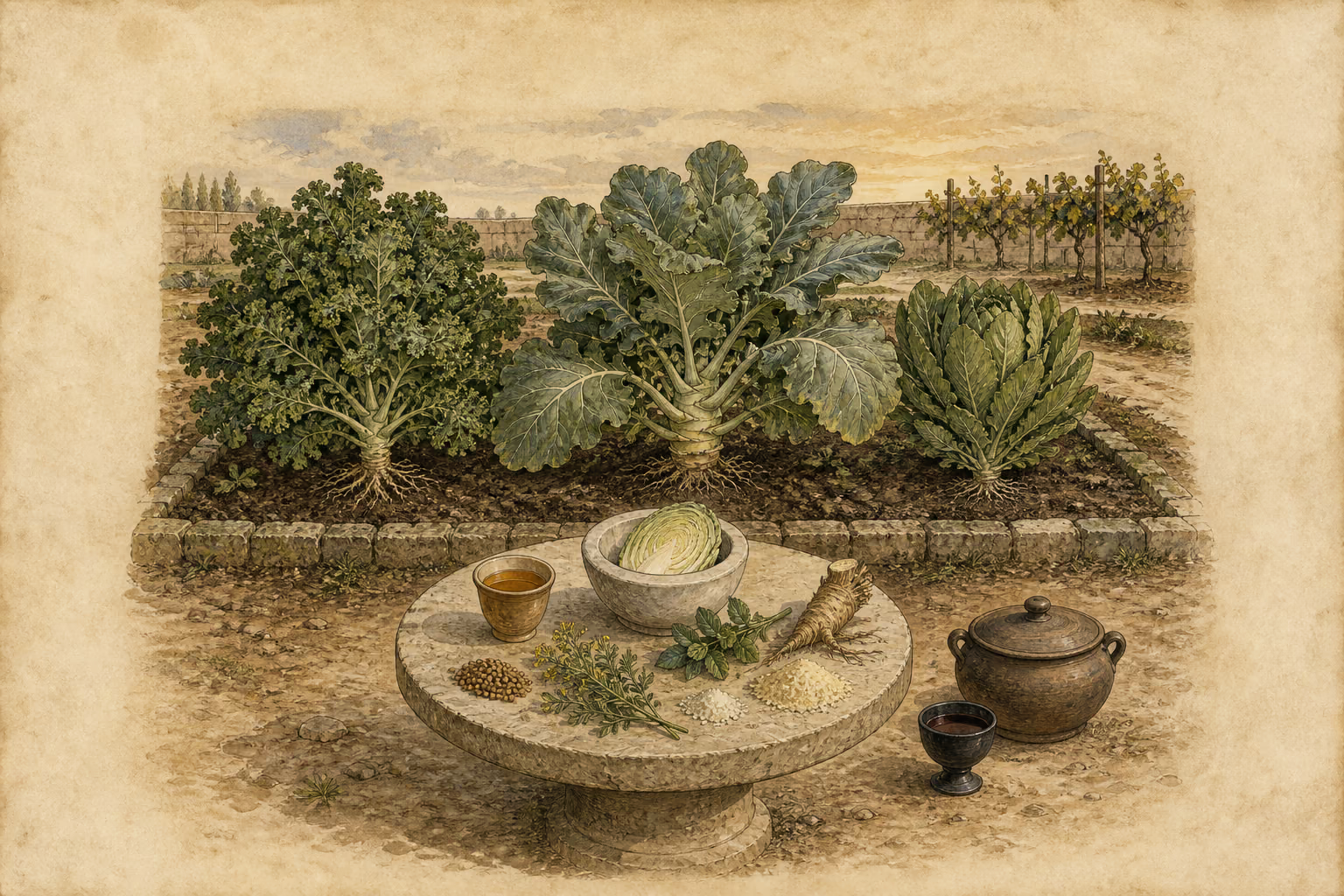
Brassicae laudes longum est exsequi, cum et Chrysippus medicus privatim volumen ei dicaverit per singula membra hominis digestum et Dieuches, ante omnes autem Pythagoras, et Cato non parcius celebraverit, cius sententiam vel eo diligentius persequi par est, ut noscatur, qua medicina usus sit annis DC populus Romanus. in tres species divisere eam Graeci antiquissimi: crispam, quam selinada vocaverunt a similitudine apii foliorum, stomacho utilem, alvum modice mollientem; alteram heliam, latis foliis e caule exeuntibus, unde caulodem quidam vocavere, nullius in medicina momenti. tertia est proprie appellata crambe, tenuioribus foliis et simplicibus densissimisque, amarior, sed efficacissima. Cato crispam maxime probat, dein levem grandibus foliis, caule magno. prodesse tradit capitis doloribus, oculorum caligini scintillationique, stomacho, praecordiis crudam ex aceto ac melle, coriandro, ruta, menta, laseris radicula sumptam acetabulis duobus matutino, tantamque esse vim, ut qui terat haec, validiorem fieri se sentiat. ergo vel cum his tritam sorbendam vel ex hoc intinctu sumendam, podagrae autem morbisque articulariis inlini cum ruta et coriandro et salis mica et hordei farina; aqua quoque eius decocta nervos articulosque mire iuvari, si foveantur. vulnera et recentia et vetera, etiam carcinomata, quae nullis aliis medicamentis sanari possint, foveri prius calida aqua iubet ac bis die tritam inponi. sic etiam fistulas et luxata et tumores, quos evocari quosque discuti opus sit. insomnia etiam vigiliasque tollere decoctam, si ieiuni edint quam plurimam ex oleo et sale; tormina, si decocta iterum decoquatur addito oleo, sale, cumino, polenta. si ita sumatur sine pane, magis profuturam. inter reliqua bilem detrahi per vinum nigrum pota. quin et urinam eius, qui brassicam esitaverit, adservari iubet, calefactamque nervis remedio esse. verba ipsius subiciam ad exprimendam sententiam: pueros pusillos, si laves ea urina, numquam debiles fieri. auribus quoque ex vino sucum brassicae tepidum instillari suadet idque etiam tarditati audientium prodesse adseverat, et inpetigines eadem sanari sine ulcere.
Graecorum quoque opiniones iam et Catonis causa poni convenit, in his dumtaxat, quae ille praetermiserit. biles trahere non percoctam putant, item alvum solvere eandemque bis coctam sistere. vino adversari ut inimicam vitibus, antecedente in cibis caveri ebrietatem, postea sumpta crapulam discuti. hunc cibum et oculorum claritati conferre multum, sucum vero crudae vel angulis tantum tactis cum Attico melle plurimum. facillime concoqui, ciboque eo sensus purgari. Erasistrati schola clamat nihil esse utilius stomacho nervisque, ideo paralyticis et tremulis dari iubet et sanguinem excreantibus. Hippocrates coeliacis et dysintericis bis coctam cum sale, item ad tenesmum et renium causa, lactis quoque ubertatem puerperis hoc cibo fieri iudicans et purgationem feminis. crudus quidem caulis si mandatur, partus quoque emortuos pelli. Apollodorus adversus fungorum venena semen aut sucum bibendum censet, Philistion opisthotonicis sucum ex lacte caprino cum sale et melle. invenio et podagra liberates edendo eam decoctaeque ius bibendo, hoc et cardiacis datum et comitialibus morbis addito sale, item splenicis in vino albo per dies XL et ictericis nec non et phreneticis. raucis crudae sucum gargarizandum bibendumque demonstrat, contra vero singultus cum coriandro et aneto et melle ac pipere ex aceto. inlitam quoque prodesse inflationibus stomachi, item serpentium ictibus et sordidis ulceribus ac vetustis, vel aqua ipsa cum hordeacia farina, sucum ex aceto vel cum feno Graeco. sic aliqui et articulis podagrisque inponunt. epinyctidas et, quidquid aliud serpit in corpore, inposita levat, item repentinas caligines, has et si mandatur ex aceto; suggillata vero et alios livores pura inlita, lepras et psoras cum alumine rotundo ex aceto. sic et fluentes capillos retinet. Epicharmus testium et genitalium malis hanc utilissime inponi, efficacius eandem cum faba trita, item convolsis, cum ruta contra ardores febrium et stomachi vitia, cum rutae semine ad secundas et muris aranei morsus. foliorum aridorum farina alterutra parte exinanit.
Ex omnibus brassicae generibus suavissima est cyma, at inutilis habetur, difficilis in coquendo et renibus contraria. illud quoque non est omittendum, aquam decoctae ad tot usus laudatam faetere humi effusam. stirpium brassicae aridorum cinis inter caustica intellegitur ad coxendicum dolores cum adipe vetusto, ac cum lasere et aceto inter psilotra: evulsis inlitus pilis nasci alios prohibet. bibitur et cum oleo subfervefactus vel per se elixus ad convolsa et rupta intus lapsoque ex alto. nulla ergo sunt crimina brassicae? immo vero apud eosdem animae gravitatem facere, dentibus et gingivis nocere. et in Aegypto propter amaritudinem non estur.
Silvestris sive erraticae inmenso plus effectus laudat Cato, adeo ut aridae quoque farinae in olfactorio collectae vel odore tantum naribus rapto vitia earum graveolentiamque sanari adfirmet. hanc alii petraeam vocant, inimicissimam vino, quam praecipue vitis fugiat aut, si non possit fugere, moriatur. folia habettenuia, rotunda, parva, levia, plantis oleris similior, candidior sativa et hirsutior. hanc inflationibus mederi, melancholicis quoque ac vulneribus recentibus cum melle, ita ne solvatur ante diem septimum, strumis, fistulis in aqua contritam Chrysippus auctor est. alii vero conpescere mala corporis, quae serpant—nomas vocant—, item excrescentia absumere, cicatrices ad planum redigere, oris ulcera et tonsillas manducatam et coctam suco gargarizato cum melle tollere, item psoras et lepras veteres, ipsius tribus partibus cum duabus aluminis in aceto acri inlitis. Epicharmus satis esse eam contra canis rabiosi morsum inponi; melius, si cum lasere et aceto acri; necari quoque canes ea, si detur ex carne. semen eius tostum auxiliatur contra serpentes,fungos, tauri sanguinem. folia cocta splenicis in cibo data et cruda inlita cum sulpure et nitro prosunt, item mammarum duritiae. radicum cinis uvae in faucibus tumenti tactu medetur et parotidas cum melle inlitus reprimit, serpentium morsus sanat. virium brassicae unum et magnum argumentum addemus ac mirabile: crustae occupent intus vasa omnia, in quis aquae fervent, ita ut non sit avellere eas; si brassica in his decoquatur, abscedunt.
Inter silvestres brassicas et lapsana est, pedalis altitudine, hirsutis foliis, sinapi similis, nisi candidior esset flore. coquitur in cibo, alvum leniter mollit.
Marina brassica vehementissime ex omnibus alvum ciet. coquitur propter acrimoniam cum pingui carne, stomacho inimicissima.
Scillarum in medicina albae et feminae nigrae; quae candidissima fuerit, utilissima erit. huic aridis tunicis direptis quod relicum e vivo est, consectum suspenditur lino modicis intervallis. postea arida frusta in cadum aceti quam asperrimi pendentia inmerguntur, ita ne ulla parte vas contingant. *gypso deinde oblitus cadus ponitur sub tegulis totius diei solem accipientibus. *hoc fit ante solstitium, diebus XLVIII*. post eum numerum dierum tollitur vas, scilla eximitur, acetum transfunditur. hoc clariorem oculorum aciem facit, salutare est stomachi, laterum doloribus ieiunis sumptum. sed tanta vis est, ut avidius haustum exstinctae animae momento aliquo speciem praebeat. prodest et gingivis et dentibus vel per se commanducata. taenias et reliqua ventris animalia pellit ex aceto et melle sumpta. linguae quoque recens subiecta praestat, ne hydropici sitiant. coquitur pluribus modis: in olla, quae coiciatur in clibanum aut furnum, vel adipe aut luto inlita, vel frustatim in patinis. et cruda siccatur, deinde conciditur coquiturque in aceto, cum serpentium ictibus inponitur. tosta quoque purgatur et medium eius iterum in aqua coquitur. usus sic coctae ad hydropicos, ad urinam ciendam tribus obolis cum melle et aceto potae, item splenicos et stomachicos, si non sentiant ulcus, quibus innatet cibus, ad tormina, regios morbos, tussim veterem cum suspirio. discutit et foliis strumas quadrinis diebus soluta, furfures capitis et ulcera manantia inlita ex oleo cocta. coquitur et in melle cibi gratia, maxime uti concoctionem faciat. sic et interiora purgat. rimas pedum sanat in oleo cocta et mixta resinae. semen eius lumborum dolori ex melle inponitur. Pythagoras scillam in limine quoque ianuae suspensam contra malorum medicamentorum introitum pollere tradit.
Ceteri bulbi ex aceto et sulpure ulceribus in facie medentur, per se vero triti nervorum contractioni et ex vino porrigini, cum melle canum morsibus; Erasistrato placet cum pice. idem sanguinem sistere eos tradit inlitos cum melle. alii, si e naribus fluat, coriandrum et farinam adiciunt. Theodorus et lichenas ex aceto bulbis curat, erumpentia in capite cum vino austero aut ovo. et bulbos epiphoris idem inlinit et siccae lippitudini media eorum. vitia, quae sunt in facie, rubentes maxime in sole inliti cum melle et nitro emendant, lentiginem cum vino aut cum aceto. vulneribus quoque mire prosunt per se aut, ut Damion, ex mulso, si quinto die solvantur. iisdem et auriculas fractas curat et testium pituitas; in articulorum doloribus miscet et farinam. in vino cocti inliti ventri duritiam praecordiorum emolliunt. dysintericis in vino ex aqua caelesti temperate dantur, ad convulsa intus cum silphio pilulis fabae magnitudine. ad sudorem tusi inlinuntur. nervis utiles, ideo et paralyticis dantur.luxata in pedibus, qui sunt rufi ex iis, citissime sanant cum melle et sale. venerem maxime Megarici stimulant, hortensii partum cum sapa aut passo sumpti, silvestres interaneorum plagas et vitia cum silphio pilulis devoratis sedant. illorum semen contra phalangia bibitur in vino. ipsi ex aceto inlinuntur contra serpentium ictus. semen antiqui bibendum insanientibus dabant. flos bulborum tritus crurum maculas varietatesque igni factas emendat. Diocles hebetari oculos ab his putat. elixos assis minus utiles esse adicit et difficile concoqui ex vi uniuscuiusque naturae.
Bolbinen Graeci vocant herbam porraceis foliis, rubicundo bulbo. haec traditur vulneribus mire utilis, dumtaxat recentibus. bulbus, quem vomitorium vocant ab effectu, folia habet nigra, ceteris longiora.
English · Bostock & Riley 1855–57
It would be too lengthy a task to enumerate all the praises of the cabbage, more particularly as the physician Chrysippus has devoted a whole volume to the subject, in which its virtues are described in reference to each individual part of the human body. Dieuches has done the same, and Pythagoras too, in particular. Cato, too, has not been more sparing in its praises than the others; and it will be only right to examine the opinions which he expresses in relation to it, if for no other purpose than to learn what medicines the Roman people made use of for six hundred years.
The most ancient Greek writers have distinguished three varieties of the cabbage: the curly cabbage, to which they have given the name of “selinoïdes,” from the resemblance of its leaf to that of parsley, beneficial to the stomach, and moderately relaxing to the bowels; the “helia,” with broad leaves running out from the stalk—a circumstance, owing to which some persons have given it the name of “caulodes”—of no use whatever in a medicinal point of view; and a third, the name of which is properly “crambe,” with thinner leaves, of simple form, and closely packed, more bitter than the others, but extremely efficacious in medicine.
Cato esteems the curly cabbage the most highly of all, and next to it, the smooth cabbage with large leaves and a thick stalk. He says that it is a good thing for headache, dimness of the sight, and dazzling of the eyes, the spleen, stomach, and thoracic organs, taken raw in the morning, in doses of two acetabula, with oxymel, coriander, rue, mint, and root of silphium. He says, too, that the virtue of it is so great that the very person even who beats up this mixture feels himself all the stronger for it; for which reason he recommends it to be taken mixed with these condiments, or, at all events, dressed with a sauce compounded of them. For the gout, too, and diseases of the joints, a liniment of it should be used, he says, with a little rue and coriander, a sprinkling of salt, and some barley meal: the very water even in which it has been boiled is wonderfully efficacious, according to him, for the sinews and joints. For wounds, either recent or of long standing, as also for carcinoma, which is incurable by any other mode of treatment, he recommends fomentations to be made with warm water, and, after that, an application of cabbage, beaten up, to the parts affected, twice a-day. He says, also, that fistulas and sprains should be treated in a similar way, as well as all humours which it may be desirable to bring to a head and disperse; and he states that this vegetable, boiled and eaten fasting, in considerable quantities, with oil and salt, has the effect of preventing dreams and wakefulness; also, that if, after one boiling, it is boiled a second time, with the addition of oil, salt, cummin, and polenta, it will relieve gripings in the stomach; and that, if eaten in this way without bread, it is more beneficial still. Among various other particulars, he says, that if taken in drink with black wine, it has the effect of carrying off the bilious secretions; and he recommends the urine of a person who has been living on a cabbage diet to be preserved, as, when warmed, it is a good remedy for diseases of the sinews. I will, however, here give the identical words in which Cato expresses himself upon this point: “If you wash little children with this urine,” says he, “they will never be weak and puny.”
He recommends, also, the warm juice of cabbage to be injected into the ears, in combination with wine, and assures us that it is a capital remedy for deafness: and he says that the cabbage is a cure for impetigo without the formation of ulcers.
As we have already given those of Cato, it will be as well to set forth the opinions entertained by the Greek writers on this subject, only in relation, however, to those points upon which he has omitted to touch. They are of opinion that cabbage, not thoroughly boiled, carries off the bile, and has the effect of loosening the bowels; while, on the other hand, if it is boiled twice over, it will act as an astringent. They say, too, that as there is a natural enmity between it and the vine, it combats the effects of wine; that, if eaten before drinking, it is sure to prevent drunkenness, being equally a dispellent of crapulence if taken after drinking: that cabbage is a food very beneficial to the eyesight, and that the juice of it raw is even more so, if the corners of the eyes are only touched with a mixture of it with Attic honey. Cabbage, too, according to the same testimony, is extremely easy of digestion, and, as an aliment, greatly tends to clear the senses.
The school of Erasistratus proclaims that there is nothing more beneficial to the stomach and the sinews than cabbage; for which reason, he says, it ought to be given to the paralytic and nervous, as well as to persons affected with spitting of blood. Hippocrates prescribes it, twice boiled, and eaten with salt, for dysentery and cœliac affections, as also for tenesmus and diseases of the kidneys; he is of opinion, too, that, as an aliment, it increases the quantity of the milk in women who are nursing, and that it promotes the menstrual discharge. The stalk, too, eaten raw, is efficacious in expelling the dead fœtus. Apollodorus prescribes the seed or else the juice of the cabbage to be taken in cases of poisoning by fungi; and Philistion recommends the juice for persons affected with opisthotony, in goats’-milk, with salt and honey.
I find, too, that persons have been cured of the gout by eating cabbage and drinking a decoction of that plant. This decoction has been given, also, to persons afflicted with the cardiac disease and epilepsy, with the addition of salt; and it has been administered in white wine, for affections of the spleen, for a period of forty days.
According to Philistion, the juice of the raw root should be given as a gargle to persons afflicted with icterus or phrenitis, and for hiccup he prescribes a mixture of it, in vinegar, with coriander, anise, honey, and pepper. Used as a liniment, cabbage, he says, is beneficial for inflations of the stomach; and the very water, even, in which it has been boiled, mixed with barley-meal, is a remedy for the stings of serpents and foul ulcers of long standing; a result which is equally effected by a mixture of cabbage-juice with vinegar or fenugreek. It is in this manner, too, that some persons employ it topically, for affections of the joints and for gout. Applied topically, cabbage is a cure for epinyctis, and all kinds of spreading eruptions on the body, as also for sudden attacks of dimness; indeed, if eaten with vinegar, it has the effect of curing the last. Applied by itself, it heals contusions and other livid spots; and mixed with a ball of alum in vinegar, it is good as a liniment for leprosy and itch-scabs: used in this way, too, it prevents the hair from falling off.
Epicharmus assures us that, applied topically, cabbage is extremely beneficial for diseases of the testes and genitals, and even better still when employed with bruised beans; he says, too, that it is a cure for convulsions; that, in combination with rue, it is good for the burning heats of fever and maladies of the stomach; and that, with rue-seed, it brings away the after-birth. It is of use, also, for the bite of the shrew-mouse. Dried cabbage-leaves, reduced to a powder, are a cathartic both by vomit and by stool.
In all varieties of the cabbage, the part most agreeable to the taste is the cyma, although no use is made of it in medicine, as it is difficult to digest, and by no means beneficial to the kidneys. At the same time, too, it should not be omitted, that the water in which it has been boiled, and which is so highly praised for many purposes, gives out a very bad smell when poured upon the ground. The ashes of dried cabbage-stalks are generally reckoned among the caustic substances: mixed with stale grease, they are employed for sciatica, and, used as a liniment, in the form of a depilatory, together with silphium and vinegar, they prevent hair that has been once removed from growing again. These ashes, too, are taken lukewarm in oil, or else by themselves, for convulsions, internal ruptures, and the effects of falls with violence.
And are we to say then that the cabbage is possessed of no evil qualities whatever? Certainly not, for the same authors tell us, that it is apt to make the breath smell, and that it is injurious to the teeth and gums. In Egypt, too, it is never eaten, on account of its extreme bitterness.
Cato extols infinitely more highly the properties of wild or erratic cabbage; so much so, indeed, as to affirm that the very powder of it, dried and collected in a scent-box, has the property, on merely smelling at it, of removing maladies of the nostrils and the bad smells resulting therefrom. Some persons call this wild cabbage “petræa:” it has an extreme antipathy to wine, so much so, indeed, that the vine invariably avoids it, and if it cannot make its escape, will be sure to die. This vegetable has leaves of uniform shape, small, rounded, and smooth: bearing a strong resemblance to the cultivated cabbage, it is whiter, and has a more downy leaf.
According to Chrysippus, this plant is a remedy for flatulency, melancholy, and recent wounds, if applied with honey, and not taken off before the end of six days: beaten up in water, it is good also for scrofula and fistula. Other writers, again, say that it is an effectual cure for spreading sores on the body, known as “nomæ;” that it has the property, also, of removing excrescences, and of reducing the scars of wounds and sores; that if chewed raw with honey, it is a cure for ulcers of the mouth and tonsils; and that a decoction of it used as a gargle with honey, is productive of the same effect. They say, too, that, mixed in strong vinegar with alum, in the proportion of three parts to two of alum, and then applied as a liniment, it is a cure for itch scabs and leprous sores of long standing. Epicharmus informs us, that for the bite of a mad dog, it is quite sufficient to apply it topically to the part affected, but that if used with silphium and strong vinegar, it is better still: he says, too, that it will kill a dog, if given to it with flesh to eat.
The seed of this plant, parched, is remedial in cases of poisoning, by the stings of serpents, eating fungi, and drinking bulls’ blood. The leaves of it, either boiled and taken in the food or else eaten raw, or applied with a liniment of sulphur and nitre, are good for affections of the spleen, as well as hard tumours of the mamillæ. In swelling of the uvula, if the parts affected are only touched with the ashes of the root, a cure will be the result; and applied topically with honey, they are equally beneficial for reducing swellings of the parotid glands, and curing the stings of serpents. We will add only one more proof of the virtues of the cabbage, and that a truly marvellous one—in all vessels in which water is boiled, the incrustations which adhere with such tenacity that it is otherwise impossible to detach them, will fall off immediately if a cabbage is boiled therein.
Among the wild cabbages, we find also the lapsana, a plant which grows a foot in height, has a hairy leaf, and strongly resembles mustard, were it not that the blossom is whiter. It is eaten cooked, and has the property of soothing and gently relaxing the bowels.
Sea-cabbage is the most strongly purgative of all these plants. It is cooked, in consequence of its extreme pungency, with fat meat, and is extremely detrimental to the stomach.
In medicine, we give the name of white squill to the male plant, and of black to the female: the whiter the squill, the better it is for medicinal purposes. The dry coats being first taken off of it, the remaining part, or so much of it as retains life, is cut into pieces, which are then strung and suspended on a string, at short distances from each other. After these pieces are thoroughly dried, they are thrown into a jar of the very strongest vinegar, suspended in such a way, however, as not to touch any portion of the vessel. This is done forty-eight days before the summer solstice. The mouth of the jar is then tightly sealed with plaster; after which it is placed beneath some tiles which receive the rays of the sun the whole day through. At the end of forty-eight days the vessel is removed, the squills are taken out of it, and the vinegar poured into another jar.
This vinegar has the effect of sharpening the eyesight, and, taken every other day, is good for pains in the stomach and sides: the strength of it, however, is so great, that if taken in too large a quantity, it will for some moments produce all the appearance of death. Squills, too, if chewed by themselves even, are good for the gums and teeth; and taken in vinegar and honey they expel tapeworm and other intestinal worms. Put fresh beneath the tongue, they prevent persons afflicted with dropsy from experiencing thirst.
Squills are cooked in various ways; either in a pot with a lining of clay or grease, which is put into an oven or furnace, or else cut into pieces and stewed in a saucepan. They are dried also in a raw state, and then cut into pieces and boiled with vinegar; in which case, they are employed as a liniment for the stings of serpents. Sometimes, again, they are roasted and then cleaned; after which, the middle of the bulb is boiled again in water.
When thus boiled, they are used for dropsy, as a diuretic, being taken in doses of three oboli, with oxymel: they are employed also in a similar manner for affections of the spleen, and of the stomach, when it is too weak to digest the food, provided no ulcerations have made their appearance; also for gripings of the bowels, jaundice, and inveterate cough, accompanied with asthma. A cataplasm of squill leaves, taken off at the end of four days, has the effect of dispersing scrofulous swellings of the neck; and a decoction of squills in oil, applied as a liniment, is a cure for dandriff and running ulcers of the head.
Squills are boiled with honey also for the table, with the view of aiding the digestion more particularly; used in this way, too, they act upon the inside as a purgative. Boiled with oil, and then mixed with resin, they are a cure for chaps on the feet; and the seed, mixed with honey, is applied topically, for the cure of lumbago. Pythagoras says that a squill, suspended at the threshold of the door, effectually shuts all access to evil spells and incantations.
Bulbs, steeped in vinegar and sulphur, are good for the cure of wounds in the face; beaten up and used alone, they are beneficial for contractions of the sinews, mixed with wine, for porrigo, and used with honey, for the bites of dogs; in this last case, however, Erasistratus says that they ought to be mixed with pitch. The same author states that, applied topically with honey, they stanch the flowing of blood; other writers say, however, that in cases of bleeding at the nose, coriander and meal should be employed in combination with them. Theodorus prescribes bulbs in vinegar for the cure of lichens, and for eruptions in the head he recommends bulbs mixed with astringent wine, or an egg beaten up; he treats defluxions of the eyes also with bulbs, applied topically, and uses a similar method for the cure of ophthalmia. The red bulbs more particularly, will cause spots in the face to disappear, if rubbed upon them with honey and nitre in the sun; and applied with wine or boiled cucumber they will remove freckles. Used either by themselves, or as Damion recommends, in combination with honied wine, they are remarkably efficacious for the cure of wounds, care being taken, however, not to remove the application till the end of four days. The same author prescribes them, too, for the cure of fractured ears, and collections of crude humours in the testes.
For pains in the joints, bulbs are used with meal; boiled in wine, and applied to the abdomen, they reduce hard swellings of the viscera. In dysentery, they are given in wine mixed with rain water; and for convulsions of the intestines they are employed, in combination with silphium, in pills the size of a bean: bruised, they are employed externally, for the purpose of checking perspirations. Bulbs are good, too, for the sinews, for which reason it is that they are given to paralytic patients. The red bulb, mixed with honey and salt, heals sprains of the feet with great rapidity. The bulbs of Megara act as a strong aphrodisiac, and garden bulbs, taken with boiled must or raisin wine, aid delivery.
Wild bulbs, made up into pills with silphium, effect the cure of wounds and other affections of the intestines. The seed, too, of the cultivated kinds is taken in wine as a cure for the bite of the phalangium, and the bulbs themselves are applied in vinegar for the cure of the stings of serpents. The ancients used to give bulb-seed to persons afflicted with madness, in drink. The blossom, beaten up, removes spots upon the legs, as well as scorches produced by fire. Diocles is of opinion that the sight is impaired by the use of bulbs; he adds, too, that when boiled they are not so wholesome as roasted, and that, of whatever nature they may be, they are difficult of digestion.
The Greeks give the name bulbine to a plant with leaves resembling those of the leek, and a red bulbous root. This plant, it is said, is marvellously good for wounds, but only when they are of recent date. The bulbous plant known as the “emetic” bulb, from the effects which it produces, has dark leaves, and longer than those of the other kinds.