LIBER XXI · CAPUT 11
TWO VARIETIES OF THE AMARACUS
Latine · Mayhoff 1906
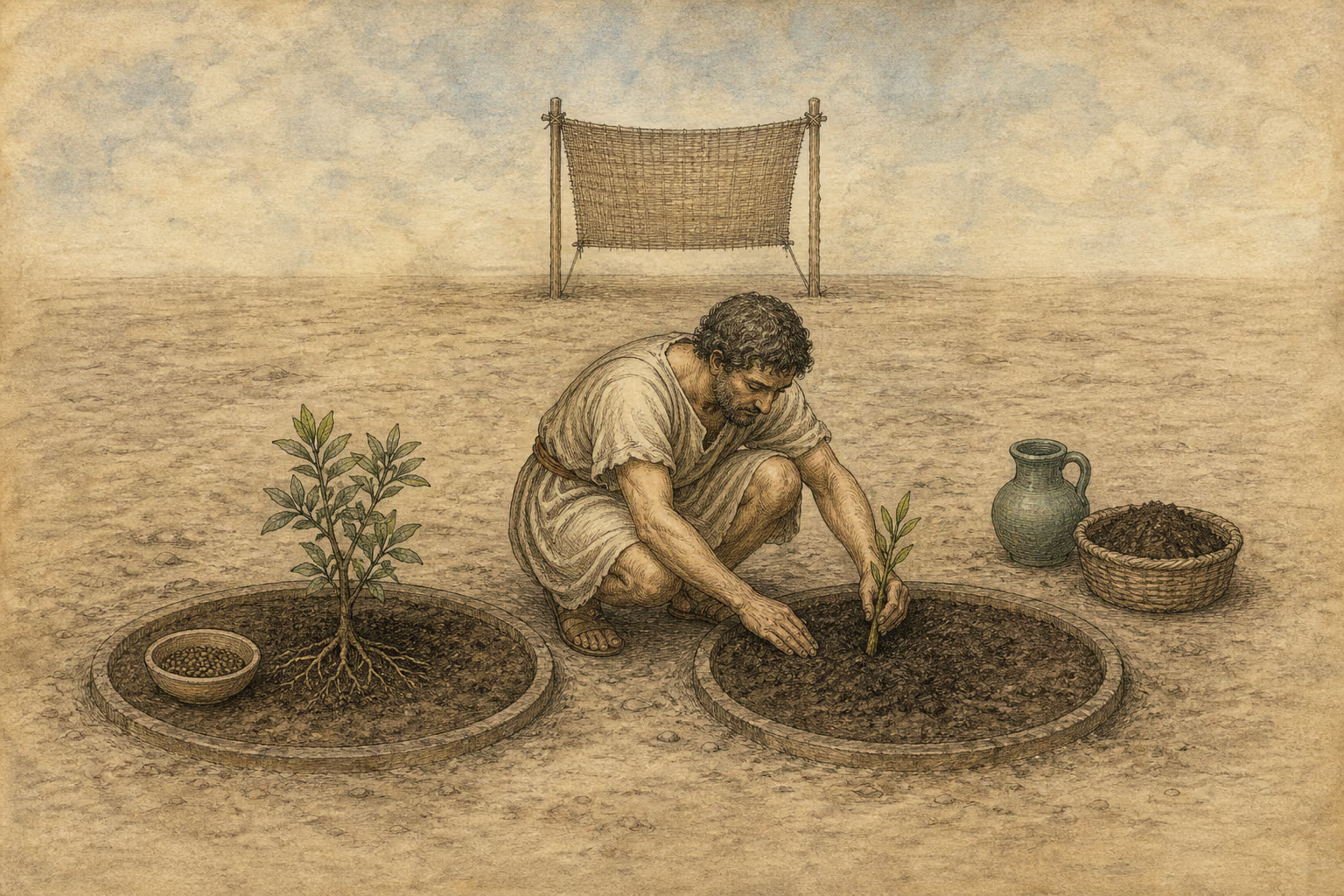
Amaracum Diocles medicus et Sicula gens appellavere, quod Aegyptus et Syria sampsucum. seritur utroque genere, et seine et ramo, vivacius supra dictis et odore mollius. copiosum amaraco aeque quam habrotono semen, sed habrotono radix una et alte descendens, ceteris in summa terra leviter haerens. reliquorum satio autumno fere incipiente, nec non et vere quibusdam locis, umbraque gaudent et aqua ac fimo.
Nyctegreton inter pauca miratus est Democritus, coloris hysgini, folio spinae, nec a terra se adtollentem, praecipuam in Gedrosia. narrat erui post aequinoctium vernum radicitus siccarique ad lunam XXX diebus, ita lucere noctibus; Magos Parthorumque reges hac herba uti ad vota suscipienda. eandem vocari chenamychen, quoniam anseres a primo conspectu eius expavescant, ab aliis nyctalopa, quoniam e longinquo noctibus fulgeat.
Melilotos ubique nascitur, laudatissima tamen in Attica; ubicumque vero recens, nec candicans et croco quam simillima, quamquam in Italia odoratior candida.
Florum prima ver nuntiat viola alba, tepidioribus vero locis etiam hieme emicat; post ea, quae ion appellatur et purpurea, proxime flammeum, quod phlox vocatur, silvestre dumtaxat. cyclaminum bis anno, vere et autumno; aestates hiemesque fugit. seriores supra dictis aliquanto narcissus et lilium trans maria, in Italia quidem, ut diximus, post rosam. Verum in Graecia tardius etiamnum anemone; est autem haec silvestrium bulborum flos, alia quam quae dicetur in medicis. sequitur oenanthe ac melanium et ex silvestribus heliochrysos, deinde alterum genus anemones, quae limonia vocatur, post hanc gladiolus comitatus hyacintho. novissima rosa, eademque prima deficit excepta sativa; e ceteris hyacinthus maxime durat et viola alba et oenanthe, sed haec ita, si devolsa crebro prohibeatur in semen ire. nascitur locis tepidis; odor idem ei, qui germinantibus uvis, atque inde nomen. hyacinthum comitatur fabula duplex, luctum praeferentis eius, quem Apollo dilexerat, aut ex Aiacis cruore editi, ita discurrentibus venis, ut Graecarum litterarum figura Al legatur inscriptum. heliochrysus florem habet auro similem, folium tenue, cauliculum quoque gracilem, sed durum. hoc coronare se Magi, si et unguenta sumantur ex auro, quod apyron vocant, ad gratiam quoque vitae gloriamque pertinere arbitrantur.
Et verni quidem flores hi sunt; succedunt illis aestivi, lychnis et Iovis flos et alterum genus lilii, item tiphyon et amaracus, quem Phrygium cognominant. sed maxime spectabilis pothos. duo genera huius: unum, cui flos hyacinthi est, alter candidus, qui fere nascitur tumulis, quoniam fortius durat. et iris aestate floret. abeunt et hi marcescuntque. alii rursus subeunt autumno: tertium genus lilii et crocum et orsini utraque genera, unum hebes, alterum odoratum, primis omnia imbribus emicantia. coronarii quidem et spinae flore utuntur, quippe cum spinae albae cauliculi inter oblectamenta quoque gulae condiantur. hic est trans maria ordo florum. in Italia violis succedit rosa, huic intervenit lilium, rosam cyanus excipit, cyanum amarantus. nam vicapervica semper viret, in modum liniae foliis geniculatim circumdata, topiaria herba, inopiam tamen florum aliquando supplet. haec a Graecis chamaedaphne vocatur.
Vita longissima violae albae trimatu. ab eo tenpore degenerat. rosa et quinquennium perfert non recisa nec adusta. illo enim modo iuvenescit. diximus et terram referre plurimum. nam in Aegypto sine odore haec omnia, tantumque myrtis odor praecipuus; alioqui etiam binis mensibus antecedit germinatio omnium. rosaria a favonio fossa oportet esse iterumque solstitio, et id agendum, ut intra id tempus purgata ac pura sint.
English · Bostock & Riley 1855–57
Diocles, the physician, and the people of Sicily have given the name of “amaracus” to the plant known in Egypt and Syria as sampsuchum. It is reproduced two ways, from seed and from cuttings, being more long-lived than the preceding plants, and possessed of a more agreeable smell. The amaracus, like the abrotonum, has a great abundance of seed, but while the abrotonum has a single root, which penetrates deep into the ground, those of the other plant adhere but lightly to the surface of the earth. Those of the other plants which love the shade, water, and manure, are generally set at the beginning of autumn, and even, in some localities, in spring.
Democritus has regarded the nyctegreton as one of the most singular of plants. According to that author, it is of a dark red colour, has leaves like those of a thorn, and creeps upon the ground. He says that it grows in Gedrosia more particularly, and that it is taken up by the roots immediately after the vernal equinox, and dried in the moonlight for thirty days; after which preparation it emits light by night. He states also, that the Magi and the kings of Parthia employ this plant in their ceremonies when they make a vow to perform an undertaking; that another name given to it is “chenomyche,” from the circumstance that, at the very sight of it, geese will manifest the greatest alarm; and that by some persons, again, it is known as the “nyctalops,” from the light which it emits at a considerable distance by night.
The melilote is found growing everywhere, though that of Attica is held in the highest esteem. In all countries, however, it is preferred when fresh gathered; that too, the colour of which is not white, but approaches as nearly as possible to the colour of saffron. In Italy, however, it is the white kind that is the most odoriferous.
The first of the flowers that announce the approach of spring is the white violet; indeed, in warm localities, it is seen peeping out in the winter even. Next to it comes the violet known as the ion, and the purple violet; then the flame-coloured flower, the name of which is phlox, but only the wild one. The cyclaminum blossoms twice a year, in spring and autumn, standing equally in awe as it does of summer and of winter. The narcissus and the lily, in the parts beyond sea, are a little later than the preceding plants: but in Italy, as we have already stated, they are in blossom with the rose. In Greece, too, the anemone blooms even later; it is the flower of a wild bulb, and is altogether different from the one which we shall have occasion to mention among the medicinal plants.
Next, after these, come the œnanthe, the melanion, and, among the wild plants, the helichrysos; then, another kind of anemone, known as the “limonia,” and after that the gladiolus, accompanied by the hyacinth. Last of all, among the spring flowers, is the rose, which, with the exception indeed of the cultivated kinds, is also the first to fade. Among the others, the flowers which last the longest, are the hyacinth, the white violet, and the œnanthe; but to make this last keep any time in flower, it is necessary to gather it repeatedly, to prevent it from running to seed. The œnanthe grows in warm localities, and has exactly the smell of the vine when in blossom, to which circumstance it is indebted for its name.
There are two fabulous stories attached to the hyacinth; according to one of them, it bears the impress of the grief which Apollo felt for the youth whom he had so tenderly loved; and we learn from the other, that it derives its name from the blood of Ajax, the veins being so arranged in the flower as to form the Greek letters ΑΙ inscribed upon it.
The helichrysos has a flower resembling gold in appearance, a small leaf, and a fine, slender, but hard, stem. According to the Magi, the person who crowns himself with a chaplet composed of this flower, and takes his unguents from a box of gold, of the kind generally known as “apyron,” will be sure to secure esteem and glory among his fellowmen. Such are the flowers of spring.
The summer flowers come next, the lychnis the flower of Jove, and another kind of lily, as also the tiphyon and the amaracus, surnamed that of Phrygia. Put the most remarkable flower of all is the pothos, of which there are two varieties, one with the flower of the hyacinth, and another with a white flower, which is generally found growing about graves, and is better able to stand bad weather. The iris, also, blossoms in summer. All these flowers pass away, however, and fade; upon which others assume their places in autumn, a third kind of lily, for instance, saffron, and two varieties of the orsinum —one of them inodorous and the other scented—making their appearance, all of them, as soon as the first autumnal showers fall.
The garland-makers employ the flowers of the thorn even for making chaplets; the tender shoots, too, of the white thorn are sometimes preserved as a choice morsel to tempt the palate.
Such is the succession of the summer flowers in the parts beyond sea: in Italy, the violet is succeeded by the rose, the lily comes on while the rose is still in flower, the cyanus succeeds the rose, and the amaranth the cyanus. As to the vincapervinca, it is an evergreen, the branches from which run out like so many strings, the leaves surrounding the stem at each of the knots: though more generally used for the purposes of ornamental gardening, it is sometimes employed in chaplets when there is a deficiency of other flowers. From the Greeks this plant has received the name of “chamædaphne.”
At the very utmost, the white violet never lasts longer than three years: should it exceed that period, it is sure to degenerate. The rose-tree will last so long as five years without being pruned or cauterized, methods by which it is made to grow young again. We have already stated that the nature of the soil is of the very greatest importance; for in Egypt, we find, all these plants are perfectly inodorous, and it is only the myrtle that has any particular smell. In some countries, too, the germination of all the plants precedes that in other parts of the world by so long a period as two months even. The rose-beds should be well spaded immediately after the west winds begin to prevail, and, a second time, at the summer solstice: every care, however, should be paid, between these two periods, to keeping the ground well raked and cleaned.