LIBER XXI · CAPUT 15
PLANTS WHICH GROW SPONTANEOUSLY: THE USE MADE OF THEM BY VARIOUS NATIONS, THEIR NATURE, AND REMARKABLE FACTS CONNECTED WITH THEM. THE STRAWBERRY, THE TAMNUS, AND THE BUTCHER’S BROOM. THE BATIS, TWO VARIETIES OF IT. THE MEADOW PARSNIP. THE HOP
Latine · Mayhoff 1906
secuntur herbae sponte nascentes, quibus pleraeque gentium utuntur in cibis maximeque Aegyptus, frugum quidem fertilissima, sed ut prope sola iis carere possit. tanta est ciborum ex herbis abundantia. in Italia paucissimas novimus, fraga, tamnum, ruscum, batim marinam, batim hortensiam, quas aliqui asparagum Gallicum vocant, praeter has pastinacam pratensem, lupum salictarium, eaque verius oblectamenta quam cibos.
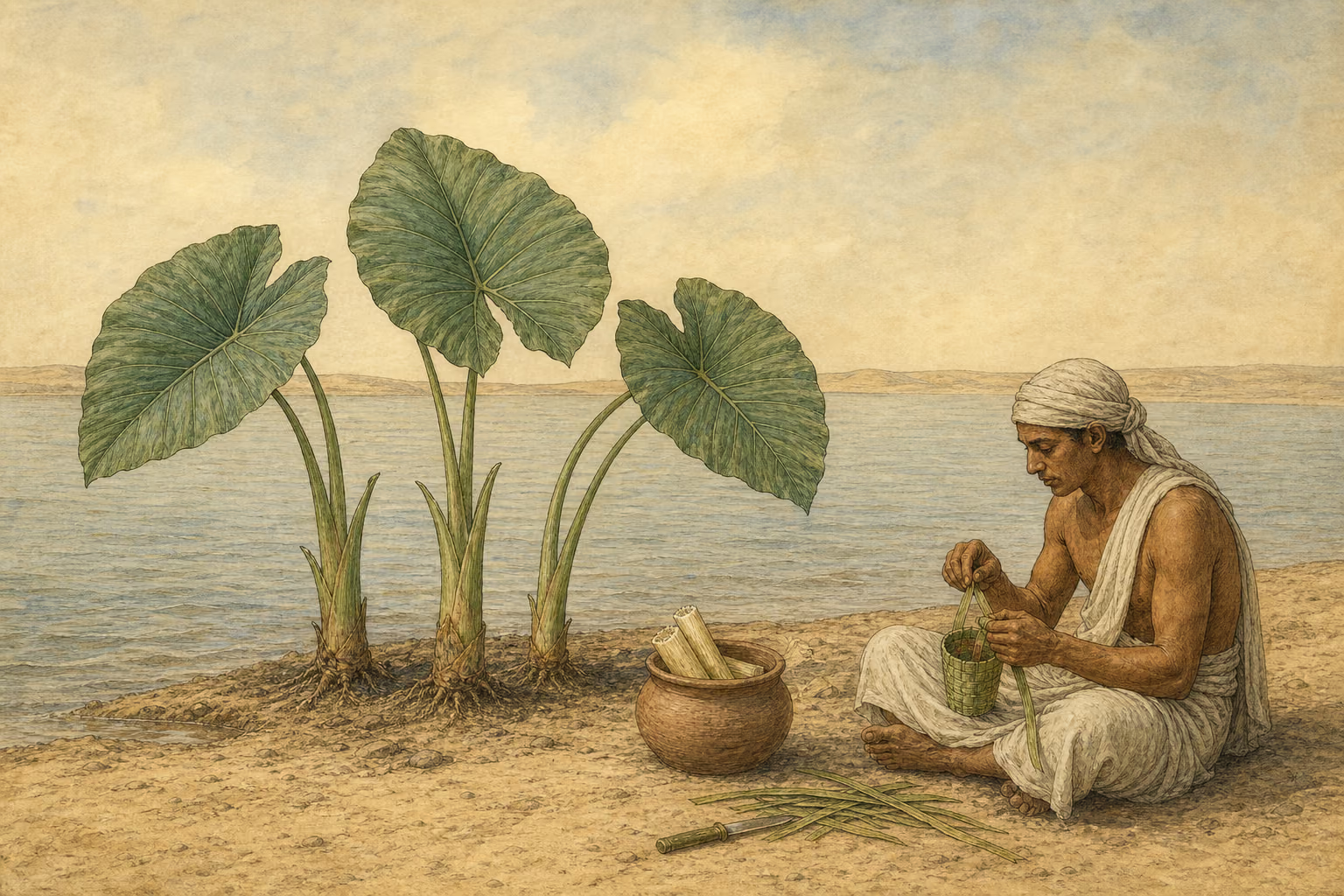
In Aegypto nobilissima est colocasia, quam cyamon aliqui vocant. hanc e Nilo metunt, caule, cum coctus est, araneoso in mandendo, thyrso autem, qui inter folia emicat, spectabili, foliis latissimis, etiam si arboreis conparentur, ad similitudinem eorum, quae personata in nostris amnibus vocamus, adeoque Nili sui dotibus gaudent, ut inplexis colocasiae foliis in variam speciem vasorum potare gratissimum habeant. seritur iam haec in Italia.
In Aegypto proxima auctoritas cichorio est, quod diximus intubum erraticum. nascitur post vergilias, floret particulatim. radix ei lenta, quare etiam ad vincula utuntur illa. anthalium longius a flumine nascitur, mespili magnitudine et rotunditate, sine nucleo, sine cortice, folio cyperi. mandunt igni comparatum. mandunt et oetum, cui pauca folia minimaque, verum radix magna. arachidne quidem et aracos, cum habeant radices ramosas ac multiplices, nec folium nec herbam ullam aut quicquam aliud supra terram habent. reliqua volgarium in cibis apud eos herbarum nomina: chondrylla, hypochoeris, caucalis, enthryscum, scandix, come, quae ab aliis tragopogon vocatur, foliis croco simillimis, parthenium, trychnum, corchorus et ab aequinoctio nascentes aphace, achynops. epipetron vocant quae numquam floret. at e contrario aphace subinde marcescente flore emittit alium tota hieme totoque vere usque in aestatem.
Multas praeterea ignobiles habent, sed maxime celebrant cnecon Italiae ignotam, ipsis autem oleo, non cibo gratam. hoc faciunt e semine eius. differentia prima: silvestris et mitior. silvestrium duae species. una mitiori similis, caule tamen rigido; itaque et colu antiquae utebantur exili, quare quidam atractylida vocant. semen eius candidum et grande, amarum. altera hirsutior, torosiore caule et qui paene humi serpat, minuto semine. aculeatarum generis haec est, quoniam distinguenda sunt et genera.
Ergo quaedam herbarum spinosae sunt, quaedam sine spinis. spinosarum multae species. in totum spina est asparagus, scorpio, nullum enim folium habent. quaedam spinosa foliata sunt, ut carduus, erynge, glycyrrhiza, urtica; his enim omnibus foliis inest aculeata mordacitas. aliqua et secundum spinam habent folium, ut tribulus et anonis. quaedam in folio non habent et in caule habent, ut pheos, quod aliqui stoeben appellavere. hippophaes spinis geniculatum. tribulo proprietas, quod et fructum spinosum habet.
Ex omnibus his generibus urtica maxime noscitur acetabulis in flore purpuream lanuginem fundentibus, saepe altior binis (ubitis. plures eius differentiae: silvestris, quam et feminam vocant, mitiorque; et silvestri quae dicitur canina acrior, caule quoque mordaci, fimbriatis foliis; quae vero etiam odorem fundit Herculanea vocatur. semen omnibus copiosum, nigrum. mirum sine ullis spinarum aculeis lanuginem ipsam esse noxiam et tactu tantum levi pruritum pusulasque confestim adusto similes existere. notum est [et] remedium olei. sed mordacitas non protinus cum ipsa herba gignitur, nec nisi solibus roborata. incipiens quidem ipsa nasci vere non ingrato, multis etiam religioso in cibo est ad pellendos totius anni morbos. silvestrium quoque radix omnem carnem teneriorem facit simul cocta. quae innoxia est, morsu carens, lamium vocatur. de scorpione dicemus inter medicas.
English · Bostock & Riley 1855–57
We now come to the plants which grow spontaneously, and which are employed as an aliment by most nations, the people of Egypt in particular, where they abound in such vast quantities, that, extremely prolific as that country is in corn, it is perhaps the only one that could subsist without it: so abundant are its resources in the various kinds of food to be obtained from plants.
In Italy, however, we are acquainted with but very few of them; those few being the strawberry, the tamnus, the butcher’s broom, the sea batis, and the garden batis, known by some persons as Gallic asparagus; in addition to which we may mention the meadow parsnip and the hop, which may be rather termed amusements for the botanist than articles of food.
But the plant of this nature that is the most famous in Egypt is the colocasia, known as the “cyamos” to some. It is gathered in the river Nilus, and the stalk of it, boiled, separates into fine filaments when chewed, like those of the spider’s web. The head, protruding from among the leaves, is very remarkable; and the leaves, which are extremely large, even when compared with those of trees, are very similar to those of the plant found in our rivers, and known by the name of “personata.” So much do the people of that country take advantage of the bounteousness displayed by their river, that they are in the habit of plaiting the leaves of the colocasia with such skill as to make vessels of various shapes, which they are extremely fond of using for drinking vessels. At the present day, however, this plant is cultivated in Italy.
In Egypt, next to the colocasia, it is the cichorium that is held in the highest esteem, a plant which we have already spoken of under the name of wild endive. It springs up after the rising of the Vergiliæ, and the various portions of it blossom in succession: the root is supple, and hence is used for making withes even. The anthalium grows at a greater distance from the river; the fruit of it is round, and about the size of a medlar, but without either kernel or rind; the leaves of the plant are similar to those of the cyperus. The people there eat the fruit of it cooked upon the fire, as also of the œtum, a plant which has a few leaves only, and those extremely diminutive, though the root is large in proportion. The arachidna, again, and the aracos have numerous branchy roots, but neither leaves nor any herbaceous parts, nor, indeed, anything that makes its appearance above ground.
The other plants that are commonly eaten in Egypt are the chondrylla, the hypochœris, the caucalis, the anthriscum, the scandix, the come, by some persons known as the tragopogon, with leaves very similar to those of saffron, the parthenium, the trychnum, and the corchorus; with the aphace and acynopos, which make their appearance at the equinox. There is a plant also, called the epipetron, which never blossoms; while the aphace, on the other hand, as its flowers die, from time to time puts forth fresh ones, and remains in blossom throughout the winter and the spring, until the following summer.
The Egyptians have many other plants also, of little note; but they speak in the highest terms of the cnecos; a plant unknown to Italy, and which the Egyptians hold in esteem, not as an article of food, but for the oil it produces, and which is extracted from the seed. The principal varieties are the wild and the cultivated kinds; of the wild variety, again, there are two sorts, one of which is less prickly than the other, but with a similar stem, only more upright: hence it is that in former times females used it for distaffs, from which circumstance it has received the name of “atractylis” from some; the seed of it is white, large, and bitter. The other variety is more prickly, and has a more sinewy stem, which may be said almost to creep upon the ground; the seed is small. The cnecos belongs to the thorny plants: indeed, it will be as well to make some classification of them.
For some plants, in fact, are thorny, while others, again, are destitute of prickles: the species of thorny plants are very numerous. The asparagus and the scorpio are essentially thorny plants, having no leaves at all upon them. Some plants, again, that are prickly have leaves as well, such as the thistle, for instance, the erynge, the glycyrriza, and the nettle; all these plants being provided with leaves that prick or sting.
Some plants have thorns at the base of their leaves, the tribulus and the anonis for instance; others, again, have thorns, not on the leaves but on the stem, the pheos for example, known as the stœbe to some. The hippophaës has thorns at the joints; the tribulus presents the peculiarity of bearing a fruit that is thorny.
But of all these plants, it is the nettle that is the best known to us, the calyces of the blossoms of which produce a purple down: it frequently exceeds two cubits even in height. There are numerous varieties of this plant; the wild nettle, known also as the female nettle, does not inflict so bad a sting as the others. Among the several varieties of the wild nettle, the one known as the dog -nettle, stings the worst, the stem of it even possessing that property; the leaves of the nettle are indented at the edge. There is one kind also, which emits a smell, known as the Herculanean nettle. The seed of all the nettles is copious, and black. It is a singular fact that, though possessed of no spinous points, the down of the nettle is of a noxious nature, and that, though ever so lightly touched, it will immediately produce an itching sensation, and raise a blister on the flesh similar in appearance to a burn: the well-known remedy for it is olive oil.
The stinging property of the nettle does not belong to the plant at the earliest period of its growth, but only developes itself under the influence of the sun. The plant first begins to grow in the spring, at which period it is by no means a disagreeable food; indeed, it has become quite a religious observance to employ it as such, under the impression that it is a preventive from diseases the whole year through. The root, too, of the wild nettle, has the effect of rendering all meat more tender that is boiled with it. The kind that is innoxious and destitute of all stinging properties, is known as the “lamium.” Of the scorpio we shall have occasion to speak when treating of the medicinal plants.