LIBER XXI · CAPUT 17
THE VARIOUS KINDS OF EARED PLANTS: THE STANYOPS; THE ALOPECUROS; THE STELEPHUROS, ORTYX, OR PLANTAGO; THE THRYALLIS
Latine · Mayhoff 1906
multis inter haec aeterna folia, sicut quibusdam arborum, inprimisque heliotropio, adianto, polio.
Aliud rursus spicatarum genus, ex quo est achynops, alopecuros, stelephuros,—quam quidam ortygem vocant, alii plantaginem, de qua plura dicemus inter medicas —, thryallis. ex his alopecuros spicam habet mollem et lanuginem densam, non dissimilem vulpium caudis, unde et nomen. proxima ei est et stelephuros, nisi quod illa particulatim floret. cichorion et similia circa terram folia habent; germinant ab radice post vergilias.
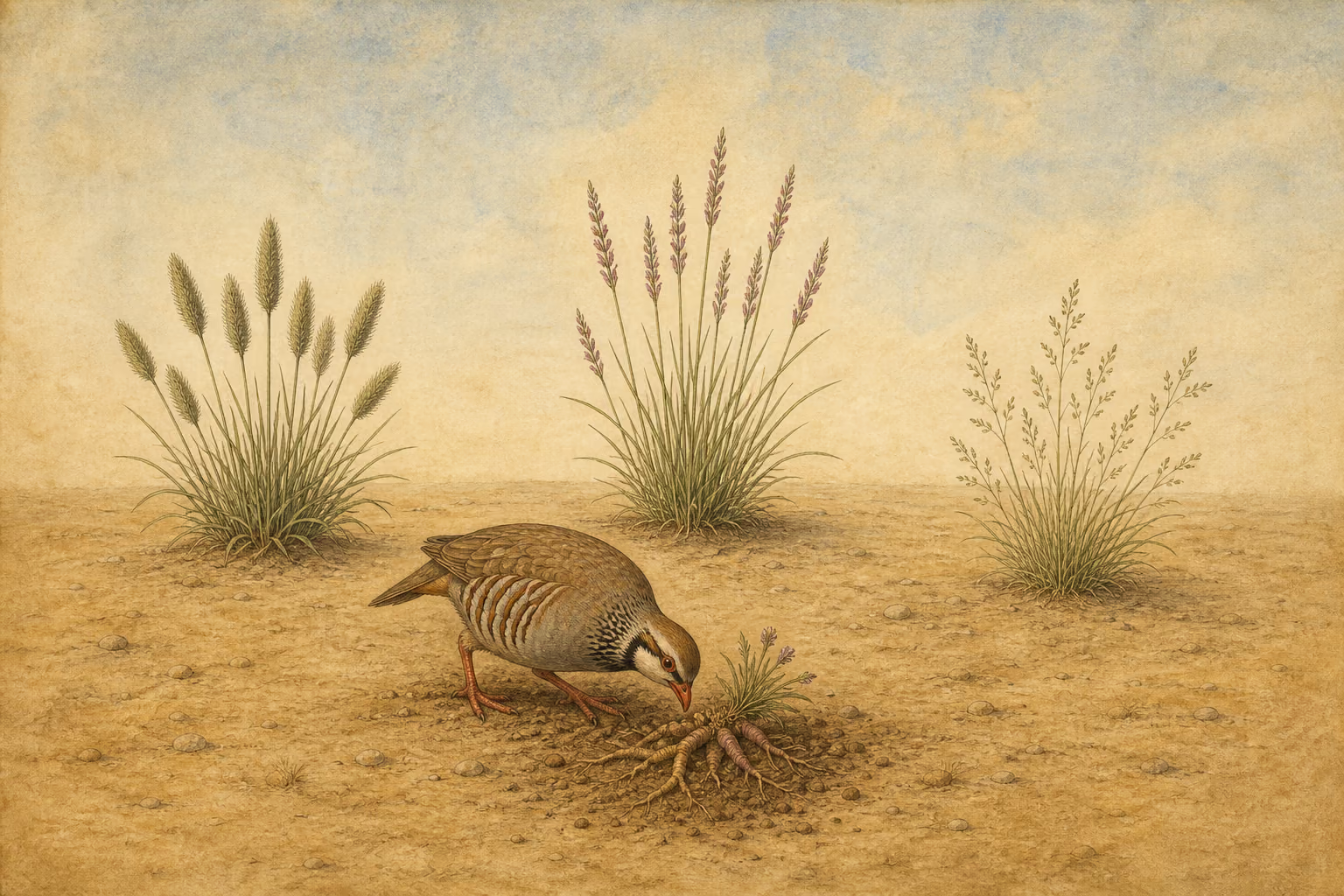
Perdicium et aliae gentes quam Aegyptii edunt. nomen dedit avis id maxime eruens. crassas plurimasque habet radices. item ornithogale caule tenero, candido, semipedali, molli, tribus aut quattuor agnatis, radice bulbosa; coquitur in pulte.
Mirum loton herbam et aegilopa non nisi post annum e semine suo nasci. mira et anthemidis natura, quod a summo florere incipit, cum ceterae omnes, quae particulatim florent, ab ima sui parte incipiant.
Notabile et in lappa, quae adhaerescit, quod in ipsa flos nascitur non evidens, sed intus occultus, et intra se germinat velut animalia, quae in se pariunt. circa Opunteme>st herba etiam homini dulcis, mirumque e folio eius radicem fieri ac sic eam nasci.
Iasine unum folium habet, sed ita implicatum, ut plura videantur. chondrylla amara est et acris in radice suci. amara et aphace et quae picris nominatur, et ipsa toto anno florens; nomen ei amaritudo inposuit.
Notabilis et scillae crocique natura, quod, cum omnes herbae folium primum emittant, mox in caulem rotundentur, in his caulis prior intellegitur quam folium. et in croco quidam flos inpellitur caule, in scilla vero caulis exit, deinde ex eo flos emergit, eademque ter floret, ut diximus, tria tempora arationum ostendens.
Bulborum generi quidam adnumerant et cypiri, hoc est gladioli, radicem. dulcis ea est et quae decocta panem etiam gratiorem faciat ponderosioremque simul subacta. non dissimilis est et quae thesium vocatur, gustu aspera.
Ceterae eiusdem generis folio differunt: asphodelus oblongum et angustum habet, scilla latum et tractabile, gladiolus simile nomini. asphodelus manditur et semine tosto et bulbo, set hoc in cinere tosto, dein sale et oleo addito, praeterea tuso cum ficis, praecipua voluptate, ut videtur Hesiodo. tradunt et ante portas villarum satum remedio esse contra veneficiorum noxiam. asphodeli mentionem et Homerus fecit. radix eius napis modicis similis est, neque alia numerosior LXXX simul acervatis saepe bulbis. Theophrastus et fere Graeci princepsque Pythagoras caulem eius cubitalem et saepe duum cubitorum, foliis porri silvestris, anthericum vocavere, radicem vero, id est bulbos, asphodelum. nostri illud albucum vocant et asphodelum hastulam regiam, caulis acinosi, ac duo genera faciunt. albuco scapus cubitalis, amplus, purus levisque, de quo Mago praecipit exitu mensis Marti et initio Aprilis, cum floruerit, nondum semine eius intumescente, demetendum findendosque scapos et quarto die in solem proferendos, ita siccati manipulos faciendos. idem oiston adicit a Graecis vocari, quam inter ulvas sagittam appellamus. hanc ab idibus Maiis usque in finem Octobris mensis decorticari atque leni sole siccari iubet; idem et gladiolum alterum, quem cypiron vocant, et ipsum palustrem, Iulio mense toto secari iubet ad radicem tertioque die in sole siccari, done candidus fiat, cotidie autem ante solem occidentem in tectum referri, quoniam palustribus desectis nocturni rores noceant.
English · Bostock & Riley 1855–57
Many of these plants, the same as certain among the trees, never lose their leaves, the heliotropium, the adiantum and the polium, for instance.
The eared plants form another variety: among them we find the cynops, the alopecuros, the stelephuros, also known to some persons as the ortyx, and to others as the plantago, of which last we shall have occasion to speak more at length among the medicinal plants, and the thryallis. The alopecuros, among these, has a soft ear and a thick down, not unlike a fox’s tail in fact, to which resemblance it owes its name. The plant most like it is the stelephuros, were it not that it blossoms only a little at a time. In the cichorium and similar plants, the leaves are near the ground, the buds springing from the root just after the rising of the Vergiliæ.
It is not in Egypt only that the perdicium is eaten; it owes its name to the partridge, which bird is extremely fond of digging it up. The roots of it are thick and very numerous: and so, too, with the ornithogale, which has a tender white stalk, and a root half a foot in thickness, bulbous, soft, and provided with three or four other offsets attached to it. It is generally used boiled in pottage.
It is a remarkable thing that the herb lotus and the ægilops never make their appearance above ground till the end of a year after the seed has been sown. The anthemis, too, offers the singular peculiarity that it begins to blossom at the top, while in all the other plants which flower gradually, it is at the lower part that the blossom first makes its appearance.
In the lappa, too, which clings so tenaciously, there is this remarkable peculiarity, that within it there grows a flower, which does not make its appearance, but remains concealed and there produces the seed, like those among the animals which produce within themselves. In the vicinity of Opus there grows a plant which is very pleasant eating to man, and the leaf of which, a most singular thing, gives birth to a root by means of which it reproduces itself.
The iasione has a single leaf only, but that so folded and involved, as to have all the appearance of being several in number. The chondrylla is bitter, and the juice of the root is of an acrid taste. The aphace, too, is bitter, and so is the plant called “picris,” which also remains in flower the whole year through: it is to this bitterness that it is indebted for its name.
The peculiarities also of the squill and saffron deserve remark; for while all other plants put forth their leaves first, and then a round stem, these show the stem before the leaf makes its appearance: in the saffron, however, the blossom is protruded by the stem, but in the squill it is the stem that first makes its appearance, and then the flower emerges from it. This plant blossoms three times in the year, indicating thereby, as previously stated, the three seasons for ploughing.
Some authors reckon among the bulbs the root of the cypiros, or gladiolus; it is a pleasant food, and when boiled and kneaded up with bread, makes it more agreeable to the taste, and at the same time more weighty. Not unlike it in appearance is the plant known to us as the “thesion,” but it is of an acrid flavour.
Other plants of the bulbous kind differ in the leaf: that of the asphodel is long and narrow, that of the squill broad and supple, and the form of that of the gladiolus is bespoken by its name. The asphodel is used as an article of food, the seed of it being parched, and the bulb roasted; this last, however, should be cooked in hot ashes, and then eaten with salt and oil. It is beaten up also with figs, and forms, as Hesiod assures us, a very delicate dish. It is said, too, that the asphodel, planted before the doors of a farm-house, will act as a preservative against the effects of noxious spells.
Homer, too, makes mention of the asphodel. The bulbs of it are like moderately-sized turnips, and there is no plant the root of which has more of them, as many as eighty bulbs being often grouped together. Theophrastus, and nearly all the Greek writers, with Pythagoras at the head of them, have given the name of “anthericos” to its stem, which is one cubit, and often two, in length, the leaves being very similar to those of the wild leek; it is to the root, or in other words, the bulbs, that they have given the name of asphodel. The people of our country call this plant “albucus,” and they give the name of “royal spear” to the asphodel the stem of which bears berries, thus distinguishing two varieties of it. The albucus has a stalk a cubit in length, large, naked, and smooth, in reference to which, Mago recommends that it should be cut at the end of March and the beginning of April, the period at which it blossoms, and before the seed has begun to swell; he says, too, that the stalks should be split, and exposed on the fourth day in the sun, after which, when dry, they should be made up into bundles.
The same author states, also, that the Greeks give the name of “pistana” to the aquatic plant known to us as the “sagitta;” and he recommends that it should be stripped of its bark, and dried in a mild sun, between the ides of May and the end of October. He says, too, that it is usual to cut down to the root, throughout all the month of July, the variety of the gladiolus called “cypiros,” which is a marsh-plant also, and at the end of three days to dry it in the sun, until it turns white; but that care must be taken every day to carry it under cover before sunset, the night dews being very injurious to marsh plants when cut.