LIBER XXI · CAPUT 18
SIX VARIETIES OF THE RUSH: FOUR REMEDIES DERIVED FROM THE CYPIROS
Latine · Mayhoff 1906
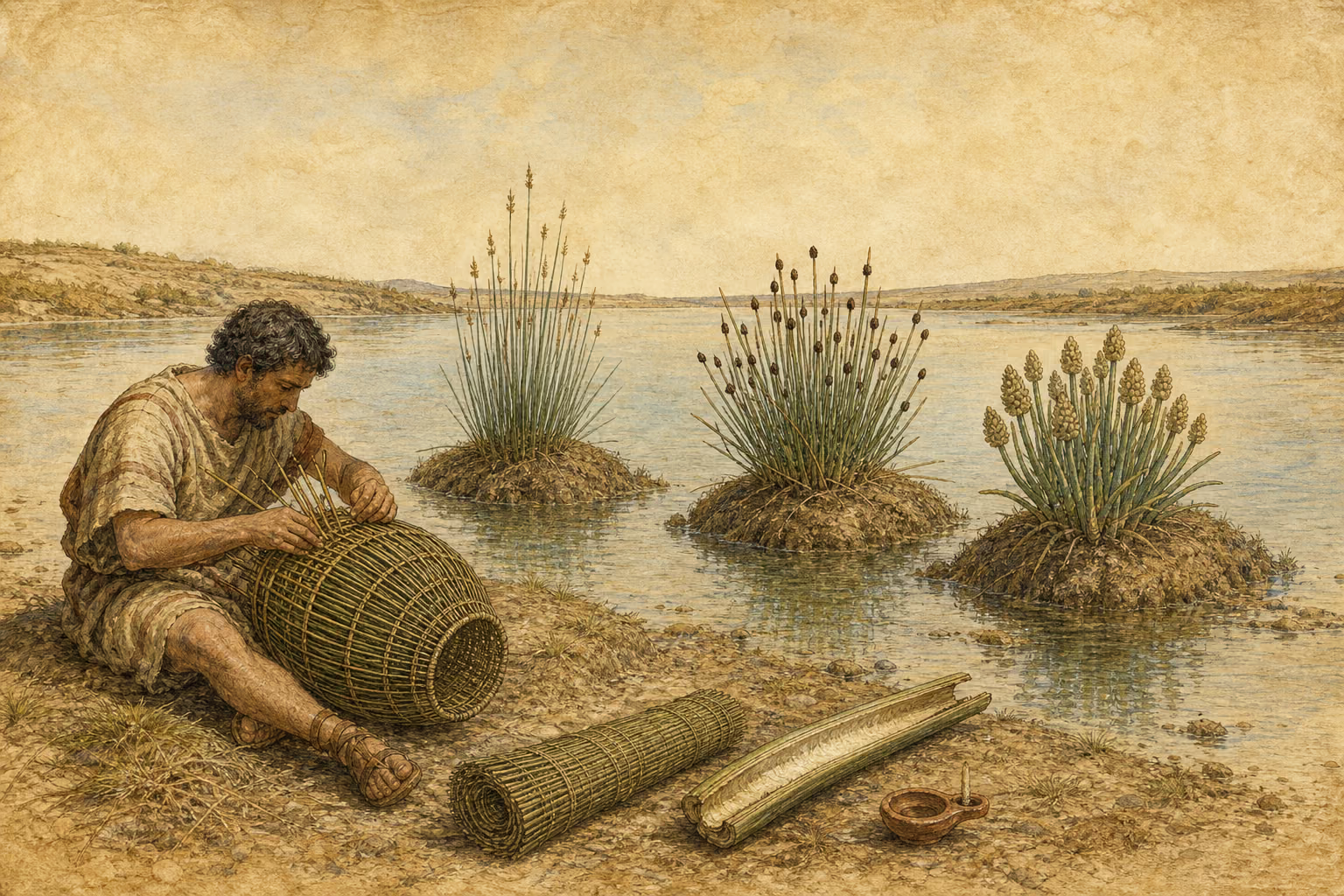
Similia praecipit et de iunco, quem mariscum appellant, ad texendas tegetes et ipsum lunio mense eximi ad Iulium medium praecipiens, cetera desiccando eadem, quae de ulva suo loco diximus. alterum genus iuncorum facit, quod marinum et a Graecis oxyschoenon vocari invenio. tria genera eius: acuti, sterilis, quem marem et oxyn Graeci vocant; reliqua feminini, ferentis semen nigrum: quem melancranim appellant, crassior hic et fruticosior, magisque etiamnum tertius, qui vocatur holoschoenus. ex his melancranis sine aliis generibus nascitur, oxys autem et holoschoenus eodem caespite. utilissimus ad vitilia holoschoenus, quia mollis et carnosus est; fert fructum ovorum cohaerentium modo. nascitur autem et is, quem marem appellavimus, ex semetipso, cacumine in terram defixo, melancranis autem suo semine. alioqui omnium radices omnibus annis intermoriuntur. usus ad nassas marinas, vitilium elegantiam, lucernarum lumina, praecipua medulla, amplitudine iuxta maritimas Alpes tanta, ut inciso ventre inpleant paene unciarum latitudinem, in Aegypto vero cubitorum longitudinem non aliis utiliorem. quidam etiamnum unum genus faciunt iunci trianguli —cyperon vocant—, multi vero non discernunt a cypiro vicinitate nominis. nos distinguemus utrumque.
Cypirus est gladiolus, ut diximus, radice bulbosa, laudatissimus in insulis Creta, dein Naxo et postea in Phoenice. Cretico candor odorque vicinus nardo, Naxio acrior, Phoenicio exiguum spirans, nullus Aegyptio, nam et ibi nascitur. discutit duritias corporum; iam remedia enim dicemus, quoniam et florum odorumque generi est magnus usus in medicina, quod ad cypiron attinet, Apollodorum quidem sequar, qui negat bibendum, quamquam professus efficacissimum esse adversus calculos. os eo fovet. feminis quidem abortus facere non dubitat; mirumque, tradit barbaros suffitum huius herbae excipientes ore lienes consumere et non egredi domibus nisi ab hoc suffitu, vegetiores enim firmioresque sic etiam in die fieri; intertriginum et alarum vitiis perfrictionibusque cum oleo inlitum non dubie mederi.
Cyperos iuncus est, qualiter diximus, angulosus, iuxta terram candidus, cacumine niger pinguisque. folia ima porraceis exiliora, in cacumine minuta, inter quae semen est. radix olivae nigrae similis, quam, cum oblonga est, cyperida vocant, magni in medicina usus. laus cypero prima Hammoniaco, secunda Rhodio, tertia Theraeo, novissima Aegyptio. qui et confudit intellectum, quoniam et cypiros ibi nascitur. sed cypirosradice durissima vixque spirans, cyperis odor et ipsis nardum imitans. est et per se Indica herba, quae cypira vocatur, zingiberis effigie; commanducata croci vim reddit. cypero vis in medicine psilotri. inlinitur pterygiis ulceribusque genitalium et quae in umore sunt omnibus, sicut oris ulceribus. radix adversus serpentium ictus et scorpionum praesentis remedii est. vulvas aperit pota; largiori tanta vis, ut et expellat eas. urinam ciet et calculos, ob id utilissima hydropicis. inlinitur et ulceribus, quae serpunt, sed his praecipua, quae in stomacho sunt, e vino vel aceto inlita.
Iunci radix in tribus heminis aquae decocta ad tertias tussi medetur. semen tostum et in aqua potum sistit alvum et feminarum menses. capitis dolores facit. qui vocatur holoschoenus.... quae proxima sunt radici, commanducantur adversus araneorum morsus. invenio etiamnum unum iunci genus quod Euripicen vocant; huius semine somnum allici, set modum servandum, ne sopor fiat.
Obiter et odorati iunci medicinae dicentur, quoniam et in..... Syria Coele, ut suo loco rettulimus, nascitur. laudatissimus ex Nabataea cognomine teuchitis, proximus Babylonius, pessimus ex Africa ac sine odore. est autem rotundus, vinosae mordacitatis ad linguam; sincerus in confricando odorem rosae emittit rubentibus fragmentis. discutit inflationes, ob id stomacho utilis bilemque reicientibus. singultus sedat, ructus movet, urinam ciet, vesicae medetur. ad muliebres usus decoquitur. opisthotonicis cum resina arida inponitur excalfactoria vi.
Rosa adstringit, refrigerat. usus eius dividitur in folia et flores, capita. foliorum partes, quae sunt candidae, ungues vocantur. in flore aliud est semen, aliud capillus, in capite aliud cortex, aliud calix. folium siccatur aut tribus modis exprimitur: per se, cum ungues non detrahuntur—ibi enim umoris plurimum—, aut cum detractis unguibus reliqua pars aut oleo aut vino maceratur in sole vasis vitreis. quidam et salem admiscent, nonnulli et anchusam aut aspalathum aut iuncum odoratum, quia talis maxime prodest vulvae ac dysintericis. exprimuntur eadem folia detractis unguibus trita per linteum spissum in aereum vas, lenique igni sucus coquitur, donec fiat crassitudo mellis. ad haec eligi oportet odoratissima quaeque folia.
English · Bostock & Riley 1855–57
Mago has likewise given similar recommendations as to the rush known to us as the “mariscus,” and which is so extensively employed for weaving mats. He says that it should be gathered in the month of June, up to the middle of July, and for drying it he gives the same precepts that have been already mentioned, in the appropriate place, when speaking of sedge. He describes a second kind, also, which I find is generally called the “marine” rush, and is known to the Greeks as the “oxyschœnos.”
Generally speaking, there are three varieties of this last rush: the pointed rush, which is barren, and by the Greeks is called the male rush and the “oxys:” the female rush, which bears a black seed, and is called the “melancranis,” thicker and more bushy than the preceding one: and a third kind, called the “holoschœnus,” which is larger still. Of these varieties, the melancranis grows separately from the others, but the oxys and the holoschœnus will grow upon the self-same clod. The holoschœnus is the most useful for all kinds of basket-work, being of a particularly supple and fleshy nature; it bears a fruit, which resembles eggs attached to one another. The rush, again, which we have spoken of as the male rush, is reproduced from itself, the summit of it being bent down into the earth; the melancranis, however, is propagated from seed. Beyond this, the roots of all the varieties of the rush die every year.
The rush is in general use for making kipes for sea-fishing, the more light and elegant kinds of basket-work, and the wicks of lamps, for which last purpose the pith is more particularly employed. In the vicinity of the maritime Alps, the rushes grow to such a vast size, that when split they measure nearly an inch in diameter; while in Egypt, on the other hand, they are so extremely fine, that the people there make sieves of them, for which, indeed, there can be nothing better.
Some authors, again, distinguish another kind of rush, of a triangular shape, to which they give the name of cyperos, though many persons make no distinction between it and the “cypiros,” in consequence of the resemblance of the names; for our own part, however, we shall observe the distinction. The cypiros, as we have already stated, is identical with the gladiolus, a plant with a bulbous root, the most esteemed being those grown in the Isle of Crete, the next best those of Naxos, and the next those of Phœnicia. The cypiros of Crete is white, with an odour strongly resembling that of nard; the produce of Naxos has a more pungent smell, that of Phœnicia but little odour of any kind, and that of Ægypt none at all; for it grows in that country as well.
This plant disperses hard tumours of the body—for we shall here begin to speak of the remedies derived from the various flowers and odoriferous plants, they being, all of them, of very considerable utility in medicine. As to the cypiros, then, I shall follow Apollodorus, who forbids it to be taken in drink, though at the same time he admits that it is extremely useful for calculi of the bladder, and recommends it in fomentations for the face. He entertains no doubt, however, that it is productive of abortion, and he mentions, as a remarkable fact, that the barbarians, by inhaling the fumes of this plant at the mouth, thereby diminish the volume of the spleen. They never go out of the house, he says, till they have inhaled these fumes, through the agency of which they daily become stronger and stronger, and more robust. He states, also, that the cypiros, employed as a liniment with oil, is an undoubted remedy for chafing of the skin, and offensive odours of the arm-pits.
The cyperos, as we have just stated, is a rush of angular shape, white near the ground, and black and solid at the top. The lower leaves are more slender than those of the leek, and those at the top are small, with the seed of the plant lying between them. The root resembles a black olive, and when it is of an oblong shape, the plant is known as the “cyperis,” being employed in medicine to a great extent. The cyperos most highly esteemed is that of the vicinity of the Temple of Jupiter Hammon, the next best being that of Rhodes, the next that of Theræ, and the worst of all that of Egypt, a circumstance which tends greatly to add to the misunderstanding on the subject, as that country produces the cypiros as well: but the cypiros which grows there is extremely hard, and has hardly any smell at all, while all the other varieties of it have an odour strongly resembling that of nard.
There is also an Indian plant, called the “cypira,” of a totally different character, and similar to ginger in appearance; when chewed, it has exactly the flavour of saffron.
The cyperos, employed medicinally, is possessed of certain depilatory properties. It is used in liniments for hang-nails and ulcerous sores of the genitals and of all parts of the body which are of a humid nature, ulcers of the mouth, for instance. The root of it is a very efficacious remedy for the stings of serpents and scorpions. Taken in drink, it removes obstructions of the uterus, but if employed in too large doses, it is liable to cause prolapsus of that organ. It acts also as a diuretic, and expels calculi of the bladder; properties which render it extremely useful in dropsy. It is employed topically, also, for serpiginous ulcers, those of the throat more particularly, being usually applied with wine or vinegar.
The root of the rush, boiled down to one third in three heminæ of water, is a cure for cough; the seed of it, parched and taken in water, arrests looseness of the bowels and the menstrual discharge, though at the same time it causes headache. The name given to this rush is holoschœnus; the parts of it nearest the root are chewed, as a cure for the bites of spiders.
I find mention made, also, of one other kind of rush, the name of which is “euripice;” the seed, they say, is narcotic, but the greatest care is necessary, not to throw the patient into a lethargy.
We will also take this opportunity of mentioning the medicinal properties of the sweet-scented rush, which is found in Cœle-Syria, as already stated by us in the appropriate place. The most esteemed kind, however, is that which grows in the country of the Nabatæi, and is known as the “teuchites;” the next best being the produce of Babylonia, and the very worst that of Africa, which is entirely destitute of smell. This rush is round, and when applied to the tongue, has a pungent, vinous flavour. The genuine kind, when rubbed, gives out an odour like that of the rose, and when broken asunder it is red within. It dispels flatulency, and hence it is very good for the stomach, and for persons when vomiting the bile or blood. It arrests hiccup also, promotes eructations, acts as a diuretic, and is curative of affections of the bladder. A decoction of it is used for female complaints; and in cases of opisthotony, it is applied in plasters with dry resin, these being highly valued for their warming properties.
The rose is of an astringent and refreshing nature. For medicinal purposes the petals, the flowers, and the heads are used. Those portions of the petals which are quite white are known as the unglets. In the flower there is the seed, as distinguished from the filaments, and in the head there is the bud, as well as the calyx. The petals are dried, or else the juice is extracted from them, by one of the three following methods: Either the leaves are employed whole for the purpose, the unglets not being removed—for these are the parts, in fact, that contain the most juice—or else the unglets are first taken off and the residue is then macerated with oil or wine, in glass vessels placed in the sun. Some persons add salt as well, and others alkanet, or else aspalathus or sweet-scented rush; as it is, when thus prepared, a very valuable remedy for diseases of the uterus and for dysentery. According to the third process, the unglets are removed from the petals, and pounded, after which they are subjected to pressure in a coarse linen cloth, the juice being received in a copper vessel; it is then boiled on a slow fire, until it has acquired the consistence of honey; for this purpose, however, the most odoriferous of the petals should be selected.