LIBER XXII · CAPUT 24
PROPOLIS: FIVE REMEDIES
Latine · Mayhoff 1906
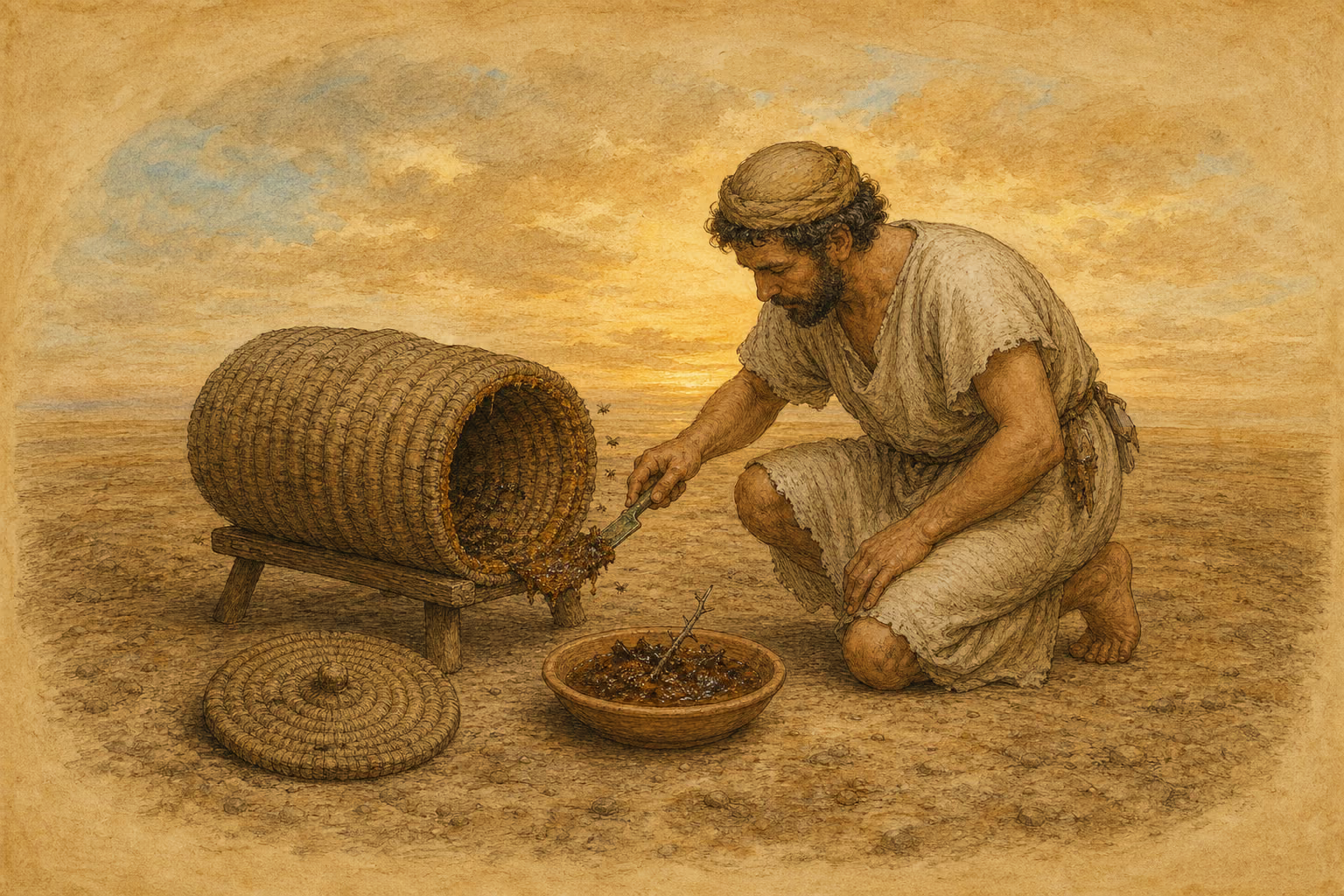
Non esset mellis auctoritas in pretio minor quam laseris, ni ubique nasceretur. illud ipsa fabricata est natura, sed huic gignendo animal, ut diximus, innumeros ad usus, si quotiens misceatur aestimemus. prima propolis alvorum, de qua diximus, aculeos et omnia infixa corpori extrahit, tubera discutit, dura concoquit, dolores nervorum mulcet ulceraque iam desperantia cicatricem cludit. mellis quidem ipsius natura talis est, ut putrescere corpora non sinat. iucundo sapore atque non aspero, alia quam salis natura, faucibus, tonsillis, anginae omnibusque oris desideriis utilissimum arescentique in febribus linguae, iam vero peripneumonicis, pleuriticis decoctum, item vulneribus, a serpente percussis et contra venena, fungos, paralyticis in mulso, quamquam suae mulso dotes constant. mel auribus instillatur cum rosaceo, lendes et foeda capitis animalia necat. usus despumati semper aptior, stomachum tamen inflat, bilem auget, fastidium creat. et oculis per se inutile aliqui arbitrantur; rursus quidam angulos exulceratos melle tangi suadent. mellis causas atque differentias nationesque et indicationem in apium ac deinde florum natura diximus, cum ratio operis dividi cogeret miscenda rursus naturam rerum pernoscere volentibus.
In mellis operibus et aqua mulsa debet tractari. duo genera eius, subitae ac recentis, alterum inveteratae. repentina despumato melle praeclaram utilitatem habet in cibo aegrotantium levi, hoc est alica eluta, viribus recreandis, ore stomachoque mulcendo, ardores refrigerando. frigidam enim dari utilius ventri molliendo. invenio apud auctores, decoctum bibendum alsiosis, item animi humilis et praeparci, quos illi dixere micropsychos. ut est ratio subtilitatis inmensae a Platone descendens, corpusculis rerum levibus scabris, angulosis rotundis, magis aut minus ad aliorum naturam accedentibus, ideo non eadem omnibus amara aut dulcia esse; sic et in lassitudine proniores esse ad iracundiam et in siti. ergo et haec animi asperitas, seu potius animae, dulciore suco mitigatur lenito transitu spiritus et molliore facto meatu, ne scindat euntem redeuntemque. experimenta in se cuique: nullius non ira luctusque, tristitia et omnis animi impetus cibo mollitur, ideoque observanda sunt quae non solum corporum medicinam, sed et morum habent.
Aqua mulsa et tussientibus utilis traditur, calefacta invitat vomitiones, contra venenum psimithii salutaris addito oleo, item contra hyoscyami cum lacte maxime asinino, et contra halicacabi, ut diximus. infunditur et auribus et genitalium fistulae. vulvis inponitur cum pane molli, subitis tumoribus, luxatis leniendisque omnibus. inveteratae usum damnavere posteri, minus innocentem aqua minusque vino firmum; longa tamen vetustate transit in vinum, ut constat inter omnes, stomacho inutilissimum nervisque contrarium.
Semper mulsum ex vetere vino utilissimum, facillimeque cum melle concorporatur, quod in dulci numquam evenit. ex austero factum non inflat stomachum, neque ex decocto melle, minusque implet, quod fere evenit; adpetendi quoque revocat aviditatem cibi. alvum mollit frigido potu, pluribus calido sistit, corpora auget. multi senectam longam mulsi tantum intrita toleravere, neque alio ullo cibo, celebri Pollionis Romili exemplo. centensimum annum excedentem eum divus Augustus hospes interrogavit, quanam maxime ratione vigorem illum animi corporisque custodisset. at ille respondit: intus mulso, foris oleo. Varro regium cognominatum arquatorum morbum tradit, quoniam mulso curetur.
Melitites quo fieret modo ex musto et melle, docuimus in ratione vini. saeculis iam fieri non arbitror hoc genus, inflationibus obnoxium. solebat tamen inveteratum alvi causa dari in febre, item articulario morbo et nervorum infirmitate laborantibus et mulieribus vini abstemiis.
Mellis naturae adnexa cera est, de cuius origine, bonitate, nationibus suis locis diximus. omnis autem mollit, calefacit, explet corpora. recens melior. datur in sorbitione dysintericis, favique ipsi in pulte alicae prius tostae. adversatur lactis naturae, ac milii magnitudine decem grana cerae hausta non patiuntur coagulari lact in stomacho. si inguen tumeat, albam ceram in pube fixisse remedio est.
Nec huius usus, quos mixta aliis praestat, enumerare possit medicina, sicuti nec ceterorum, quae cum aliis prosunt. ista, ut diximus, ingeniis constant. non fecit ceratum, malagmata, emplastra, collyria, antidota parens illa ac divina rerum artifex; officinarum haec, immo verius avaritiae commenta sunt. naturae quidem opera absoluta atque perfecta gignuntur, paucis ex causa, non ex coniectura rebus adsumptis, ut suco aliquo sicca temperentur ad meatus aut corpore alio umnentia ad nexus. scripulatim quidem colligere ac miscere vires non coniecturae humanae opus, sed inpudentiae est. nos nec Indicarum Arabicarumque mercium aut externi orbis adtingimus medicinas. non placent remediis tam longe nascenlia, non nobis gignuntur, immo ne illis quidem; alioqui non venderent. odorum causa unguentorumque et deliciarum, si place, etiam superstitionis gratia emantur, quoniam ture supplicamus et costo. salutem quidem sine istis posse constare, vel ob id probabiimus, ut tanto magis sui delicias pudeat.
Sed medicinas e floribus coronamentisque et hortensiis quaeque mandantur herbae persecuti quonam modo frugum omittimus? Nimirum et has indicare conveniat.
English · Bostock & Riley 1855–57
Honey would be held in no less esteem than laser, were it not for the fact that nearly every country produces it. Laser is the production of Nature herself; but, for the formation of honey, she has created an insect, as already described. The uses to which honey is put are quite innumerable, if we only consider the vast number of compositions in which it forms an ingredient. First of all, there is the propolis, which we find in the hives, as already mentioned. This substance has the property of extracting stings and all foreign bodies from the flesh, dispersing tumours, ripening indurations, allaying pains of the sinews, and cicatrizing ulcers of the most obstinate nature.
As to honey itself, it is of so peculiar a nature, that it prevents putrefaction from supervening, by reason of its sweetness solely, and not any inherent acridity, its natural properties being altogether different from those of salt. It is employed with the greatest success for affections of the throat and tonsils, for quinsy and all ailments of the mouth, as also in fever, when the tongue is parched. Decoctions of it are used also for peripneumony and pleurisy, for wounds inflicted by serpents, and for the poison of fungi. For paralysis, it is prescribed in honied wine, though that liquor also has its own peculiar virtues. Honey is used with rose-oil, as an injection for the ears; it has the effect also of exterminating nits and foul vermin of the head. It is the best plan always to skim it before using it.
Still, however, honey has a tendency to inflate the stomach; it increases the bilious secretions also, produces qualmishness, and, according to some, if employed by itself, is injurious to the sight: though, on the other hand, there are persons who recommend ulcerations at the corners of the eyes to be touched with honey.
As to the elementary principles of honey, the different varieties of it, the countries where it is found, and its characteristic features, we have enlarged upon them on previous occasions: first, when treating of the nature of bees, and secondly, when speaking of that of flowers; the plan of this work compelling us to separate subjects which ought properly to be united, if we would arrive at a thorough knowledge of the operations of Nature.
While speaking of the uses of honey, we ought also to treat of the properties of hydromel. There are two kinds of hydromel, one of which is prepared at the moment, and taken while fresh, the other being kept to ripen. The first, which is made of skimmed honey, is an extremely wholesome beverage for invalids who take nothing but a light diet, such as strained alica for instance: it reinvigorates the body, is soothing to the mouth and stomach, and by its refreshing properties allays feverish heats. I find it stated, too, by some authors, that to relax the bowels it should be taken cold, and that it is particularly well-suited for persons of a chilly temperament, or of a weak and pusillanimous constitution, such as the Greeks, for instance, call “micropsychi.”
For there is a theory, remarkable for its extreme ingenuity, first established by Plato, according to which the primary atoms of bodies, as they happen to be smooth or rough, angular or round, are more or less adapted to the various temperaments of individuals: and hence it is, that the same substances are not universally sweet or bitter to all. So, when affected with lassitude or thirst, we are more prone to anger than at other times. These asperities, however, of the disposition, or rather I should say of the mind, are capable of being modified by the sweeter beverages; as they tend to lubricate the passages for the respiration, and to mollify the channels, the work of inhalation and exhalation being thereby unimpeded by any rigidities. Every person must be sensible of this experimentally, in his own case: there is no one in whom anger, affliction, sadness, and all the emotions of the mind may not, in some degree, be modified by diet. It will therefore be worth our while to observe what aliments they are which exercise a physical effect, not only upon the body, but the disposition as well.
Hydromel is recommended, too, as very good for a cough: taken warm, it promotes vomiting. With the addition of oil it counteracts the poison of white lead; of henbane, also, and of the halicacabum, as already stated, if taken in milk, asses’ milk in particular. It is used as an injection for diseases of the ears, and in cases of fistula of the generative organs. With crumb of bread it is applied as a poultice to the uterus, as also to tumours suddenly formed, sprains, and all affections which require soothing applications. The more recent writers have condemned the use of fermented hydromel, as being not so harmless as water, and less strengthening than wine. After it has been kept a considerable time, it becomes transformed into a wine, which, it is universally agreed, is extremely prejudicial to the stomach, and injurious to the nerves.
As to honied wine, that is always the best which has been made with old wine: honey, too, incorporates with it very readily, which is never the case with sweet wine. When made with astringent wine, it does not clog the stomach, nor has it that effect when the honey has been boiled: in this last case, too, it causes less flatulency, an inconvenience generally incidental to this beverage. It acts as a stimulant also upon a failing appetite; taken cold it relaxes the bowels, but used warm it acts astringently, in most cases, at least. It has a tendency also to make flesh. Many persons have attained an extreme old age, by taking bread soaked in honied wine, and no other diet—the famous instance of Pollio Romilius, for example. This man was more than one hundred years old when the late Emperor Augustus, who was then his host, asked him by what means in particular he had retained such remarkable vigour of mind and body.—“Honied wine within, oil without,” was his answer. According to Varro, the jaundice has the name of “royal disease” given to it, because its cure is effected with honied wine.
We have already described how melitites is prepared, of must and honey, when speaking on the subject of wines. It is, I think, some ages, however, since this kind of beverage was made, so extremely productive as it was found to be of flatulency. It used, however, to be given in fever, to relieve inveterate costiveness of the bowels, as also for gout and affections of the sinews. It was prescribed also for females who were not in the habit of taking wine.
To an account of honey, that of wax is naturally appended, of the origin, qualities, and different kinds of which, we have previously made mention on the appropriate occasions. Every kind of wax is emollient and warming, and tends to the formation of new flesh; fresh wax is, however, the best. It is given in broth to persons troubled with dysentery, and the combs themselves are sometimes used in a pottage made of parched alica. Wax counteracts the bad effects of milk; and ten pills of wax, the size of a grain of millet, will prevent milk from coagulating in the stomach. For swellings in the groin, it is found beneficial to apply a plaster of white wax to the pubes.
As to the different uses to which wax is applied, in combination with other substances in medicine, we could no more make an enumeration of them than we could of all the other ingredients which form part of our medicinal compositions. These preparations, as we have already observed, are the results of human invention. Cerates, poultices, plasters, eye-salves, antidotes,—none of these have been formed by Nature, that parent and divine framer of the universe; they are merely the inventions of the laboratory, or rather, to say the truth, of human avarice. The works of Nature are brought into existence complete and perfect in every respect, her ingredients being but few in number, selected as they are from a due appreciation of cause and effect, and not from mere guesswork; thus, for instance, if a dry substance is wanted to assume a liquefied form, a liquid, of course, must be employed as a vehicle, while liquids, on the other hand, must be united with a dry substance to render them consistent. But as for man, when he pretends, with balance in hand, to unite and combine the various elementary substances, he employs himself not merely upon guesswork, but proves himself guilty of downright impudence.
It is not my intention to touch upon the medicaments afforded by the drugs of India, or Arabia and other foreign climates: I have no liking for drugs that come from so great a distance; they are not produced for us, no, nor yet for the natives of those countries, or else they would not be so ready to sell them to us. Let people buy them if they please, as ingredients in perfumes, unguents, and other appliances of luxury; let them buy them as adjuncts to their superstitions even, if incense and costus we must have to propitiate the gods; but as to health, we can enjoy that blessing without their assistance, as we can easily prove—the greater reason then has luxury to blush at its excesses.
Having now described the remedies derived from flowers, both those which enter into the composition of garlands, and the ordinary garden ones, as well as from the vegetable productions, how could we possibly omit those which are derived from the cereals?