LIBER XXII · CAPUT 6
THE ONLY CENTURION THAT HAS BEEN THUS HONOURED
Latine · Mayhoff 1906
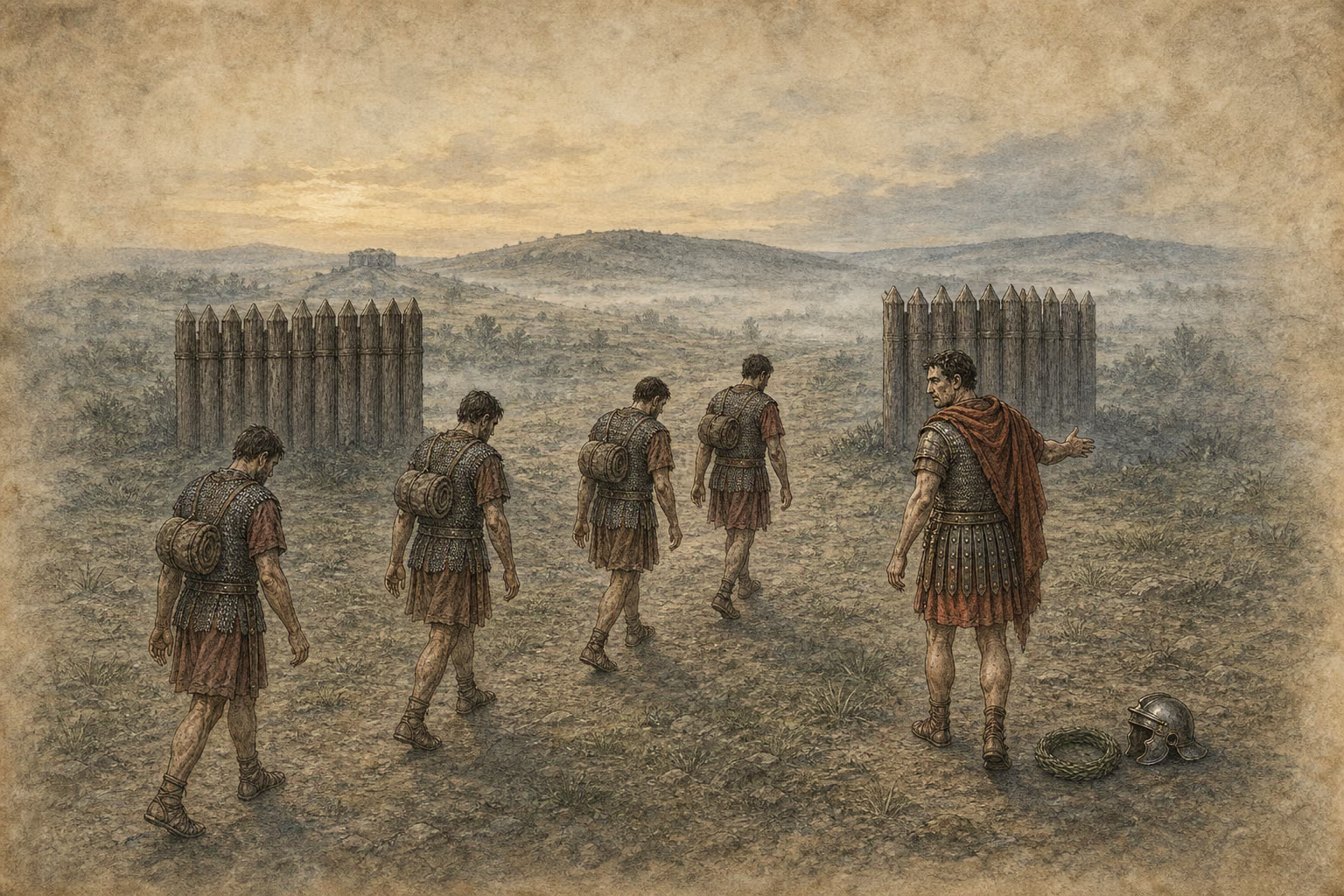
Praeter hos contigit eius coronae honos M. Calpurnio Flammae tribuno militum in Sicilia, centurioni vero uni ad hoc tempus Cn. Petreio Atinati Cimbrico bello. primum pilum is capessens sub Catulo exclusam ab hoste legionem suam hortatus tribunum suum dubitantem per castra hostium erumpere interfecit legionemque eduxit. invenio apud auctores eundem praeter hunc honorem adstantibus Mario et Catulo cos. praetextatum immolasse ad tibicinem foculo posito. scripsit et Sulla dictator ab exercitu se quoque donatum apud Nolam legatum bello Marsico, idque etiam in villa sua Tusculana, quae fuit postea Ciceronis, pinxit. quod si verum est, hoc exsecrabiliorem eum dixerim, quandoquidem eam capiti suo proscriptione sua ipse detraxit, tanto paucioribus civium servatis quam postea occisis. addat etiamnum huic gloriae superbum cognomen Felicem, ipse tamen obsessis in toto orbe proscriptis hac corona Sertorio cessit. Aemilianum quoque Scipionem Varro auctor est donatum obsidionali in Africa Manilio consule, III cohortibus servatis totidemque ad servandas eas eductis, quod et statuae eius in foro suo divus Augustus inscripsit. ipsum Augustum M. Cicerone filio consule idibus Septembribus senatus obsidionali donavit; adeo civica non satis videbatur. nec praeterea quemquam invenimus donatum.
Nullae ergo herbae fuere certae in hoc honore, sed quaecumque fuerant in periculi sede, quamvis ignobiles ignotaeque, honored nobilem faciebant, quod latere apud nos minus quidem miror cernens neglegi ea quoque, quae ad valitudinem conservandam cruciatusque corporis propulsandos et mortem arcendam pertinent. sed quis non mores iure castiget? addidere vivendi pretia deliciae luxusque; numquam fuit vitae cupido maior nec minor cura. aliorum hanc operae esse credimus ac ne mandato quidem nostro alios id agere, medicisque provisum esse pro morbis. ipsi fruimur voluptatibus et, quo nihil equidem probrosius duco, vivimus aliena fiducia. immo vero plerisque ultro etiam inrisui sumus ista commentantes atque frivoli operis arguimur, magno quamquam inmensi laboris solatio, sperni cum rerum natura, quam certe non defuisse nobis docebimus et invisis quoque herbis inseruisse remedia, quippe cum medicinas dederit etiam aculeatis. haec enim proxime restant ex iis, quas priore libro nominavimus, in quibus ipsis providentiam naturae satis mirari amplectique non est. dederat quas diximus molles cibisque gratas, pinxerat remedia in floribus visuque ipso animos invitaverat etiam deliciis auxilia permiscens:en, excogitavit aliquas aspectu hispidas, tactu truces, ut tantum non vocem ipsius fingentis illas rationemque reddentis exaudire videamur, ne scilicet depascat avida quadripes, ne procaces manus rapiant, ne neglecta vestigia obterant, ne insidens ales infringat, iis muniendo aculeis telisque armando, remediis ut tuta ac salva sint. ita hoc quoque, quod in iis odimus, hominum causa excogitatum est.
English · Bostock & Riley 1855–57
In addition to the persons already mentioned, the honour of this crown has been awarded to M. Calpurnius Flamma, then a military tribune in Sicily; but up to the present time it has been given to a single centurion only, Cneius Petreius Atinas, during the war with the Cimbri. This soldier, while acting as primipilus under Catulus, on finding all retreat for his legion cut off by the enemy, harangued the troops, and after slaying his tribune who hesitated to cut a way through the encampment of the enemy, brought away the legion in safety. I find it stated also by some authors, that, in addition to this honour, this same Petreius, clad in the prætexta, offered sacrifice at the altar, to the sound of the pipe, in presence of the then consuls, Marius and Catulus.
The Dictator Sylla has also stated in his memoirs, that when legatus in the Marsic War he was presented with this crown by the army, at Nola; an event which he caused to be commemorated in a painting at his Tusculan villa, which afterwards became the property of Cicero. If there is any truth in this statement, I can only say that it renders his memory all the more execrable, and that, by his proscriptions, with his own hand he tore this crown from his brow, for few indeed were the citizens whom he thus preserved, in comparison with those he slaughtered at a later period. And let him even add to this high honour his proud surname of “Felix,” if he will; all the glories of this crown he surrendered to Sertorius, from the moment that he put his proscribed fellow-citizens in a stage of siege throughout the whole world.
Varro, too, relates that Scipio Æmilianus was awarded the obsidional crown in Africa, under the consul Manilius, for the preservation of three cohorts, by bringing as many to their rescue; an event commemorated by an inscription upon the base of the statue erected in honour of him by the now deified Emperor Augustus, in the Forum which bears his name. Augustus himself was also presented by the senate with the obsidional crown, upon the ides of September, in the consulship of M. Cicero the Younger, the civic crown being looked upon as not commensurate with his deserts. Beyond these, I do not find any one mentioned as having been rewarded with this honour.
No plant in particular was employed in the composition of this crown, such only being used as were found growing on the spot so imperilled; and thus did they become the means, however humble and unnoted themselves, of conferring high honour and renown. All this, however, is but little known among us at the present day; a fact which I am the less surprised at, when I reflect that those plants even are treated with the same indifference, the purpose of which it is to preserve our health, to allay our bodily pains, and to repel the advances of death! And who is there that would not visit with censure, and justly visit, the manners of the present day? Luxury and effeminacy have augmented the price at which we live, and never was life more hankered after, or worse cared for, than it is at present. This, however, we look upon as the business of others, forsooth; other persons must see to it, without our troubling ourselves to request them, and the physicians must exercise the necessary providence in our behalves. As for ourselves, we go on enjoying our pleasures, and are content to live—a thing that in my opinion reflects the highest possible disgrace—by putting faith in others.
Nay, even more than this, we ourselves are held in derision by many, for undertaking these researches, and are charged with busying ourselves with mere frivolities! It is some solace, however, in the prosecution of these our boundless labours, to have Nature as our sharer in this contempt: Nature who, as we will prove beyond a doubt, has never failed in coming to the assistance of man, and has implanted remedies for our use in the most despised even of the vegetable productions, medicaments in plants which repel us with their thorns.
It is of these, in fact, that it remains for us now to speak, as next in succession to those which we have mentioned in the preceding Book; and here we cannot sufficiently admire, and, indeed, adore, the wondrous providence displayed by Nature. She had given us, as already shewn, plants soft to the touch, and agreeable to the palate; in the flowers she had painted the remedies for our diseases with her varied tints, and, while commingling the useful with the delicious, had attracted our attention by means of the pleasures of the eye. Here, however, she has devised another class of plants, bristling and repulsive to the sight, and dangerous to the touch; so much so, indeed, that we fancy we all but hear the voice of her who made them as she reveals to us her motives for so doing. It is her wish, she says, that no ravening cattle may browse upon them, that no wanton hand may tear them up, that no heedless footstep may tread them down, that no bird, perching there, may break them: and in thus fortifying them with thorns, and arming them with weapons, it has been her grand object to save and protect the remedies which they afford to man. Thus we see, the very qualities even which we hold in such aversion, have been devised by Nature for the benefit and advantage of mankind.