LIBER XXIII · CAPUT 4
THE LEAVES OF THE WILD OLIVE: SIXTEEN REMEDIES
Latine · Mayhoff 1906
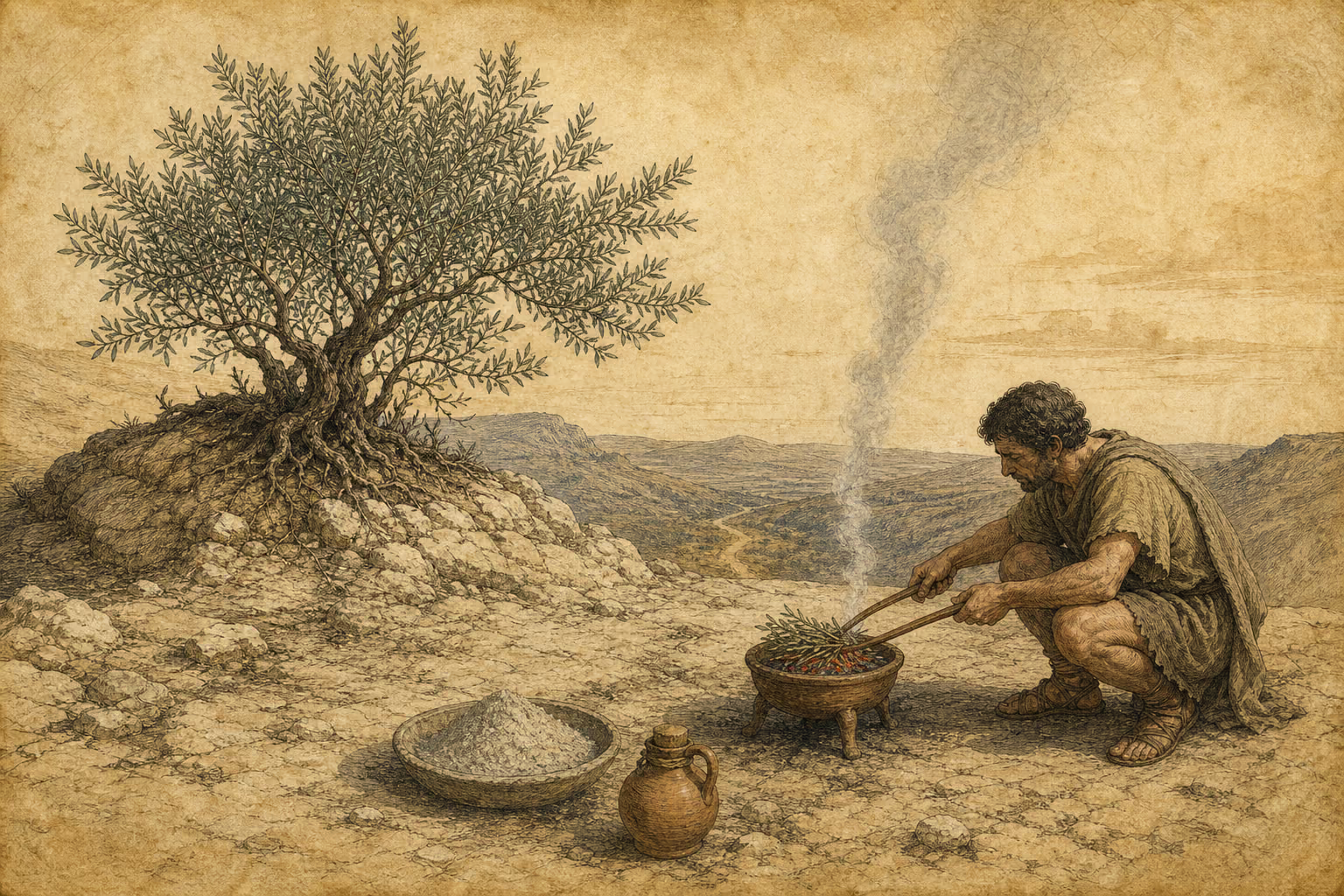
Oleastri foliorum eadem natura. spodium e cauliculis vehementius inhibet rheumatismos. sedat et inflammationes oculorum, purgat ulcera alienata et explet, excrescentia leniter erodit siccatque et ad cicatricem perducit. cetera ut in oleis, peculiare autem, quod folia decocuntur ex melle et dantur coclearibus III contra sanguinis excreationes. oleum tantum acrius efficaciusque, et ideo os quoque colluitur illo ad firmitatem dentium. inponuntur folia et paronychiis et carbunculis et contra omnem collectionem cum vino, iis vero, quae purganda sint, cum melle. miscentur oculorum medicamentis decoctum foliorum et sucus oleastri. utiliter et auribus instillatur cum melle vel si pus effluat. fore oleastri condylomata inlinuntur et epinyctides, item cum farina hordeacia venter in rheumatismo, cum oleo capitis dolores. cutem in capite ab ossibus recedentem cauliculi decocti et cum melle inpositi conprimunt. ex oleastro maturi in cibo sumpti sistunt alvum, tosti autem et cum melle triti nomas repurgant, carbunculos rumpunt.
Olei naturam causasque abunde diximus. ad medicinam ex olei generibus haec pertinent, utilissimum esse omphacium, proxime viride, praeterea quam maxime recens—nisi cum vetustissimum quaeritur—, tenue, odoratum quodque non mordeat, e diverso quam cibis eligitur. omphacium prodest gingivis, si contineatur in ore, et colorem dentium custodit motusque stabilit. sudores cohibet. oenanthino idem effectus qui rosaceo. omni autem oleo mollitur corpus, vigorem et robur accipit. stomacho contrarium, auget et ulcerum incrementa. fauces exasperat et venena omnia hebetat, praecipue psimithi et gypsi, in aqua mulsa aut ficorum siccarum decocto potum contra meconium, ex aqua contra cantharidas, buprestim, salamandras, pityocampas, per se potum redditumque vomitionibus contra omnia supra dicta. lassitudinum et perfrictionum refectio est. tormina calidum potum cyathis VI magisque ruta simul decocta pellit, item ventris animalia. solvit alvum heminae mensura cum vino et calida aqua potum aut tisanae suco, vulnerariis emplastris utile faciem purgat. bubus infusum per nares, donec ructent, inflationem sedat. vetus autem magis excalfacit corpora magisque discutit sudores, duritias magis diffundit, lethargicis auxiliare et inclinato morbo. oculorum claritati confert aliquid cum pari portione mellis acapni. capitis doloribus remedium est, item ardoribus in febri cum aqua. si vetusti non sit occasio, decoquitur, ut vetustatem repraesentet.
Oleum cicinum bibitur ad purgationes ventris cum pari caldae mensura. privatim dicitur purgare praecordia. prodest et articulorum morbis, duritiis omnibus, vulvis, auribus, ambustis, cum cinere vero muricum sedis inflammationibus, item psorae. colorem cutis commendat capillumque fertili natura evocat. semen, ex quo fit, nulla animans attingit. ellychnia ex uva fiunt claritatis praecipuae, ex oleo lumen obscurum propter nimiam pinguitudinem. folia igni sacro inlinuntur ex aceto, per se autem recentia mammis et epiphoris, eadem decocta in vino inflammationibus cum polenta, croco; per se autem triduo inposita faciem purgant.
Oleum amygdalinum purgat, mollit corpora, cutem erugat, nitorem commendat, varos cum melle tollit e facie. prodest et auribus cum rosaceo aut melle et mali punici tegmine decoctum vermiculosque in his necat et gravitatem auditus discutit, sonos incertos et tinnitus, obiter capitis dolores et oculorum. medetur furunculis et a sole ustis cum cera. ulcera manantia et furfures cum vino expurgat, condylomata cum meliloto; per se vero capiti inlitum somnum adlicit.
Oleum laurinum utilius, quo recentius quoque viridius colore. vis eius excalfactoria, et ideo paralyticis, spasticis, ischiadicis, suggillatis, capitis doloribus, inveteratis destillationibus, auribus in calyce punici calfactum inlinitur.
Similis et myrtei olei ratio. adstringit, indurat. medetur gingivis, dentium dolori, dysinteriae, volvae exulceratae, vesicis, ulceribus vetustis vel manantibus cum squama aeris et cera, item eruptionibus, ambustis. adtrita sanat et furfures, rhagadas, condylomata, articulos luxatos, odorem gravem corporis. adversatur cantharidi, bupresti aliisque malis medicamentis, quae exulcerando nocent.
Chamaemyrsinae sive oxymyrsinae eadem natura. —Cupressinum oleum eosdem effectus habet quos myrteum, item citreum.—E nuce vero iuglande, quod caryinum appellavimus, alopeciis utile est et tarditati aurium infusum, item capitis dolori inlitum, cetero iners et gravi sapore. enimvero si quid in nucleo putridi fuerit, totus modius deperit. —Ex Cnidio grano factum eandem vim habet quam cicinum.—E lentisco factum utilissimum acopo est idemque proficeret quod rosaceum, ni durius paulo intellegeretur. utuntur eo et contra nimios sudores papulasque sudorum. scabiem iumentorum efficacissime sanat.—Balaninum oleum repurgat varos, furunculos, lentigines, gingivas.
Cypros qualis esset et quemadmodum ex ea fieret oleum docuimus. natura eius excalfacit, emollit nervos. folia stomacho inlinuntur et vulvae concitatae, sucus quoque eorum adponitur. folia recentia commanducata ulceribus in capite manantibus, item oris medentur et collectionibus, condylomatis. decoctum foliorum ambustis et luxatis prodest. ipsa rufant capillum tusa adiecto struthei mali suco. flos capitis dolores sedat cum aceto inlitus, item combustus in cruda olla nomas sanat et putrescentia ulcera per se vel cum melle. odor floris oleique somnum facit. —Adstringit gleucinum et refrigerat eadem ratione qua oenanthinum.
Balsaminum longe pretiosissimum omnium, ut in unguentis diximus, contra omnes serpentes efficax, oculorum claritati plurimum confert, caliginem discutit, item dyspnoeas, collectiones omnes duritiasque lenit. sanguinem densari prohibet, ulcera purgat, auribus, capitis doloribus, tremulis, spasticis, ruptis perquam utile. adversatur aconito ex lacte potum, febres cum horrore venientes perunctis leviores facit. utendum tamen modico, quoniam adurit augetque vitia non servato temperamento.
Malobathri quoque naturam et genera exposuimus. urinam ciet, oculorum epiphoris in vino expressum utilissime inponitur, item frontibus dormire volentibus, efficacius, si et nares inlinantur aut si ex aqua bibatur. oris et halitus suavitatem commendat linguae subditum folium, sicut et vestium odorem interpositum.
Hyoscyaminum emolliendo utile est, nervis inutile. potum quidem cerebri motus facit.—Therminum e lupinis emollit, proximum rosaceo effectu.—Narcissinum dictum est cum suo flore.—Raphaninum phthiriasis longa valitudine contractas tollit scabritiasque cutis in facie emendat. —Sesaminum aurium dolores sanat et ulcera, quae serpunt, et quae cacoēthe vocant.—Lilinum, quod et syrium vocavimus, renibus utilissimum est sudoribusque evocandis, vulvae molliendae concoquendisque intus. —Selgiticum nervis utile esse diximus, sicut herbacium quoque, quod Iguvini circa Flaminiam viam vendunt.
Elaeomeli, quod in Syria ex ipsis oleis manare diximus, sapore melleo, non sine nausea alvum solvit, bilem praecipue detrahit II cyathis in bemina aquae datis; qui bibere, torpescunt excitanturque crebro. potores certaturi praesumunt ex eo cyathum unum.—Pissino oleo usus ad tussim et quadripedum scabiem est.
A vitibus oleisque proxima nobilitas palmis. inebriant recentes, capitis dolorem adferunt minus siccae, nec, quantum videtur, utiles stomacho. tussim exasperant, corpus alunt. sucum decoctarum antiqui pro hydromelite dabant aegris ad vires recreandas, sitim sedandam, in quo usu praeferebant Thebaicas, sanguinem quoque excreantibus utiles, in cibo maxime. inlinuntur caryotae stomacho, vesicae, ventri, intestinis cum cotoneis et cera et croco. suggillata emendant. nuclei palmarum cremati in fictili novo cinere loto spodi vicem efficiunt miscenturque collyriis et calliblephara faciunt addito nardo.
English · Bostock & Riley 1855–57
The leaves of the wild olive are possessed of similar properties. The spodium that is made by burning the young branches is of remarkable efficacy for arresting fluxes; it allays inflammations of the eyes also, acts as a detergent upon ulcerous sores, makes the flesh grow on wounds from which it has been removed, and acts gently as a caustic upon fleshy excrescences, drying them up and making them cicatrize. The rest of its properties are similar to those of the cultivated olive. There is, however, one peculiarity in it; the leaves, boiled with honey, are given in doses of a spoonful for spitting of blood. The oil, too, of the wild olive is more acrid, and possesses greater energy than that of the cultivated olive; hence it is that it is usual to rinse the mouth with it for the purpose of strengthening the teeth.
The leaves, too, are applied topically, with wine, to whitlows, carbuncles, and all kinds of gatherings; and, with honey, to sores which require a detergent. Both a decoction of the leaves and the natural juices of the wild olive form ingredients in medicaments for the eyes; and the latter are found useful as an injection for the ears, in the case of purulent discharges even. From the blossom of the wild olive a liniment is prepared for condylomata and epinyctis: it is applied also to the abdomen, with barley-meal, for fluxes, and to the head, with oil, for head-ache. In cases where the scalp becomes detached from the cranium, the young branches, boiled and applied with honey, have a healing effect. These branches, too, when arrived at maturity, taken with the food, arrest diarrhœa: parched and beaten up with honey, they act as a detergent upon corroding sores, and bring carbuncles to a head and dispers them.
As to olive oil, we have abundantly treated of its nature and elements already. It now remains to speak of the medicinal properties of the various kinds of oil. The most useful of all is omphacium, and next to that, green oil; in addition to which, we may remark that oil ought to be as fresh as possible, except in cases where old oil is absolutely required. For medicinal purposes, too, oil should be extremely fluid, have an agreeable smell, and be free from all taste, just the converse, in fact, of the property which we look for in food. Omphacium is good for the gums, and if kept from time to time in the mouth, there is nothing better as a preservative of the whiteness of the teeth. It checks profuse perspirations.
Oil of œnanthe has just the same properties as oil of roses. Like oil in general, it makes the body supple, and imparts to it strength and vigour; it is injurious to the stomach, promotes the increase of ulcers, irritates the fauces, and deadens the effect of all poisons, white-lead and gypsum in particular, if taken in hydromel or a decoction of dried figs. Taken with water, it is good as an antidote to the effects of opium, and to injuries inflicted by cantharides, the buprestis, the salamandra, and the pine caterpillar. Taken pure as an emetic, it is highly esteemed as an antidote in all the before-mentioned cases. It is also a refreshing remedy for extreme lassitude, and for fits of shivering from cold. Taken warm, in doses of six cyathi, and more particularly when boiled with rue, it relieves gripings of the stomach and expels intestinal worms, Taken in doses of one hemina with wine and warm water, or else with barley water, it acts as a purgative upon the bowels. It is useful, also, in the composition of plasters for wounds, and it cleanses the complexion of the face. Injected into the nostrils of oxen, till it produces eructation, it cures attacks of flatulency.
When old it is of a more warming nature than when new, and acts more energetically as a sudorific, and as a resolvent for indurations. It is very efficacious in cases of lethargy, and more particularly in the decline of the disease. Mixed with an equal proportion of honey which has not been smoked, it contributes in some degree to the improvement of the sight. It is a remedy, also for head-ache; and, in combination with water, for the burning attacks in fevers. If old oil should happen not to be at hand, the new oil is boiled to act as a substitute for it.
Castor oil, taken with an equal quantity of warm water, acts as a purgative upon the bowels. It is said, too, that as a purgative this oil acts more particularly upon the regions of the diaphragm. It is very useful for diseases of the joints, all kinds of indurations, affections of the uterus and ears, and for burns: employed with the ashes of the murex, it heals itch-scabs and inflammations of the fundament. It improves the complexion also, and by its fertilizing tendencies promotes the growth of the hair. The cicus, or seed from which this oil is made, no animal will touch; and from these grape-like seeds wicks are made, which burn with a peculiar brilliancy; the light, however, that is produced by the oil is very dim, in consequence of its extreme thickness. The leaves are applied topically with vinegar for erysipelas, and fresh-gathered, they are used by themselves for diseases of the mamillæ and defluxions; a decoction of them in wine, with polenta and saffron, is good for inflammations of various kinds. Boiled by themselves, and applied to the face for three successive days, they improve the complexion.
Oil of almonds is of a purgative and emollient nature; it effaces wrinkles on the skin, improves the complexion, and, in combination with honey, removes spots on the face. A decoction of it with oil of roses, honey, and pomegranate rind, is good for the ears, and exterminates the small worms that breed there; it has the effect also, of dispelling hardness of hearing, recurrent tinglings and singing in the ears, and is curative of head-ache and pains in the eyes. Used with wax, it cures boils, and scorches by exposure to the sun; in combination with wine it heals running ulcers and scaly eruptions, and with melilote, condylomatous swellings. Applied by itself to the head, it invites sleep.
As to oil of laurel, the fresher and greener it is, the more valuable are its properties. It is of a heating nature, and is consequently applied, warm, in a pomegranate rind, for paralysis, spasms, sciatica, bruises, head-ache, catarrhs of long standing, and diseases of the ears.
Oil of myrtle has similar properties. It is of an astringent and indurative nature; mixed with the scoria of copper, and wax, it cures diseases of the gums, tooth-ache, dysentery, ulcerations of the uterus, affections of the bladder, inveterate or running ulcers, eruptions, and burns. It exercises a healing effect also, upon excoriations, scaly eruptions, chaps, condylomata, and sprains, and it neutralizes offensive odours of the body. This oil is an antidote to cantharides, the buprestis, and other dangerous poisons of a corrosive nature.
Oil of chamæmyrsine, or oxymyrsine, possesses similar properties. Oil of cypress also, produces the same effects as oil of myrtle, and the same as to oil of citrus. Oil of walnuts, which we have previously mentioned as being called “caryinon,” is good for alopecy, and is injected into the ears for the cure of hardness of hearing. Used as a liniment, it relieves head-ache; but in other respects it is of an inert nature and disagreeable taste; indeed, if part only of one of the kernels should happen to be decayed, the whole making is spoilt. The oil extracted from the grain of Cnidos has similar properties to castor oil. Oil of mastich is very useful as an ingredient in the medicinal preparation known as “acopum;” indeed it would be fully as efficacious as oil of roses, were it not found to be somewhat too styptic in its effects. It is employed in cases of too profuse perspiration, and for the cure of pimples produced thereby. It is extremely efficacious also for itch in beasts of burden. Oil of balanus removes spots on the skin, boils, freckles, and maladies of the gums.
We have already enlarged upon the nature of the cyprus, and the method of preparing oil of cyprus. This oil is naturally warming, and relaxes the sinews. The leaves of the tree are used as an application to the stomach, and the juice of them is applied in a pessary for irritations of the uterus. Fresh gathered and chewed, the leaves are applied to running ulcers of the head, ulcerations of the mouth, gatherings, and condylomatous sores. A decoction of the leaves is very useful also for burns and sprains. Beaten up and applied with the juice of the strutheum, they turn the hair red. The blossoms, applied to the head with vinegar, relieve head-ache, and the ashes of them, burnt in a pot of raw earth, are curative of corrosive sores and putrid ulcers, either employed by themselves, or in combination with honey. The odour exhaled by these blossoms induces sleep.
The oil called “gleucinum” has certain astringent and refreshing properties similar to those of oil of œnanthe.
The oil of balsamum is by far the most valuable of them all, as already stated by us, when treating of the unguents. It is extremely efficacious for the venom of all kinds of serpents, is very beneficial to the eyesight, disperses films upon the eyes, assuages hardness of breathing, and acts emolliently upon all kinds of gatherings and indurations. It has the effect, also, of preventing the blood from coagulating, acts as a detergent upon ulcers, and is remarkably beneficial for diseases of the ears, head-ache, trembling, spasms, and ruptures. Taken in milk, it is an antidote to the poison of aconite, and used as a liniment upon the access of the shivering fits in fevers, it modifies their violence. Still, however, it should be used but sparingly, as it is of a very caustic nature, and, if not employed in moderation, is apt to augment the malady.
We have already spoken, also, of the nature of malobathrum, and the various kinds of it. It acts as a diuretic, and, sprinkled in wine upon the eyes, it is used very advantageously for defluxions of those organs. It is applied also to the forehead, for the purpose of promoting sleep; but it acts with still greater efficacy, if the nostrils are rubbed with it, or if it is taken in water. The leaves, placed beneath the tongue, impart a sweetness to the mouth and breath, and put among clothes, they produce a similar effect.
Oil of henbane is of an emollient nature, but it is bad for the nerves; taken in drink, it disturbs the brain. Therminum, or oil of lupines, is emollient, and very similar to oil of roses in its effects. As to oil of narcissus, we have already spoken of it when describing that flower. Oil of radishes, cures phthiriasis contracted in a long illness, and removes roughness of the skin upon the face. Oil of sesame is curative of pains in the ears, spreading ulcers, and the cancer known as “cacoethes.” Oil of lilies, which we have previously mentioned as being called oil of Phaselis and oil of Syria, is extremely good for the kidneys and for promoting perspiration, as also as an emollient for the uterus, and as tending to bring internal tumours to a head. As to oil of Selga, we have already spoken of it as being strengthening to the tendons; which is the case, also, with the herbaceous oil which the people of Iguvium sell, on the Flaminian Way.
Elæomeli, which, as we have already stated, exudes from the olive-trees of Syria, has a flavour like that of honey, but not without a certain nauseous taste. It relaxes the bowels, and carries off the bilious secretions more particularly, if taken in doses of two cyathi, in a semisextarius of water. After drinking it, the patient falls into a torpor, and requires to be aroused every now and then. Persons, when about to drink for a wager, are in the habit of taking a cyathus of it, by way of prelude. Oil of pitch is employed for the cure of cough, and of itch in cattle.
Next in rank after the vine and the olive comes the palm. Dates fresh-gathered have an inebriating effect, and are productive of head-ache; when dried, they are not so injurious. It would appear, too, that they are not wholesome to the stomach; they have an irritating effect on coughs, but are very nourishing to the body. The ancients used to give a decoction of them to patients, as a substitute for hydromel, with the view of recruiting the strength and allaying thirst, the Thebaïc date being held in preference for the purpose. Dates are very useful, too, for persons troubled with spitting of blood, when taken in the food more particularly. The dates called caryotæ, in combination with quinces, wax, and saffron, are applied topically for affections of the stomach, bladder, abdomen, and intestines: they are good for bruises also. Date-stones, burnt in a new earthen vessel, produce an ash which, when rinsed, is employed as a substitute for spodium, and is used as an ingredient in eye-salves, and, with the addition of nard, in washes for the eye-brows.