LIBER XXIV · CAPUT 1
THE ANTIPATHIES AND SYMPATHIES WHICH EXIST AMONG TREES AND PLANTS
Latine · Mayhoff 1906
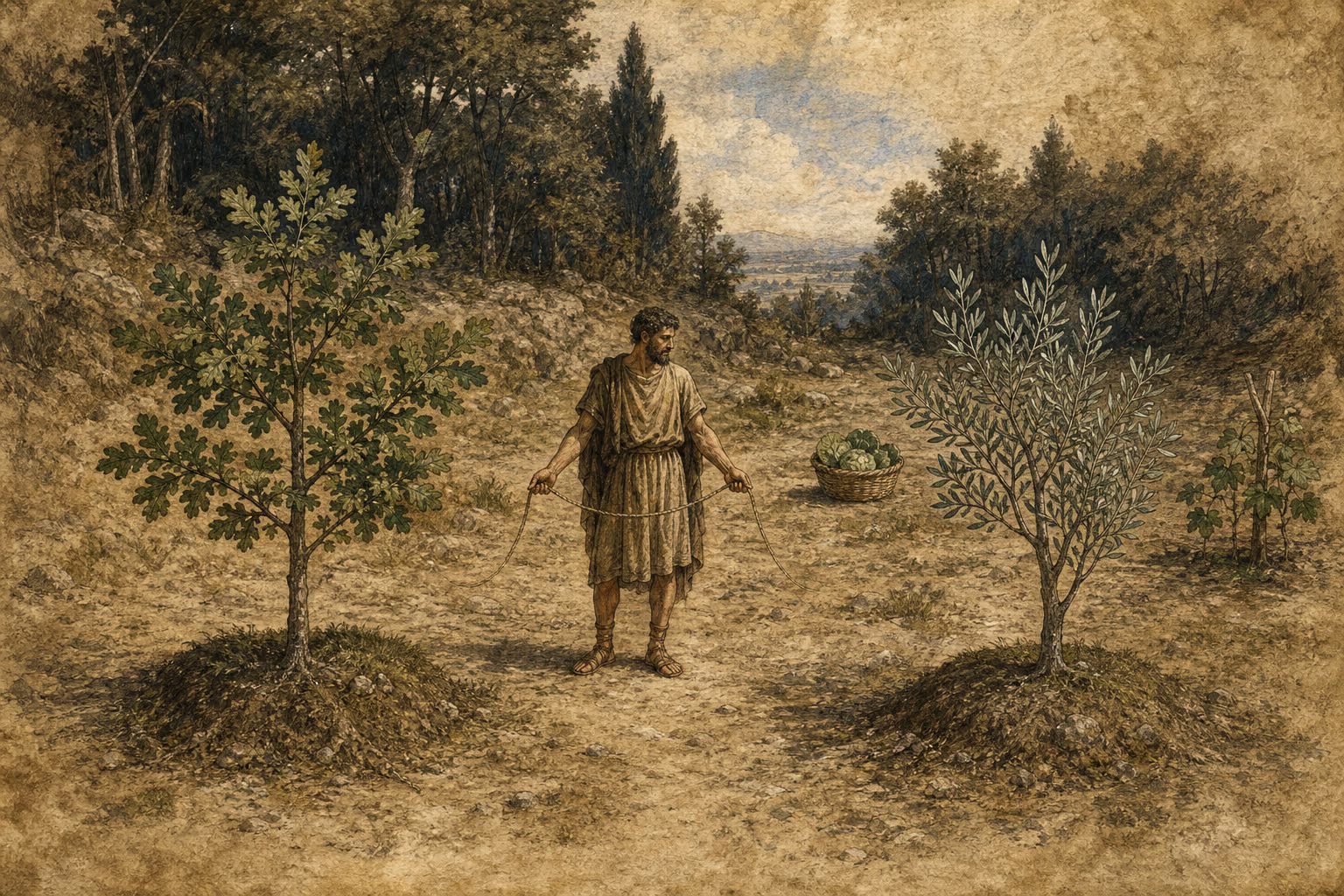
Ne silvae quidem horridiorque naturae facies medicinis carent, sacra illa parente rerum omnium nusquam non remedia disponente homini, ut medicine fieret etiam solitudo ipsa, et ad singula illius discordiae atque concordiae miraculis occursantibus. quercus et olea tam pertinaci odio dissident, ut altera in alterius scrobe depacta emoriantur, quercus vero et iuxta nucem iuglandem. pernicialia et brassicae cum vite odia; ipsum olus, quo vitis fugatur, adversum cyclamino et origano arescit. quin et annosas iam et quae sternantur arbores difficilius caedi, celerius marcescere tradunt, si prius manu quam ferro attingantur. pomorum onera a iumentis statim sentiri, ac, nisi prius ostendantur iis, quamvis pauca portent, sudare ilico. ferulae asinis gratissimo sunt in pabulo, ceteris vero iumentis praesentaneo veneno, qua de causa id animal Libero patri adsignatur, cui et ferula. surdis etiam rerum sua cuique sunt venena ac minimis quoque. philyra coci et polline nimium salem cibis eximunt; praedulcium fastidium sal temperat; nitrosae aut amarae aquae polenta addita mitigantur, ut intra duas horas bibi possint, qua de causa in saccos vinarios additur polenta. similis vis Rhodiae cretae et argillae nostrati. concordia valent, cum pix oleo extrahitur, quando utrumque pinguis naturae est. oleum solum calci miscetur, quando utrumque aquas odit. cummis aceto facilius eluitur, atramentum aqua, innumera praeterea alia, quae suis locis dicentur adsidue.
Hinc nata medicina. haec sola naturae placuerat esse remedia, parata vulgo, inventu facilia ac sine inpendio e quibus vivimus. postea fraudes hominum et ingeniorum capturae officinas invenere istas, in quibus sua cuique homini venalis promittitur vita. statim compositiones et mixturae inexplicabiles decantantur, Arabia atque India remedia aestimantur, ulcerique parvo medicina a Rubro mari inputatur, cum remedia vera cotidie pauperrimus quisque cenet. nam si ex horto petantur aut herba vel frutex quaeratur, nulla artium vilior fiat. ita est profecto, magnitudine populus R. perdidit ritus, vincendoque victi sumus. paremus externis, et una artium imperatoribus quoque imperaverunt. verum de his alias plura.
English · Bostock & Riley 1855–57
Not even are the forests and the spots in which the aspect of Nature is most rugged, destitute of their peculiar remedies; for so universally has that divine parent of all things distributed her succours for the benefit of man, as to implant for him medicinal virtues in the trees of the desert even, while at every step she presents us with most wonderful illustrations of those antipathies and sympathies which exist in the vegetable world.
Between the quercus and the olive there exists a hatred so inveterate, that transplanted, either of them, to a site previously occupied by the other, they will die. The quercus too, if planted near the walnut, will perish. There is a mortal feud existing also between the cabbage and the vine; and the cabbage itself, so shunned as it is by the vine, will wither immediately if planted in the vicinity of cyclamen or of origanum. We find it asserted even, that aged trees fit to be felled, are cut with all the greater difficulty, and dry all the more rapidly, if touched by the hand of man before the axe is applied: it is a common belief, too, that when their load consists of fruit, beasts of burden are immediately sensible of it, and will instantly begin to sweat, however trifling it may be, unless the fruit is duly shown to them before starting. Fennel-giant, as a fodder, is extremely grateful to the ass, and yet to other beasts of burden it is a deadly poison: hence it is that the ass is consecrated to Father Liber, to which deity the fennel is also sacred.
Inanimate objects again, even of the most insignificant character, have their own peculiar antipathies. Cooks disengage meat of the brine, when it has been too highly salted, by the agency of fine meal and the inner bark of the linden-tree. Salt again, tends to neutralize the sickly flavour of food when over-sweet. The taste of water, when nitrous or bitter, is modified by the addition of polenta, so much so indeed, as to be rendered potable in a couple of hours: it is for a similar reason, too, that a layer of polenta is put in our linen wine-strainers. A similar property is possessed also by the chalk of Rhodes, and the argilla of our own country.
Equal affinities exist as well; pitch, for instance, is extracted by the agency of oil, both of them being of an unctuous nature: oil again, will incorporate only with lime, both of them having a natural antipathy to water. Gum is most easily removed with vinegar, and ink with water; in addition to which, there are numberless other instances of sympathy and antipathy which we shall be careful to mention in their appropriate places.
It is in tendencies of this description that the medical art first took its rise; though it was originally intended, no doubt, by Nature, that our only medicaments should be those which universally exist, are everywhere to be found, and are to be procured at no great outlay, the various substances, in fact, from which we derive our sustenance. But at a later period the fraudulent disposition of mankind, combined with an ingenuity prompted by lucre, invented those various laboratories, in which each one of us is promised an extension of his life—that is, if he will pay for it. Compositions and mixtures of an inexplicable nature forthwith have their praises sung, and the productions of Arabia and India are held in unbounded admiration in the very midst of us. For some trifling sore or other, a medicament is prescribed from the shores of the Red Sea; while not a day passes but what the real remedies are to be found upon the tables of the very poorest man among us. But if the remedies for diseases were derived from our own gardens, if the plants or shrubs were employed which grow there, there would be no art, forsooth, that would rank lower than that of medicine.
Yes, avow it we must—the Roman people, in extending its empire, has lost sight of its ancient manners, and in that we have conquered we are the conquered: for now we obey the natives of foreign lands, who by the agency of a single art have even out-generalled our generals. More, however, on this topic hereafter.