LIBER XXIV · CAPUT 6
HAMMONIACUM: TWENTY-FOUR REMEDIES
Latine · Mayhoff 1906
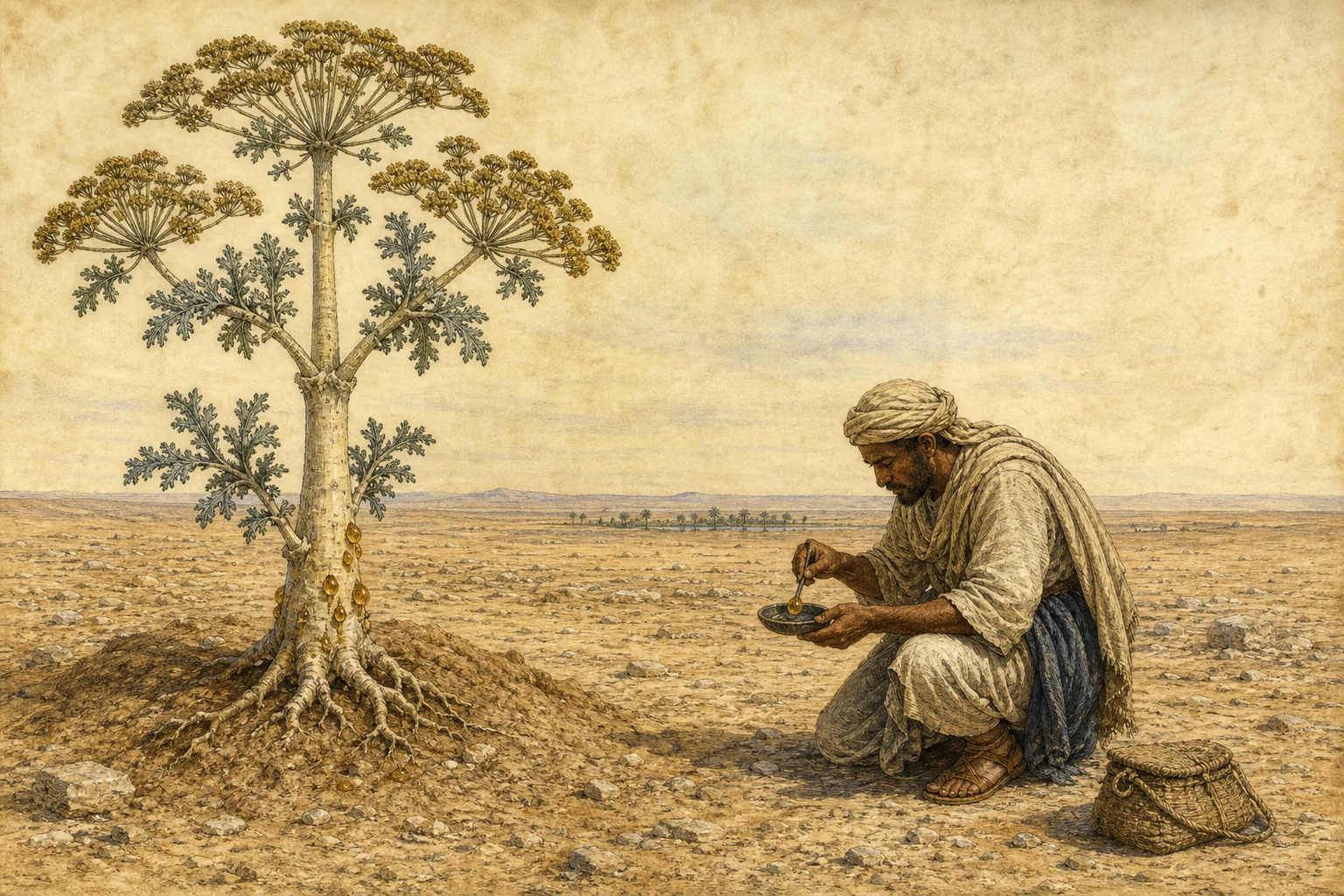
Similis hammoniaci natura atque lacrimae, probandae ut diximus. mollit, calefacit, discutit, dissolvit. claritati visus in collyriis convenit, pruritum, cicatrices, albugines oculorum tollit, dentium dolores sedat, efficacius accensum. prodest dyspnoicis, pleuriticis, pulmonibus, vesicis, urinae cruentae, lieni, ischiadicis potum—sic et alvum solvit—, articulis et podagrae cum pari pondere picis aut cerae et rosaceo coctum. maturat panos, extrahit clavos cum melle; sic et duritias emollit; lieni cume aceto et cera Cypria vel rosaceo efficacissime inponitur. lassitudines perungui cum aceto et oleo exiguoque nitro utile.
Et styracis naturam in peregrinis arboribus exposuimus. placet praeter illa, quae diximus, maxime pinguis, purus, albicantibus fragmentis. medetur tussi, faucibus, pectoris vitiis, vulvae praeclusae duritieve laboranti, ciet menses potu adposituque, alvum mollit. invenio potu modico tristitiam animi resolvi, largiore contrahi. sonitus aurium emendat infusu, strumas illitu nervorumque nodos. adversatur venenis, quae frigore necent, ideo et cicutae.
Spondylium una demonstratum infunditur capitibus phreneticorum et lethargicorum, item capitis doloribus longis cum oleo vetere; bibitur et in iocinerum vitiis, morbo regio, comitialibus, orthopnoicis, vulvarum strangulatione, quibus et suffitu prodest. alvum mollit. illinitur ulceribus, quae serpunt, cum ruta. flos auribus purulentis efficaciter infunditur, sed sucus, cum exprimitur, integendus est, quoniam mire adpetitur a muscis et similibus. radix derasa et in fistulas coniecta callum earum erodit. auribus quoque instillatur cum suco. datur et ipsa contra morbum regium et in iocineris vitio et vulvarum. capillos crispos facit peruncto capite.
Sphagnos sive sphacos sive bryon et in Gallia, ut indicavimus, nascitur, vulvis insidentium utilis, item genibus et feminum tumoribus mixtus nasturtio et aquae salsae tritus. cum vino autem et resina sicca potus urinam pellit celerrime. hydropicos inanit cum vino et iuniperis tritus ac potus.
Terebinthi folia et radix collectionibus inponuntur. decoctum eorum stomachum firmat. semen in capitis dolore bibitur in vino et contra difficultatem urinae, ventrem leniter emollit, venerem excitat.
Piceae et laricis folia trita.... et in aceto decocta dentium dolori. prodest cinis corticum intertrigini, ambustis; potus alvum sistit, urinam movet, suffitu vulvas corrigit. piceae folia privatim iocineri utilia sunt drachmae pondere in aqua mulsa pota. silvas eas dumtaxat, quae picis resinaeque gratia radantur, utilissimas esse phthisicis aut qui longa aegritudine non recolligant vires satis constat et illum caeli aëra plus ita quam navigationem Aegyptiam proficere, plus quam lactis herbidos per montium aestiva potus.
Chamaepitys Latine abiga vocatur propter abortus, ab aliis tus terrae, cubitalibus ramis, flore pinus et odore. altera brevior et incurva,.... similis. tertia eodem odore et ideo nomine quoque, parvola, cauliculo digitali, foliis scabris, exiliblls, albis, in petris nascens, omnes herbae, sed propter cognationem nominis non differendae. prosunt adversus scorpionum ictus, item iocineri inlitae cum palmis aut cotoneis; renibus et vesicae decoctum earum cum farina hordeacea. morbo quoque regio et urinae difficultatibus ex aqua decoctae bibuntur. novissima contra serpentes valet cum melle; sic et adpositu vulvas purgat. sanguinem densatum extrahit pota. sudores facit perunctis ea, peculiariter renibus utilis. fiunt ex ea et hydropicis pilulae cum fico alvum trahentes. lumborum dolorem victoriati pondere in vino finit et tussim recentem. mortuos partus ex aceto cocta et pota eicere protinus dicitur.
Cum honore et pityusa simili de causa dicetur, quam quidam in tithymali genere umerant. frutex est similis piceae, flore parvo, purpureo. bilem et pituitam per alvum detrahit radix decocti hemina aut seminis lingula in balanis. folia in aceto decocta furfures cutis emendant, mammas quoque mixto rutae decocto et tormina et serpentium ictus et in totum collectiones incipientes.
Resinam supra dictis arboribus gigni docuimus et genera eius et nationes in ratione vini ac postea in, arboribus. summae species duae, sicca et liquida. sicca e pinu et picea fit, liquida terebintho, larice, lentisco, cupresso; nam et hae ferunt in Asia ac Syria. falluntur qui eandem putant esse e picea atque larice; picea enim pinguem et turis modo sucosam fundit, larix gracilem ac mellei coloris, virus redolentem. medici liquida raro utuntur et in ovo fere, e larice propter tussim ulceraque viscerum—nec pinea magnopere in usu —, ceteris non nisi coctis. et coquendi genera satis demonstravimus.
Arborum differentia placet terebinthina odoratissima atque levissima, nationum Cypria et Syriaca, utraque mellis Attici colore, sed Cypria carnosior crassiorque. in sicco genere quaerunt ut sit candida, pura, perlucida, in omni autem ut montana potius quam campestris, item aquilonia potius quam ab alio vento. resolvitur resina ad vulnerum usus et malagmata oleo, in potiones amygdalis amaris. natura in medendo contrahere vulnera, purgare, discutere collectiones. lenit pectoris vitia terebinthina; inlinitur eadem calida membrorum doloribus spasticisque —in sole abluitur —et totis corporibus mangonum maxime cura ad gracilitatem emendandam, spatiis ita laxantium cutem per singula membra, capacioraque ciborum facienda corpora. proximum locum optinet e lentisco. inest ei vis adstringendi, movet et ante ceteras urinam. reliquae ventrem emolliunt, cruda concocunt, tussim veterem sedant, vulvae onera extrahunt etiam suffitae. privatim adversantur visco, panos et similia cum sebo taurino et melle sanant. palpebras lentiscina commodissime replicat, fractis quoque utilissima et auribus purulentis, item in pruritu genitalium. pinea capitis vulneribus optime medetur.
English · Bostock & Riley 1855–57
Of a similar nature to galbanum is hammoniacum, a tearlike gum, the qualities of which are tested in manner already stated. It is of an emollient, warming, resolvent, and dispellent nature. Employed as an ingredient in eye-salves, it improves the sight. It disperses prurigo, effaces the marks of sores, removes spots in the eyes, and allays tooth-ache, more particularly when burnt. It is very useful too, taken in drink, for hardness of breathing, pleurisy, affections of the lungs, diseases of the bladder, bloody urine, maladies of the spleen, and sciatica: employed in a similar manner, it acts as a purgative upon the bowels. Boiled with an equal proportion of pitch or wax, and with oil of roses, it is good for diseases of the joints, and for gout. Employed with honey it ripens hard tumours, extracts corns, and has an emollient effect upon indurations. In combination with vinegar and Cyprian wax, or oil of roses, it is extremely efficacious as a liniment for affections of the spleen. In cases of extreme lassitude, it is an excellent plan to use it as a friction, with vinegar and oil, and a little nitre.
In speaking too of the exotic trees, we have made mention of the properties of storax. In addition to those which we have already mentioned, it ought to be very unctuous, without alloy, and to break to pieces in whitish fragments. This substance is curative of cough, affections of the fauces, diseases of the chest, and obstructions or indurations of the uterus. Taken in drink, or employed as a pessary, it acts as an emmenagogue; it has a laxative effect also upon the bowels. I find it stated that, taken in moderate doses, storax dispels melancholy; but that when employed in large quantities, it promotes it. Used as an injection it is good for singings in the ears, and employed as a friction, for scrofulous swellings and nodes of the sinews. It neutralizes poisons of a cold nature, and consequently, hemlock.
At the same time we have also spoken of spondylium; an infusion of which is poured upon the head in cases of phrenitis and lethargy, and of head-ache of long standing. Combined with old oil, it is taken in drink for affections of the liver, jaundice, epilepsy, hardness of breathing, and hysterical suffocations, maladies for which it is equally serviceable in the shape of a fumigation. It relaxes the bowels, and with rue it is applied to ulcers of a serpiginous nature. The juice which is extracted from the blossom is a most useful injection for suppurations of the ears; but the moment it is extracted it should be covered up, as flies and other insects of a similar nature are remarkably fond of it.
Scrapings of the root, introduced into the interior of fistulas, have a caustic effect upon their callosities; and they are sometimes used, in combination with the juice, as an injection for the ears. The root itself also is prescribed for jaundice, and for diseases of the liver and uterus. If the head is rubbed with the juice, it will make the hair curl.
Sphagnos, sphacos, or bryon, grows, as we have already stated, in Gaul. A decoction of it, employed as a sitting-bath, is useful for affections of the uterus: mixed with nasturtium, and beaten up in salt water, it is good for the knees and for swellings in the thighs. Taken in drink with wine and dried resin, it acts very powerfully as a diuretic. Pounded in wine with juniper berries, and taken in drink, it draws off the water in dropsy.
The leaves and root of the terebinth are used as applications for gatherings; and a decoction of them is strengthening to the stomach. The seed of it is taken in wine for head-ache and strangury: it is slightly laxative to the bowels, and acts as an aphrodisiac.
The leaves of the pitch-tree and the larch, beaten up and boiled in vinegar, are good for tooth-ache. The ashes of the bark are used for excoriations and burns. Taken in drink this substance arrests diarrhœa, and acts as a diuretic; and used as a fumigation, it reduces the uterus when displaced. The leaves of the pitch-tree are particularly good for the liver, taken in doses of one drachma in hydromel.
It is a well-known fact that forests planted solely with trees from which pitch and resin are extracted, are remarkably beneficial for patients suffering from phthisis, or who are unable to recover their strength after a long illness: indeed it is said, that in such cases to breathe the air of localities thus planted, is more beneficial even than to take a voyage to Egypt, or to go on a summer’s journey to the mountains to drink the milk there, impregnated with the perfumes of plants.
The chamæpitys, called in Latin “abiga,” because it promotes abortion, and known to some as “incense of the earth,” has branches a cubit in length, and the odour and blossoms of the pine. Another variety of it, which is somewhat shorter, has all the appearance of being bent downwards; and there is a third, which, though it has a similar smell, and consequently the same name, is altogether smaller, with a stem the thickness of one’s finger, and a diminutive, rough, pale leaf: it is found growing in rocky localities. All these varieties are in reality herbaceous productions; but in consequence of the resemblance of the name, I have thought it as well not to defer the consideration of them.
These plants are good for stings inflicted by scorpions, and are useful as an application, mixed with dates or quinces, for maladies of the liver: a decoction of them with barley-meal is used for the kidneys and the bladder. A decoction of them in water is used also for jaundice and for strangury. The kind last mentioned, in combination with honey, is good for wounds inflicted by serpents, and a pessary is made of it, with honey, as a detergent for the uterus. Taken in drink it brings away coagulated blood, and rubbed upon the body it acts as a sudorific: it is particularly useful also for the kidneys. Pills of a purgative nature are made of it for dropsy, with figs. Taken in wine, in doses of one victoriatus, it dispels lumbago, and cures coughs that are not of an inveterate description. A decoction of it in vinegar, taken in drink, will instantaneously bring away the dead fœtus, it is said.
For a similar reason, too, we shall accord the same distinction to the pityusa, a plant which some persons reckon among the varieties of the tithymalus. It is a shrub, resembling the pitch-tree in appearance, and with a diminutive purple blossom. A decoction of the root, taken in doses of one hemina, carries off the bilious and pituitous secretions by stool, and a spoonful of the seed, used as a suppository, has a similar effect. A decoction of the leaves in vinegar removes scaly eruptions of the skin; and in combination with boiled rue, it effects the cure of diseases of the mamillæ, gripings in the bowels, wounds inflicted by serpents, and incipient gatherings of most kinds.
In treating, first of wines, and then of trees, we have stated that resin is the produce of the trees above-mentioned, and have described the several varieties of it, and the countries in which they are respectively produced. There are two principal kinds of resin, the dry and the liquid. The dry resins are extracted from the pine and the pitch-tree, the liquid from the terebinth, the larch, the lentisk, and the cypress; these last producing it in the province of Asia and in Syria. It is an error to suppose that the resin of the pitch-tree is the same as that of the larch; for the pitch-tree yields an unctuous resin, and of the same consistency as frankincense, while that of the larch is thin, like honey in colour, and of a powerful odour. It is but very rarely that medical men make use of liquid resin, and when they do, it is mostly that produced by the larch, which is administered in an egg for cough and ulcerations of the viscera. The resin of the pine, too, is far from extensively used, and that of the other kinds is always boiled before use: on the various methods of boiling it, we have enlarged at sufficient length already.
As to the produce of the various trees, the resin of the terebinth is held in high esteem, as being the most odoriferous and the lightest, the kinds which come from Cyprus and Syria being looked upon as the best. Both these kinds are the colour of Attic honey; but that of Cyprus has more body, and dries with greater rapidity. In the dry resins the qualities requisite are whiteness, purity, and transparency: but whatever the kind, the produce of mountainous districts is always preferred to that of champaign countries, and that of a north-eastern aspect to that of any other quarter. Resins are dissolved in oil as a liniment and emollient cataplasm for wounds; but when they are used as a potion, bitter almonds are also employed. The curative properties of resins consist in their tendency to close wounds, to act as a detergent upon gatherings and so disperse them, and to cure affections of the chest.
The resin of the terebinth * * * it is used too, warmed, as a liniment for pains in the limbs, the application being removed after the patient has taken a walk in the sun. Among slave-dealers too, there is a practice of rubbing the bodies of the slaves with it, which is done with the greatest care, as a corrective for an emaciated appearance; the resin having the property of relaxing the skin upon all parts of the body, and rendering it more capable of being plumped out by food.
Next after the resin of the terebinth comes that of the lentisk: it possesses astringent properties, and is the most powerful diuretic of them all. The other resins are laxative to the bowels, promote the digestion of crudities, allay the violence of inveterate coughs, and, employed as a fumigation, disengage the uterus of foreign bodies with which it is surcharged: they are particularly useful too as neutralizing the effects of mistletoe; and, mixed with bull suet and honey, they are curative of inflamed tumours and affections of a similar nature. The resin of the lentisk is very convenient as a bandoline for keeping stubborn eyelashes in their place: it is useful also in cases of fractures, suppurations of the ears, and prurigo of the generative organs. The resin of the pine is the best of them all for the cure of wounds in the head.